Lesbian Feminism
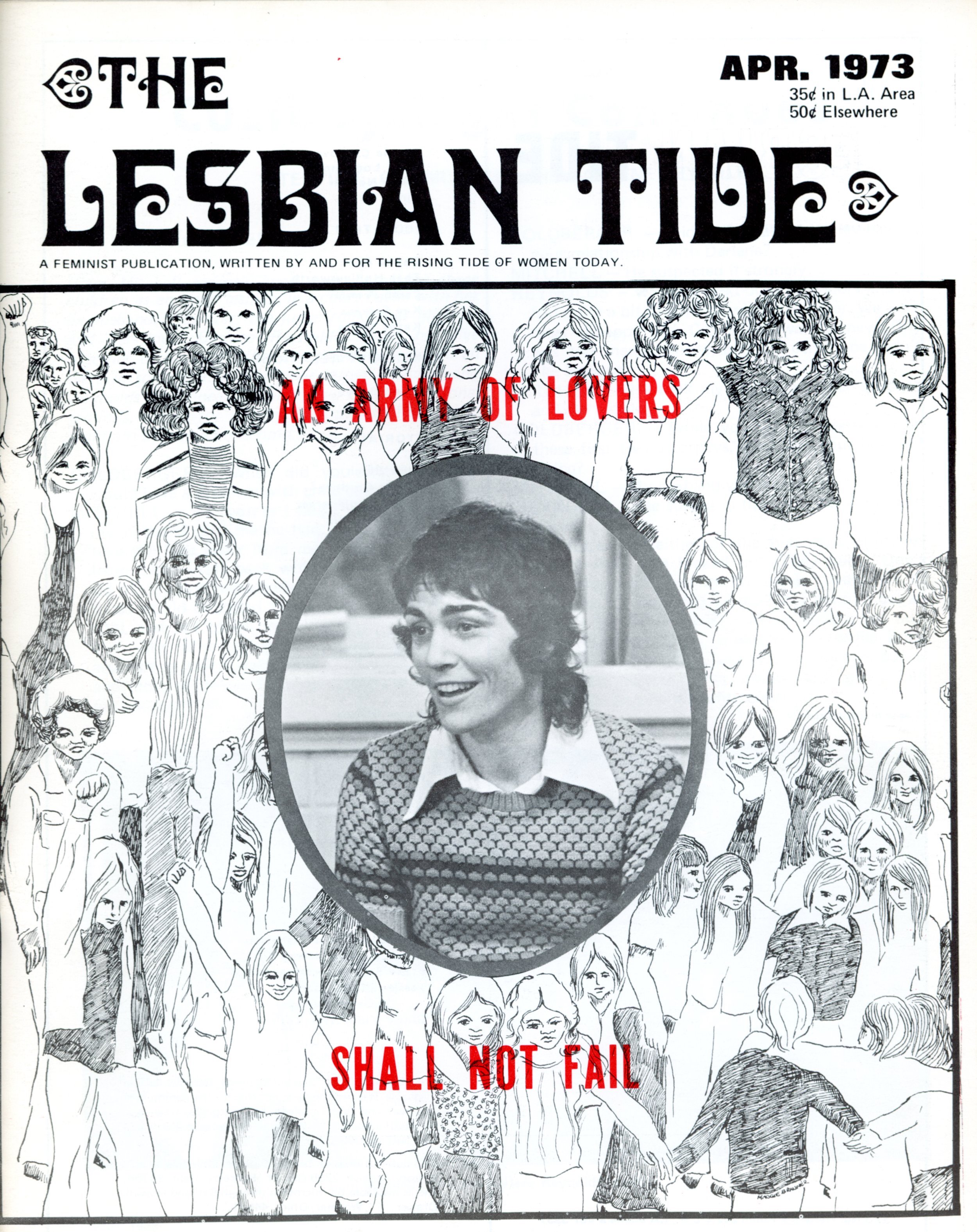
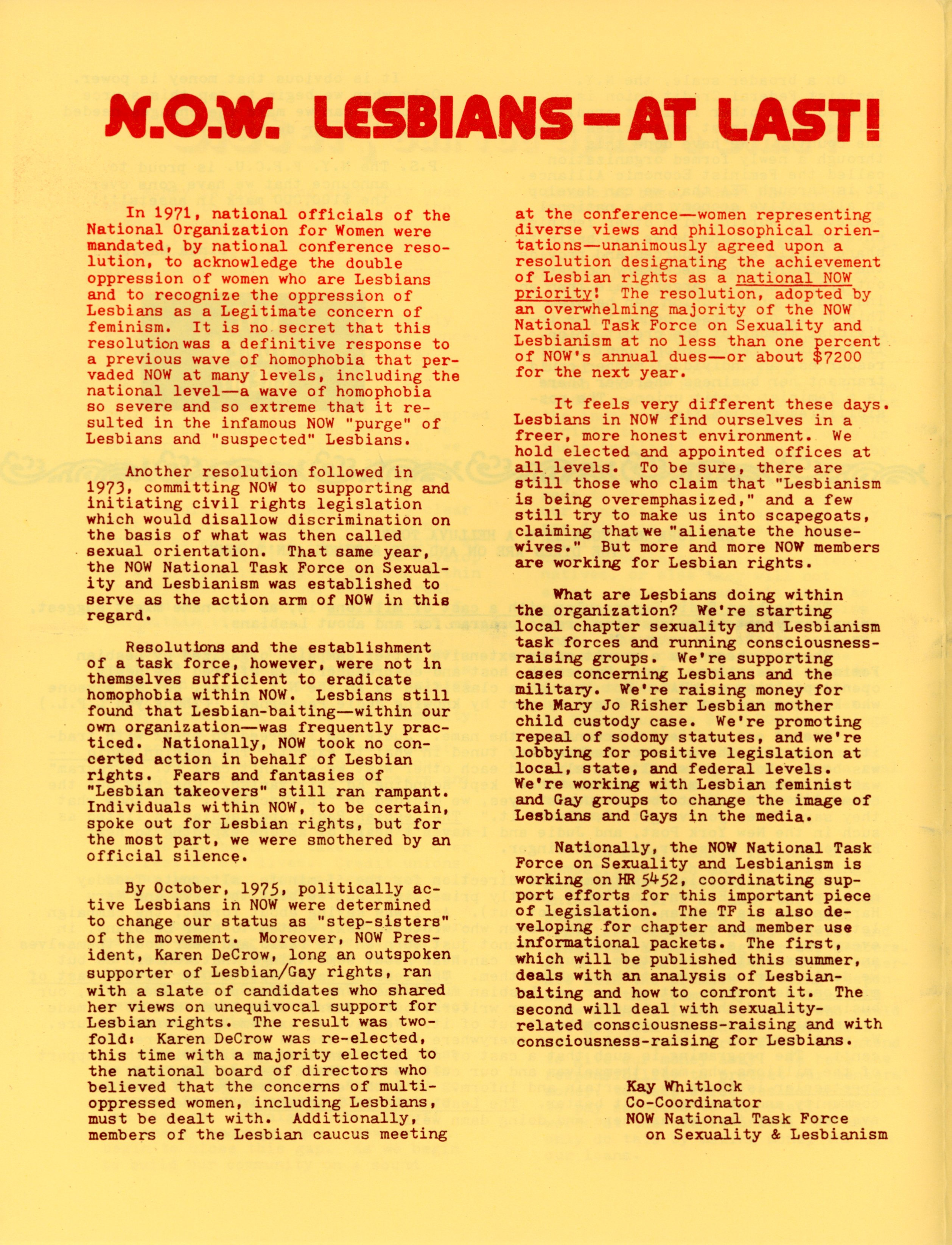
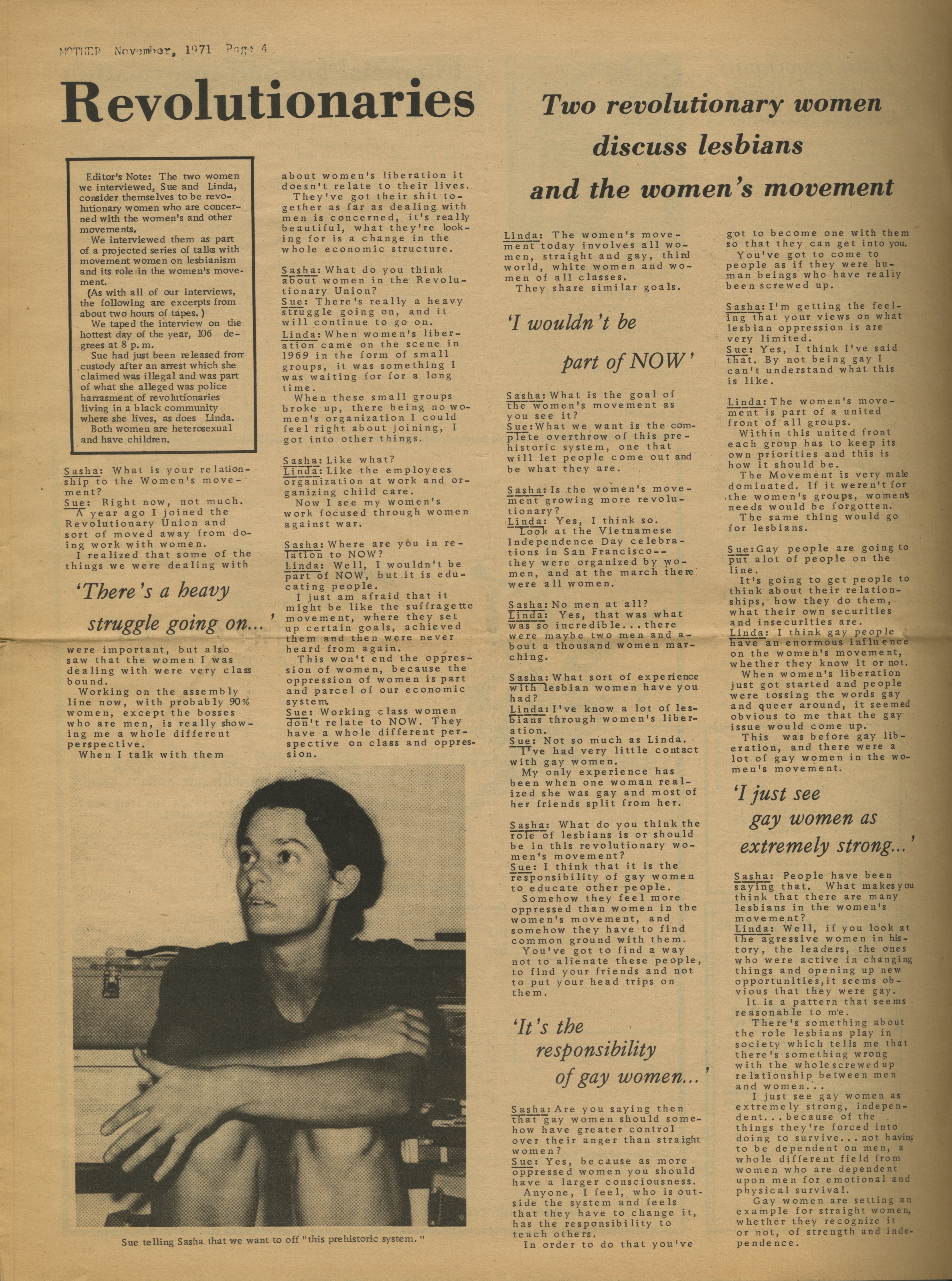
Women in L.A. in the 1970s, still excluded from the Women’s Liberation movement, and dissatisfied with the centrality of gay men in the GLF, rallied behind Lesbian Feminism. Lesbianism was still an issue in Women's Liberation, an issue that was thought of as private by NOW President Betty Friedan. It is a quote from her that coined the phrase, "lavender menace," suggesting that lesbians threatened the political efficacy of the organization and of feminism.[1]
A key piece of literature written to confront differences between lesbians and straight women in the Women's Movement, and change policy that excluded lesbians in NOW, was the paper Woman-Identified Woman (WiW), written by radical lesbian activists in the early 1970s. Woman-Identified Woman was presented at NOW' Second Congress to Unite Women on May 2, 1970, along with a Lavender Menace action protesting lack of lesbian representation at the conference, in NYC. The paper and action ultimately was one of the catalysts to change the National Chapter of NOW's policy on including lesbian issues in their fight.
Central arguments in WiW were:
- Lesbianism as a category is created out of a society with rigid sex roles defined by men to divide and keep women in line, therefore it is essential that the women’s movement combat the heterosexual and patriarchal structure that dictates social relationships.
- These categories, and the insults “dyke” and “faggot” are used to imply that someone is not a “real woman” or “real man”, expressing that a person is not acting within their assigned gender role. For women, this meant that they were acting like men, not conforming to femininity, and assuming a man’s role.
- This idea of lesbians assuming a man’s role is then used to create prejudice in straight women, and reduce potential relationships to those that are sexual or romantic, rather than allies in gender liberation.[2]
Lesbian Feminism believed in the resistance to the hetero-normativity and patriarchy that is institutionalized in the world. It is deeply rooted in the idea that the personal is political, centering lesbianism as a political identity.
Lesbian Feminism itself fractured between lesbians who felt completely separate from gay liberation, those who still aligned with the movement, and lesbian separatists, where women dissociated from men, even gay men, and heterosexual women, striving to live in communities only of lesbian women. Some of these differences stem from views fixating on discrete gender roles, conflating gender, sex, and biology, therefore questioning who is included in liberation, being hostile towards trans women, and distrusting bisexuality.
Citations
[1] Stephanie Gilmore, Elizabeth Kaminski, A Part and Apart: Lesbian and Straight Feminist Activists Negotiate Identity in a Second-Wave Organization (Austin: University of Texas Press, January 2007), 96, https://doi.org/10.1353/sex.2007.0038
[2] Woman Identified Woman,” box 9, folder 16, Margaret Cruikshank Collection, June L. Mazer Lesbian Archives, Los Angeles, CA.
This page has paths:
- Women's Liberation and Lesbian Feminism Bonnie Morris/Julia Tanenbaum/Angela Brinskele