Becoming Visible
1 2024-03-08T17:59:26-08:00 Bonnie Morris/Julia Tanenbaum/Angela Brinskele ef6dc7f76d6383521c985b036594e440c4099a58 43632 2 Flyer for the First Black Lesbian Conference. 2024-03-08T18:27:28-08:00 Bonnie Morris/Julia Tanenbaum/Angela Brinskele ef6dc7f76d6383521c985b036594e440c4099a58This page has tags:
- 1 2023-12-15T22:37:33-08:00 Bonnie Morris/Julia Tanenbaum/Angela Brinskele ef6dc7f76d6383521c985b036594e440c4099a58 Subject Files Bonnie Morris/Julia Tanenbaum/Angela Brinskele 4 plain 2024-03-25T19:29:36-07:00 Bonnie Morris/Julia Tanenbaum/Angela Brinskele ef6dc7f76d6383521c985b036594e440c4099a58
This page is referenced by:
-
1
2023-10-03T16:18:55-07:00
Race, Class, and the Equal Rights Amendment
112
image_header
2024-06-22T21:42:22-07:00
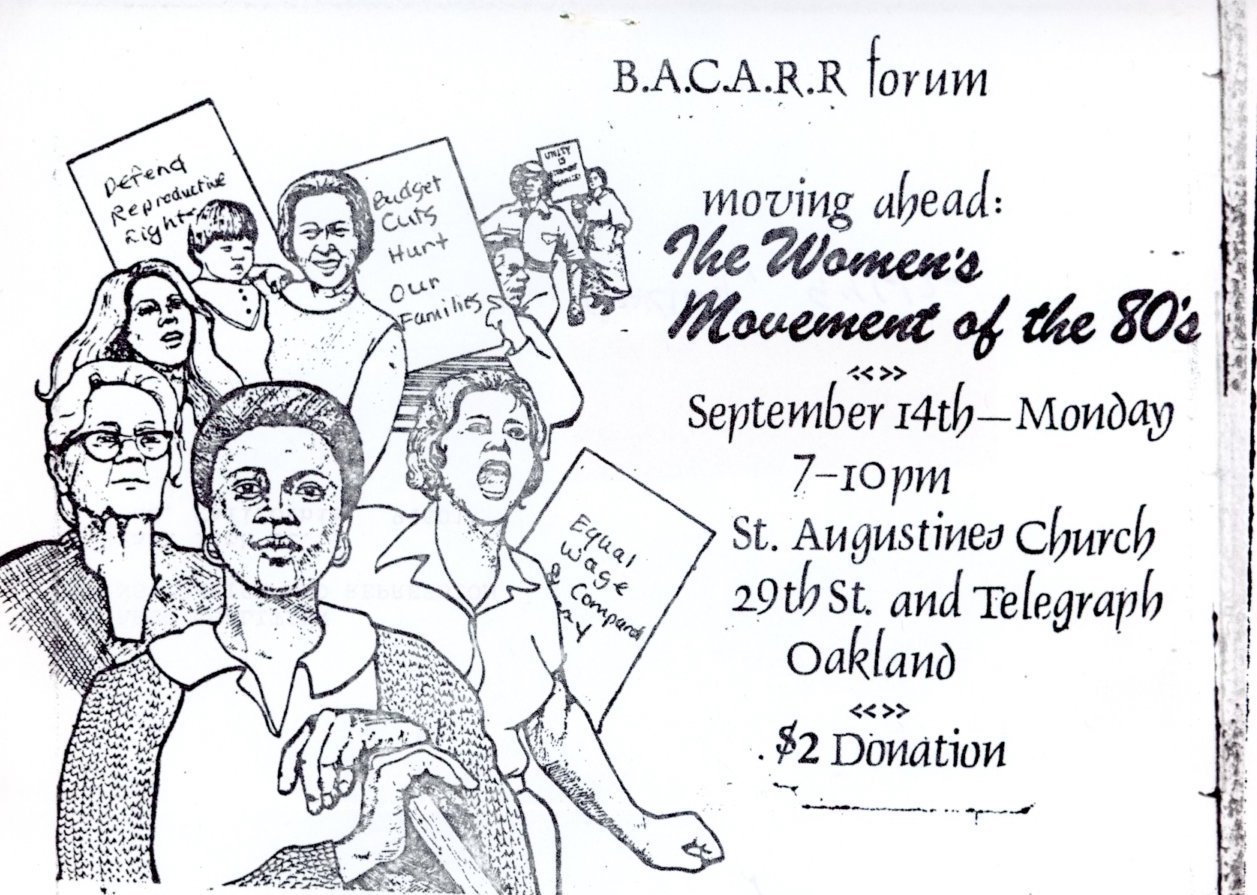
From the late 1970s and into the 80s the monolithic view of lesbians was challenged more openly with discussions on the intersectionality of class, race, gender, and sexuality. The Women’s Liberation Movement and feminist movements were dominated and documented by white middle-class individuals who often erased and excluded the experiences, feminist ideas, and foundational work by women of color in these movements. In the 1980s more discussion on the different voices within the lesbian feminist movement were brought into the mainstream.
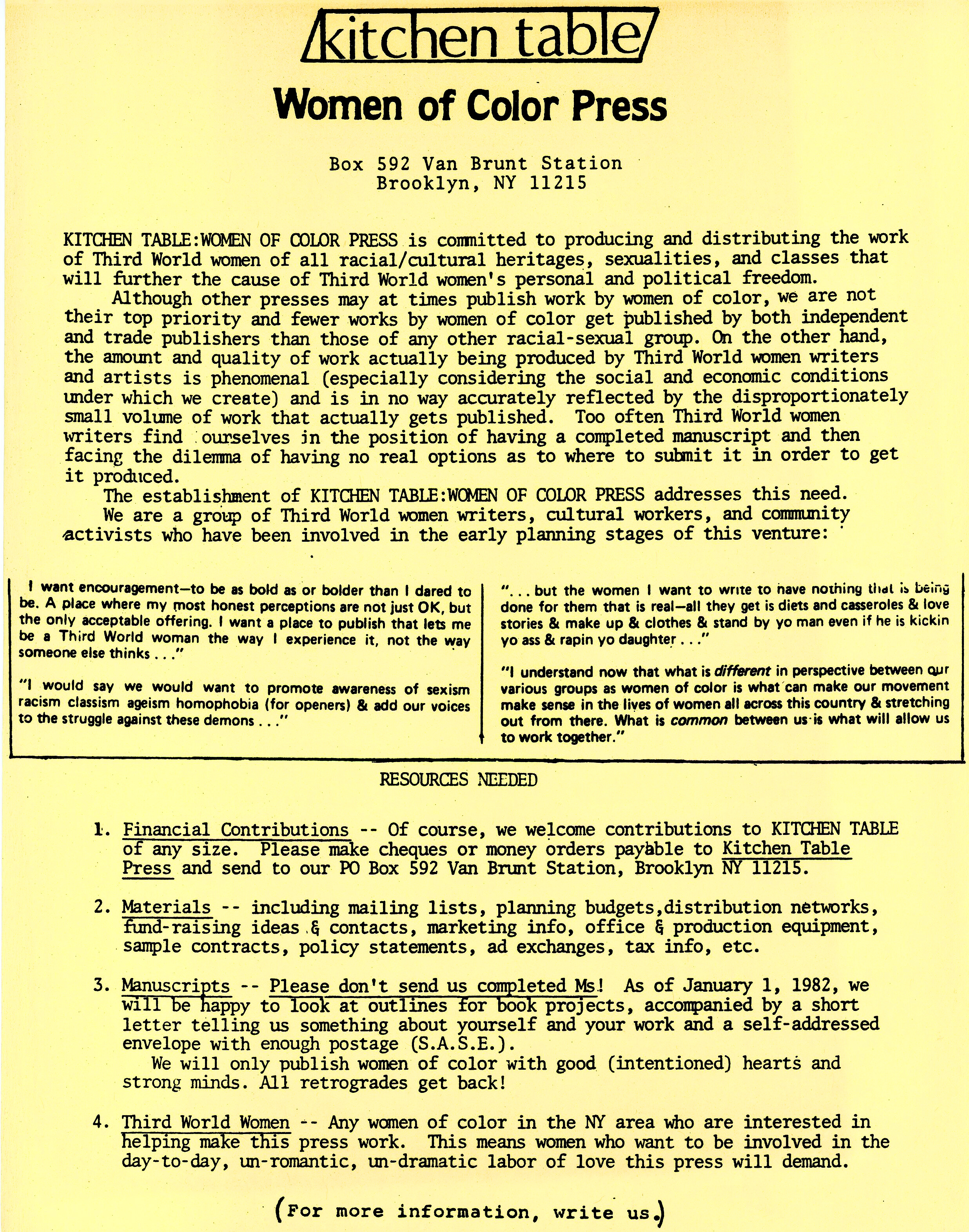
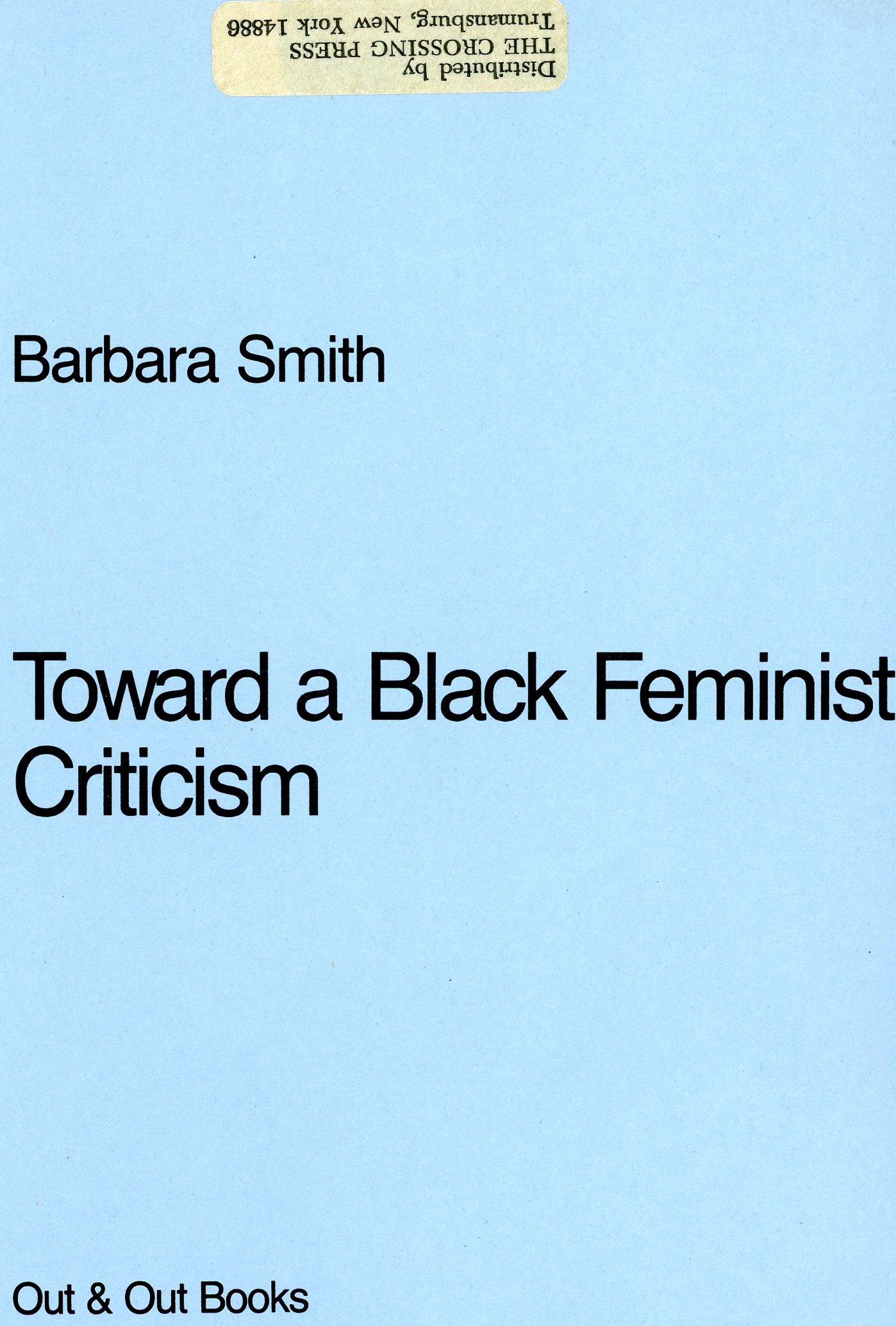
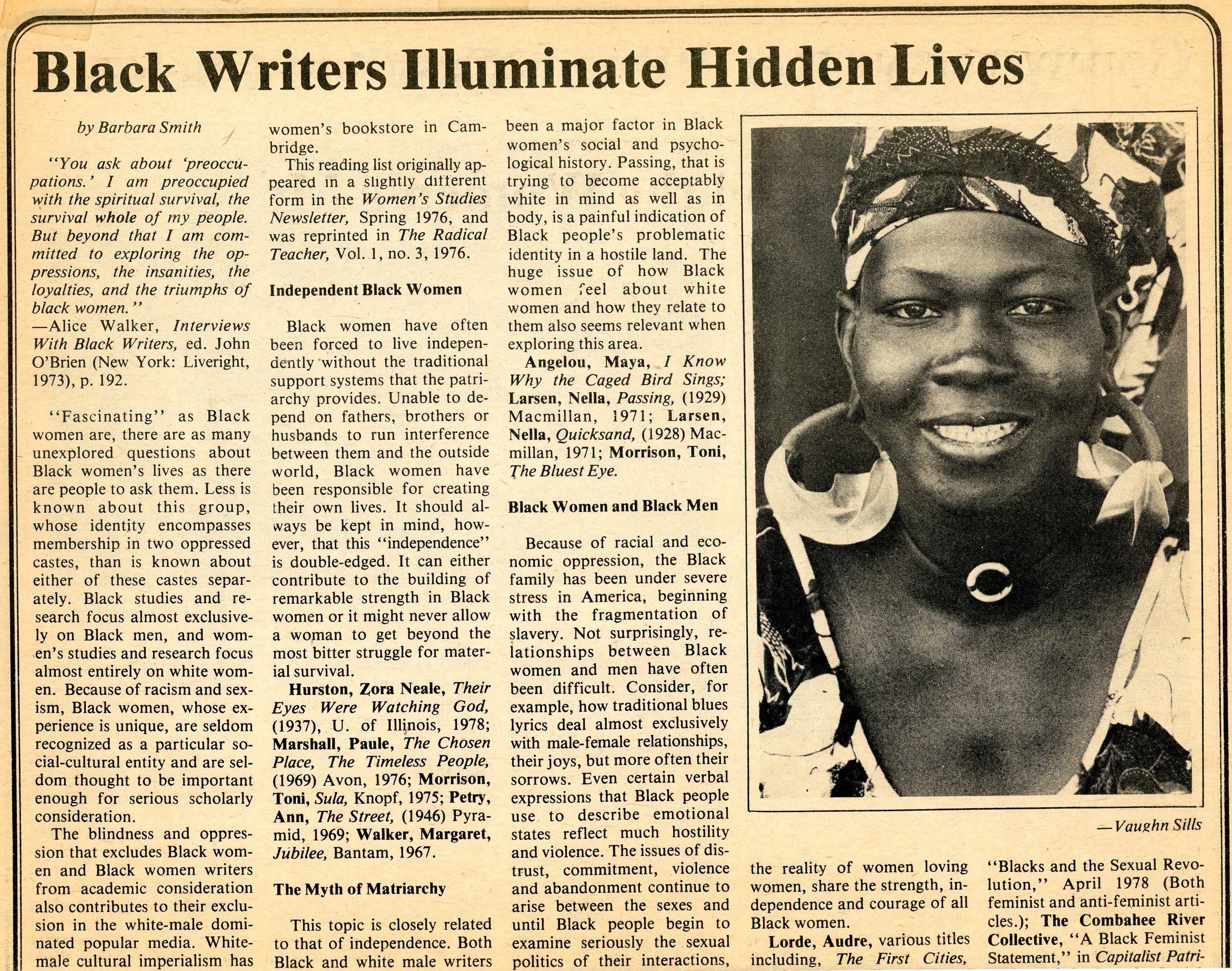
Books, essays, and papers published by women of color led the conversations of a more intersectional feminism. In 1981 the feminist anthology Bridge Called my Back: Writings by Radical Women of Color edited by Cherríe Moraga and Gloria E. Anzaldúa was published, as was Ain’t I a Woman by Bell Hooks. Kitchen Table Women of Color Press, run by Barbara Smith, Cherríe Moraga, and Audre Lorde, was in full operation publishing feminist and lesbian writers of color. In 1983 Kitty Tsui published The Words of a Woman On Fire, making her the first Chinese American lesbian to come out with a book, following Korean American Willyce Kim, who published Eating Artichokes in 1972.[1]Barbara Smith's book, Toward a Black Feminist Criticism (1977) begins with Smith saying:
"I do not know where to begin. Long before I tried to write this realized that I was attempting something unprecedented, something dangerous, merely by writing about Black lesbian writers from any perspective at all. These things have not been done. Not by white male critics, expectedly. Not by Black male critics. Not by white women critics who think of themselves as feminists. And most crucially not by Black women critics who, although they pay the most attention to Black women writers as a group, seldom use a consistent feminist analysis or write about Black lesbian literature. All segments of the literary world-whether establishment, progressive, Black, female, or lesbian —do not know, or at least act as if they do not know, that Black women writers and Black lesbian writers exist.
For whites, this specialized lack of knowledge is inextricably connected to their not knowing in any concrete or politically transforming way that Black women of any description dwell in this place. Black women's existence, experience, and culture and the brutally complex systems of oppression which shape these are in the "real world" of white and/or male consciousness beneath consideration, invisible, unknown."
-Barbara Smith, Toward a Black Feminist CriticismThe First Black Lesbian Conference
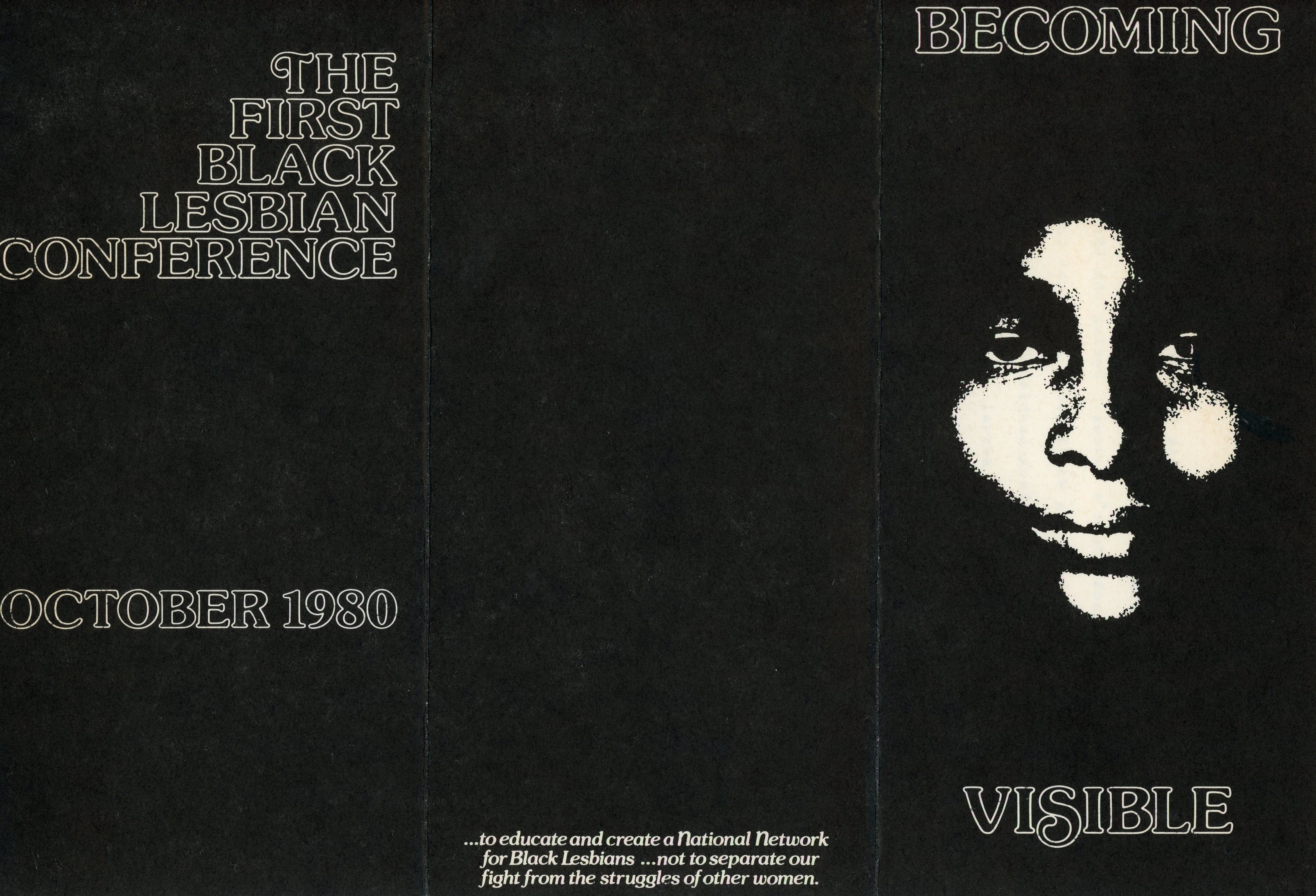
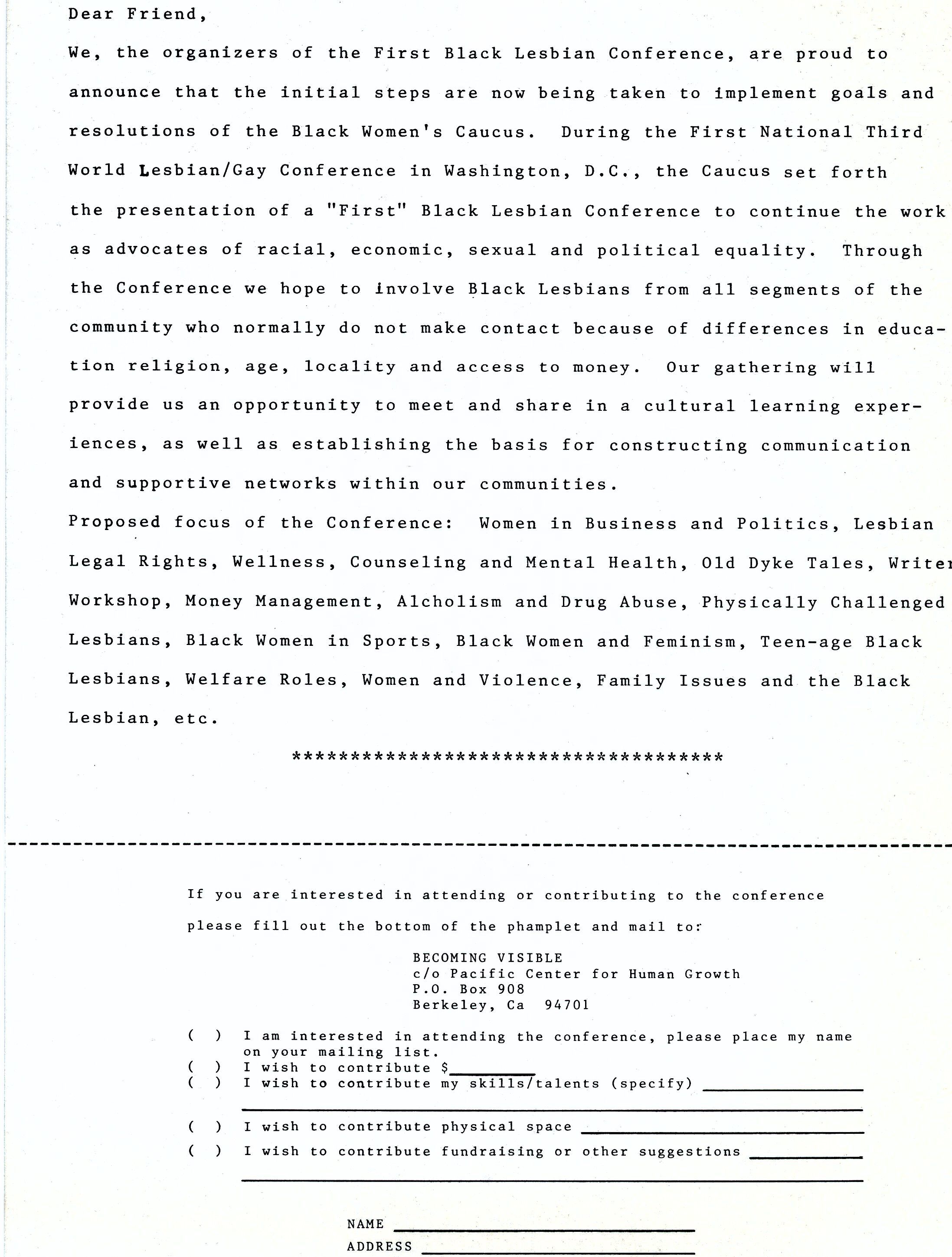
The first National Third World Lesbian and Gay Conference, organized by the National Coalition of Black Gays, took place in Washington D.C. in October 1979 in conjunction with the 1979 National March on Washington. Growing out of this conference, the following year the first Black Lesbian Conference was held at the Women's Building in San Francisco October 17-19th, 1980. It was the first conference organized to support the needs of Black Lesbians. Andrea Canaan, Pat Norman, and Angela Davis were the keynote speakers, all speaking to the strengths and oppression of Black Lesbians, and the responsibility of "becoming visible".[2]
Andrea Canaan shared her experience of coming out as a lesbian in her role as Program Coordinator of Women and Employment for the State of Louisiana, and consequently being fired after an employee Canaan had let go accused her of sexual assault. She went on to say that she knows that exposure means the loss of jobs, friends, and family, and there is still power in being hidden or visible, as long as Black lesbians are united.[3]
Pat Norman was the coordinator of Gay Health Services for San Francisco's Public Health Department, a founder of the Lesbian Mothers' Union and a board member of the National Gay Task Force. She spoke on internalized racism and it's role in keeping Black people from uniting. Norman concluded with a question."So, Black Lesbians, will we continue to just survive and not make progress?. . .Break the chains of internalized racism! Let's move together as Black women, Black Lesbians, becoming visible, becoming unafraid, coming together, using our differences and growing together."[4]
Angela Davis, legendary activist, author, academic, abolitionist, who was at the time a professor of Women's Studies at San Francisco State University, lauded the conference as an historic event for Black people and a turning point in the Women's Movement. She spoke about Ruby Doris Johnson, Assata Shakur, and Joanne Little as unacknowledged inspirations in Women's Movement, but stressed that naming them is not enough, instead it is organized resistance that is the most necessary against racism, sexism, and economic oppression.[5]
Part of Davis's statements on the Women's Movement were, "I think that as Black women we have a special contribution to make to the struggles that are unfolding in the Women's Movement. Yesterday there was a march for abortion rights. That's very important for us to fight for abortion rights. But at the same time if we want to know why it is that the Movement appears to be virtually all white, it is because still you have some white women's organizations who won't pick up the issue of sterilization."[6]Unbound Feet
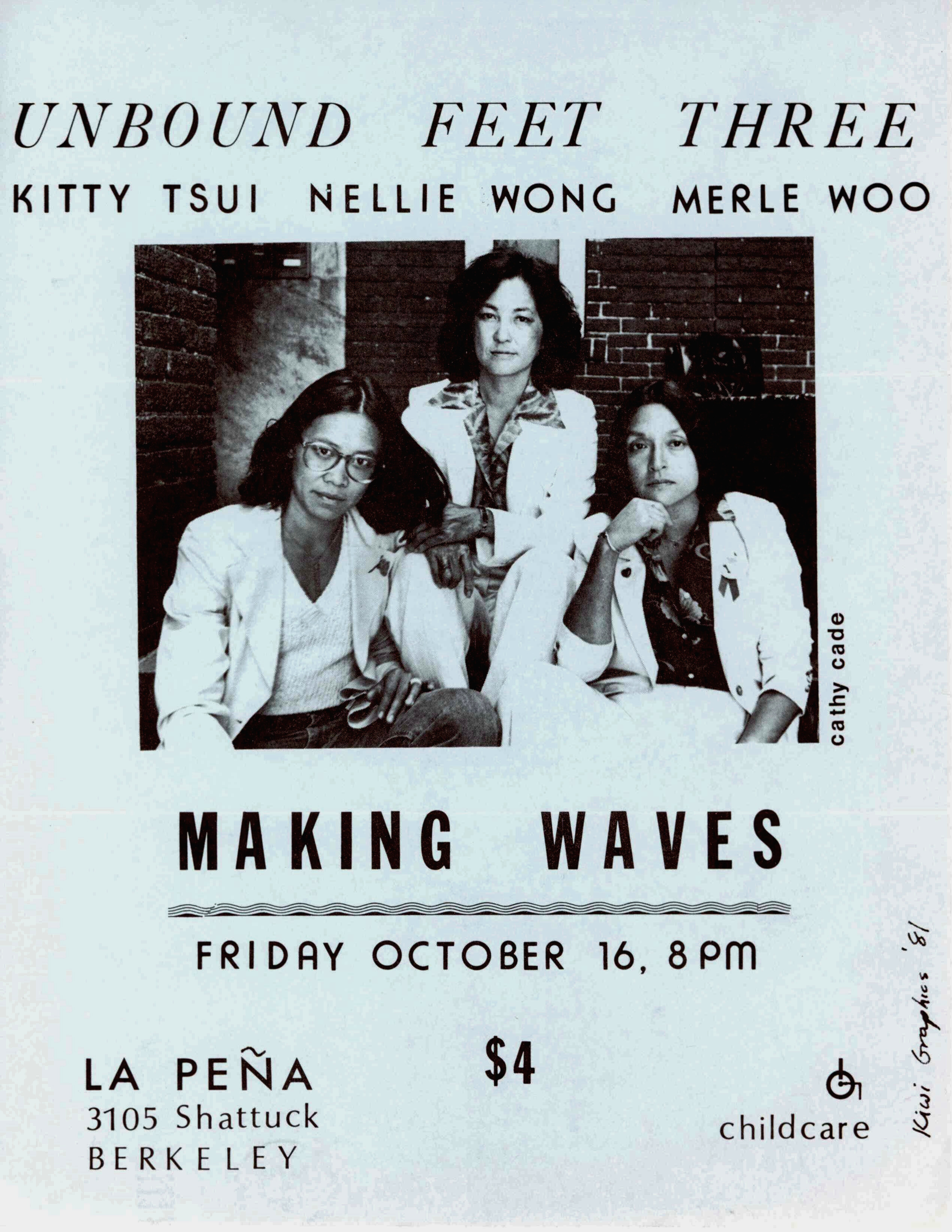
In the summer of 1979 in San Francisco, the collective of Asian American women writers and performers called Unbound Feet was formed by Kitty Tsui, Nellie Wong, Merle Woo, Nancy Hom, Genny Lim, and Canyon Sam. Canyon Sam and Kitty Tsui had previously met through the Asian American Feminists rap group, where their shared pursuits as writers, poets, dramatists, and feminists connected them.[7] The group was radical in their presence on stage, in a time when Asian American women were rarely seen as performers; after their first performance at the James Moore Oakland Museum Theater, the group was very successful, gathering crowds up to 600 people during their next two years performing.[8] Tsui, Sam, and Woo did not address lesbianism in their performances, but the show's program explicitly stated their sexuality, without shame, bringing visibility to lesbians in the Asian American community.[9]
By 1981, the group disbanded and broke apart after a dispute concerning Merle Woo's fight with the University of California, Berkeley. Woo was terminated from her position as an Asian American Studies lecturer by the University over criticism of her department. She then charged them with discrimination for being a "lesbian, a socialist feminist, and trade unionist".[10] Woo was hoping to use the platform of the Unbound Feet to garner support for her case against the University, but the women were divided over whether to use the group as an outlet for workplace grievances that would put them in conflict with the Asian American Community; ultimately Woo, Tsui, and Wong went on to form the Unbound Feet Three in 1985, after the others went separate ways.[11]
The momentum of the first National Third World Lesbian and Gay Conference also affected Asian American gays and lesbians, who began to join together in networks of support.[12] The Asian/Pacific Lesbians and Gays (A/PLG), now known as the Asian/Pacific Gays and Friends, was founded in 1981 by queer Asian activists, including Tak Yamamoto. Phoenix Rising newsletter provided a platform for Asian American lesbians and queer people in 1984. It was founded by Lori Lai, May Lee, Susan Lee, Pam Nishikawa, Gisele Pohan, Marie Shim, Doreena Wong, and Zee Wong.[13] The Asian/Pacifica Lesbian Sisters (A/PLS) was founded in 1988. The Asian Pacific Islander Queer Women Transgender Community (APIQWTC) was founded in 1987 by a few women and later run by activists Crystal Jang, Koko Lin, and Trinity Ordona. Asian American lesbians organized retreats like the 1987 West Coast Asian Pacific Lesbian Retreat and the 1989 "Coming Together, Moving Forward" the Asian/Pacific Lesbian Network (A/PLN) retreat.Zoe Nicholson and the Equal Rights Amendment
In addition to issues and organizing around labor, class, and racial identity, the 1980s brought a resurgence of effort to pass the Equal Rights Act (ERA). This had always been a part of NOW’s mission, and members put tremendous effort into pressuring the legislature to pass the amendment. Zoe Nicholson is a lesbian activist and has fought for the ERA since the 1970s.
Between 1923 and 1970 the ERA was buried, amended, and nullified, before finally being passed by a vote from the full House of Representatives for the first time in 47 years. But it took until 1971 before the ERA as it was intended was approved by the House and passed by the Senate. The National Organization of Women (NOW) was integral to pushing the ERA through in the late 1960s and 1970, and effectively reversing opposition in state governments. For an amendment to be added, 38 states need to ratify. In 1972 a deadline was set that demanded that in 7 years the ERA needed to be ratified by the full 38, but by 1973, only 30 states had done so.[14] Eventually the deadline would come and go without enough state support, getting extended for 3 more years ending in 1982. Even then, only 35 states ever ratified. While the deadline has been expired for decades, feminist continued to push the ERA, and in 2020 Virginia became the 38th state to ratify. In 2021, there are ongoing debates over whether the ratifications occurring after the expiration of the deadline are valid, and these keep the ERA from being fully passed by the House and Senate.[15]
The Equal Rights Act (ERA) was an amendment to the US Constitution introduced in the 1920s after Women’s Suffrage. It would remove legal distinction between men and women, asserting that sex would not determine legal rights, especially surrounding laws that determine child support and job opportunities.
Zoe Nicholson is a member of NOW, as well as president of the Pacific Shore NOW chapter, the founder of ERA Once and for ALL, and a member of the ERA Roundtable. In 1982 she acted to persuade Illinois legislators to ratify the ERA by publicly fasting for 37 days with six other women. She published her experience in a memoir titled The Hungry Heart: a Woman’s Fast for Justice.[16]
Zoe Nicholson donated materials to the June L. Mazer Lesbian Archives on February 29, 2022, which includes her book manuscripts, book-related material, activism ephemera, photographs, articles, activism presentations and audiovisual material relating to the ERA and Nicholson’s political contributions. She recorded a oral history interview for the Mazer with Angela Brinskele in early 2023.
Zoe Nicholson speaks on her hungers strike for ERA ratification in Illinois.Zoe Nicholson address, "Where are the Women" at the Los Angeles United Nations Rally in 2012:
"I want a world where women and men and children attend the matter of life.
I want a world where everyone is well, thriving, prospering.
I want a world where women make all family planning and healthcare decisions.
I want a world with women at the helm, in parliaments,
on the front line of justice and law enforcement.
I want a world where women are empowered to lead the way to PEACE
I am so proud to be here with you today.
I am in love with equality and you are too
It is just that simple.
Welcome to this moment
Welcome to the place our opponents fear the most.
Where we have drawn a line
We have drawn the line to say enough is enough
When we rise up together to say enough is enough
In all 50 states We UNITE to say, enough is enough.
Welcome to this moment
We are women and men who demand equality
We are LGBT who demand equality
We are First Nation who demand equality
We are First Immigrants who demand equality
We are the 99% who demand equality under the law.
Welcome to this moment
when the majority sees their power,
seizes their power,
exercises their power
The moment of UNITY has arrived
when we refuse to be divided, diminished, dismissed.
Welcome to this moment
The whole of Mother Earth is calling for change.
The forces are collecting
The tipping point has arrived
From Egypt to Wall Street, from India to Mexico
The people are rising up and uniting for change
Welcome to this moment
Throw open your arms, be of good cheer,
we have found one another as never before
I am in love with equality and you are too
It is just that simple.
Today Let Us declare:
Peace on Women
Peace on Immigrants
Peace on Queers
Peace on Workers
Peace on the Poor
Peace on America
Peace on Earth."Citations
[1] Amy Sueyoshi, "Breathing Fire: Remembering Asian Pacific American Activism in Queer History," in LGBTQ America: A Theme Study of Lesbian, Gay, Bisexual, Transgender, and Queer History, ed. Megan E. Springate (Washington D.C.: National Parks Foundation) 11-20-11-21. https://www.nps.gov/subjects/lgbtqheritage/upload/lgbtqtheme-asianpacific.pdf.
[2] Gabrielle Daniels, "First Black Lesbian Conference," Off Our Backs, December 1980, 4.
[3] Daniels, "First Black Lesbian Conference."
[4] Daniels, "First Black Lesbian Conference."
[5] Daniels, "First Black Lesbian Conference."
[6] Daniels, "First Black Lesbian Conference."
[7] Sueyoshi, "Breathing Fire," 11-17; Trinity Ann Ordona, “Coming Out Together: An Ethnohistory of the Asian and Pacific Islander Queer Women’s and Transgendered People’s Movement of San Francisco,” PhD diss., University of California, Santa Cruz, 2000, 128-132; "The Struggle of Unbound Feet," Subject Files, Drawer 05-03, June L. Mazer Lesbian Archives, Los Angeles, CA.
[8] Sueyoshi, "Breathing Fire." 11-17; Trinity Ordona, “Asian Lesbians in San Francisco: Struggles to Create a Safe Space, 1970s–1980s,” in Asian/Pacific Islander Women: A Historical Anthology, eds. Shirley Hune and Gail Nomura (New York: New York University Press, 2003), 327.
[9] Sueyoshi, "Breathing Fire." 11-17; Ordona, “Coming Out Together," 134-136.
[10] "Victory Newsletter, no. 1," Subject Files, Drawer 05-03, June L. Mazer Lesbian Archives, Los Angeles, CA.
[11] Sueyoshi, "Breathing Fire." 11-19; Ordona, “Coming Out Together," 136-137.
[12] Sueyoshi, "Breathing Fire." 11-19.
[13] Jaimee A. Swift, “Exploring Black and Asian American Lesbian Archives: Aché and Phoenix Rising,” Asian American Writers’ Workshop, March 25, 2021.https://aaww.org/exploring-black-and-asian-american-lesbian-archives-ache-and-phoenix-rising/.
[14] "Timeline of the ERA until 1978," n.d., drawer 02-03, folder 6, subfolder 1, Subject Files, June L. Mazer Lesbian Archives, Los Angeles, CA.
[15] Veronica Stracqualursi, “House Passes Joint Resolution to Remove ERA Deadline | CNN Politics,” CNN, March 17, 2021. https://www.cnn.com/2021/03/17/politics/congress-era-deadline-joint-resolutions/index.html.
[16] Casey Winkelman, "Biographical Note," Zoe Nicholson Collection, June L. Mazer Lesbian Archives.