This tag was created by Curtis Fletcher. The last update was by Linda Huynh.
Program Goal - Manage and Lead Diverse Projects and Teams
Foundation Memo
For GSBA 502 Management Communications for Leaders, this Foundation Memo demonstrates a communication method to communicate with primary work colleagues about foundation research that might be a good fit to support our project ideas. Before the MMLIS program, I had never drafted a memo before. According to Raffaelli and Varghese (2021), memos are an effective formal tool for managers to advance ideas, earn credibility, and garner support for common goals. In my memo, I stated a clear subject heading in which I shared two foundations I recommend for our library – La Jolla’s Athenaeum Music & Arts Library. After naming each foundation, I follow this with the foundation vision, the library’s eligibility to apply for foundation funds, the types of funds offered, and additional information relevant to our project ideas. I then end the memo with my reasons why our team should consider both foundations.
Team Experiences Discussion
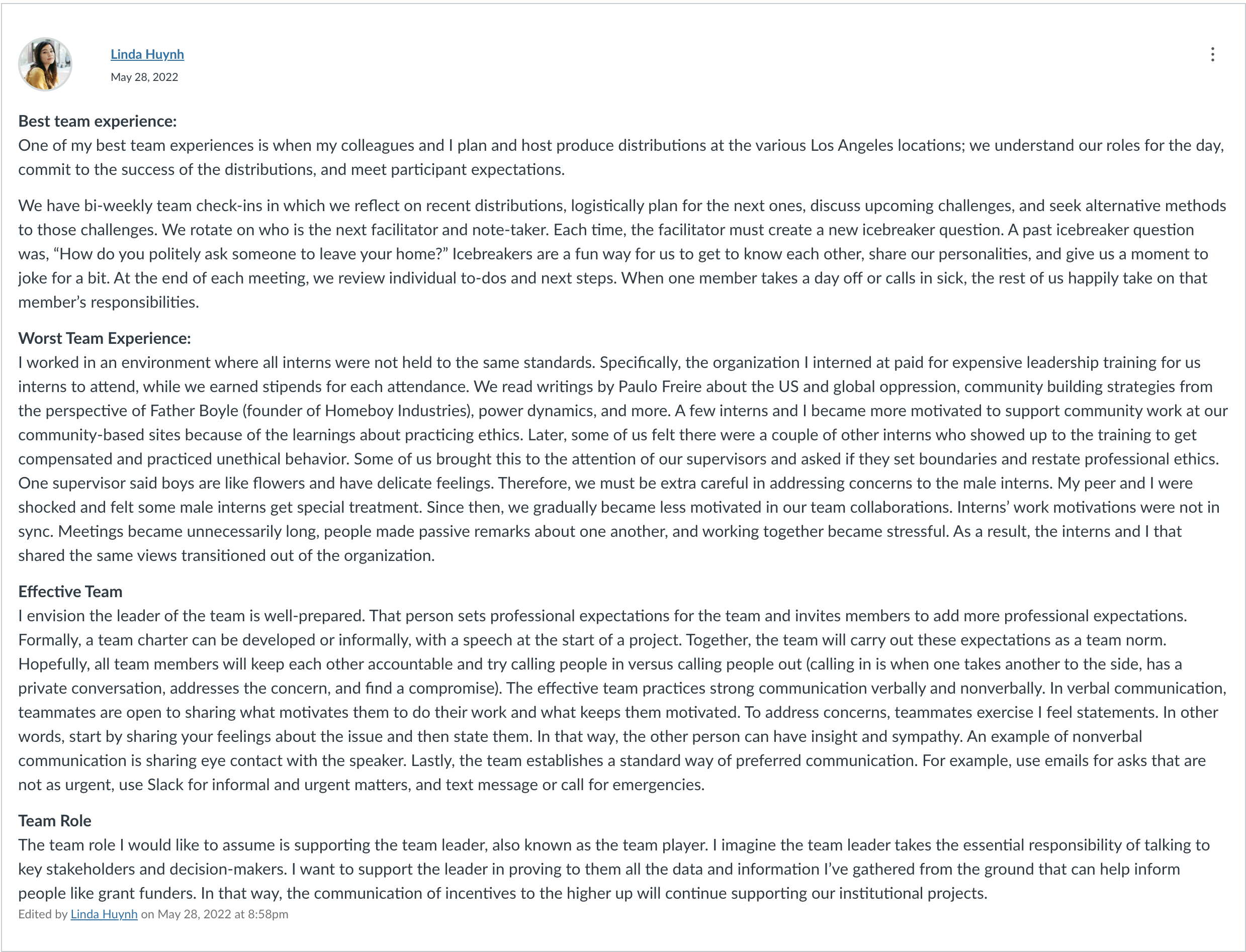
The discussion artifact was a response to a prompt shared in LIM 536 Library Project Management and my viewpoint of how I would act as a leader to manage diverse projects and teams to ensure positive stakeholder satisfaction. The prompt asked me to share a best and worst team experience, my vision of an effective team, and what team role I would like to assume. I mentioned that my best team experience occurs at my current job at a community non-profit. Currently, I am a program manager, and to briefly put it, I think what makes my team successful is communicating roles beforehand, reviewing them again, and then trusting that we all will do a great job. Any mishaps meant we needed to plan better next time, and no one was at fault. Creating small opportunities to learn about each other’s personalities will motivate us to help each other because, as humans, we all like to help people we appreciate. To briefly describe my worst team experience, I and fellow female non-profit intern observed that an existing power hierarchy in management preferred male interns and did not enforce the same work standards and expectations as females. I lost my work motivation and realized it was not a healthy environment because it impaired my work ethic. Therefore, I transitioned out. Through my work experiences, I believe an effective team means that all team members must commit to uplifting each other’s work, form an agreed team communication style, and challenge each other to refine work skills to result in successful project implementation and outcomes. Although not mentioned in this discussion post, I am proud to convey that I was able to advocate for a staff member to graduate from part-time to full-time. A year later, I helped him transition to another elevated title. These changes resulted from me often surveying my team and assessing their work motivations and their desire of what types of roles they see themselves taking in the organization in the coming years.
Conclusion
Each artifact expresses my understanding of the program goal in two ways: (1) communication tools like memos are effective ways to motivate teams to understand project goals, and (2) envisioning what an effective team looks like beforehand will lead to successful team projects, which then contributes to client satisfaction. These tools, skills, and understandings are relevant to LIS professionals because they constantly work with diverse communities and intend to serve them well. Therefore, working with team members who offer unique skills and can meet many needs is necessary. With these lessons, I hope that, in my LIS career, I will have chances to manage teams meaningfully.
References
Raffaelli, R. L., and Varghese, A. (2021). How to write an action-planning memo. Harvard Business Review. https://store.hbr.org/product/how-to-write-an-action-planning-memo/422033
This page has paths:
- Program Goals Linda Huynh