Thanks for your patience during our recent outage at scalar.usc.edu. While Scalar content is loading normally now, saving is still slow, and Scalar's 'additional metadata' features have been disabled, which may interfere with features like timelines and maps that depend on metadata. This also means that saving a page or media item will remove its additional metadata. If this occurs, you can use the 'All versions' link at the bottom of the page to restore the earlier version. We are continuing to troubleshoot, and will provide further updates as needed. Note that this only affects Scalar projects at scalar.usc.edu, and not those hosted elsewhere.
Josie Andrews 412 Midterm Projects
Main Menu
Introduction
The Ideological Function of Stars: Contradictions and Promises of Individualism.
Prompt Analysis
Little Women (George Cukor 1933)
Tomboyism: Negotiating and Celebrating a Strong, Sprited Woman in the Great Depression
Sylvia Scarlett (George Cukor, 1936)
"Woman of the Year" (George Stevens, 1942)
Conclusion
Bibliography
CATCH ME IF YOU CAN
The Contradictions and Promises of Individualism in the Films of Katharine Hepburn 1933-1942
Josephine Andrews
3a113b8327c230bc7c10dd21f21428c4f7bcd00c
Woman of the Year
1 2018-03-04T03:06:11-08:00 Josephine Andrews 3a113b8327c230bc7c10dd21f21428c4f7bcd00c 28637 2 Ending plain 2018-03-04T03:06:29-08:00 Josephine Andrews 3a113b8327c230bc7c10dd21f21428c4f7bcd00cThis page has annotations:
- 1 2018-03-10T00:26:46-08:00 Josephine Andrews 3a113b8327c230bc7c10dd21f21428c4f7bcd00c Women of the Year: Ending Josephine Andrews 2 plain 2018-03-10T00:30:37-08:00 Josephine Andrews 3a113b8327c230bc7c10dd21f21428c4f7bcd00c
This page is referenced by:
-
1
media/WomanoftheYear1.jpg
2018-03-04T05:37:45-08:00
"Woman of the Year" (George Stevens, 1942)
30
plain
2018-03-10T16:01:33-08:00
The Philadelphia Story (Cukor, 1940): A New Katharine Hepburn
Within three years of making “Sylvia Scarlett,” Kate became labeled box office poison. Returning to the east coast, she asked her friend, Philip Barry, to write a Broadway play for her based on her own family. Barry wrote “The Philadelphia Story,” a story about a Philadelphia Main Line family’s daughter, Tracy Lord, who is caught in a love triangle between her ex-husband, a reporter, and her fiancé. The problem is that everyone believes she is an “imperious virgin goddess” without a heart (Piermont 174-175). Kate and the play were a smash hit on Broadway, and she bought the film rights to ensure she would retain control over casting herself and the director (George Cukor). MGM backed Hepburn’s come back and Kate came back with an agenda that would last the rest of her cinematic life. She would carefully construct a public persona that negotiated a balance between masculinity and her “independent woman” type that appealed to audiences. She also wanted to establish that, despite her boyish figure, she had a “sexual quality.”
The time to make up your mind about people is never.” With these very poignant, personal words in “The Philadelphia Story” (Cukor 1940), Tracy Lord helps transform Katharine Hepburn’s image of a box office poison into a box office success. Understanding that her image had to change to save her career; Hepburn used Tracy Lord as a vehicle for her transformation. This romantic comedy focused on the very character traits that audiences disliked the most about Hepburn—her arrogance, intolerance, and refusal to conform, and let them see a new side of her. It also incorporated traits fans loved about her: the high society life of the elite and a woman’s attempt to find some middle ground between independence and being an overly aggressive, assertive women who does not need or want male approval.
Woman of the Year (George Stevens, 1942).
"The Philadelphia Story" was one of the biggest box office hits of the year and earned Hepburn her third Oscar, giving her back the power she needed to negotiate a long-term contract with MGM that included director and screenwriting control. Hepburn's next project was “Woman of the Year,” –a film that introduced Hepburn to Spencer Tracy and showed a sexier, “independent” woman: “Woman of the Year.” The film was released when the nation was on the brink of war and gender roles were radically transforming as women prepared to temporarily move into traditional male roles. The film addresses the inherent tensions the need for more independent and strong females in the workforce created for women who also desired marital life and family.
Contradictions abound in “Woman of the Year.” The appeal of this film is that these contradictions are not just plot devices but recognize the off-screen problems of women. As expected in a Hepburn film, Tess is cosmopolitan, upper-class political columnist. Sam (Spencer Tracy) is an unsophisticated working class sportswriter. The two use words (columns) to feud, but eventually their animosity turns to love and they marry, moving in to Tess’s high-end luxury apartment.
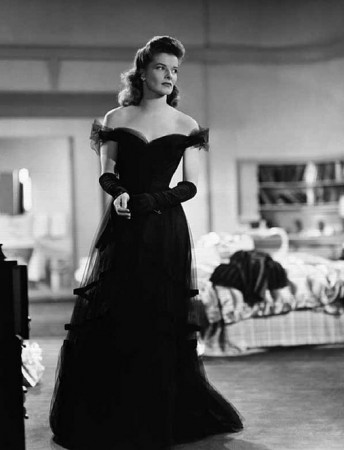
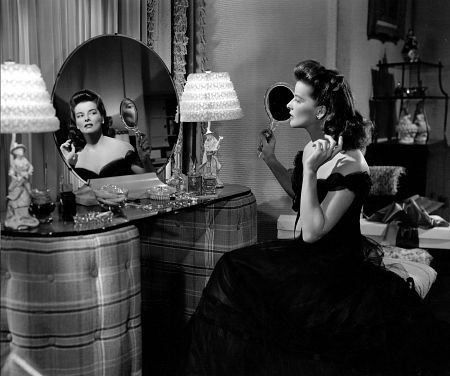
In the opening scene, the first thing Sam sees is Tess’s leg and her smoothing her hose, reinforcing the attractive woman as the object of the male gaze (desirability which brings men and women great pleasure (Heavenly Bodies 39). In fact, “Woman of the Year” is the first film to try and create a sexy, more feminine Katharine Hepburn. And, as the May 1942 American Cinematographer noted, cameraman Joe Ruttenberg does “more to glamorize Katherine Hepburn that we’d have thought possible.” The film then immediately undermines this stereotype by constructing Tess in the role of bread winner and source of power in the home—an unsettling idea for most men in 1942 but likely a tantalizing (at least temporarily) ideal for women at that time. Because Tess’s conduct clashes with a patriarchal social order, she is portrayed negatively, as someone not fit to be mother and certainly not a ‘Woman of the Year.’ Their marriage is an outstanding example of the cultural contradictions that define Hepburn's star image as she and women of that time try to negotiate the conflicting ideals of femininity, marriage and independence.
She unilaterally adopts a young Greek immigrant boy for publicity purposes, but then abandons him immediately to go to her awards dinner. Furious, Sam is convinced Tess is self-centered and incapable of fulfilling her biological function of being a mother. Unfortunately, the clip is not available but the dialogue is wonderful. Sam: It’s too bad I’m not covering this dinner of yours tonight, because I’ve got an angle that would really be sensation. The outstanding woman of the year isn’t a woman at all.”
At the end, Tess (and the women in the audience) finish their “little adventure” with independence, and return to the kitchen and home. This film does give us some hope, though, that a new relationship that is a bit more balanced, will be negotiated. Here is the clip: