West African Art
West African art is an exotic concoction of traditional customs and modern influences. West African art creators spend most of their lives perfecting skills that are passed down from one generation to another. For that reason, the study of their art provides a way of learning about their history and culture.
West Africans made beautiful textiles (or fabrics). Three types of these textiles are stamped fabrics, story fabrics, and kente cloth. Stamped fabrics are made by drawing a grid onto cloth. They then used stamps to fill in the squares with patterns. Story fabrics show events like a king on a lion hunt. Story cloths were made by appliqué (pronounced app-li-kay) in which small pieces of cloth are attached to a larger piece of cloth. The final type of textile is kente cloth which is made by sewing together narrow strips of silk or cloth. Kente cloth is worn around the world today.The rich fabric of African printed and factory-woven textiles reflects changing times, fashions and tastes. From eastern to southern Africa, the social and historical significance of these beautiful and diverse materials are also reflected in the identities of those who wear them.
Textile making has been part of African culture since ancient times. They are especially well admired for their textiles and weaving. These textiles are usually made with silks and natural materials. Some weaving has spiritual meaning. During Ancient times, textiles and weaving were used as a form of identification from tribe to tribe. Each textile very colorful and intricate. They are mostly made out of cotton, but they also sometimes use wool, silk, bark, flax and jute. African weavings often symbolize special occasions such as political and tribal events, weddings, funerals, burials and naming ceremonies.
West African story telling textile
A second unique art form in West Africa is masks. West African masks are usually carved out of wood or made from cloth and decorated with paint and beads. Masks are generally worn during celebrations or cultural rituals. Masks are not only significant to the West African culture, but they’re very valuable and sought after by people in other countries.
The uses of these masks were mostly for rituals and ceremonies. They represent animal or mythological hero spirits or may represent an abstract subject. Animals such as the buffalo, hyena, hawk, crocodile, and antelope serve as symbols of virtue. The masks that appear like the animals allow them to communicate with the animal for hunting or safety purposes. Details come from different animals to represent a certain virtue, such as antelope horns which represent power. A large chin represents power and strength. A female mask is meant to portray the ideal of feminine beauty. It is believed that when a mask is worn by a dancer, they become "bearer" of the mask's spirit. Masks are chosen by a dancer during important events such as celebrations, crop harvesting, and war preparation. At ritual ceremonies, the wearer of the mask goes into a trance in which he or she connects with their ancestor. Masks may be used by a shaman just once a year in a special dance. Masking ceremonies are now rare in Africa.
A traditional West African Mask worn for ceremonies
West African Art also consisted of making sutures. These sculptures were typically in human form, but they are not proportional. They were made from materials used wood, but also stone and metal. Traditional African sculpture is religious or spiritual. These purposes varied for wanting good good harvests, warding off disease, helping with decisions and judgements, important events, political statements. Most were not created for the market, but instead to celebrate an important event, political, or religious.
A West African Hornbill Harvest Bird Sculpture made for wanting good a harvest


West Africans art also consisted of crafting amazing jewelry. They were usually made from ivory, carved stone, bone, animal teeth or hair, glass, and wood. Gold and silver are often added to these pieces. Africa is the birthplace of both human civilization and jewelry. On the coast of South Africa in a cave named Blombos, Archaeologists have unearthed perforated pea-sized snail shells used as beads dating back 75,000 years. Beyond their use for self adornment, these pieces also have cultural importance. In Africa, jewelry can be a sign of wealth, power, and indicate their standing in the society. African craftsmen continue to produce traditional bead work unique to their regions or tribe. Supplying beads has been a major source of income for many of the tribal people of Africa. Outside of Africa, people are creating African inspired jewelry, showing how Africa has impact jewelry all over the world.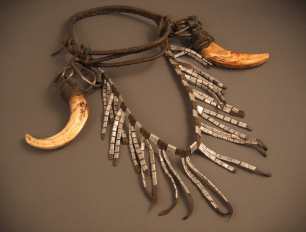
West African Tribal necklace made from tusks, shells, and leather
Overall, the African continent has produced a great diversity of art from prehistoric times to the present day. In many instances, art production has been related to ritual or tribal ceremonies, as well as serving more secular decorative functions, but it is not always easy to determine the function of a particular work. It is also problematic to label as 'art' the productions of African craftspeople who frequently considered their work as an essential part of secular or religious life.
This page has paths:
- Arts and Culture in Western Africa Jennifer Coronado