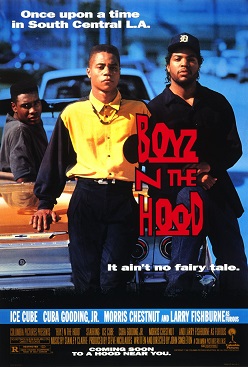
Boyz n the Hood (John Singleton 1991)
1 2017-08-07T21:08:31-07:00 Phil Ethington e37d40405599cccc3b6330e6c4be064cc03ef7a5 677 3 Movie poster. Critical Fair Use plain 2017-08-07T21:09:39-07:00 Phil Ethington e37d40405599cccc3b6330e6c4be064cc03ef7a5This page has tags:
- 1 2018-08-15T15:28:40-07:00 Phil Ethington e37d40405599cccc3b6330e6c4be064cc03ef7a5 1990s Phil Ethington 2 Decadal Tag structured_gallery 2018-08-15T15:31:13-07:00 Phil Ethington e37d40405599cccc3b6330e6c4be064cc03ef7a5
This page is referenced by:
-
1
2018-07-23T21:41:03-07:00
Rap and Rebellion: Manifestos for the Uprising, 1982-1992
15
plain
2021-03-16T09:28:51-07:00
“Ah yeah, right about now Compton's in de mothafuckin' house (yeah do it do it)
NWA's in full effect
Hey yo yella boy, kick me that funky-ass beat
Yeah, who's in de mothafuckin' house?
Compton's in the mothafuckin' house!
Yeah, Compton's definitely in the house”
“Compton’s N the House,”
from Straight Outta Compton (N.W.A, Ruthless, 1988)
N.W.A’s “Compton’s N the House" declares a territorial invasion of America’s mass-mediated public sphere. The "house" is both a real and metaphoric house: any nightclub or performance space, and also, the "house" of mass mediated popular music. "Compton" takes on the qualities of a verb, or an action noun, signifying the rappers promoting themselves and the police-occupied places of South LA at the same time. Never a household place-name until N.W.A made it so, the City of Compton put its boots down in that global house, making it a global city during the American Uprising of 1988-1992.
Words have never been closer to bullets. In Public Enemy's "Miuzi Weighs a Ton," Chuck D's "uzi" is his tongue. The Uzi, Israel's 9-mm military submachine gun, or "machine pistol," became the ideal gangland street weapon owing to its fearsome firepower and concealable size.Note. These heavy weapons, manufactured or sold in the United States under its permissive gun laws, flooded south across the Mexican border to enflame the drug cartel lawlessness in Latin America, for decades. In South LA, a stash of machine guns was social power within reach. All of this is wrapped together in Public Enemy's conflation of rap's rhymes and gangland's guns:
The contrast between verbiage and violence goes back a long way, as in the cliche of modern times: "pen is mightier than the sword." The language of political discourse, however, is always freighted with forebodings of force, because state power is maintained by its police and its military. In short, it takes political speech to wield the sword of state. But never in American mainstream discourse has political language carried such verbal violence. More accurately: rap music spoke counter-violence. As aggressive as political rap of the 1980s sounds, the principal claims are against the armed occupation of US inner cities by militarized police forces, especially in Los Angeles."I'm a Public Enemy but I don't rob banks / I don't shoot bullets and I don't shoot blanks ... It was war they wanted and war they got / But they wilted in the heat when my uzi got hot."Note.
By 1988, N.W.A., an acronym for "Niggaz Wit Attitudes," was a newly-minted group from Compton that both allied with and rap-battled New York's Public Enemy. Both rap groups had just declared war on White America's apartheid. Political Rap and Hip Hop in the late 1980s became the most defiant, rebellious, disrespectful, misogynistic, violent, and fearless music ever to enter the American mainstream. N.W.A.'s debut album, Straight Outta Compton, sold 3 million copies. Ice Cube, MC Ren, Dr. Dre, and Eazy-E wrote and rapped a fearless “Fuck You” to the entire legacy of white supremacy in the United States of America. They channeled the rage of the of “post” Civil Rights generation, born in the 1960s never knowing anything but the still-unrealized promises of the Civil Rights and Voting Rights Acts of 1964-5.
The single most rebellious song in N.W.A.'s Straight Outta Compton was, "Fuck Tha Police" is rapped as a mock trial "In the case of N.W.A. versus the Police Department," "Judge Dre presiding"; "Prosecuting attorneys are MC Ren, Ice Cube And Eazy-motherfucking-E." Ice Cube, the rap's author, testifies first:Fuck the police coming straight from the underground
A young nigga got it bad cause I'm brown
And not the other color, so police think
they have the authority to kill a minority
...
Ice Cube will swarm
on ANY motherfucker in a blue uniform
Just cause I'm from, the CPT
Punk police are afraid of me!
HUH, a young nigga on the warpath
And when I'm finished, it's gonna be a bloodbath
of cops, dying in L.A.
Yo Dre, I got something to say
Explicit does not accurately describe these lyrics. They are word-bullets, as Eazy explains when it is his turn to testify:When we're on the stage, we're in a mothafuckin' rage
So Dre (“what up?”), why don't you get the 12 guage (yeah)
And show 'em how Eazy-Duz-ItBackstory
We need to rewind the timeline here, however, to tell this story properly. Hip-Hop's territorial invasion of US popular music had originated several years earlier, at the beginning of the Reagan era, in Greater New York. The history of Rap music begins with the 1982 hit single, "The Message," a political rap anthem by New York City's Grandmaster Flash and the Furious Five: “Don't push me cause I'm close to the edge…” While political, however, The Message was not gangsta rap.
The gangster rap rebellion also begins with 1983's Scarface, and Al Pacino's landmark performance as Tony Montana, a Cuban-American immigrant and Miami cocaine drug lord. Scarface is a remake and transposition of Chicago's Al Capone, as portrayed in The Public Enemy (1931), starring James Cagney and Jean Harlow. Screenwriter Oliver Stone, himself at the time addicted to coke, interviewed actual Columbian narco gangsters while researching the script. Director Brian Di Palma, whose blood-soaked Carrie (1976) and Dressed to Kill (1980), put him in the vanguard of carnography, transposed Italian Chicago's Al Capone into Cuban Miami's Tony Montana, and the brutal bootleg trade of 1920s Chicago into the brutal cocaine trade of 1980s Miami. Howard Hawks' 1931 portrait Al Capone, including the St. Valentine's Day Massacre, became a landmark in American cinematic realism, much admired and remembered in the 1960s and 70s when the New Hollywood created their own bloodbaths.
To rappers and gang members themselves, Tony Montana offered a relatable portrait of a fearless, reckless, and ruthless gangster, a romantic and also a stone-cold killer in the Reagan Eighties. In the movie, Tony Montana slips into the United States during the Mariel Boat Lift, when Cuba's Fidel Castro let 125,000 Cubans emigrate. These Cuban immigrants became USA's latest refugees: tired, hungry, yearning to be free. Miami and Los Angeles became the new Ellis Islands, and these late-20th century Latino sunbelt cities replayed much of the stories from New York and Chicago in the early 20th century.
In an early scene, Tony Montana washes dishes in a Miami Cuban late-night grill. He watches the patrons of a night club across the street, as a well-dressed man exits a fancy car among well-dressed ladies, and gripes: "What has he got that I don't got?" Tony, like the Italian mafiosi in Francis Ford Coppola's Godfather and Godfather II, is a satiric version of the "model" immigrant: ambitious, entrepreneurial, upwardly mobile. Tony works hard at being hard, and playing hard. Tony's "leetle friend," a powerful, military machine gun, is also the phallic indulgence of the Reagan Eighties, when Wall Street "Yuppies" (Young Upwardly-mobile Urban Professionals") made cocaine the coin of the realm in Upper Manhattan, the Gold Coast, and Beverly Hills. Stone's script packed with viral, and virile, one-liners: "All I have in this world is my balls and my word and I don’t break them for no one." Di Palma's Scarface was a huge hit among young men in the inner cities and was quoted endlessly in gangster rap. The image of Tony/Pacino gritting his teeth and firing his machine gun at the police remains pop cultural icon, usually printed with the movie's tagline "Say hello to my leetle friend."Note
Rap and Hip-Hop got mainstream recognition thanks to the group Run D-M-C. Musical rebels don't usually get a mainstream audience at first precisely because they are rebels against such mainstreams. But great music that speaks to its time is is also great music that sells. The group's self-titled first album, Run D-M-C, released in March of 1984, was Hip Hop's first gold album, and first to be nominated fro the Grammys. The group went on to claim the first Hip-Hop platinum album in 1985 with King of Rock. From the streets of Queens, Joseph Simmons, Darryl McDaniels, and Jason Mizell, fused rap and rock to transform Hip-Hop from the flashy glam of Grandmaster Flash into a new branch of rebellious popular music, following jazz, blues, rock and be-bop. Their Rock Box video was the first of the Hip-Hop genre to air on MTV in 1985, setting so much of the style of the movement: inflated self-promotion, defiant demeanor, baggy clothes:
"[Verse 3: Run, D.M.C., Both]
We got all the lines
And all the rhymes
We don't drop dimes
And we don't do crimes
We bake a little cake with Duncan Hines
And never wear the vest they call the Calvin Kleins
'Cause Calvin Klein's no friend of mine
Don't want nobody's name on my behind
Lee on my legs, sneakers on my feet
D by my side and Jay with the beat"Note
Political Rap and Hip Hop evolved rapidly into decidedly a bi-coastal rap battle by the late 1980s. New York's rappers deserve first credits, with Public Enemy's 1987 album Yo! Bum Rush the Show. NWA's Straight Outta Compton appeared in answer the following year; then the battle returned to New York Public Enemy's It takes a Nation of Millions to Hold Us Back; and Public Enemy's Fight the Power! soundtrack to Spike Lee's breakthrough 1989 film, Do the Right Thing, (US release July 21, 1989). The rap battle returned to LA in Ice Cube's debut solo album, Amerikka's Most Wanted, and then to NYC in Public Enemy's Fear of a Black Planet, followed in LA by NWA's second and final album for Ruthless Records, Niggaz4Life. Dr. Dre next left NWA to partner with Marion "Suge" (pron: shug) Knight to form Death Row Records and released his landmark 1992 album, The Chronic.
Featured in nightly TV news on a daily basis, gang-related homicides peaked at 803 dead souls across LA County in 1992. At that time, the LAPD estimated 15,742 Crips in 108 sets, plus thousands more members of the Bloods.Note.
The cinematic branch of this rebellion began with a dud, when a white rebel of the 1960s tried to represent something they he never knew. Dennis Hopper, the clown prince of the Counterculture of the 1960s and lifelong denizen of LA's urban underworlds and counter-worlds, was drawn to the drama of the paramilitary gangs, making a wooden representation of that world as told through two white cops. His Colors (1988) is about the Crips and Bloods. Much more important were two films by African American directors. Spike Lee's 1989 Do The Right Thing, and John Singleton's 1991 Boyz N the Hood.
Do The Right Thing, set in gentrifying Bedford-Stuyvesant, Brooklyn, portrayed the moral choice of "Mookie" (Lee), following the police killing by choke-hold of a beloved neighborhood character, "Radio Raheem," at the climax of the movie. Lee knows the "right thing" to do in response is to smash the Italian-American pizza parlor that employed him. The senseless waste of a Sal's place was a necessary response to an intolerable police state of siege. On the strength of Public Enemy's 1988 album, It Takes a Nation of Millions to Hold Us Back, Lee persuaded Chuck D to compose an anthem for his film: "I wanted it to be defiant," recalls Lee: "I wanted it to be angry, I wanted it to be very rhythmic. I thought right away of Public Enemy." Produced by The Bomb Squad, Fight the Power was released as a single and hit the top of several charts. "Fight the Power is not about fighting authority—it’s not that at all," says Public Enemy's Bass player Brian Hardgroove" "It’s about fighting abuse of power."Note.
Chuck D's Fight the Power was the political rap song to beat in 1989. Forceful and intimidating, its rhythm and rhyme alone do the job. It is not an explicit song, however. No "muthafuckas", no slang for sex organs, no threats to kill cops. Even so, it was understood as militant. In 1989, Virginia Beach, Virginia local government panicked, surrounding African-American college students with thousands of police and Virginia National Guard. Crowds blasted the Fight The Power from boom-boxes while some smashed windows.
By 1990, Ice Cube had an answer with his explosive Amerikkka's Most Wanted, released in May of that year. Calling his crew "Da Lench Mob," the whole album is a counterattack on centuries of racial oppression, flagging the Ku Klux Klan in the album title, re-appropriating the forms of oppression (and re-spelling them, re-minting them, for this purpose) along with the N-word. Nigga or Niggaz became terms of solidarity, as in the album's title track "The Nigga You Love To Hate" Having declared war on cops in Fuck the Police," Cube does not hesitate to threaten them with murder:"Cause I'm about to fuck up the program
Shooting out the window of a drop-top Brougham
When I'm shooting, let's see who drop
The police, the media, and suckers that went pop"
An ultimate product of the "LA Rebellion" of black filmmakers that arose from the Film program at UCLA in the 1970s and 1980s was John Singleton's 1991 Boyz n the Hood. Boyz artfully narrates gangs and violence from a neighborhood-eye view, reversing the perspective of Hopper's Colors. Singleton cast Lawrence Fishburne as Furious Styles an aged 1960s Black Panther imposing a Malcolm X discipline on his wayward son Tre (Cuba Gooding Jr). Tre stays out of the fray, but his friend "Doughboy," played by NWA legend Ice Cube, succumbs to the death trap. Cube wrote and recorded the song "How To Survive in South Central" for the film's soundtrack:Rule number one: get yourself a gun
A nine in your ass'll be fine
Keep it in your glove comparment
Cause jackers (yo) they love to start shit
Now if you're white you can trust the police
But if you're black they ain't nothin but beasts
Watch out for the kill
Enter the Rodney King Beating. Singleton was still in the editing room cutting Boyz n the Hood when a violent global spectacle erupted: The videotaped beating of motorist Rodney King on 3 March, 1991 by four LAPD officers, surrounded by a cordon of 17 more. Recorded on a hand-held consumer "camcorder" by bystander George Halliday, the video went "viral" just before the arrival of the Internet. Without benefit of the 'Net. his analog video spread worldwide by satellite-networked global news organizations. Shock and outrage spread. Not accidentally, the LAPD looked like the terrorizing force of the US-client dictatorships set up by Nixon and Reagan.
The chain of events from the Rodney King Beating onward were swift at first initially, and then painfully gradual, for almost exactly one year. By 14 March, four LAPD officers--Sgt. Stacey C. Koon and Officers Laurence M. Powell, Theodore J. Briseno and Timothy Wind--were indicted on felony charges and pleaded not guilty.
Then on 16 March 15-year-old girl, Latasha Harlins, was shot and killed by a Korean immigrant shop owner named Soon Ja Du. The Harlins killing was also videotaped--by an automatic security camera--which provided the same kind of common-sense evidence of injustice. Replayed, it was clear to most that Soon Ja Du had shot her in the back of the head. It captured a murder, and became iconic of the other dimension of poorly-policed South LA: everyone was armed, and inter-ethnic tensions were very high in many large neighborhoods. In Koreatown, Korean immigrants were landlords and employers of Latinos and some blacks. When the uprising reached this neighborhood in April-May 1992, the form of violence was comparable to the 1919 Chicago Race Riot: ecological battles between ethnic groups, not directed at state authorities.
On 1 May, Mayor Bradley appointed in "Independent Commission on the Los Angeles Police Department," headed-up by the respected lawyer and diplomat Warren Christopher (who next served as U.S. Secretary of State in the Clinton administration from 1993-1997). The "Christopher Commission," as it came to be called, issued its scathing report on 9 July. The trial of the four LAPD officers had not even begun, but the Christopher Commission report confirmed the carnographic images of the Holliday video, played on TV in slow-motion ad infinitim by mid-summer. Excessive force was indeed a major problem in the LAPD, had been for a long time, and was the failure of the top command: "The failure to control these officers is a management issue that is at the heart of the problem."
By this point, public opinion seemed to assume the officers would be convicted of assault with deadly weapons charges, but perceptions of the trial's fairness took a sudden turn when the defense filed an appeal to have the venue was moved from Los Angeles County, where the incident occurred, to a distant site in a neighboring county, on the claim that "notorious" cases prejudice the local jury.The commission has found, however, that there is a significant number of officers who repetitively misuse force and persistently ignore the written policies and guidelines of the department regarding force."
The commission highlighted the problem of "repeat offenders" on the force, finding that of approximately 1,800 officers against whom an allegation of excessive force or improper tactics was made from 1986 to 1990, more than 1,400 had only one or two allegations. But 183 officers had four or more allegations, forty-four had six or more, sixteen had eight or more, and one had sixteen such allegations. Generally, the forty-four officers with six complaints or more had received positive performance evaluations that failed to record "sustained" complaints or to discuss their significance.Note.
This motion stirred much suspicion, but when in November of 1991 nearly all-white city of SImi Valley in Ventura County was selected, the appearance was of a fix at the jury-selection level. The community from which the jury was drawn had high proportions of law-enforcement and military families. Indeed, the empaneled jury had "no blacks, six white men, four white women, one Hispanic woman, and an asian woman born in the Philippines," and "On the questionnaires, all said they had positive opinions of police in general and the role of police officers."Note.
Ice Cube's second album, Death Certificate, was released on 29 October 1991. It is even angrier, more explicit, and more defiant than Amerikka's Most Wanted, his rhymes woven now with lines from the Nation of Islam. Written and recorded while the drama of the Rodney King aftermath unfolding every day, Death Certificate bristles with verbal violence. In Cube's "Good Cop Bad Cop," there are no good cops, because any who are decent are required to cover for the killers "Black police showin' out for the white cop / White police showin' out for the black cop" It concludes with a staccato blast of indictments:Black Lives Matter is not chit chatter
'Cause all they wanna do, is scatter brain matter
A mind is a terrible thing to waste
A nine is terrible in your face
The mace has a terrible fuckin' taste
The pen is a terrible fuckin' place
The kings all hate the fuckin' ace
The judge sabotaged my fuckin' case
Racist motherfucker
The violent, completely uncensored rebelliousness of political rap proved enormously popular, and enormously profitable. Normally, the choice to politicize or make sexually explicit any popular entertainment had been, prior to this moment, to commit "box office poison" and relegate one's art to the underground. Not any longer. Black kids and kids of any experience in the occupied conditions of Reagan's America bought the records first, but the popularity went way beyond the communities of color. Ruthless Records estimated that most of its sales were in the white suburbs. The popularity of these records is evident in sales. Straight Outta Compton sold millions, reaching triple platinum status. As Jerry Heller, NWA's controversial first manager put it: "The economics of it were staggering. Just staggering," Heller says. "If you were with Warner Bros., for example, and you sold 500,000 records, they might drop you from the label. The way we were doing it, if you sold 200,000 records you made a quarter million dollars. And you made it right there. We'd take the check to the bank, cash it and split it up on the corner.'"
Public Enemy's 1990 Fear of a Black Planet reached 2 million in sales, and Death Row's landmark 1992 The Chronic sold 5.5 million. With ultimate irony of grandest contradiction, these sales were so strong that corporate America stood in the path of a Congressional move to somehow put the cork back in the bottle of uncensorship. While much of the early recording profits went to black-owned labels like Death Row, the major labels wanted as much of this action as they could get, so they defended rapper's right to free speech and gleefully profited on the most rebellious music ever made.
While rebellious beyond precedent, the political content of the music lacked a positive program. It was anti-authoritarian, and even defensive in its violence, but nearly all rappers by 1991 wrote demeaning misogynistic lyrics ("Women Ai'nt Shit but Ho's and Tricks," is a track on Dr. Dre's breakthrough The Chronic of 1992). Another recognizable ideology in political rap of this period was Nation of Islam nationalism, which was also intensely patriarchal. Veneration for Scarface movie images and postures belies the "pulp" in this rebellion.
Therefore, while political rap was clearly anti-authoritarian rebellion, it was not a very coherent pro-democracy movement. Thanks to these contradictions in the political discourse of rap music, in the LA Uprising of 1992, rebellion devolved into inter-ethnic warfare, symbolic cruelty, and bathos.
It was a pulp rebellion to match the pulp fascism that it opposed.