Siri
Finally, one of the most interactive components of the iPhone is the voice command operator, Siri. By giving the iPhone a voice with the iPhone 4 in 2010, the device is humanized in the interaction with the user. With the ability to tell Siri to “Read my latest email,” “Wake me up at 7AM tomorrow,” and ask “Where’s a good Indian place around here?” Siri becomes personified within the communication of the user. Currently, Siri has become more advanced and interactive with new commands like, “Find videos I took at Iva’s birthday party” and “Show my selfies from New Year’s Eve” (Hey Siri). Although other smartphones contain voice systems like Siri (Google Now), Siri is said to have a greater personality. Arguably, Google Now may be the most knowledgeable voice command, but is the least liked because it is the least personable operator (Google Now). Again, the voice command of Siri is exclusive in the way Siri is programmed. Users can make Siri call and pronounce the owners name specifically and the user can ask Siri personal questions while receiving (semi) human-like responses. Siri is also exclusive in the fact that it is solely for Apple’s iPhone, whereas Google Now can be downloaded onto the iPhone. Overall, Siri’s behavior constitutes a deeper connection in regards to how the personified system is capable of holding a conversation. In making Siri perform mundane tasks through voice, Siri is an extension of the user through the way the user casually communicates with Siri. Ultimately, Siri becomes a construct of the user because the individual still has to tell Siri to perform the task.
Considering Siri’s capability to communicate with the user, there is potential for multiple Siris to converse with one another. In thinking of this, we must question who Siri is. While Siri is supposed to remain a technology, the association of one Siri in contact with another Siri personifies the iPhone in a way that creates a simulation of a false human interaction. Mark Poster explains, “a simulation is different from a fiction or lie in that it not only presents an absence as a presence, the imaginary as the real, it also undermines any contrast to the real, absorbing the real within itself” (Kellner). This definition helps expose the hidden existence of the imaginary, or perhaps, the human identity within Siri. With this, the user cannot disconnect Siri from the humanized form she simulates. Using immediacy, Siri engulfs the user into a new “reality” away from the physical media of the technological interface. Although Siri’s ability to communicate with other technologies, like other Siris or Google Nows, Siri’s presence is a simulation because she cannot be separated from her human-like attributes.
In an attempt to identify Siri as a technology, we can also identify Siri as a human based on who recorded her voice. Because the user can choose the voice of Siri, male (Jon Briggs) or female (Susan Bennett), Siri is merely a constructed companion based on user preference. Primarily discussing the main voice of Siri, Susan Bennett, are we allowed to categorize Bennett as Siri? While Bennett identifies herself as Siri, she is not the personified technology, but the voice of the iPhone. Bennett confesses, “when people ask if I talk to Siri much, I say: ‘No, I talk to myself enough as it is,’” to show how she identifies herself as Siri (Parkinson). Therefore, because we naturally give Siri human characteristics, Siri not only become an extended means of communication with the self, but also a real person in the physical world.
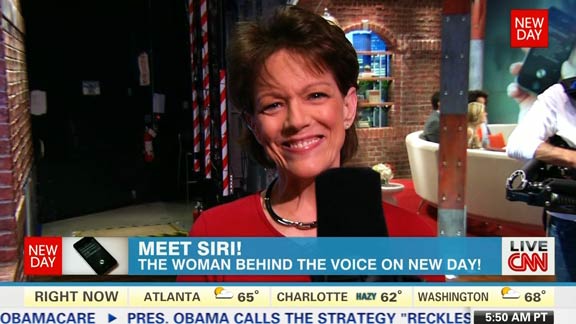
An alternative way Siri can be considered humanized is through programming. With Siri’s response to all user questions, it can be argued that Siri responds a certain way based on how Apple as a company programmed Siri. Siri, “often hits the news – for good and bad. Siri has befriended an autistic child, been accused of homophobia, fought for trans rights, mocked maths dunces, come out as a talented rapper and possibly inspired Spike Jonze film (which Siri did not appreciate)” (Hey Siri). The fact that Siri can be accused, as a system, indicates that Siri is in fact a person. But who is she? Siri can be identified as a voice (Susan Bennett), programmed algorithms (Apple as a company), or as a simulated companion through immediacy. Overall Siri is personified to generate a simulated relationship to expand the relationship between the user and the iPhone.
| Previous page on path | The Virtual Window, page 1 of 1 |
Discussion of "Siri"
Add your voice to this discussion.
Checking your signed in status ...