Thanks for your patience during our recent outage at scalar.usc.edu. While Scalar content is loading normally now, saving is still slow, and Scalar's 'additional metadata' features have been disabled, which may interfere with features like timelines and maps that depend on metadata. This also means that saving a page or media item will remove its additional metadata. If this occurs, you can use the 'All versions' link at the bottom of the page to restore the earlier version. We are continuing to troubleshoot, and will provide further updates as needed. Note that this only affects Scalar projects at scalar.usc.edu, and not those hosted elsewhere.
Film Studies in Motion: From audiovisual essay to academic research videoMain MenuIntroductionChapter I: From Scribe to ScreenChapter II: Current PracticeChapter III: Closing the GapFinal RemarksReferencesThomas van den Berg05debbe0c938b9e7170e68167598b10193a9540eMiklos Kissbab68bf9457e82557cb440971c8c3307eac46327
Discussion
12016-03-10T06:23:22-08:00Miklos Kissbab68bf9457e82557cb440971c8c3307eac4632781155plain2016-05-31T01:39:54-07:00Miklos Kissbab68bf9457e82557cb440971c8c3307eac46327Chapter II: Current PracticeThis chapter weaves a broad tapestry of angles, technologies and ideas. One thing that stands out is that those that have analytical goals with moving images and sound have been grappling for a way to ‘write’ by audiovisual means in a similar way as filmmakers have. While Faden’s designation of ‘media stylo’ may seem playful, it is in fact expressive: it signifies the desired fusion of study and the studied into a single format, and echoes both Bellour’s theoretical musings as well as the filmmaker’s ‘camera pen’. This development is underscored by a keen observation from John Bresland, who declared: “We’re calling it the video essay. Because most of us experience the motion picture as video, not film[.] Film is analog. Film requires shutter to convey motion” (Bresland 2010, our emphasis). This is currently the case even more so, since in the time between Bresland’s article and this publication the entire movie industry has migrated to a digital workflow (see, for example, Bordwell 2012a). Digital cameras are commonplace, production of celluloid has technically ceased, and 35mm projection has made way for digital screening as the new industry standard. Thus, we have technologically progressed beyond both Bellour’s thought experiment and Bresland’s moniker.
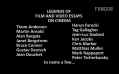
With this we hope to have shown that designating the video essay as a direct descendant from the essay film is an oversimplification, technologically speaking; Godard’s works were arguably the first ‘video essays’, as they were produced with VHS (Histoires Du Cinéma) and Digital Video (JLG/JLG). Despite the fact that this overview only scratches the surface of subjects that deserve book-sized studies in themselves (see also Lee’s overview about filmmakers who made some kinds of ‘video essays’, decades prior to today’s booming trend [Figure 10]), we also hope to have shown that there are common tendencies and evolutions to the mediatization of studying films, audiovisual essaying and cinephile-marketed film extensions. In sum, current manifestations of audiovisual essays echo traits and earlier investigations in first person documentary and hypertext; Film Studies has been developing to reach beyond written word for almost a century. Incorporation of ‘film’ (then video, and now digital file) was a long-awaited prospect, as well as a logical next step opening up theoretical possibilities. Whereas the incorporation of stills in the past was hampered by practical (technological) and financial (copyright) hurdles, work with video suffers virtually no impairments today. In terms of technological properties, scholarly efforts, amateur inquiries, and consumer-marketed paratexts are growing in a similar direction. In all cases, the film ‘object’ (in the Bellourian sense) and paratextual supplements (be it of a theoretical nature imposed by a third party, or additional information delivered by the filmmakers themselves) become different modalities of the same ‘text’. As the entire film industry – from pre-production to shooting and post-production – is migrating to digital, this merge is only further facilitated, since there is no longer a need for physical transferal of the film text: in the era of digital projection, the ‘film object’ is without ‘object’. A minor but, for us, significant consequence of this change is that such rapid developments of the medium influence not only the production but also the ‘discursive industry’ around cinema: within the latter, academic integrity in terms of informational quality and scholarly validity is jeopardized due to lingering infatuation with new technology, since scholarly audiovisual efforts tend to gravitate towards the aesthetically attractive, technically creative, and tonally poetic. At the moment there is a strong need for overviewing the coming of age of the form – which we hope this chapter has done, at least in part – and for mapping current tendencies – as will be seen in Chapter II – in order to show what the possibilities are. As we have indicated in this chapter and will further illustrate in subsequent parts, this work is necessary because current practice is lagging behind theoretical forecasts. We will describe, formulate, and argue in favor of several possible ways in which the videographic form could reach maturity. If anything, we hope to iron out the semantics.
This page has paths:
12016-02-12T02:38:19-08:00Miklos Kissbab68bf9457e82557cb440971c8c3307eac46327Chapter I: From Scribe to ScreenMiklos Kiss4plain2339182016-05-25T06:27:40-07:00Miklos Kissbab68bf9457e82557cb440971c8c3307eac46327
This page references:
12016-05-31T01:36:51-07:00Figure 102Kevin B. Lee lists of early film and video essayists on cinema in his tribute video essay on Mark Rappaport: 'Breaking Through the Screen: Video Essays by Mark Rappaport' (2015).media/Figure 10.pngplain2016-05-31T01:37:40-07:00