Scalar's 'additional metadata' features have been disabled on this install. Learn more.
Exploding Tongues: Language, Art, and the Russian Avant-garde
Main Menu
Back to Futurism: Russian Artist Books
Introductory Page by Chris Gilman
BookENDS: A Working Theory of Textuality as Cultural Dominant, 1912-
An Introduction and Conclusion to a Semester's Investigation into the Book Arts as an Avant-garde Practice
Book Case Studies
Collaborative Research by Case Studies
Big Bang: Timeline of Russian Avant-Garde Book Arts and Their Cultural Impacts
A Timeline of Russian Avant-Garde Book Arts and Their Cultural Impacts
CoaRse CaLIBration
ARTS 227 "Introduction to Letterpress Printing" (Pedersen) and CSLC134/RUSN334 "Exploding Tongues" (Gilman)
NthOlogy
A limited edition collaborative book arts project by students of ARTS 227 (Pedersen) and CSLC 134/RUSN 334 (Gilman), Spring, '17
MANIFESTERS (AB & Kelly): A portfolio of process and products
Appendix: A Path Through Russian Avant-Garde Books
Christopher Gilman
1985b99a2acd541caa12a10c3ebf6896565283ab
Dexter Blackwell
92e005ca94195f836c6089cf147faff4c74fa79e
Zoe Foster-La Du
c1c8954189fb3ee4ab6e36bfb90fae86777eab97
Stephen Heim
7069d17c035042745c96bc6c7619096cd7b33da4
Kelly Kirkland
e1805e502570d093d70f00df18f145c99290d0a3
Ian Lehine
b028c384a69e4b92166e7791b002fa3f2cee5818
Timothy Lewis
13880d3d99b4b71ce85be63e69a6d44e38853d68
Jmedina2
9ac3fc10003fb639ac412984b59b01a5b826e161
Taylor Robinson
aa08dd3939f1f1c6162c5518ae531385e51659af
Evan Sarafian
042e10782d9a6d3f0001a4b35abb02f58ad84684
Craig Dietrich
2d66800a3e5a1eaee3a9ca2f91f391c8a6893490
ILiADS (Institute for Liberal Arts Digital Scholarship)
Kruchenykh and Larionov
1 2018-08-29T00:01:07-07:00 Christopher Gilman 1985b99a2acd541caa12a10c3ebf6896565283ab 12041 2 plain 2018-08-29T00:02:11-07:00 Christopher Gilman 1985b99a2acd541caa12a10c3ebf6896565283abSee:
Kruchenykh...
This page is referenced by:
-
1
2017-04-17T10:03:48-07:00
BookENDS: A Working Theory of Textuality as Cultural Dominant, 1912-
55
An Introduction and Conclusion to a Semester's Investigation into the Book Arts as an Avant-garde Practice
plain
2018-08-29T00:01:18-07:00
Textuality and the Nullification of Dimension
This page marks both a beginning and an end. It is an introduction to the assignments, projects and resources contained in the project, as well as a summary of ideas that resulted from a semester's process of inquiry.
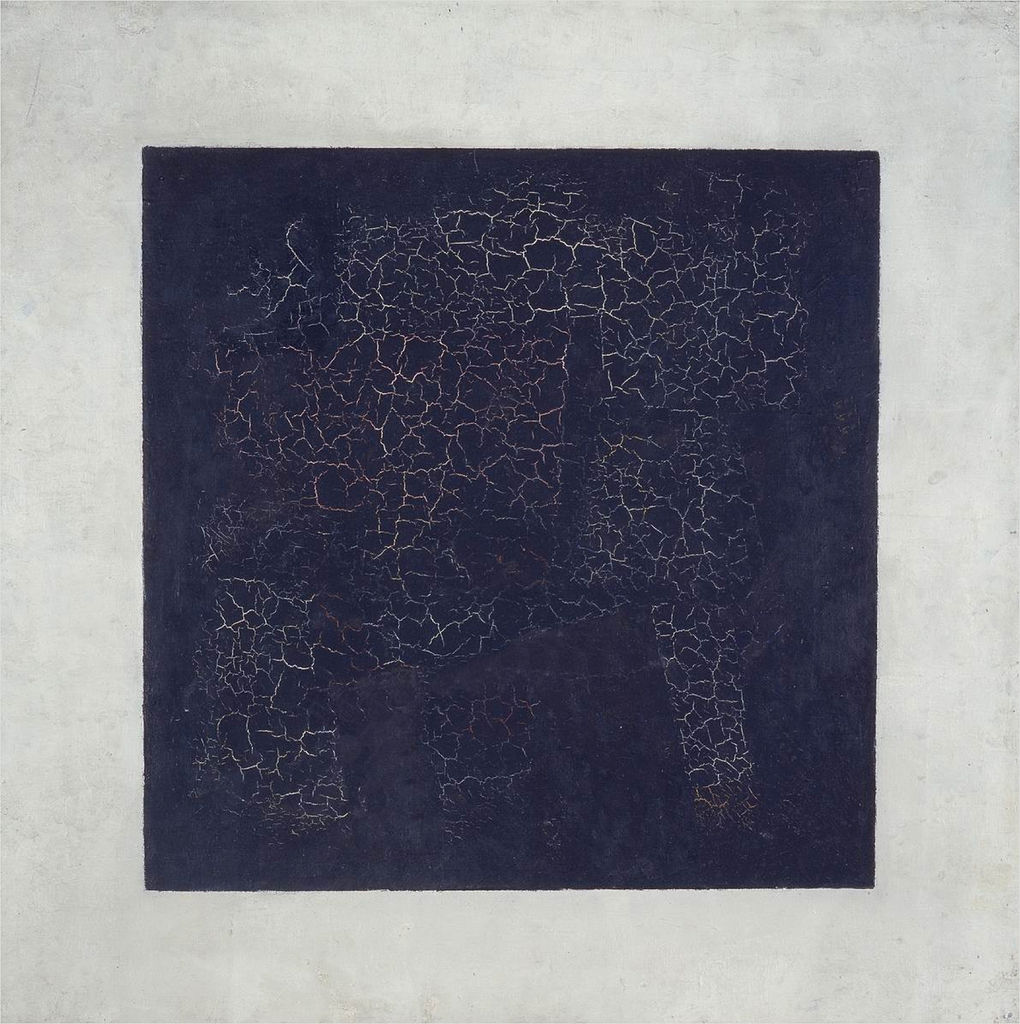
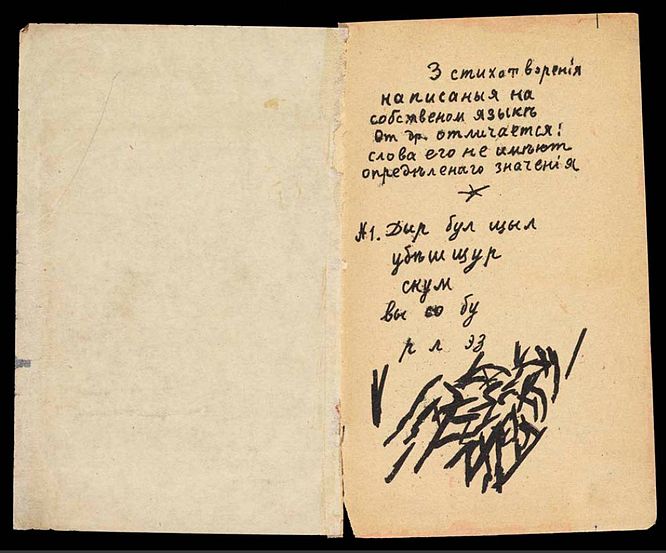
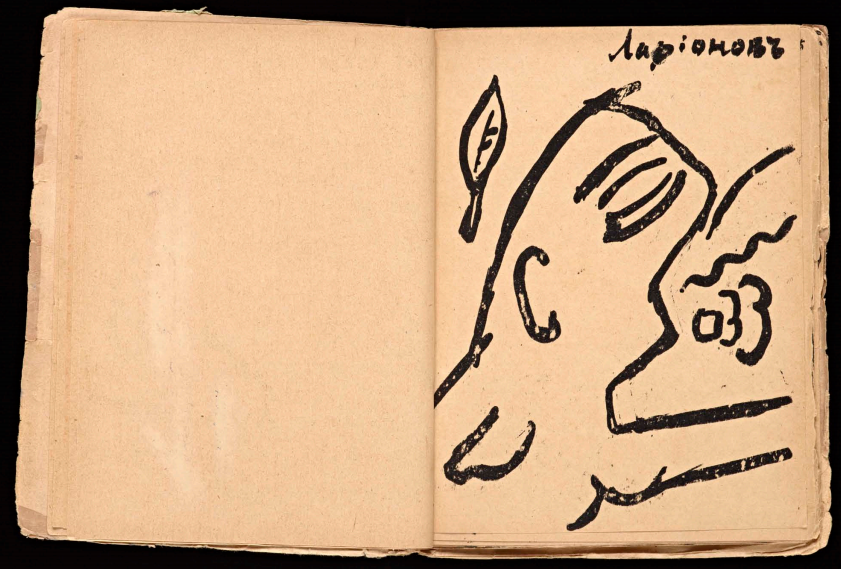
We began our course by considering two artifacts: Kazimir Malevich's "Black Square" (1915) and Aleksei Kruchenykh's first zaum ("transrational") poem "Dyr bul shchyl" (1913) Each is a well-recognized cultural monument in the history of modernism. The "Black Square," an unruly gesture in crudely simplified geometric form, redacts any referentiality with an overlay of thick, black, oil paint; "Dyr bul shchyl" (1913) upends language as such by substituting primordial sounds for poetry in lines scribbled hastily above a tangled thicket of an illustration. Malevich and Kruchenykh were friends and collaborators. The question was whether these two phenomena were parallel, loosely inspired by each other, or whether there was some more fundamental relationship between them, causal or otherwise.
Abstraction has been described as an idea. In a landmark 2012-13 exhibit at the Museum of Modern Art, "Inventing Abstraction, 1910-1925," Curator Leah Dickerman assembled works representing a trans-Atlantic network of artists and theorists, whose collective efforts and social connections, more than any individual discoveries of feats of genius, were responsible for the emergent realization of abstraction as a defining feature of 20th Century visual arts. If one accepts Dickerman's reasonable presupposition, that abstraction was an idea, a shared thought that could transcend any material or formal instance, then making the connection between zaum poetry and Suprematist painting becomes quite easy: each cultural practitioner in his/her/their own way grasped the notion as it spread through their social networks, and sought in the materials, forms and processes of their own media to achieve its realization.
This course in its investigations seeks a different route between artists of different disciplines, bypassing the transmission of ideas. It is inspired by a metaphor less compelling than Dickerman's social network diagram, but one that is, perhaps, more germane to the period under investigation. The goal here is to understand how a few, focused efforts by a very small number of cultural practitioners could effect a wholesale collapse and regeneration of socio-cultural communication by strategically (though perhaps not consciously) targeting the nerve center, the most central nexus point through which the most diverse modalities of expression and communication could travel.
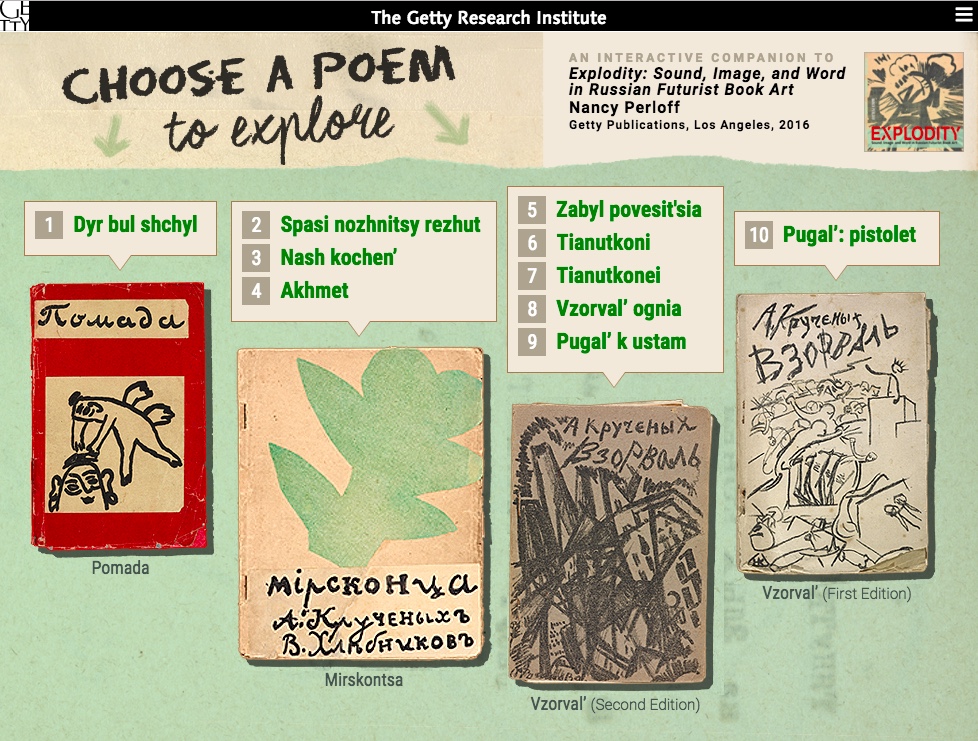
This approach to the general topic of modernity and abstraction has been greatly facilitated by another collection of artifacts, Explodity: Sound, Image, and Word in Russian Futurist Book Art (2016) a book publication by Curator Nancy Perloff of the Getty Research Institute, and accompanying interactive website and tagged materials in an online collection of Russian Futurist Books.
The scenario that emerges from inquiry is one of highly specific, almost accidental, contingencies of personal biography, idiosyncratic processes, and random found material that leverage, nevertheless, immense cultural processes to follow, because the changes occurred simultaneously on the orders of parole (speech) and langue (language). The efforts by the Russian Avant-garde to “emancipate” (words, sounds, meanings, objects, etc.) amounted to an explosion in meaning that reverberated indefinitely in emanating spherical waves in historical time and place, and impacted all things, however minutely, in its wake.
The metaphor of cultural explosion presents a much different set of tasks for researchers. Unlike a social network, which suggests a diffuse series of phenomena over time and space, the prospect of a singular moment or "big bang" event requires a reduction in time, scale, and scope, as well as material specificity as one approaches that occurrence. A period, such as 1910-1925, becomes less important than the compressed moments of late 1912 and early 1913. The global scale of cultural transmission, enabled by travel, publications, and new forms of communication, reduce to the effects of late-evening collaboration between a few people at a worktable creating irregular, limited-edition objects with their hands.Thesis: The Codex as Language and Image
The conclusion of our collaborative work is that a strong case for significant causal connection between the verbal and visual languages of "Dyr bul shchyl" and "Black Square" is to be found in the particular materiality of the "artist books" of the 1910s, especially in the collaborative products issued by Kruchenykh himself, working with many prominent artists and writers who went on, like Malevich, to gain fame and notoriety for their respective investigations in "abstraction." The impact of this work upon the visual arts was to displace mimetic representation and the predominant understanding of a picture frame since the Renaissance as a "window on the world" with a different operative metaphor of a canvas as a page, with characters instead of images, unmarked paper instead of implied space, and margins to distinguish between significant and insignificant areas for meaning.
To grasp the significance of this narrower interpretation of the Russian branch of modernism, one must take into account a number of important scholarly contributions over the past several decades on the specificities of written and printed language, as well as the material form of the codex itself as a kind of language, since its widespread distribution and acceptance after Gutenberg.
This page references:
- 1 2016-10-18T10:47:20-07:00 Cigarette Seller on Strastnaya Square 2 Alexander Rodchenko (Russian, St. Petersburg 1891–1956 Moscow) plain 2016-11-17T10:09:58-08:00