El Lessitzky's Prouns as visual language
El Lessitzky’s prouns build upon the idea of reorienting language into a system of visual signs. This means, if we compare the pieces of Lessitzky’s art and look at the patterns that emerge, we can start to develop a system of signs not so dissimilar to that in language, a vocabulary of abstract shape. As Lessitzky’s career developed, these patterns became more and more explicit and their meanings became more accessible to a wider audience.
In Lessitzky's prouns, he added three-dimensionality to the previously two dimensional nature of earlier suprematist art. This situated the art in three dimensional, physical space. This led to Lessitzky’s involvement in the constructivist movement in which he designed buildings and architecture actually intended to be built, representing a further progression towards the concept of art with a social function. This finally culminated in his propaganda work, in which he used explicit language in order to transmit to the largest possible audience a desired message.
The photograph of an anonymous hand in Lessitzky's Untitled piece is seen often throughout his work, and this very picture is implemented in many different ways and in many different pieces. It is possible look at the hand and se the hand of a worker, of a proletarian, connecting the art to the masses. However, the use of the photograph is perhaps more noteworthy, further situating the art in the "real world." The hand is also holding a compass, an architectural tool, which calls attention to the architect (being synonymous with "the artist" in the context of constructivism) as a subject. The compass is a tool that serves as a connection between the hand of the architect and the drawn line on the page. It blurs the line between the "real world” outside of the art (the photograph) and the world within the art. This proposes the possibility of art as having social utility or purpose, a major tenant of the constructivist ideology, a movement to which Lessitzky contributed much.
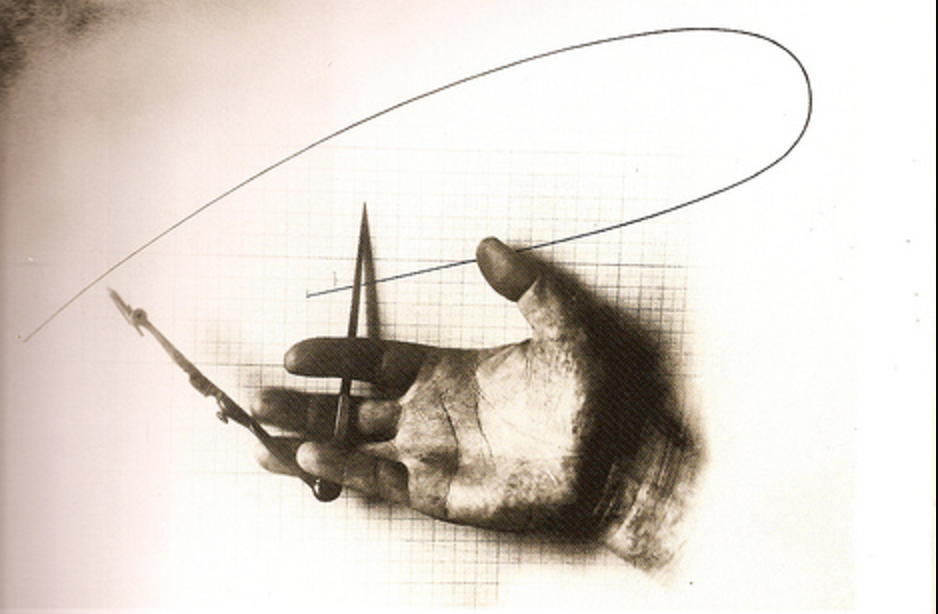
As contrasted with the linear features of Malevich’s suprematist works, another common feature of Lessitzky's work is the presence of very precise curvilinear lines. These curvilinear lines are present in most of Lessitzky's Prouns and remained an important piece throughout the rest of his career. The extreme precision of the lines implies that they were drawn almost mechanically, which is something that the untitled piece in particular lays bare. This fits with the idea that Lessitzky’s work became more explicit as his career advanced.