Thanks for your patience during our recent outage at scalar.usc.edu. While Scalar content is loading normally now, saving is still slow, and Scalar's 'additional metadata' features have been disabled, which may interfere with features like timelines and maps that depend on metadata. This also means that saving a page or media item will remove its additional metadata. If this occurs, you can use the 'All versions' link at the bottom of the page to restore the earlier version. We are continuing to troubleshoot, and will provide further updates as needed. Note that this only affects Scalar projects at scalar.usc.edu, and not those hosted elsewhere.
Digital Writing
Main Menu
Table of Contents
Introduction
Assignment Design
for Scalar Books
Preparation
Evaluation and Assessment
Other Tools and Platforms
Technical Instruction and Support
Example of a Scalar Page Using Scalar Features
1 2017-05-07T06:53:14-07:00 Kristine Kelly 704347a0fb0f4b5c42bc63d040b84f065ec3a67c 14782 1 Screenshot of Kim Browne's page on The Genome Project plain 2017-05-07T06:53:14-07:00 Kristine Kelly 704347a0fb0f4b5c42bc63d040b84f065ec3a67cThis page is referenced by:
-
1
media/gemoneproject scalar screenshot.jpg
media/dna model..jpeg
2017-05-07T06:21:33-07:00
Sample Assignment: Class Book
20
USNA 271's Human Genome project
image_header
2017-05-08T20:23:38-07:00
Collaborative Digital Project
USNA 271: Genes, Environment, and Behavior
Spring 2017
Our class will collaboratively produce a Scalar site in which students will explore and present a unique and interesting aspect of their assigned chromosomes using a combination of visual and audio media and text. The audience for the project will be high school students and other adult readers with a minimal background in this field of study. We intend to have future USNA 271 classes add pages to the project in the hopes that it will someday represent the entire human genome!
One important goal of this project is for us to consider how to present ideas of the course in multimedia forms. In this regard, you will also have an opportunity to use innovative and creative strategies in your approach to understanding the interaction between genes and environment on behavior and to think about issues of aesthetics, technology, audience, and writer/ reader engagement.
Individual role:
Each student will be responsible for one chromosome in the human genome and will tell a story, explain, present, and/or teach about one trait or condition influenced by a gene located on that chromosome. The presentations should make use of images, video, audio and text to present the trait in interesting ways. While you will need to conduct research and present accurate information, the final product should not be a standard research essay or slide presentation. Instead, you might for instance, tell an interactive story about your trait, use a sequence of captioned images, create a game, or even make a short action video or audio file.
Modes of presentation: Student will each be assigned one of the following presentation modes:
1. A single page or a short path, rich with text and media, composed on Scalar, an open source web publishing platform.
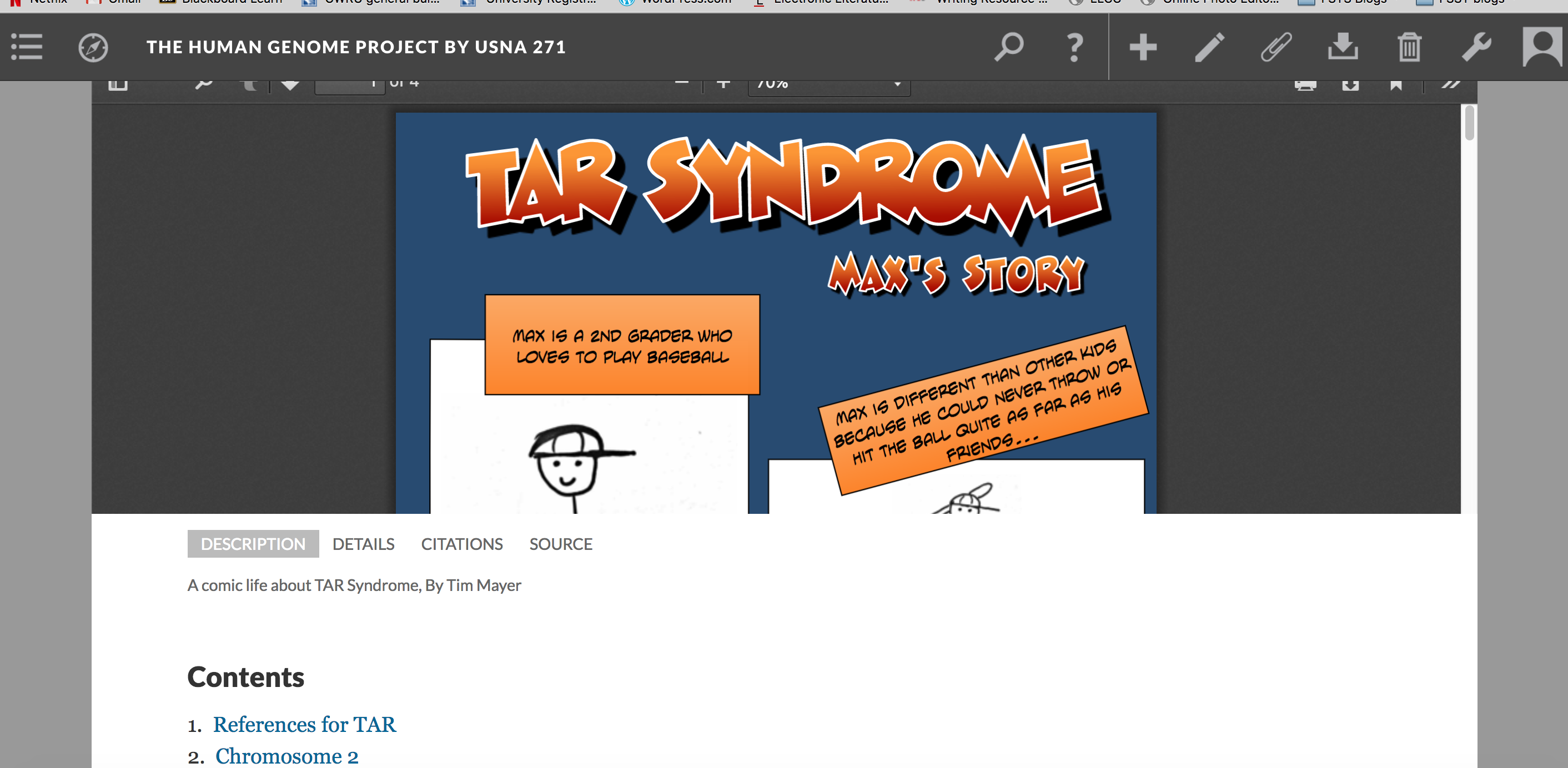
2. A Comic Life comic book (approximately 4 comic life pages) uploaded onto a Scalar page.
3. An interactive Twine story or game uploaded or linked to a Scalar page.
Software Platforms:
All platforms are free with the exception of Comic Life which has a free 30-day trial (and costs $29.95 after the trial) or is otherwise freely available on the KSL Freedman center computers.
Using Digital Tools
Everyone will need to gain some basic skills using Scalar. We will review these in class but it is helpful to watch the Webinar for Scalar 2 (Introduction) or the Scalar 2 User’s guide. Students in each group will need to develop some further mastery in their assigned platform.- Scalar users will need to learn to upload media, build paths, and annotate images
- Twine Users should watch the An Introduction to Twine 2.0 by Dan Cox
- Comic Life has a “Getting Started” tutorial in the “Help” menu.
- Both Professors Kelly and Thompson are happy to help on an individual basis
- Call on your peers to collaborate and consult
- All pages need a “References” section (these can be built into a final frame of a Comic life book, added into Twine, or appended to your Scalar page). Note that all images need to be correctly cited in APA format.
Check out our book! The Human Genome Project
Assignment designed by Lee Thompson and Kristine Kelly