Thanks for your patience during our recent outage at scalar.usc.edu. While Scalar content is loading normally now, saving is still slow, and Scalar's 'additional metadata' features have been disabled, which may interfere with features like timelines and maps that depend on metadata. This also means that saving a page or media item will remove its additional metadata. If this occurs, you can use the 'All versions' link at the bottom of the page to restore the earlier version. We are continuing to troubleshoot, and will provide further updates as needed. Note that this only affects Scalar projects at scalar.usc.edu, and not those hosted elsewhere.
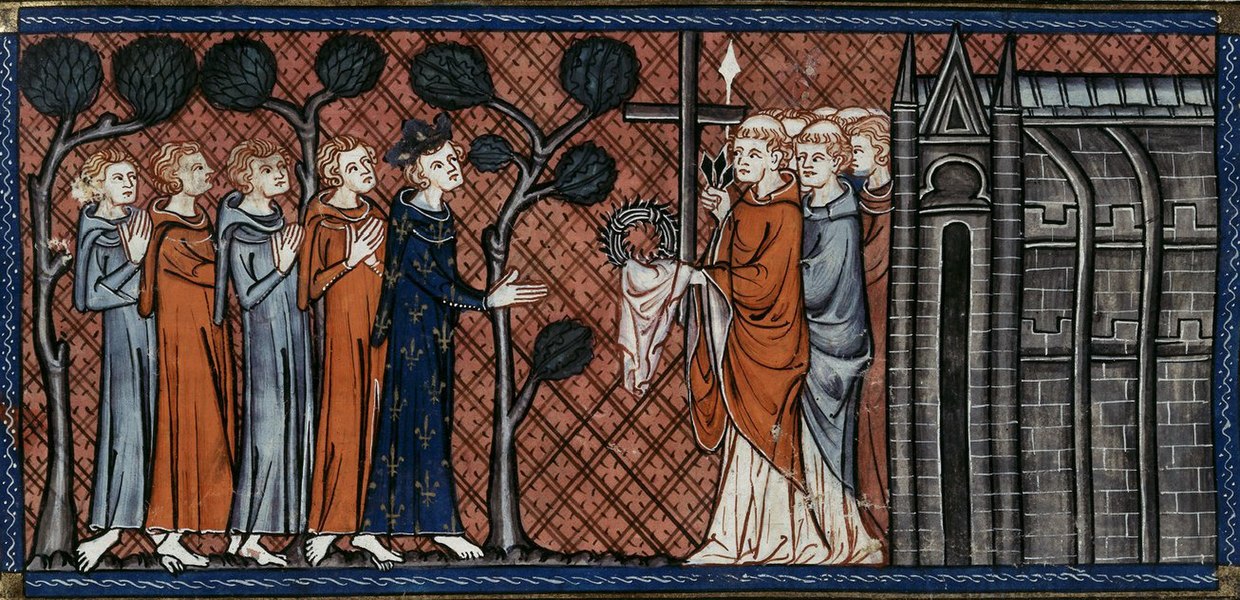
1media/Louis9+Relics-1_thumb.jpg2021-12-12T12:31:28-08:00Emma Vanseverenb272c9802dbb32e7278cf3640e8132d3bdcff81d394473Saint Louis IX of France receiving the Crown of Thorns, the holy Lance, the true Cross and other relics from Constantinople. Chroniques de Saint-Denis. circa 1332-1350. British Library, Royal 16 G VI f. 395. via Wikimedia Commonsplain2023-01-14T11:03:30-08:00Brooke Hendershottb0a907cd0f989ee79e94592378a1545647719cfb
This page is referenced by:
12021-11-03T13:52:13-07:00Where was this produced?11plain2023-01-14T08:59:07-08:00By Emma VanSeveren '23
The Morgan Bible is believed to have been produced in Paris, France under the rule of King Louis IX. Paris became the capital of manuscript illumination in France in the mid-thirteenth century. King Louis IX of France also commissioned the royal chapel known as the Sainte-Chapelle in Paris in the thirteenth century, around the same time as the Morgan Bible. The Morgan Bible would likely have been produced in a decentralized workshop environment in Paris, where tasks could be distributed amongst several artists.