Thanks for your patience during our recent outage at scalar.usc.edu. While Scalar content is loading normally now, saving is still slow, and Scalar's 'additional metadata' features have been disabled, which may interfere with features like timelines and maps that depend on metadata. This also means that saving a page or media item will remove its additional metadata. If this occurs, you can use the 'All versions' link at the bottom of the page to restore the earlier version. We are continuing to troubleshoot, and will provide further updates as needed. Note that this only affects Scalar projects at scalar.usc.edu, and not those hosted elsewhere.
ARTH3810 2019F Class Projects (Publication)Main MenuThe Tent Room at Rideau HallKyle Kreutner, Page 1 of 6The Webley Shacks: Unconventional Furniture Use in the Context of Ceaseless SurveillanceJose BawaganImperial Theater By Munawar MobinKeagan F - CSTM Sound HistoryIntroductionThe Mayfair TheatreSimran S.An Investigation of Hospital Interiors Effect on Patients144 Loretta Avenue North, Aidan MacNaullAidan MacNaull 144 Loretta Avenue NorthWest Block - Canada's New House of Commonsby Devon RudykRideau Street Chapel: The Effects of Relocation on the Experience of an Interiorby Ty FollisThe Church of St. Andrew's OttawaDavid Bastien-AllardMaking the Past Present: Union Station Restoration – A Political Facelift?by Vivian AstroffDelegation of the Ismali ImamatThe National Arts Centre: Reflecting on its Past and PresentSaint Paul University - A Shift in ValuesReem SiageFilm in Ottawa: The Mayfair theatreby Giovanna Maria SangCGM -An Investigation of Hospital Interiors Effect on PatientsThe Chateau LaurierBy Jessica El-GhazalReusable Space: The Senate of Canada Buildingby Syenne HolderNational Gallery of Canada - Seeing the Colonnade Through a Semiological Lens by Ricky TongRickyTHE OTTAWA STATIONEhidiamen Iyamabo, HomePageAVRC81ff8dad33b7fe77eee9a543209e890531c75438
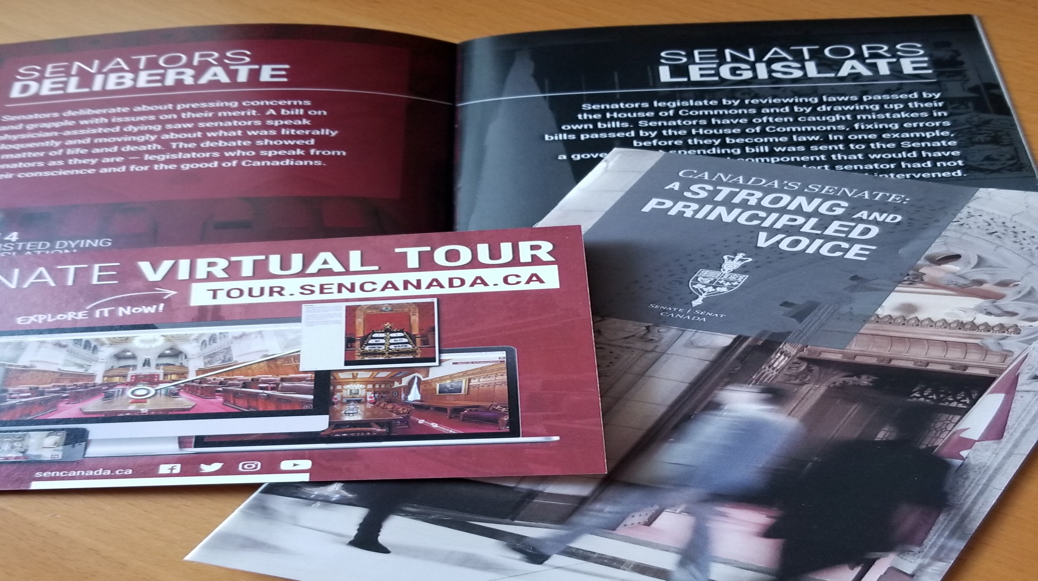
Senate Virtual Tour Pamphlets
1media/senate deliberate virtual tour materials_thumb.png2019-11-27T14:54:12-08:00Vivian Astroff547b670c11cdaf4feffb64da8b89311ca928b70b358162Image: Vivian Astroff.plain2023-08-02T11:49:31-07:00Maegen Sargentf8c37f900ecb77afe0a6ed383bd0b77ea6c1266b
This page is referenced by:
12023-08-01T13:10:07-07:00Conclusion14plain9449802023-10-24T11:26:45-07:00In spite of the prevalence of the maple leaf symbol, which reaches back in Canadian history to the Indigenous people of the early 1700s, the narrative in the restored Union Station is one of exclusivity and privilege. The history of the original building, on the other hand, is one of achievement and of Ottawa's literal "rising from the mud." In 1989, the station was designated a Federal Heritage Building “because of its historical associations, and its architectural and environmental values.” Parks Canada acknowledged that it is “one of the best examples associated with the great railway-building era in pre-war Canada, an activity central to the development of Canada’s early national unity and prosperity” (Parks Canada). Consequently, I maintain that there is an obvious divergence between Canadian identity and heritage – the rich history of Union Station as part of Ottawa's everyday life, and this "place" as it has been taken over and politicized by the Senate.
Smith describes heritage as a “cultural process," a continuing dialogue with the past. By its nature, this dialogue includes many community and individual narratives and meanings beyond the “authorized heritage discourse.” We see an example of "individual meanings" in the YouTube clip that opens this essay. Architect Barry Padolsky, who contributed to the building's "heritage conservation plan," narrates his experience as a young man passing through Union Station on arriving in Ottawa, and tells how it has remained a cherished memory. Union Station, as a place, is linked in a meaningful way to his individual identity, as much as to our collective national heritage.
In the framework of critical heritage theory, "the fabric of a heritage object can change so long as the socio-cultural meanings are conserved" (Wells). At the same time, the negotiation of meanings of heritage "is a struggle over power…because heritage is itself a political resource” (Smith). So while the much-maligned Senate bathes in the station's glow, the public can at least reacquaint itself with a magnificent piece of Ottawa's history.