Thanks for your patience during our recent outage at scalar.usc.edu. While Scalar content is loading normally now, saving is still slow, and Scalar's 'additional metadata' features have been disabled, which may interfere with features like timelines and maps that depend on metadata. This also means that saving a page or media item will remove its additional metadata. If this occurs, you can use the 'All versions' link at the bottom of the page to restore the earlier version. We are continuing to troubleshoot, and will provide further updates as needed. Note that this only affects Scalar projects at scalar.usc.edu, and not those hosted elsewhere.
ARTH3810 2019F Class Projects (Publication)Main MenuThe Tent Room at Rideau HallKyle Kreutner, Page 1 of 6The Webley Shacks: Unconventional Furniture Use in the Context of Ceaseless SurveillanceJose BawaganImperial Theater By Munawar MobinKeagan F - CSTM Sound HistoryIntroductionThe Mayfair TheatreSimran S.An Investigation of Hospital Interiors Effect on Patients144 Loretta Avenue North, Aidan MacNaullAidan MacNaull 144 Loretta Avenue NorthWest Block - Canada's New House of Commonsby Devon RudykRideau Street Chapel: The Effects of Relocation on the Experience of an Interiorby Ty FollisThe Church of St. Andrew's OttawaDavid Bastien-AllardMaking the Past Present: Union Station Restoration – A Political Facelift?by Vivian AstroffDelegation of the Ismali ImamatThe National Arts Centre: Reflecting on its Past and PresentSaint Paul University - A Shift in ValuesReem SiageFilm in Ottawa: The Mayfair theatreby Giovanna Maria SangCGM -An Investigation of Hospital Interiors Effect on PatientsThe Chateau LaurierBy Jessica El-GhazalReusable Space: The Senate of Canada Buildingby Syenne HolderNational Gallery of Canada - Seeing the Colonnade Through a Semiological Lens by Ricky TongRickyTHE OTTAWA STATIONEhidiamen Iyamabo, HomePageAVRC81ff8dad33b7fe77eee9a543209e890531c75438
Seaman, Renee M. Straight Lines. October, 2019. Ottawa
12019-12-03T09:45:21-08:00The Char Bagh at the Delegation1plain2019-12-03T09:45:21-08:00The interior courtyard is only a small part of a masterful structure, but it is absolutely deserving of careful attention. At first glance, the space seems like any other Char Bagh. It is symmetrical, split into four parts and contains a number of carefully cared for vegetation. If anything, it may seem to disappoint because of its lack of a water fountain or feature, an element typical to traditional char bagh's (“Taj Mahal Gardens.” N.d.). However, this is the area where Maki's brilliance is best displayed in the whole building because of his subtle and genius inclusions of all these important elements and more!
Starting with the lack of a fountain, being an interior courtyard, a grand water fountain is not encouraged. Maki cleverly worked around this by the careful design of rainwater and snow melt collection. The floor of the courtyard is designed to tilt slightly downwards towards the center of the courtyard. This creates a pooling effect of the water at the centre, mimicking a fountain feature at the centre of traditional char bagh's. As well, the floor is heated so during the winter months the snow on the pathway melts and runs down the pathway to pool at the centre and then be collected by the drains hidden beneath the benches. The heated floors play into the Islamic traditions while also being an original way to accommodate the Canadian climate. As well, embedded into the walls of the garden beds there are lights that illuminate the pathway. It has a stunning effect which appears to imitate flowing water. The rainwater and snowmelt that is collected is then recycled to water the garden vegetation.
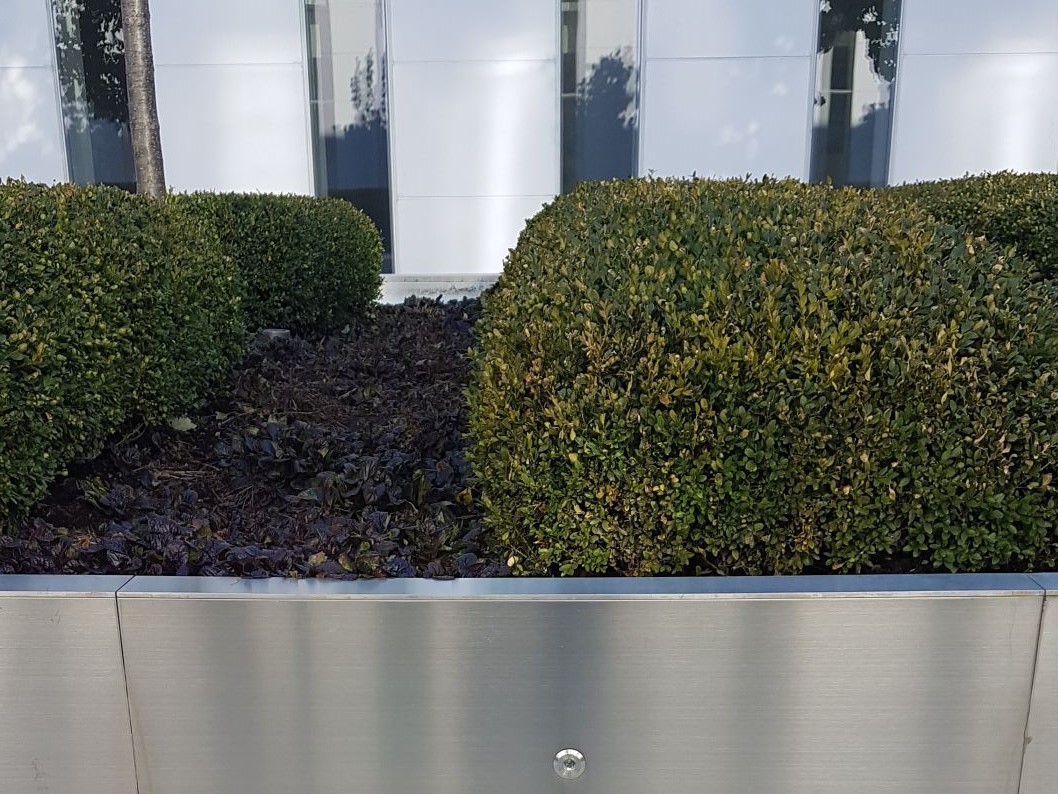
Speaking of the vegetation, every plant found in the garden was specifically chosen to work in Ottawa's climate as well pay homage to the architect. In the garden, one will find Japanese Lilac trees, groomed boxwood hedges with flowering groundcover worked in between (“Visit the Delegation of the Ismaili Imamat.” 2019). The selection of such plants is important because they work well in the overall design of the space, accomodating all four seasons and collectively creating a splendid image regardless of the time of year. During the winter months the snow piles over the boxwood hedges and creates the visual of rolling snow-covered hills.
In both Japanese and Islamic architecture straight lines are an important aspect of design; something which Maki did with a great degree of precision (Chodikoff 2010). Every line in the Delegation is designed to be continued throughout the structure, joining together with others as it moves through the building. In the courtyard, you can see this linear aspect demonstrated in how the lines of the flooring tiles align with those from the boxwood hedges and continue on to the lines created by the panels on the walls. This phenomenon is carried throughout the entire building as it from the courtyard transitions into the interior spaces. The building is designed to be in perfect linear alighnment with itself.
The walls are a spectacular sight as well. Made of Neoparies, "unique crystalized glass panels that create a smooth, opaque surface", the walls have a diffusing and reflective quality (“Visit the Delegation of the Ismaili Imamat.” 2019). Throughout the day the walls change in colour, ranging from their natural opaque white to softs oranges and reds as it captures the light from sunrise through to sunset. An act of genius manipulation of light on Maki's part and a magical sight that furthers the perseption of the char bagh as a symbolic representation of the 'Garden of Paradise'.