ARTH3810 2019F Class Projects (Publication)

A Passage Through Time

Constructed from 1909-1912 as Ottawa’s Union Station (Government of Canada 2019, par. 6), the building originated as a central railroad station for the city. The station included a connection to the Chateau Laurier which was also constructed around the same time, creating a unified travel destination in Ottawa's developing downtown. It was designed by Bradford Lee-Gilbert, an architect based in New York, but later was taken over by Ross and MacFarlane firm from Montréal (Government of Canada 2019, par. 11). Its form was inspired by the Beaux-Arts style with reference to Roman Classical baths, including elements like tall Doric columns on the façade and barrel-vaulted coffered ceilings in the General Waiting Room and Concourse. After the station’s closure in 1966, the government slated the building for demolition. It was saved, however, by the people because of its architecture and history, and became the Government Conference centre in 1968, with renovations completed in 1973 (Government of Canada 2019, par. 7). It served this title until December 2018, hosting many conferences for the development of Canada like the G20 conference in 2001, but it was also debated to be used for other unfulfilled functions like as a Sports Hall of Fame (Government of Canada 2019, par. 10). In 1989, it was designated as a Federal Heritage Building (Government of Canada 2019, par. 5), and in 2014 it began modernization and restoration under the government’s Long-Term Vision for the Parliamentary Precinct (Government of Canada 2019, par. 4). When Public Services and Procurement Canada started planning the 10-year rehabilitation of the Centre Block in the early 2000's, the Government Conference Centre was chosen to be the new temporary home of Canada’s Senate (Government of Canada 2019, par. 11). It opened to the public as the Senate of Canada Building in 2019, and is planned to serve this purpose until the Centre Block's completion.

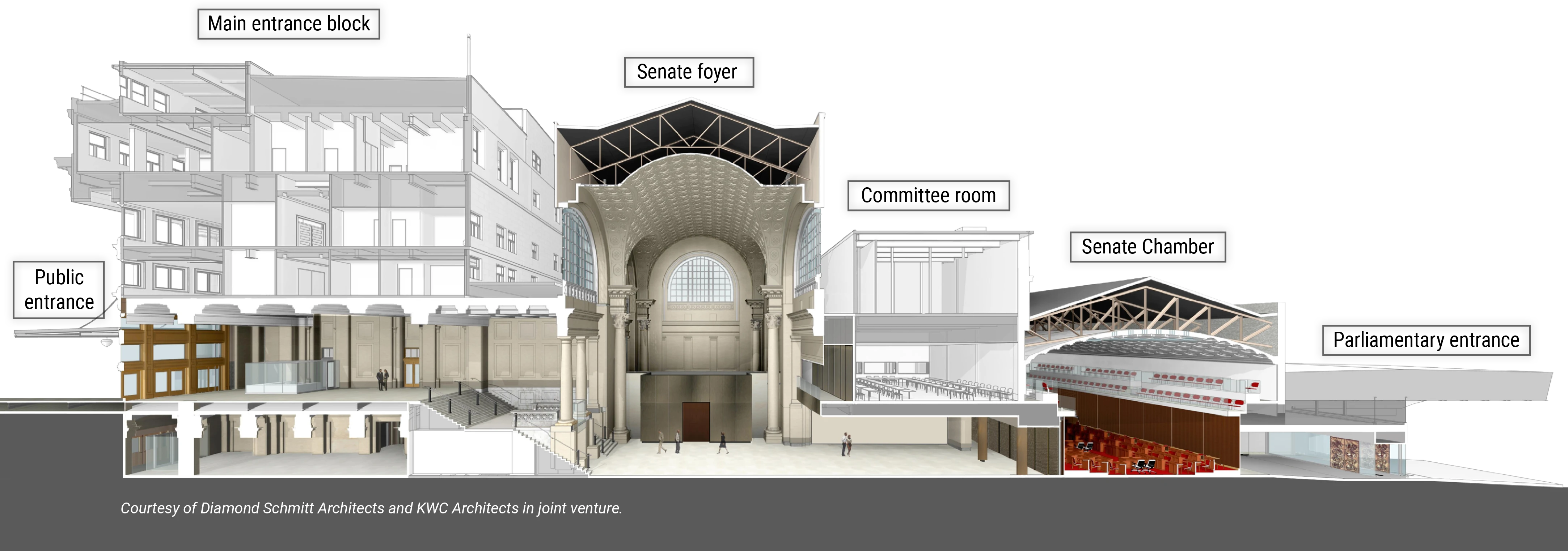
The modernization and restoration was designed by Diamond Schmitt and KWC Architects ("Senate of Canada Building", par. 1). The idea was to preserve the building's heritage, while improving the structure and updating to modern designs and technology. A section of the building, imaged below, shows the relationships between the new interior spaces within the historic building.

This page has paths:

  1. Bibliography Maegen Sargent
  2. Reusable Space: The Senate of Canada Building Maegen Sargent
Contents of this tag:

  1. Construction
  2. Ottawa Union Station
  3. The Government Conference Centre
  4. The Senate of Canada Building
  5. Slated for Demolition
  6. Rehabilitation Period
  7. 100 Years of Canada

This page references: