Thanks for your patience during our recent outage at scalar.usc.edu. While Scalar content is loading normally now, saving is still slow, and Scalar's 'additional metadata' features have been disabled, which may interfere with features like timelines and maps that depend on metadata. This also means that saving a page or media item will remove its additional metadata. If this occurs, you can use the 'All versions' link at the bottom of the page to restore the earlier version. We are continuing to troubleshoot, and will provide further updates as needed. Note that this only affects Scalar projects at scalar.usc.edu, and not those hosted elsewhere.
Modern Architectures of North AmericaMain MenuHelp! Help! Help!SuburbiaArchitecture Relating to the Natural EnvironmentPatients, Prisoners, PoliticsIdentity: What Lies Beneath Style and FormChange and AdaptationErica Morawski - The Hotel Nacional de Cuba: Making Meanings and Negotiating NationalismsAmanda - Organic Architecture/F.L. WrightSteph - Moorish Revival ArchitectureBrittney - Sustainable Urban DesignsThe Shift: Art Deco & Modernismby Bayleigh BoganTransition to Streamline ModerneSydney - The Coppelia Ice Cream Shop in Havana, Cuba: A Cultural Moment ManifestedKatie - LevittownGenevieve - The Multifaceted Development of Creole ArchitectureThe Former Church of the Holy Communion: A Specific Example of Change and Adaptation of a Single Building Over TimeRe-Purposing a Religious BuildingZarah Ferrari: Tule Lake Segregation Center: Rising Above an Unjust SystemZarah FerrariLaura - The Suburban Kitchen in Levittown, PABy Laura Krok-HortonMarianna Mapes, Disease and the Body Politic: The National Leprosarium at Carville, LouisianaLiz - Eichler, Neutra, and the mid-century Californian SuburbV. Nash- Berkeley City Women's Club (1929), Berkeley, CA, Julia MorganJulia Morgan was a West Coast architect.Metropolitan Museum of Art: A Transition to ModernismBrendan - Academy of Music
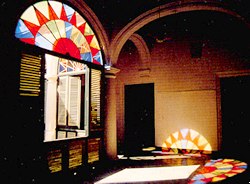
These stained glass panels are a prominent feature of the second floor, and they are rooted in Cuban architectural tradition.
12016-03-07T16:55:56-08:00Sydney Burta27c63e6fd632c314bf4cd3158e17d7f4e8e761481807plain2016-03-28T19:28:38-07:00Sydney Burta27c63e6fd632c314bf4cd3158e17d7f4e8e7614Stained glass appeared in Cuban colonial architecture after learning the art from Europeans, and the earliest stained glass on the island used only simple hues of primary colors. It was found in the panels above doors and shuttered windows, which were often semi-circular and therefore called "medio puntos." They allowed light inside rooms when doors and windows were closed against the heat (Black). According to Simon McBride and Alexandra Black, stained glass is “an art that encapsulates the Cuban love of color and frivolity.”
Contents of this annotation:
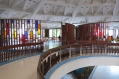
12016-03-07T16:55:07-08:00Sydney Burta27c63e6fd632c314bf4cd3158e17d7f4e8e7614Interior view Coppelia2An interior view of Coppelia. Image courtesy of Flickr user Elisa.media/interiorcoppelia.jpgplain2016-03-28T18:14:51-07:00Sydney Burta27c63e6fd632c314bf4cd3158e17d7f4e8e7614