Thanks for your patience during our recent outage at scalar.usc.edu. While Scalar content is loading normally now, saving is still slow, and Scalar's 'additional metadata' features have been disabled, which may interfere with features like timelines and maps that depend on metadata. This also means that saving a page or media item will remove its additional metadata. If this occurs, you can use the 'All versions' link at the bottom of the page to restore the earlier version. We are continuing to troubleshoot, and will provide further updates as needed. Note that this only affects Scalar projects at scalar.usc.edu, and not those hosted elsewhere.
Accounts of the British Empire
Main Menu
Introduction and Chapter Headings
"Sultan to Sultan: Adventures Among the Masai and other Tribes of East Africa" by Mary Sheldon
by Abby McCoy, Paul Tremonti, Alex Zeng
“The CMS Juvenile Instructor Volume 1”
CMS Juvenile Instructor Vol. 1
Missionaries in the West Indies : “A Few Simple Facts for the Friends of the Negro”
Tracing Women Through History: "Women's Suffrage BIll" Millicent Fawcett
China, England and Opium -Il Park Pat O'Donnell
The Effects of European Colonization in South Africa; Fox Bourne's “Blacks and Whites in South Africa: an account of the past treatment and present condition of South African Natives under British and Boer control” Sarah DiGennaro, Sean Steven, Lucas Inve
Sarah DiGennaro, Sean Stevens, Lucas Invernizzi
"Thoughts Upon the African Slave Trade" - Josie Thal and Tessa Askew
Josie Thal and Tessa Askew
About the Authors
Assignment Guidelines
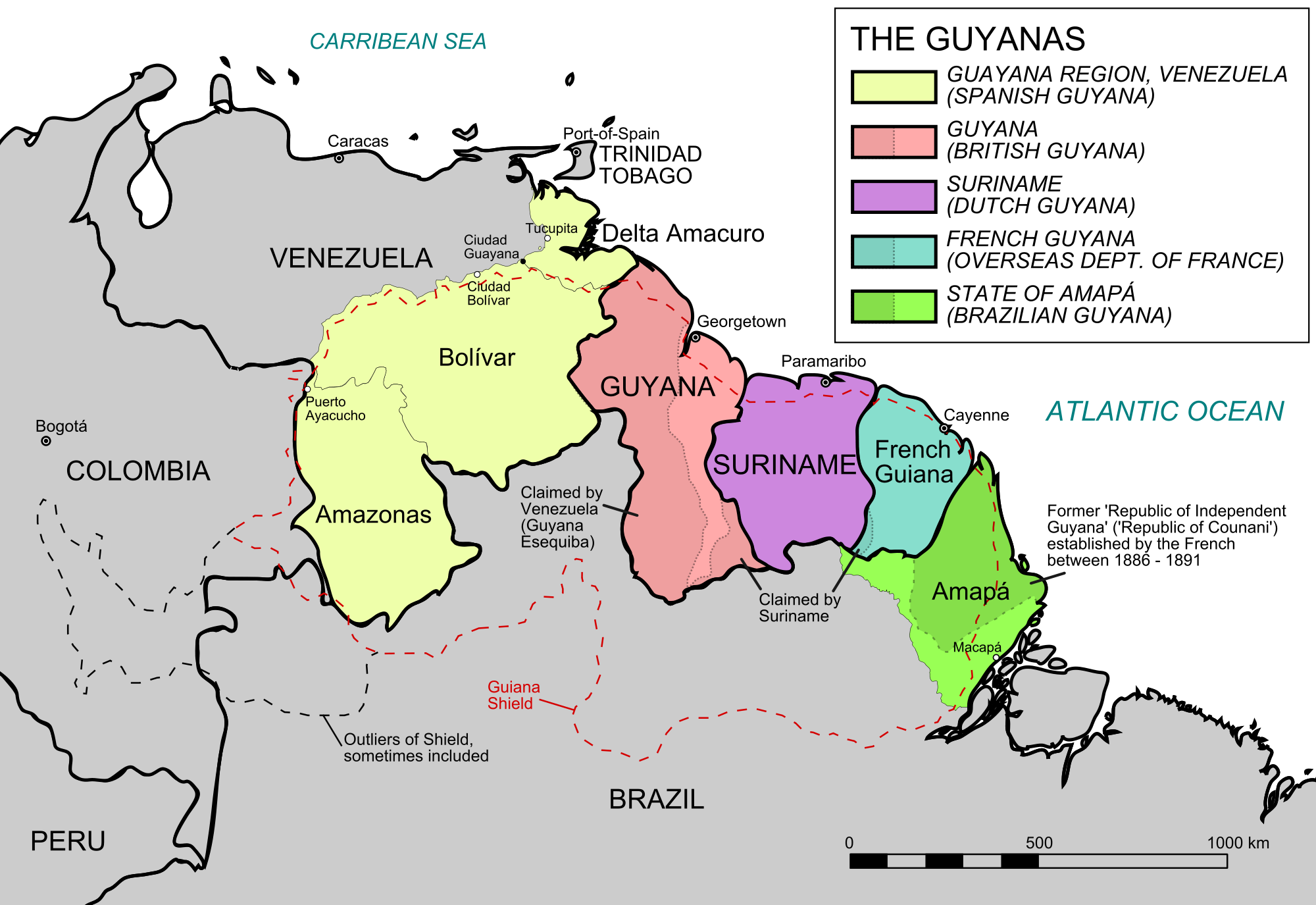
Map of British Guiana
1 2017-03-25T10:36:51-07:00 Jared Cassarly f5576eeb1c7a92c4d1f9452af1fcd41bb450de92 15683 1 English: Map of the Guyanas (2012), Wikimedia Commons plain 2017-03-25T10:36:52-07:00 Jared Cassarly f5576eeb1c7a92c4d1f9452af1fcd41bb450de92This page is referenced by:
-
1
2017-03-08T17:13:27-08:00
Summary
24
The CMS Juvenile Instructor Vol. 1
plain
2017-03-25T11:32:27-07:00
The CMS Juvenile Instructor Volume 1, L. & G. Seeley; Hatchard and Son; and J. Nisbet & Co.
The Juvenile Instructor provides a general view of the Missionaries in British Guiana in order to show the prowess of the British Empire. This passage in the book, written in 1842, begins by describing the geography of the region that the Mission settled. The Mission mainly occupied Bartica Grove which was “at the junction of the rivers Mazaroony and Essequibo” (L. & G. Seeley et al 75). There were eight native tribes in the region and 5000 of the natives followed British traditions while 20000 did not, and the Mission wanted to change this statistic (L. & G. Seeley et al 76). The Mission wanted to convert more of the natives and used British advancements in technology to do so.
Overview of the Mission in British Guiana
For example, the Mission introduced Western technology to the natives of British Guiana, evident in the quote from the leader of the Mission, Reverend J. H. Bernau, when he says “’there is nothing which operates so forcibly upon their minds as the example of industry, order, and punctuality” (L. & G. Seeley et al 81). The Mission showed the natives houses, gardens, and other useful items that made the natives more interested in assimilating into British civilization (L. & G. Seeley et al 82). The increased interest in British culture allowed the Missionary to grow as there were more hands willing and able to help in the expansion, giving the natives more opportunities.
One of these opportunities the Mission gave to the natives was a school. Native children were successful in the school and were often converted to Christianity as the school placed a large emphasis on religion. Evidence of the emphasis on religion can be found in Bernau’s explanation of a typical day on the Mission for the natives consisted of Morning Prayers, then classes, and finally a full service (L. & G. Seeley et al 84). This description of a typical day shows that British ideologies, like chivalry and building communities through a parish, are spread through religion into the natives that are attracted to live near the Mission for the new and interesting opportunities it provides with new technology.
In addition to changing the natives’ beliefs, the Mission was very kind to the natives. One of the men that worked on the Mission, Mr. Youd, stated that he was happy that he got to hear the natives pray in their own language (L. & G. Seeley et al 88-89). This genuine interest in helping the natives allowed the Mission to be more successful and convert more natives. More natives showed up to see what was happening at the services and more joined the Mission.
The Juvenile Instructor goes on to provide accounts of more specific events in British Guiana and other Missions in the New World.