Judith Butler's "Theatrical Machines"
Why?
My inspiration for this project came from my laptop's text-to-speech function. In doing so many readings for all of my classes, I wanted to experiment with listening to the readings to see if I would better retain information. Along the way, I noticed that the computer's text-to-speech function had a fatal flaw: if a word was started at the end of one line and continued at the start of the next, my laptop would treat that one word as two separate words. I was fascinated by this technological failure, and so I decided to apply the idea to my project.The What
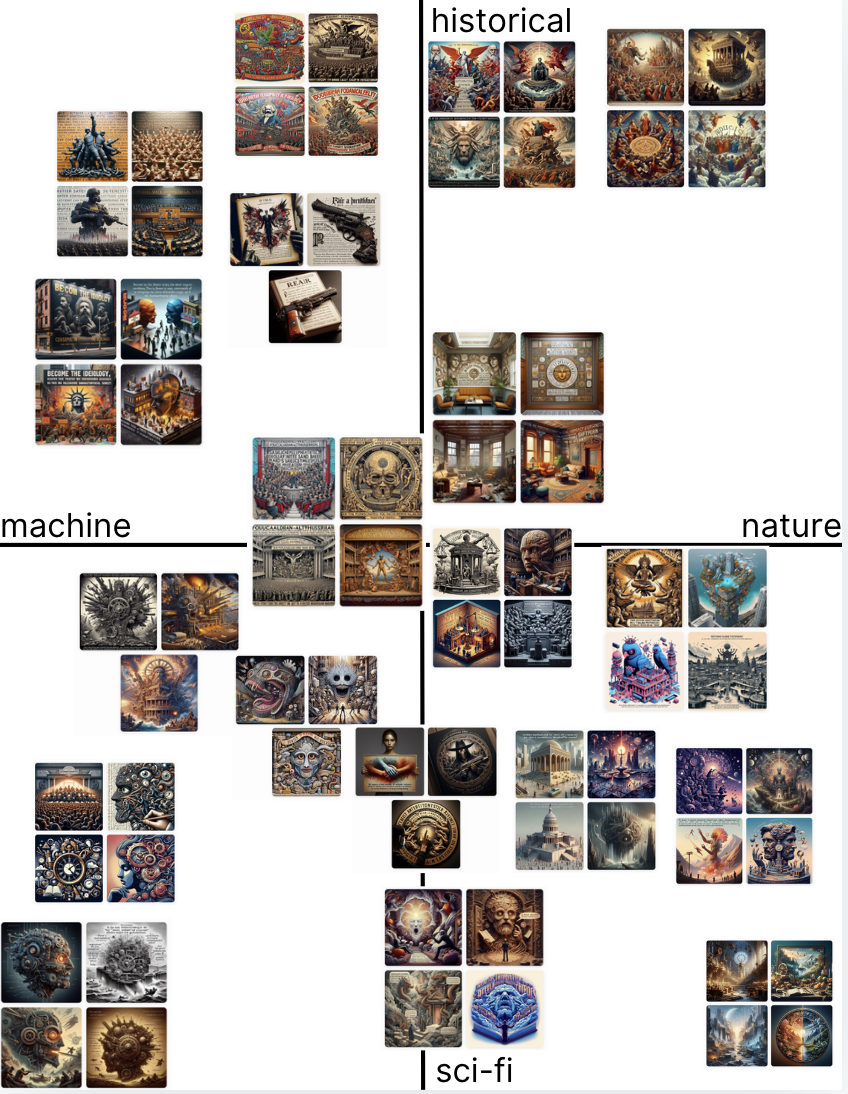
For this project, I went through each page of "Theatrical Machines" and took the first word, or chunk of a word, from each line to input into copilot. For example, if the final word of a line was "accomplice" but only "accom-" was present at the end of that line, then i took "-plice" as the first word of the next line.I prompted Copilot one page at a time, directing the system to create an image based on the words I had shared. It created 3-4 images for each prompt, even though I had only asked for one; I would later learn that Copilot always provided this number of images. The images were freaky and ghoulish, evoking images of monsters and ghosts, or, for some prompts, philosophy and capitalism. I started to notice certain thematic trends in the images that were created, and I was curious what I could do to create something artistic in collaboration with the images Copilot generated. After all images were done, I decided to create a political spectrum-inspired visualization; with the images' themes and similarities, I decided to create an x-axis of machine to nature and a y-axis of historical to sci-fi.
The Prompts
The following page includes information on all of the words used to prompt the Copilot image generation:The Final Spectrum
Inspirations
Much like the tape experiment, this project had me reckoning with the "golden age" of capitalism in which machines attempt to be creative in an attempt at humanity. I found myself returning to Althusser's ideas of pursuing work for the sake of work, and it reminded me of the larger debates taking place regarding AI and employment. I was curious if AI had enough skill to take over the creative arts, and whether human collaboration would be necessary to create something that could reasonably be deemed art. While AI did create some art, I am unsure of how I feel about said art when looking at each individual page. Looking at the spectrum, though, makes me feel as though I was able to craft meaning from monsters and mythos.I mentioned within my section on research questions that I did not really explore AI and language in this course. This particular experiment was the one exception, where I could see how AI took in language and interpreted it without context. I personally do not believe this is a fair understanding of AI's language skills, as I only offered some portions of the text for Copilot to play with, but it was meaningful for me nonetheless; in doing this experiment, I was able to expose how Copilot grasps on to particular words in a set rather than all of them, throwing away words that humans might use for meaning-making simply because Copilot and other AI systems lack an understanding of contextual importance.
This project encouraged me to explore how machines and AI use language, but it also encouraged me to consider the creativity of the unnatural. Humans created machines, created computers, inventing something out of our own heads and built them by hand. We then, many (many) years later, offloaded our need to be creative onto them. They were born from us only to be given our responsibilities and desires. I grew curious about how creative a nonhuman machine could be, and, the truth is, that they truly are not. My spectrum shows how limited computer artwork is right now, and my expectations for a machine's abilities were lessened greatly.
References
Butler, Judith. "Theatrical Machines." differences, vol. 26, no. 3, 2015, pp. 23-42.Microsoft CoPilot. https://copilot.microsoft.com/.
This page has paths:
- "Theatrical Machines" Copilot Prompts Laine Matkin
- "Theatrical Machines" Visual Spectrum Laine Matkin
- Contents Laine Matkin
This page has tags:
Contents of this tag:
- "Theatrical Machines" page 28
- "Theatrical Machines" page 30
- "Theatrical Machines" page 23
- "Theatrical Machines" page 24
- "Theatrical Machines" page 32
- "Theatrical Machines" page 40
- "Theatrical Machines" page 25
- "Theatrical Machines" page 33
- "Theatrical Machines" page 41
- "Theatrical Machines" page 26
- "Theatrical Machines" page 34
- "Theatrical Machines" page 27
- "Theatrical Machines" page 35
- "Theatrical Machines" page 36
- "Theatrical Machines" page 29
- "Theatrical Machines" page 37
- "Theatrical Machines" page 38
- "Theatrical Machines" page 31
- "Theatrical Machines" page 39