The Center for Women's History and Leadership
Center for Women's History and Leadership
1730 Chicago Avenue
Evanston, IL 60201
info@franceswillardhouse.org
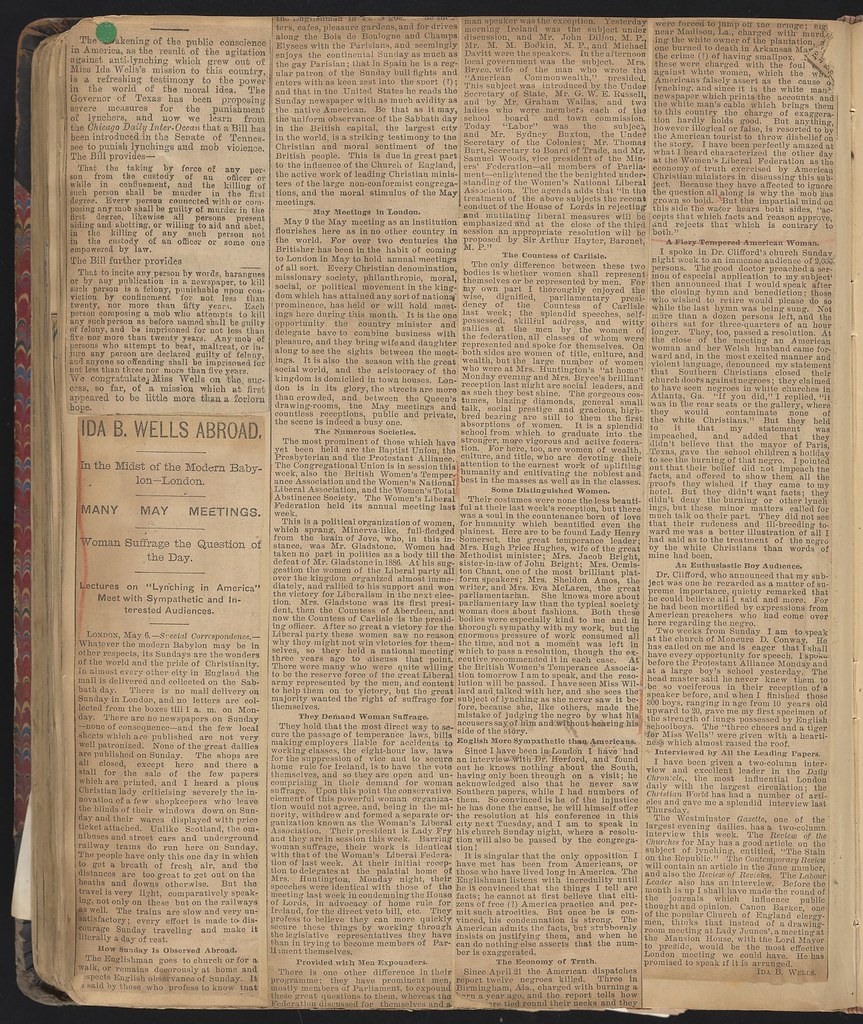
Ida B. Wells Abroad - May 6
1 2019-01-09T16:14:34-08:00 The Center for Women's History and Leadership 396bd2bebf501b08ca215cf721fbba097eb2e1a2 30425 1 Second column plain 2019-01-09T16:14:36-08:00 The Center for Women's History and Leadership 396bd2bebf501b08ca215cf721fbba097eb2e1a2This page has tags:
- 1 media/truthtelling-header.gif 2018-11-09T16:37:46-08:00 The Center for Women's History and Leadership 396bd2bebf501b08ca215cf721fbba097eb2e1a2 Ida B. Wells Abroad The Center for Women's History and Leadership 47 "I have seen Miss Willard and talked with her, and she sees the subject of lynching as she never saw it before..." -Ida B. Wells, 1894 image_header 2019-02-25T19:51:37-08:00 04-23-1894 The Center for Women's History and Leadership 396bd2bebf501b08ca215cf721fbba097eb2e1a2
This page is referenced by:
-
1
media/truthtelling-header.gif
2018-11-09T16:37:46-08:00
Ida B. Wells Abroad
24
"I have seen Miss Willard and talked with her, and she sees the subject of lynching as she never saw it before..."
image_header
2019-01-29T14:33:15-08:00
04-23-1894
In the spring of 1894, Wells's ongoing criticism of Willard broke out into open conflict. Wells traveled to England for a speaking tour. Her goal was to communicate the horror of the lynching crisis to British audiences. Willard was also in England, staying with Lady Isabella Somerset, her close friend and the president of the British Women's Temperance Association (BWTA).
In a column she wrote for the Chicago newspaper the Inter-Ocean during her time in England, Wells repeatedly mentioned Willard along with other well-regarded white leaders. She charged them with spreading the falsehood that most lynchings occurred after a black man had raped a white women. In her column of March 24, she wrote:
To prove her case about Willard, Wells had found a copy of the Voice interview from 1890. She arranged to have it reprinted in an anti-racist British newspaper called Fraternity.I find wherever I go that we are deprived the expression of condemnation such hangings and burnings deserve, because the world believes negro men are despoilers of the virtue of white women. ... Unfortunately for the negro race and for themselves, Miss Frances E. Willard and Bishops Fitzgerald and Haygood have published utterances in condemnation of this slander.
In her column of May 6, 1894, however, Wells's tone about Willard changed.
However, the issue of Fraternity with Willard's interview and accompanying critique from Wells had already been sent to the printers.