Thanks for your patience during our recent outage at scalar.usc.edu. While Scalar content is loading normally now, saving is still slow, and Scalar's 'additional metadata' features have been disabled, which may interfere with features like timelines and maps that depend on metadata. This also means that saving a page or media item will remove its additional metadata. If this occurs, you can use the 'All versions' link at the bottom of the page to restore the earlier version. We are continuing to troubleshoot, and will provide further updates as needed. Note that this only affects Scalar projects at scalar.usc.edu, and not those hosted elsewhere.
The Bestselling Novel: Currents in American History and CultureMain MenuIntroductionIntersectionality and Power Relations in BestsellerismAn intersectional analysis of the concepts of gender, race and power relationships, highlighting how the overlap between these concepts fueled the novels’ rise as bestsellers.Slavery Beyond ChainsThe Variation of the Forms of Slavery Inflicted on Charlotte in Susanna Rowson's _Charlotte Temple_ and Dana in Octavia Butler's _Kindred_.Perception of Women in SocietyInspecting the ways in which the woman’s default “doomed” status can be blamed on the society's narrow perception of women in Susanna Rowson's Charlotte Temple and Edith Wharton's House of Mirth.Gendered Violence and Racism: The Short End of the StickThe Struggle of the Black Woman Across the CenturiesBrief summaries of course textsStudents in ENG 410: American Novel, an upper-level undergraduate seminar8105943177cf94521fefbbebb901e86333202954
The Portrayal of Dana vs. Kevin
1media/19335527-hair-background-hair-style-pattern-vector-illustration.jpgmedia/african-ornament-12089948.jpg2018-05-09T10:54:43-07:00Sana Yamlikha95889ec5e9e7f4e25c75e4a5d45cdd960a176ba92976115image_header2019-05-14T10:21:59-07:00Students in ENG 410: American Novel, an upper-level undergraduate seminar8105943177cf94521fefbbebb901e86333202954The novel Kindred, by Octavia E. Butler, mainly focuses on the two themes of race and gender. These two themes are reflected in how the main characters Dana and Kevin try to maintain their relationship in the present and the past. Their story represents gender in different times, the past in 1800’s and the present in the 1970’s. In the present, the married couple lives in Los Angeles and has just moved into a new apartment. Although they are married, there are many situations concerning race that show ways in which they cannot relate to each other.
An example of this is when Dana is discussing her time travels with Kevin:
You mean you could forgive me for having been raped? Dana, I lived there. I know what those people were like”(245).
It might seem that her husband is trying to be accepting of whatever might happen to her in the past. However, he does not seem to understand the fact that is not right, that no women should be put in any of these kinds of situations whether it is in the past or the present. Therefore, he is not supposed to tell her whether he is going to forgive her or not as it is not his right to do so.
Moreover, the fact that Dana and Kevin are forced to act as a slave and slave owner reveals additional divisions in their relationship. Kevin does not seem to understand Dana’s point of view in the quote above. He is not only acting as a man when he told her that he would forgive her, he has also been acting as a white man who readily acknowledges what happens to these slaves.
Moreover, the author must have thought that is important to show the readers how Kevin can not relate with Dana in order to spread awareness in the present about the aspects of racism and gendered violence. To explain, there are two points the author had wanted to portray that are foreshadowed by Kevin's gender and race. Kevin as a white man is not able to understand Dana although she is his wife. That inability to relate and understand someone that is so close proves that even in Dana and Kevin's present, society has still not reached a point where gender and race are not used to make assumptions. These ideologies are restraining individuals with different racial and gender identities from understanding each other as equal human beings.
Reference
Butler, Octavia E. Kindred. Beacon Press, 2003
This page has paths:
1media/Group4_Cover Page_Gendered Violence.png2018-04-18T11:24:16-07:00Students in ENG 410: American Novel, an upper-level undergraduate seminar8105943177cf94521fefbbebb901e86333202954Gendered Violence and Racism: The Short End of the StickStudents in ENG 410: American Novel, an upper-level undergraduate seminar16The Struggle of the Black Woman Across the Centuriessplash7180782018-05-17T18:57:38-07:00Students in ENG 410: American Novel, an upper-level undergraduate seminar8105943177cf94521fefbbebb901e86333202954
This page references:
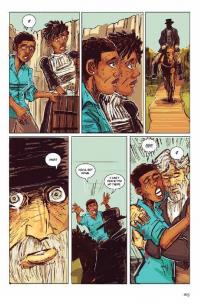
12018-05-15T00:49:27-07:00Dana and Kevin Meeting After 5 years Apart.1Image from Damian Duffy and John Jennings' graphic novel adaptation of Octavia Butler's novel, _Kindred_, published in 2017. For more on the adaptation, see Charles Pulliam Moore, "The Kindred Graphic Novel Should Be Everyone’s Introduction to Octavia Butler," io9, 12 Jan 2017. https://io9.gizmodo.com/the-kindred-graphic-novel-should-be-everyone-s-introduc-1791135453media/586b964b1500001300e9e13b.jpgplain2018-05-15T00:49:27-07:00