Thanks for your patience during our recent outage at scalar.usc.edu. While Scalar content is loading normally now, saving is still slow, and Scalar's 'additional metadata' features have been disabled, which may interfere with features like timelines and maps that depend on metadata. This also means that saving a page or media item will remove its additional metadata. If this occurs, you can use the 'All versions' link at the bottom of the page to restore the earlier version. We are continuing to troubleshoot, and will provide further updates as needed. Note that this only affects Scalar projects at scalar.usc.edu, and not those hosted elsewhere.
The Bestselling Novel: Currents in American History and Culture
Main Menu
Introduction
Intersectionality and Power Relations in Bestsellerism
An intersectional analysis of the concepts of gender, race and power relationships, highlighting how the overlap between these concepts fueled the novels’ rise as bestsellers.
Slavery Beyond Chains
The Variation of the Forms of Slavery Inflicted on Charlotte in Susanna Rowson's _Charlotte Temple_ and Dana in Octavia Butler's _Kindred_.
Perception of Women in Society
Inspecting the ways in which the woman’s default “doomed” status can be blamed on the society's narrow perception of women in Susanna Rowson's Charlotte Temple and Edith Wharton's House of Mirth.
Gendered Violence and Racism: The Short End of the Stick
The Struggle of the Black Woman Across the Centuries
Brief summaries of course texts
Students in ENG 410: American Novel, an upper-level undergraduate seminar
8105943177cf94521fefbbebb901e86333202954
Red Right Hand, Nick Cave and The Bad Seeds
1 2018-05-01T09:23:51-07:00 Aisha Al-Ali 12c48ad02761638fdbc4d58875ce0e368091e608 29761 2 Nick Cave and the Bad Seeds. "Red Right Hand." Let Love In, Geffen, 1994. plain 2018-05-02T13:18:55-07:00 Aisha Al-Ali 12c48ad02761638fdbc4d58875ce0e368091e608This page is referenced by:
-
1
2018-04-25T08:45:44-07:00
Alienated
20
Charlotte's Physical Enslavement
plain
2018-05-21T17:23:33-07:00
“Let me direct you,” said Montraville, lifting her into the chaise.
“Oh! My dear forsaken parents!” cried Charlotte.
The chaise drove off.
She shrieked, and fainted into the arms of her betrayer (Rowson 37).
Charlotte Temple is a young British girl who attends a boarding school. One day in Chichester, as she was leaving church, she encounters the start of the end of her life.
Montraville is a British officer who is about to relocate to America. He serenades Charlotte with his love letters and manipulates her into falling in love with him.
“Come with me to America,” he said—what a brilliant idea!
Montraville then threatens to kill himself if she disappoints "his ardent hopes" (Rowson 37).
Charlotte gives in to his manipulation since it became a "sentimental" moment where he "presumably" was willing to sacrifice his life if she refuses to fulfil his hopes of wanting her to join him on his trip to America.
The quote above portrays the first act in which Montraville enslaves Charlotte physically as a result of her emotional enslavement to him. He lifts her into the chaise as a movement of physical domination.
As the chaise moves, Charlotte faints into her betrayer’s arms (Montraville) once she realises the lack of power and inability to leave.
Following that incident, Charlotte is then placed on a boat that is scheduled to leave for New York.
Lauren Coats analyzes the scene upon Charlotte's arrival, “When Charlotte is removed from her ship cabin to the American shore, Montraville, her seducer, ensconces her in a ‘small house a few miles from New York’” (336). In that Farmhouse, Charlotte is abandoned and deprived of love, support and care.
Poor Charlotte is unable to navigate her way around a foreign land, nor is she able to physically deliver letters that could provide her a salvation. What's worse is that Charlotte is kicked out of the Farmhouse, then walks in awful weather conditions and ends up at the Hovel.
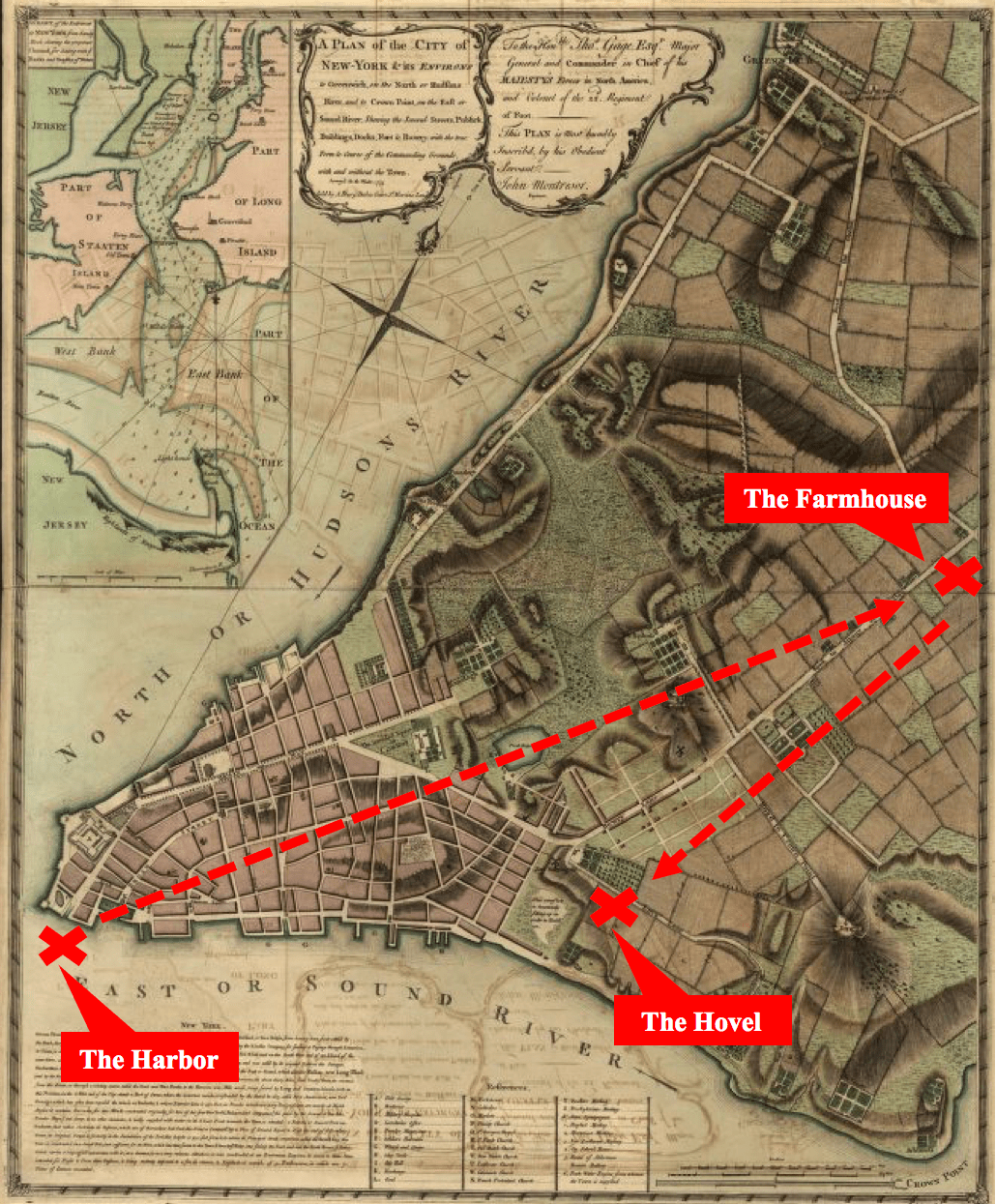
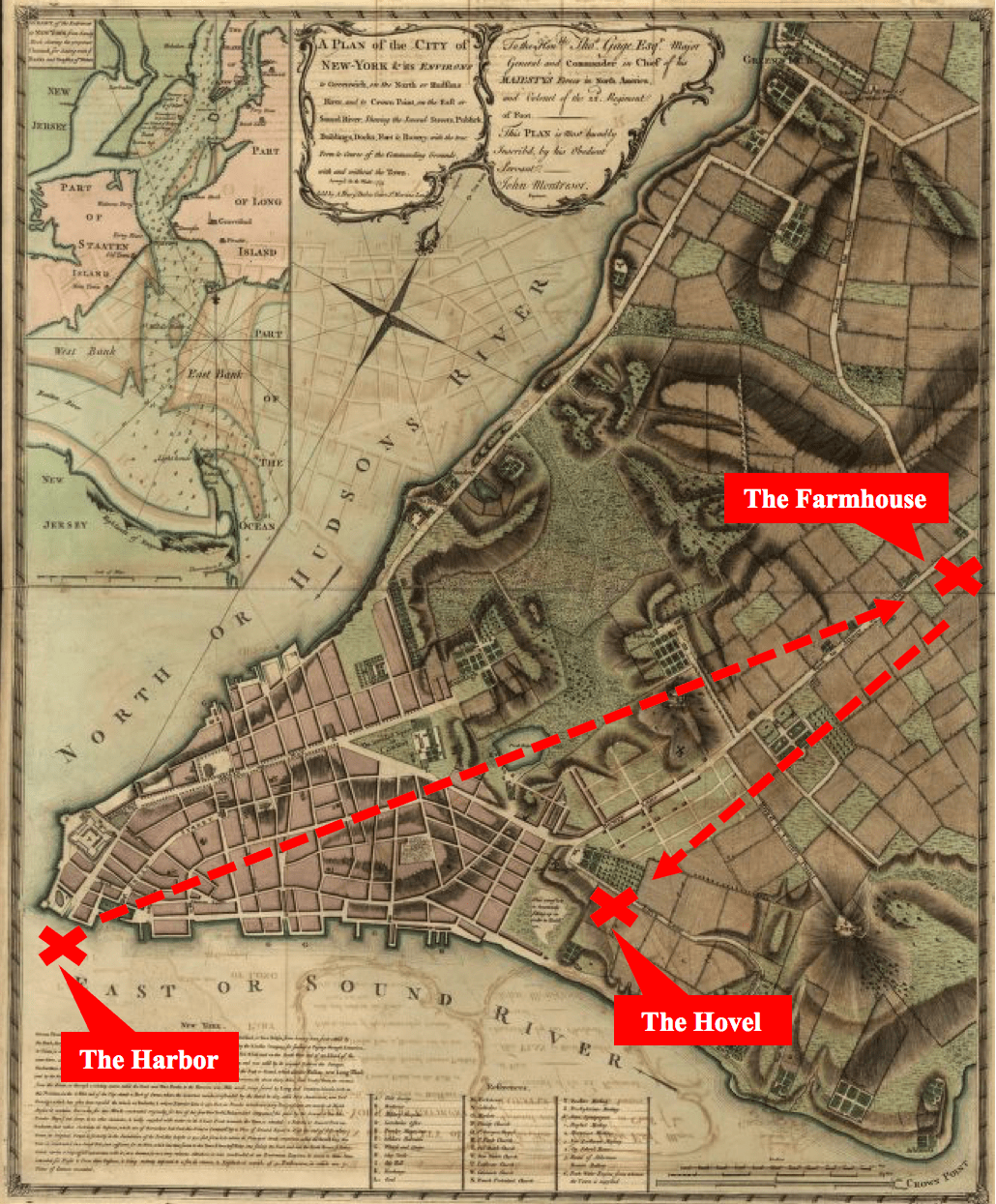
Here's a map of New York that shows Charlotte's locations:
The map shows an estimated layout of Charlotte's trips around New York. As you can see, the Hovel and the Shore are not so far away from each other. Charlotte could have had a chance to make it to shore and return home, but she was unable due to her physical and emotional strain.
Poor Charlotte crossed physical barriers of geographical locations and fates, only to remain trapped in a foreign land and endure a variety of misfortunes, such as illness, depression and carrying the burden of an innocent life (her baby). Montraville is not even physically present to enforce her confinement because he failed to fulfil his promise of marrying her and instead married someone else. Lauren Coats argues that: “Charlotte’s travel across an ocean has culminated not in freedom or expanded geographical horizons, but in confinement. Immobilized, Charlotte spends her time as captive to Montraville because ‘he had [her] from all her connections” (338).
From a deconstructivist point of view, one could argue that Montraville's (physical) absence is supplemented through the presence of his domination. Montraville's domination has stripped Charlotte away from her connection to her home, respect, love and dignity.
Rowson. Susanna. Charlotte Temple. 1794. New York: W. W. Norton & Company, 2011.