Thanks for your patience during our recent outage at scalar.usc.edu. While Scalar content is loading normally now, saving is still slow, and Scalar's 'additional metadata' features have been disabled, which may interfere with features like timelines and maps that depend on metadata. This also means that saving a page or media item will remove its additional metadata. If this occurs, you can use the 'All versions' link at the bottom of the page to restore the earlier version. We are continuing to troubleshoot, and will provide further updates as needed. Note that this only affects Scalar projects at scalar.usc.edu, and not those hosted elsewhere.
The Bestselling Novel: Currents in American History and Culture
Main Menu
Introduction
Intersectionality and Power Relations in Bestsellerism
An intersectional analysis of the concepts of gender, race and power relationships, highlighting how the overlap between these concepts fueled the novels’ rise as bestsellers.
Slavery Beyond Chains
The Variation of the Forms of Slavery Inflicted on Charlotte in Susanna Rowson's _Charlotte Temple_ and Dana in Octavia Butler's _Kindred_.
Perception of Women in Society
Inspecting the ways in which the woman’s default “doomed” status can be blamed on the society's narrow perception of women in Susanna Rowson's Charlotte Temple and Edith Wharton's House of Mirth.
Gendered Violence and Racism: The Short End of the Stick
The Struggle of the Black Woman Across the Centuries
Brief summaries of course texts
Students in ENG 410: American Novel, an upper-level undergraduate seminar
8105943177cf94521fefbbebb901e86333202954
Upper-class society
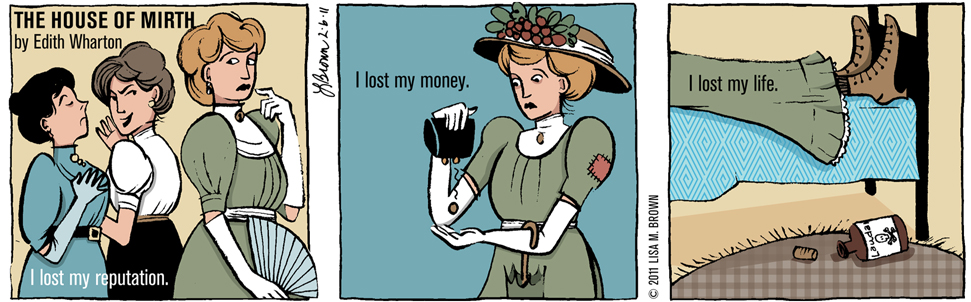
1 2018-05-02T00:18:22-07:00 Tanjuma Islam c75462b51f7a9d86235b8025584f97354045516d 29761 4 Lisa M. Brown, Three panel comic strip of House of Mirth. Three Panel Book Review. 2011. Web. 15 Feb 2016. https://threepanelbookreview.tumblr.com/post/56166552387/the-house-of-mirth-by-edith-wharton plain 2018-05-05T13:15:23-07:00 Tanjuma Islam c75462b51f7a9d86235b8025584f97354045516dThis page is referenced by:
-
1
media/Screen_Shot_2017-06-07_at_11.50.33_AM_1024x1024.png
2018-05-02T00:21:29-07:00
When Money Stays, Friends Do Too
18
plain
2018-05-22T06:16:17-07:00
Being born into a once well-off family, Lily, even though she is critical of Bertha Dorset, is forced to live up to those standards to be a part of that society. Meanwhile, Gerty Farish, “being fatally poor and dingy” (89), still manages to live a life at her own discretion. Gerty Farish is thus the character living the “ideal” life of independence that Lily craves for herself. As Lily points out,"It is not always easy to be quite independent and self-respecting when one is poor and lives among rich people" (Wharton 178).
Lily is thus entrapped in the specific expectations of society and is forced to be the manipulative woman she accuses Bertha to be in order to make herself a part of the society. The struggle of living up to societal expectations in a world which eventually leaves "her out of its calculations” (p.27) costs Lily her self-respect and freedom, in addition to all the money she loses in bridge. All of Lily's struggle however, is in vain, only leading her to be a "doomed victim" of the upper-class society and its shallow perceptions. The loss of her reputation was the first big step to Lily's "doomedness." This loss results in the loss of her so-called "friends" like Bertha Dorset and the others.
Gerty, on the other hand, is portrayed to be free from the entrapment of societal expectations because she flouts the upper-class standards. This allows her to live an independent life in her own free will, though she is never embraced by high society. Sadly, despite being the poor and dingy person Gerty may be, she is the only person who tries to support Lily in any possible way.
The shallowness of the relationship of Lily with the other upper-class members is a contrast to her relationship with Gerty. While Gerty's "dinginess" allows her to stay by Lily at all situations, Bertha and the others are not only lost as soon as Lily loses her reputation but also are contributors to Lily's loss of money and reputation, which eventually leads to the loss of her life. As is depicted in the illustration, the loss of Lily's reputation is set against a background of women talking behind her back--a strong depiction of the way society can pit women against one another.
Wharton, Edith. The House of Mirth. Penguin Classics, 1986.