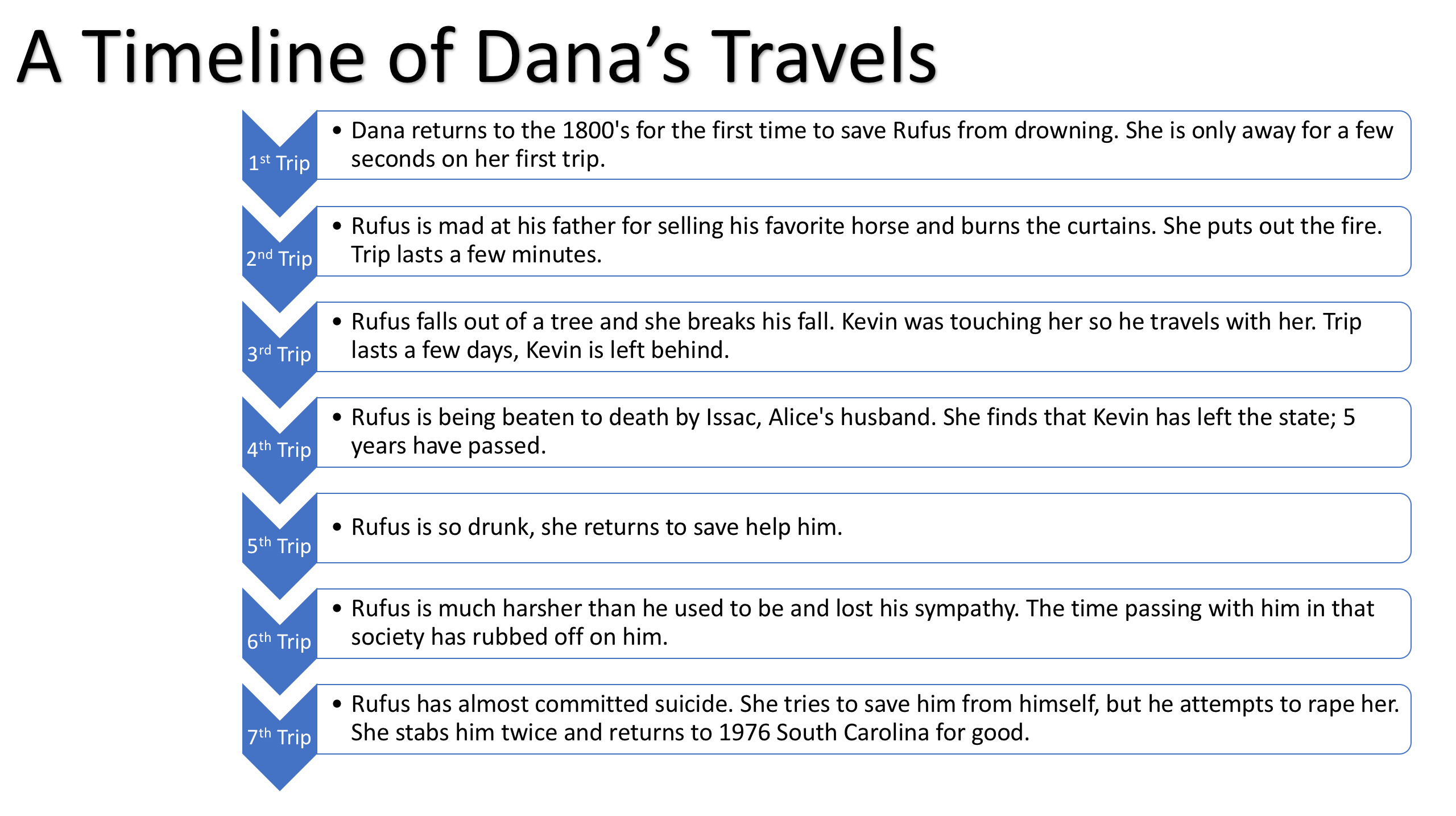
A Timeline of Dana's Travels
1 2018-05-08T11:03:29-07:00 Zaina Al Merabi 595cb72c8a5c67f889288b1015cd7914cf620c9f 29761 1 This is a timeline illustrating Dana's travel from present day to 19th century America. plain 2018-05-08T11:03:29-07:00 Zaina Al Merabi 595cb72c8a5c67f889288b1015cd7914cf620c9fThis page is referenced by:
-
1
2018-05-05T18:27:07-07:00
Bending Genres in Kindred
13
plain
2018-05-21T15:48:19-07:00
The novel Kindred by Octavia Butler uses the concept of time travel to address issues of slavery, identity, and race. The author blends contemporary styles of writing that keeps readers hooked with serious themes.
Every time Dana travels from 1976 back to the nineteenth century, she gains a better understanding of slavery and a new realization of how sheltered and protected she had been. The timeline I created below summarizes her trips back to the 1800's and why she was called back each time. Its purpose is to visualize the time travels to show how dislocating they might feel. It is her connection to Rufus as her ancestor and the need to ensure he (and thus, she) stays alive that initiates the travels. But when her own life is bodily at risk, she is able to return back to the future.
I found that addressing those serious themes through a modern style of writing made the issues easier to grasp and relate to. For example, with Uncle Tom’s Cabin, it was very easy to lose interest in the text and to find it really difficult to read (not only because of the language, but because of the narration style), while Kindred is a page turner and cannot be put down. The stark difference in my reading experiences between these two books is an issue of Bestsellerism.
Bestsellerism trends vary according to popular culture, while UTC was a huge success at the time of publication, it cannot draw the interest of the contemporary reader. What played a factor in Kindred becoming a bestseller is blending genres, as with the example of Gone Girl.
The author is trying to bring attention to how the history of slavery still haunts modern Americans and that they shouldn’t wash their hands of the past. Dana's attitude pre-time travel was more like “it is in the past and it doesn’t affect me,” which is a modern view on the issue. Her experience in the past was necessary for her to claim an identity and to serve as a reminder. The fact that the book contrasts the two attitudes bluntly shocks readers into the realizing how serious the issue is. Because the book opens up conversations about outlook on race, which is a significant issue that appeals to a large mass of readers, it is attractive to them.
The novel is difficult to categorize because of the fact that it deals with so many different themes. It is a science fiction work that deals with an exploration of human psychology, a fictional text drawing on tropes of the slave narrative, and also a feminist text. Sherryl Vint says in regards to categorizing Kindred that it is "partly historical novel, partly slave narrative, and partly the story of how a twentieth-century black woman comes to terms with slavery as her own and her nation's past.” It is a realistic spin on the idea of travel, which is usually foreign.
ReferencesSherryl Vint. “‘Only by Experience’: Embodiment and the Limitations of Realism in Neo-Slave Narratives.” Science Fiction Studies, vol. 34, no. 2, 2007, pp. 241–261. JSTOR, JSTOR, www.jstor.org/stable/4241524.