Scalar's 'additional metadata' features have been disabled on this install. Learn more.
Scalar Class Project: Loss
Main Menu
Collective Introduction
About the Works
About the Authors
Who We Are
Works Cited
Madeline Tobias
7378da82b909bca8a5df63148b1d90cff58f214b
Jerry Chen
aec50bbe8bd353223081e5dc517b93c06deb424c
Kyle Yuan
bc84047bc24f942789df70757fc91e851f7323f2
William Siege
fa3be04f6f0fd0a07d8b890b0fc5b40fb9290cb9
page 41
1 media/Screen Shot 2019-11-11 at 9.47.58 PM_thumb.png 2019-11-12T16:10:33-08:00 Madeline Tobias 7378da82b909bca8a5df63148b1d90cff58f214b 35494 1 plain 2019-11-12T16:10:33-08:00 Madeline Tobias 7378da82b909bca8a5df63148b1d90cff58f214bThis page is referenced by:
-
1
2019-11-14T13:50:25-08:00
interactivity and loss
9
or loss of interactivity?
plain
2019-11-19T12:18:26-08:00
the interactivity of this digital work is interesting, due to the fact that there is not much traditional interactivity for readers to participate in. clicking once on the main screen of "my hands/wishful thinking" brings up a pop-up window that contains the entirety of the story. thus, clicking brings up the idealized situation that the writing follows: aka the ideal situation for a black person in society.
then, if you ever try to click again, nothing happens. you are locked into the storyline, a mere passenger with no way to do anything against the switching slides of the story pop-up. this is a direct contrast to the message conveyed in the story, one of freedom and the ability to choose different options with no repercussions. the interactive element of this story locks the reader in to one path where they have no freedom to pace themselves or start and stop the story at their own times.
this form of minimalistic interactivity is extremely effective for a story of this type. if there were too many elements for a reader to interact with, the storyline wouldn't be as linear, and the focus of the story would be elsewhere. Through this very limited storyline, "my hands/wishful thinking" follows the definition of interactivity as proposed by mark meadows, that "increased attention has to be paid to what is being generated" (Meadows 37). Because the changing of the text of the story happens on a set time change, readers must pay more attention to the story. i found that it is almost essential to read the story at least twice in order to read all of the text, which adds to the meaning of the work.
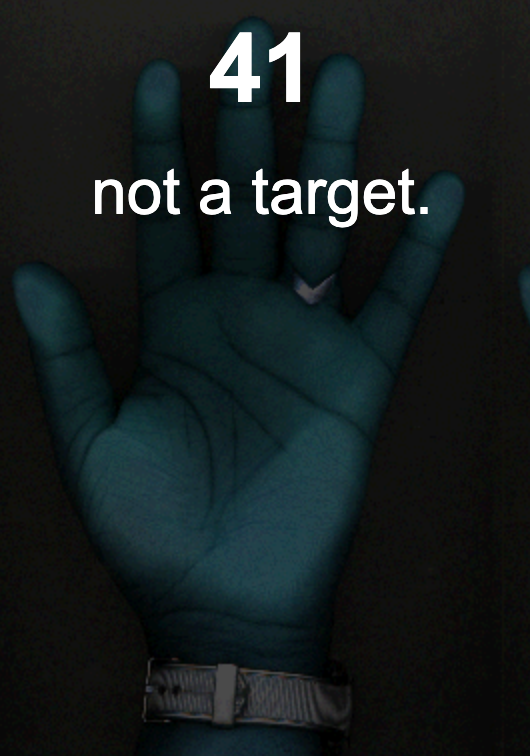
meadows also describes interactivity as a set of rules, where "the rule sets are iterative and often unconscious, providing a framework" (Meadows 38). Through this part of the definition, there is a clear connection with the unconscious interaction of the text and the prevalent theme of loss. the framework of the story is supported by this interactivity; in other words, the fact that the reader physically cannot do anything to prevent the story from progressing is very similar to the loss that Amadou Diallo faced, and the characters in the idealized story, as shown in page 41 of the story, do not. in the story, choices are made and things happen at the times which the characters want them to. they are not targets for crimes, and face no losses of their own influence or their own lives. for Diallo and the reader, they have no say against the changing circumstances around them, and are mere passengers and targets living with the loss of their own effect on the world around them.
next page: background images
by: maddie tobias