Thanks for your patience during our recent outage at scalar.usc.edu. While Scalar content is loading normally now, saving is still slow, and Scalar's 'additional metadata' features have been disabled, which may interfere with features like timelines and maps that depend on metadata. This also means that saving a page or media item will remove its additional metadata. If this occurs, you can use the 'All versions' link at the bottom of the page to restore the earlier version. We are continuing to troubleshoot, and will provide further updates as needed. Note that this only affects Scalar projects at scalar.usc.edu, and not those hosted elsewhere.
Reading Nature, Observing Science: Examining Material Practices in the Lick Observatory Archives and Kenneth S. Norris PapersMain MenuIntroduction to the Lick Observatory ArchivesThe Lick Observatory: Imaging the CosmosThe Lick Observatory: Eclipse ExpeditionsEclipse Intro page (first in a path)Introduction to Kenneth S. Norris PapersKenneth S. Norris Papers: Natural History in PracticeKenneth S. Norris Papers: Pedagogy and ConservationConnections: In Relation to NatureThese images demonstrate the different constructions of nature in the two archivesConnections: Materials of ObservationVisualization of the ConnectionsVisualizes the connections between all the contentReading Nature, Observing ScienceCaptions and information for the cases of objects on display at UCSC Special CollectionsAlex Moore6cd84a9f7efd71803c15562e48a509db9e0bb5a6Christine Turkb279a3dcf419860f915007f04f08e6fc0f8662ceDanielle Crawford22ce6a14f83c9ff73c3545a665951a092258f08e
Photographing and Printing the Cosmos
12016-06-01T17:58:36-07:00Christine Turkb279a3dcf419860f915007f04f08e6fc0f8662ce918422for physical exhibitgallery2016-06-05T13:23:08-07:00Christine Turkb279a3dcf419860f915007f04f08e6fc0f8662ceThe two primary telescopes at the Lick Observatory--the 36" Great Lick refractor and the 36" Crossley reflector--were designed for photographic purposes. While astronomers at the Lick spent much of their time studying the moon, and the planets and their satellites, discovering many new moons in the process, they were particularly concerned with using the telescopes to discover and photograph objects that are not visible to the naked eye, like nebulae and galaxies. Many of these objects could not even be seen through the telescope itself, only becoming visible through the long exposures produced by the telescope's camera. N.B.: At the time, any distant, large grouping of stars was referred to as a "nebula"; many of these objects are now identified as galaxies.
The astrophotographers working at the Lick were often amateur scientists without formal education in either astronomy or optics, whose interest in photography led them to the study of astronomy. In addition to the fact that
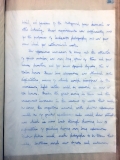
Because the earth rotates, observers had to carefully guide the telescope throughout the night in order to create a static image of the object under observation. This was difficult to accomplish, especially given the length of exposure time required to capture the light of distant bodies, and the resulting images were often more blurry than desired. The process of guiding the telescope was especially tricky in the case of comets, and their trails often appeared "ragged," according to Edward Barnard, an amateur photographer who eventually become a professor at the Lick; for more about Barnard's experiences, see the photo of Barnard in Case 1 and this article on his experiences with astrophotography at the Lick. In an early reflection on the merits of astrophotography, one page of which is displayed here, Charles Perrine, also an amateur astronomer, discusses the difficulty of capturing the light of celestial bodies. For the full article, see our digital exhibit.
Although astronomers and technicians continued to develop technologies to automate the guiding process, resulting in clearer and sharper images, the images produced were still difficult to reproduce on paper. Most of these images were made on small glass plates, measuring 3.25" by 4.25", that were coated with photosensitive chemicals. As you can see with the plates displayed here, the initial images were very small--stars often measuring only millimeters in diameter on the plate. The Lick sent these images to printers around the country, seeking out the most skilled photographic technicians to create "faithful" duplicates of the successful images that astronomers worked so hard to create.
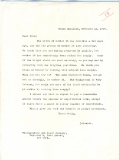
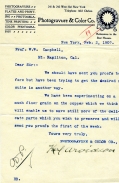
But was difficult for printers to duplicate the resolution and "sharpness" of the original image, especially when trying to enlarge them. called half-tone and photogravure, both of which had limitations when it came to producing a "faithful" reproduction of the original image onto the copper plates used for printing. Astronomers, working within certain ideas about what the cosmos looks like and how to best represent it, often had many complaints--the loss of light or detail due to various chemical processes, the lack of "snappiness" or contrast or the artifact of unsmooth gradation often created by the half-tone process, the "thinness" or lack of depth or "darkness" of the sky behind the object pictured due to the thickness of the ink coating the copper plate. The Lick's directors often required the printers to try again, yet then expressed concern that the prints were too retouched and therefore not truly objective pieces of data. To see more of the letters exchanged between Lick directors and printing companies, see our digital exhibit.
These images and documents tell us how difficult it was for astronomers to create these early images of the cosmos, speaking to a certain intensity of labor on the part of the individual astronomer and the technicians that would assist him or her in the process; but they also tell us how the aesthetic expectations and concerns of the Lick's astronomers conditioned their ideas of objectivity and reality. Additionally, they also archive another story about how these aesthetic concerns impacted the labor of the printers in meeting the expectations of the Lick's directors.
This page has paths:
12016-06-01T16:07:18-07:00Christine Turkb279a3dcf419860f915007f04f08e6fc0f8662ceExhibition at UCSC Special CollectionsDanielle Crawford21Captions and information for the cases of objects on display at UCSC Special Collectionsstructured_gallery2016-06-04T23:26:46-07:00Danielle Crawford22ce6a14f83c9ff73c3545a665951a092258f08e
Contents of this path:
12016-06-02T20:23:03-07:00Christine Turkb279a3dcf419860f915007f04f08e6fc0f8662ce"Astronomical Photography and Some of Its Merits," Charles Perrine, circa 1890s.1Perrine discusses the exposure time necessary for making images of nebulae, as well as the difficulty of capturing their light and the details of their structures.media/Perrine_copybook_295.jpgplain2016-06-02T20:23:03-07:00Christine Turkb279a3dcf419860f915007f04f08e6fc0f8662ce
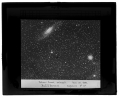
1media/UA36/UA36_Bx463B_andromeda1894.jpg2016-05-11T22:14:56-07:00Craig Dietrich2d66800a3e5a1eaee3a9ca2f91f391c8a6893490Andromeda Nebula, photographed by Edward Barnard, 1894.1Professor Edward Barnard produced most of the Lick's early photographic images. He used the type of lens typically used to make portraits, along with a 6.5" telescope, to create this image. N.B.: This is now known as the Andromeda Galaxy. Astronomers were not yet certain that nebulae and galaxies are different kinds of celestial bodies. See introductory note for more information.media/UA36/UA36_Bx463B_andromeda1894.jpg2016-05-11T22:14:56-07:00Craig Dietrich2d66800a3e5a1eaee3a9ca2f91f391c8a6893490
1media/UA36/UA36_Bx463B_spiral1899.jpg2016-05-11T22:14:56-07:00Craig Dietrich2d66800a3e5a1eaee3a9ca2f91f391c8a6893490Great Spiral Nebula, photographed by Earl Rosse, 1899.1This is a four-hour exposure of the Great Spiral Nebula using the Crossley telescope. N.B.: This is now known as the Whirlpool Galaxy. Astronomers were not yet certain that nebulae and galaxies are different kinds of celestial bodies. See introductory note for more information.media/UA36/UA36_Bx463B_spiral1899.jpg2016-05-11T22:14:56-07:00Craig Dietrich2d66800a3e5a1eaee3a9ca2f91f391c8a6893490
12016-06-03T15:13:26-07:00Christine Turkb279a3dcf419860f915007f04f08e6fc0f8662ceLetter from Charles Perrine to Photogravure and Color Company, 1907.1Perrine and the printers at the Photogravure and Color Company exchanged a series of letters regarding the difficulties of reproducing the glass negatives of nebulae created at the Lick. Printers used chemicals to "etch" the image of the original glass plate into copper plates. The etched portions were then filled with ink to create a print. Details of the original image were often lost in the process.media/UA36_Bx113_nebulae021-2.jpgplain2016-06-03T15:13:26-07:00Christine Turkb279a3dcf419860f915007f04f08e6fc0f8662ce
12016-06-03T15:09:59-07:00Christine Turkb279a3dcf419860f915007f04f08e6fc0f8662ceLetter from Photogravure and Color Company to Charles Perrine, 1907.1Perrine and the printers at the Photogravure and Color Company exchanged a series of letters regarding the difficulties of reproducing the glass negatives of nebulae created at the Lick. Printers used chemicals to "etch" the image of the original glass plate into copper plates. The etched portions were then filled with ink to create a print. Details of the original image were often lost in the process.media/UA36_Bx113_nebulae020-2.jpgplain2016-06-03T15:09:59-07:00Christine Turkb279a3dcf419860f915007f04f08e6fc0f8662ce