Plants
Pitcher Plants and Hardwicke's Woolly Bats
Pitcher plants like Nepenthes hemsleyana are carnivorous plants with leaves that have evolved to form something called a pitfall trap. Pitcher plants have specialized leaves that for a deep well-like structure that features digestive liquid at the bottom.The plant uses nectar and the odour of the nectar to lure the insects in, and then two "fang-like" structures hanging just on the edge of the lip of the plant narrow, causing the insect to lose its footing and fall into the pitfall trap, where it is drowned and digested.
What is fascinating about pitcher plants is that they allow a species of vesper bat named Kerivoula hardwickii, or Hardwicke's woolly bat, to sleep inside their pitfall traps, just above the digestive liquid sitting at the bottom of the trap, during the daytime, and in turn, the bats defecate inside the pitfall traps. The pitcher plants then digest the feces, and have an easily accessible, reliable source of sustenance. The bat poop contains nitrogen that the plant needs to survive, since this particular species of Nepenthes is not exceptional about catching insects on its own. However, rather than evolve a structure more conducive to catching plants, such as the Venus Flytrap, who's trap only closes if two trigger hairs are touched, or developing a more attractive nectar, like the Titan Arum, who's infamous odour is known to attract pollinators "up to an acre away".
Bullhorn Acacia and Acacia Ants
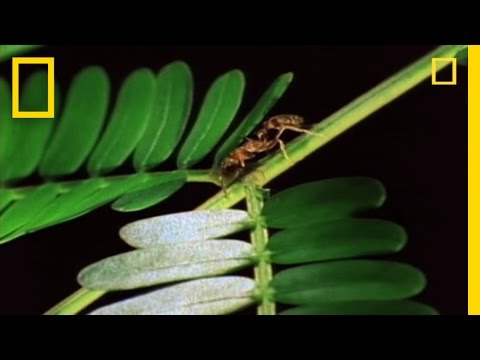
One of the swollen-thorn acacia tree species found in Mexico known as the Bullhorn Acacia (Vachellia cornigera) take care of Acacia Ants (Pseudomyrmex ferrugineus) ants in another symbiotic relationship. The tree provides shelter in the hollows of its thorns, and produces a kind of sap that the ants eat that contains protein-lipid nodules called Beltian bodies that disallow it's consumers to ingest any other type of sucrose, by blocking the ants' invertase enzyme, which is responsible for digesting the sucrose that makes up a lot of the ants' diet. It is important to note that there is no known purpose for these Beltian bodies other than to feed the acacia ants.In turn, the ants will defend the tree by demolishing any upstart plant saplings that begin to grow around the base of the tree, swarming to sting at any animal that lays its lips to the leaves. According to ecologist Daniel H. Janzen, animals that may otherwise wish to chomp at the tree can smell the pheromones the acacia ants will exude when the tree is threatened, and so stay away from the plant. The employment of the ant by the acacia tree is similar to that of a guard dog. It is worth mentioning that humans and dogs co-evolved in much the same way.
The main point is to note how the acacia ants are taken care of by the plant, and by nature they defend their home. The acacia has made itself accessible, desirable, and beneficial to the ants, in order for its Maximal Greatness to be achieved.
The point of inter-species relations in a religious context is not merely for survival, but in the pursuit of attaining Ultimate Perfection. The pitcher plants The acacia trees evolved without the bitter alkaloids that typically ward off herbivores, and instead of evolving to spread faster than they can be eaten (such as the common pigweed, which produces tens of thousands of seeds per plant) or developing a toxin that is poisonous to its predators (such as white baneberry plants, which is poisonous to humans but not the birds that distribute its seeds), the Bullhorn Acacia co-evolved with its ants and "learned" to take care of them in a way that heavily resembles stewardship.
This page has paths:
- Inter-Species Relationships Sam Henrickson
This page references:
- Daniel Janzen, Costa Rican Natural History, 1983
- A Novel Resource-Service Mutualism Between Bats and Pitcher Plants
- Woolly bat emerging from an N. hemsleyana pitcher
- Nepenthes Hemsleyana upper pitcher, Brunei
- The first plant to become a venus fly trap
- Is this the first bat-eating plant? - Nature's Weirdest Events: Episode 4 Preview - BBC Two
- Amazing Symbiosis: Ant Army Defends Tree | National Geographic
- Specimen: CASENT0005785 Pseudomyrmex ferrugineus