Thanks for your patience during our recent outage at scalar.usc.edu. While Scalar content is loading normally now, saving is still slow, and Scalar's 'additional metadata' features have been disabled, which may interfere with features like timelines and maps that depend on metadata. This also means that saving a page or media item will remove its additional metadata. If this occurs, you can use the 'All versions' link at the bottom of the page to restore the earlier version. We are continuing to troubleshoot, and will provide further updates as needed. Note that this only affects Scalar projects at scalar.usc.edu, and not those hosted elsewhere.
The Digital Piranesi
Main Menu
About
The Digital Piranesi is a developing digital humanities project that aims to provide an enhanced digital edition of the works of Italian illustrator Giovanni Battista Piranesi (1720-1778).
Works and Volumes
Genres, Subjects, and Themes
Bibliography
Glossary
the most intact of this form that remains in Rome today, both in the exterior and the interior
1 2022-03-05T12:48:19-08:00 Jeanne Britton e120651dde677d5cf1fd515358b14d86eb289f11 22849 1 plain 2022-03-05T12:48:20-08:00 Jeanne Britton e120651dde677d5cf1fd515358b14d86eb289f11This page is referenced by:
-
1
2019-02-15T17:15:38-08:00
View of the Temple of Bacchus
26
Veduta del Tempio di Bacco, inoggi Chiesa di Sant' Urbano, distante due miglia da Roma fuori della Porta di San Sebastiano. Esso è il più intero di questa forma che sia rimaso a Roma ai giorni nostri, sì nell’esterno che nell’interno. La sua Ara si conserva peranche nel Pronao colla iscrizione εCTIAI Δ IONYCOY AπPωNIANOC IζPOΦANTHC: Ara di Bacco, Aproniano Sacerdote.
plain
2024-02-23T11:36:39-08:00
Each volume of the Vedute di Roma can be experienced as an imaginary itinerary. The second volume in the Didot edition (volume 17) concludes outside the city, most notably with images from Hadrian’s Villa; likewise, this volume heads beyond the city’s gates with this image. Except the Portico di Ottavia (itself one of the gates to Rome), each of the structures that follow in this volume is noted for its distance from the city. Passing through the Porta di San Sebastiano along Rome’s former southern boundary, Piranesi takes his viewers to the Temple of Bacchus in this etching before proceeding, in the following images, to what is now the Caffarella Park, the city of Cori, and elsewhere. Here, two miles outside of Rome, Piranesi draws attention to the temple’s state of preservation: it is, the caption notes, “il più intero di questa forma che sia rimaso a Roma ai giorni nostri, sì nell’esterno che nell’interno.” The image, though, foregrounds ruin, with heavy shading drawing viewers’ eyes to the deep gash in the façade, and a visual boundary of rubble, including a bust and another fragment that interrupts the caption, fragmenting the word “Tempio” in an effective use of trompe-l’oeil. Individual annotations point out sections of repair, most prominently the walls between the columns of the pronaos, which Piranesi specifies were built under the restorations by Urban VIII and his family, the Barberini, in the 1630s.
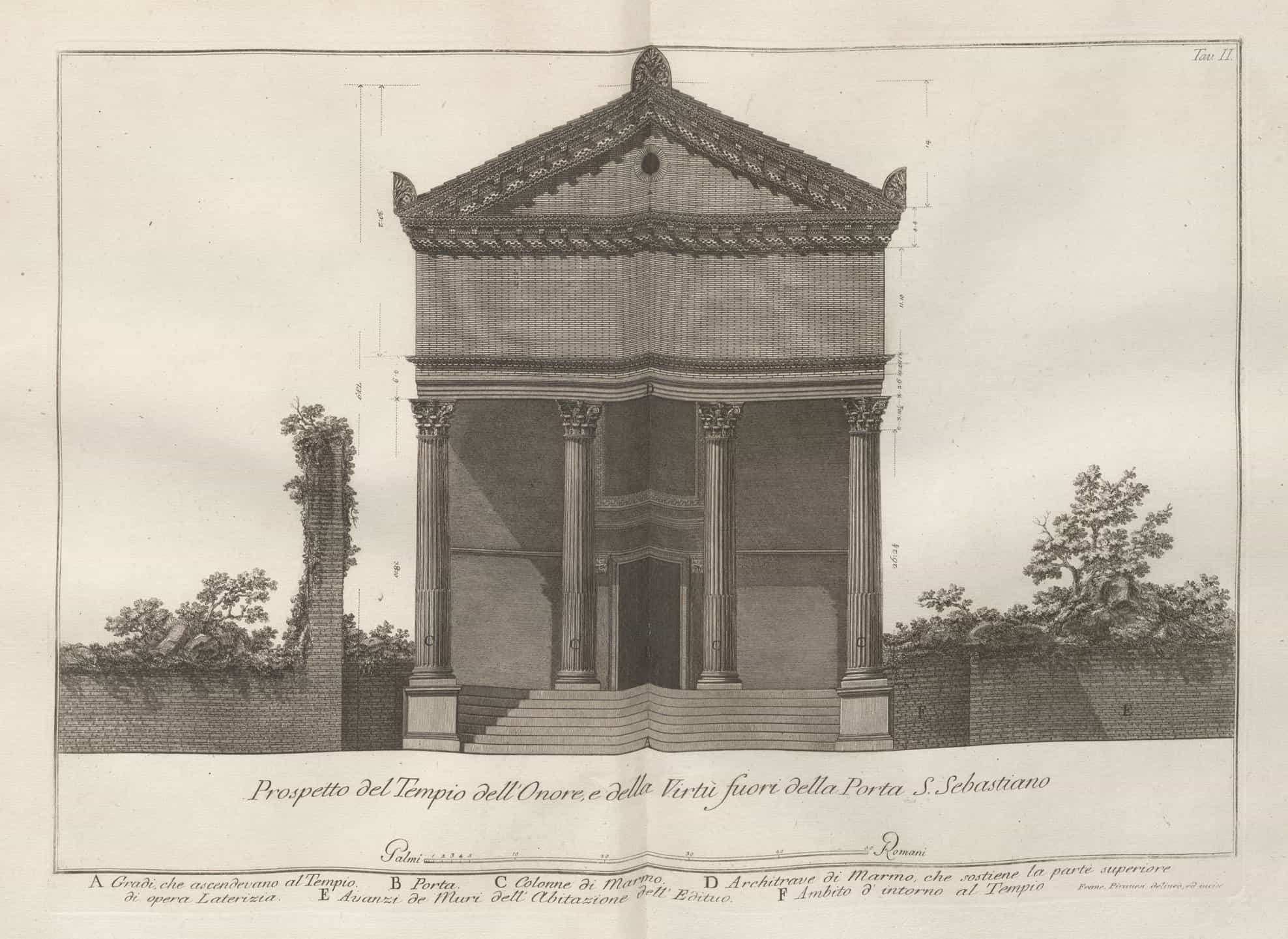
In his Raccolta de’ Tempj Antichi (1780), included in the Didot edition of the Opere, Francesco Piranesi devotes a total of eight plates to this monument, including a conjectural elevation of its original state (below).
(Following later theories about the identity of the temple, he calls it the Tempio dell’ Onore e della Virtù fuori di Porta Capena, which is now considered to be a different temple of which no remains survive.) Among Francesco’s plates is an image of the ancient altar that includes the inscription.
Giambattista, by contrast, does not duplicate this inscription visually in the following image of the interior. Instead, the annotation in this image renders the altar’s text in ways that characterize his persistent combination of visual and verbal evidence, as he does in his view of the Temple of the Sibyl. Among the temple’s intact details, he notes that a Greek inscription survives on the ancient altar, duplicates the Greek in a tidy script, and offers a Latin translation in a similar upright lettering. His own Italian text simulates manuscript with its italicized slant. Similar visual differentiation between languages and texts appears
Piranesi cites the inscription verbally rather than depicting it visually, as Francesco does in his etching of the altar itself. Giambattista’s choices indicate the centrality of his own written texts to his presentation of the city and its ruins. The monk who seems, in the following view of the temple’s interior, to read closely on the altar might demonstrate Piranesi’s own dedication to careful visual examination of either textual or visual evidence. (JB)
To see this image in the Vedute di Roma, volume 16 of Piranesi’s Opere, click here.