Thanks for your patience during our recent outage at scalar.usc.edu. While Scalar content is loading normally now, saving is still slow, and Scalar's 'additional metadata' features have been disabled, which may interfere with features like timelines and maps that depend on metadata. This also means that saving a page or media item will remove its additional metadata. If this occurs, you can use the 'All versions' link at the bottom of the page to restore the earlier version. We are continuing to troubleshoot, and will provide further updates as needed. Note that this only affects Scalar projects at scalar.usc.edu, and not those hosted elsewhere.
The Digital Piranesi
Main Menu
About
The Digital Piranesi is a developing digital humanities project that aims to provide an enhanced digital edition of the works of Italian illustrator Giovanni Battista Piranesi (1720-1778).
Works and Volumes
Genres, Subjects, and Themes
Bibliography
Glossary
shadow
1 2022-03-05T12:57:07-08:00 Jeanne Britton e120651dde677d5cf1fd515358b14d86eb289f11 22849 1 plain 2022-03-05T12:57:07-08:00 Jeanne Britton e120651dde677d5cf1fd515358b14d86eb289f11This page is referenced by:
-
1
2019-02-15T17:35:43-08:00
View of the Fountain and the Grotto of Egeria Outside the Porta Capena
37
Veduta della fonte e delle Spelonche d’Egeria fuor della porta Capena or di San Sebastiano
plain
2023-06-20T12:17:08-07:00
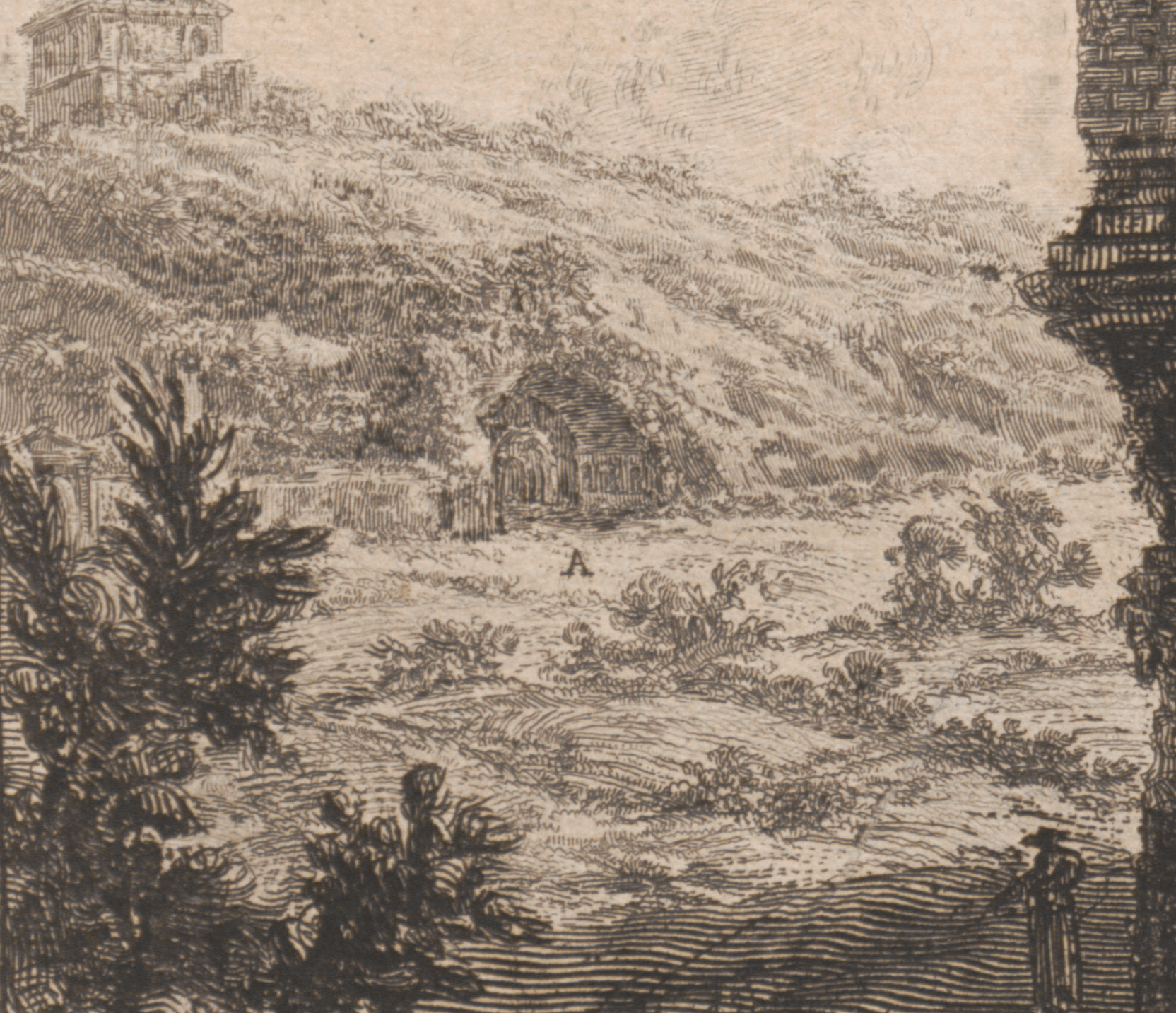
Here, Piranesi depicts the sacred fountain grotto associated with Egeria, the water nymph thought to have advised Numa Pompilius, the second king of Rome. The previous view presents the fountain at a distance, in its picturesque setting, behind the Tempio delle Camene.
In this view, Piranesi highlights the grotto’s successive interior spaces with alternating light and shade on the ceiling of the apse, drawing viewers’ eyes into the central depths of the image. At the same time, though, the large, pronounced caption directs readers towards a textual source and mythic history at the image’s margin. The fountain is enveloped by natural overgrowth, which hangs from the grotto and extends from the sloping ground into which it is built towards the sky. In the upper right, clouds and foliage that are engraved with similar strokes seem to merge in a place where a work of art blends into the natural landscape.
A similar blurred boundary is the subject of Piranesi’s caption, which is unique in the Vedute di Roma for identifying a structure primarily through the citation of a classical author. The illusionistic scroll cites a lament from Juvenal’s Satires that this grotto, so unlike nature, would be more faithful to its spirit if it were fringed by grass and if its marble hadn’t corrupted the natural tufa. The citation begins with the deictic statement that “hic ubi” Numa met Egeria. This geographic indication is reinforced with bibliographical specificity when Piranesi identifies and again cites his source: “Cosi Giovenal nella Satire 3, ove pur dice ... .” Especially for subsequent generations of artists and writers, the grotto represented the return to a natural state after neglect and decay overpowered the effects of man and art that Juvenal had originally lamented (Pinto 2016). While Piranesi’s caption includes an asterisk to indicate the Tempio di Bacco, the subject of two earlier views, its other indications emphasize physical and bibliographical presence instead of identifying architectural structures or features: it is here in this place that Numa met Egeria, and it is here in his Satire that Juvenal describes the grotto. In light of Juvenal’s lament, nature’s reclaiming of this site is, Piranesi suggests, notable. “How much more beautiful would the grove be if fringed by grass,” Juvenal complains. “How beautiful it is,” Piranesi’s image seems to respond, “now that it is overtaken with foliage.” Similarly, the textures of the grotto’s built surfaces appear rough and irregular, with little suggestion of the smooth marble that Juvenal found to spoil the natural tufa. A misquotation—he writes “umbras” for Juvenal’s “undas”—betrays Piranesi’s preference for shade and shadow. But the image is quite clear in its emphasis on the present state, the deictic “now,” of the grotto. Between this view’s words and its image, Piranesi summons the deictic functions of annotation and citation to shift from the past of antiquity to the present moment and, with it, the passage of time. (JB)
To see this image in the Vedute di Roma, volume 16 of Piranesi’s Opere, click here.