Thanks for your patience during our recent outage at scalar.usc.edu. While Scalar content is loading normally now, saving is still slow, and Scalar's 'additional metadata' features have been disabled, which may interfere with features like timelines and maps that depend on metadata. This also means that saving a page or media item will remove its additional metadata. If this occurs, you can use the 'All versions' link at the bottom of the page to restore the earlier version. We are continuing to troubleshoot, and will provide further updates as needed. Note that this only affects Scalar projects at scalar.usc.edu, and not those hosted elsewhere.
The Digital Piranesi
Main Menu
About
The Digital Piranesi is a developing digital humanities project that aims to provide an enhanced digital edition of the works of Italian illustrator Giovanni Battista Piranesi (1720-1778).
Works and Volumes
Genres, Subjects, and Themes
Bibliography
Glossary
newly adorned
1 2022-03-10T13:13:43-08:00 Jeanne Britton e120651dde677d5cf1fd515358b14d86eb289f11 22849 1 plain 2022-03-10T13:13:43-08:00 Jeanne Britton e120651dde677d5cf1fd515358b14d86eb289f11This page is referenced by:
-
1
2018-11-09T19:44:46-08:00
Interior view of Santa Maria degli Angeli
38
Veduta interna della Chiesa della Madonna degli Angioli detta della Certosa che anticamente era la principal sala delle Terme di Diocleziano
plain
2023-06-26T08:00:23-07:00
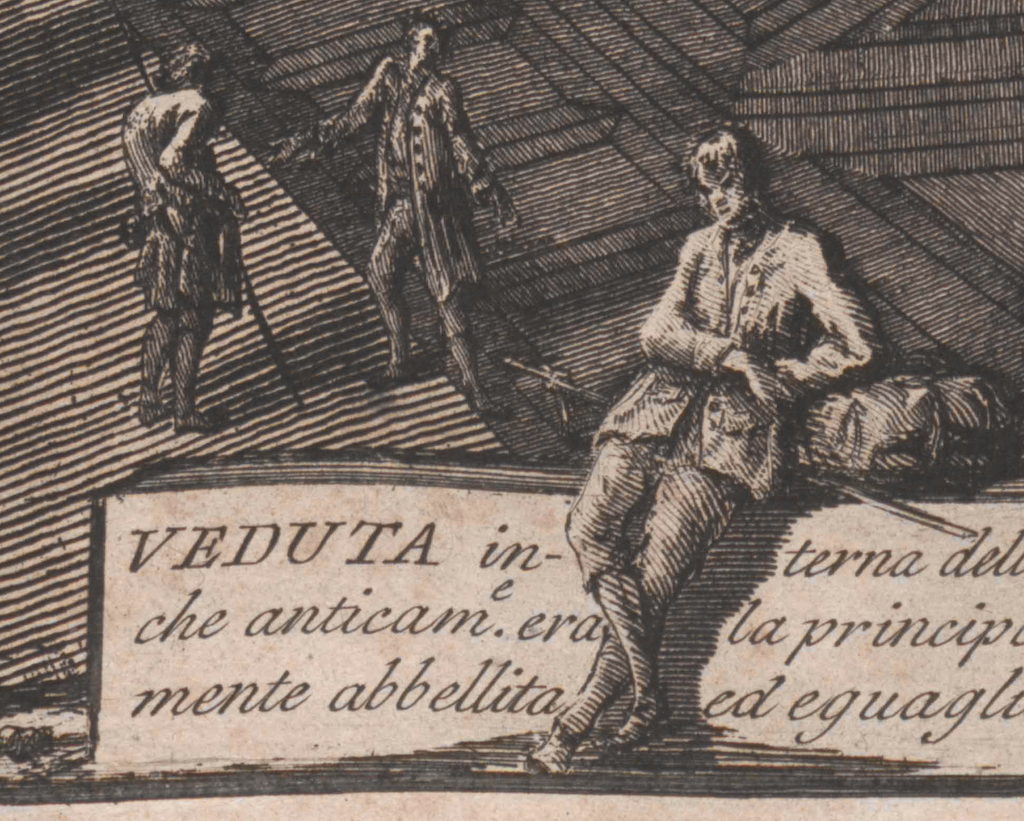
Like the weary traveler who rests on the caption in the foreground, viewers of this image pause to observe the vast interior of Santa Maria Angeli. The traveler seen in the closeup below is a kind of intermediary between the exterior shown in the previous view and this interior view.
Throughout the image, he signals the way that a sequential experience of the Vedute di Roma provides a visual tour of the city. Indeed, grand tourists can be seen pointing, discussing, and gesturing throughout the image; for example, one tourist marvels at the large ribbed vaults, octagonal coffers, geometrical design of the floor, Corinthian columns, and ornate architectural details. It is difficult not to lose oneself in the image’s infinitesimal details and seemingly never-ending archways or to be drawn into the drama playing out among the church’s many visitors (as seen in the gallery below).
This varied cast of characters includes dogs, monks, tourists, noble ladies, beggars, and a mysterious figure who sits on the right side of the caption, apparently heating his feet on a profusely smoking pot. Both architectural and figural details emphasize the dizzying and all-encompassing quality of ornament.
The structure, “nuovamente abbellita,” as Piranesi tells us in the caption, was “eguagliata quanto si è potuto all’antica fabbrica.” In fact, without careful study, it is difficult to distinguish between ancient and modern in this image. Typically, Piranesi takes great pains to differentiate ancient ruins from later historical interventions through etching details and textual annotations. In this sense, Piranesi’s statement in the caption reveals his approach to restoration in his own inventive restorations of antiquities, which he often sold from his personal museum. Here, though, his approach to the restoration of architecture seems to be more restrained, from his emphasis, with the term “eguagliata,” on the integration between ancient and modern. Marveling at the ornamental detail of this interior, viewers of this image are not likely to disentangle its ancient and modern elements. (ZL)
To see this image in the Vedute di Roma, volume 17 of Piranesi’s Opere, click here.