Thanks for your patience during our recent outage at scalar.usc.edu. While Scalar content is loading normally now, saving is still slow, and Scalar's 'additional metadata' features have been disabled, which may interfere with features like timelines and maps that depend on metadata. This also means that saving a page or media item will remove its additional metadata. If this occurs, you can use the 'All versions' link at the bottom of the page to restore the earlier version. We are continuing to troubleshoot, and will provide further updates as needed. Note that this only affects Scalar projects at scalar.usc.edu, and not those hosted elsewhere.
The Digital Piranesi
Main Menu
About
The Digital Piranesi is a developing digital humanities project that aims to provide an enhanced digital edition of the works of Italian illustrator Giovanni Battista Piranesi (1720-1778).
Works and Volumes
Genres, Subjects, and Themes
Bibliography
Glossary
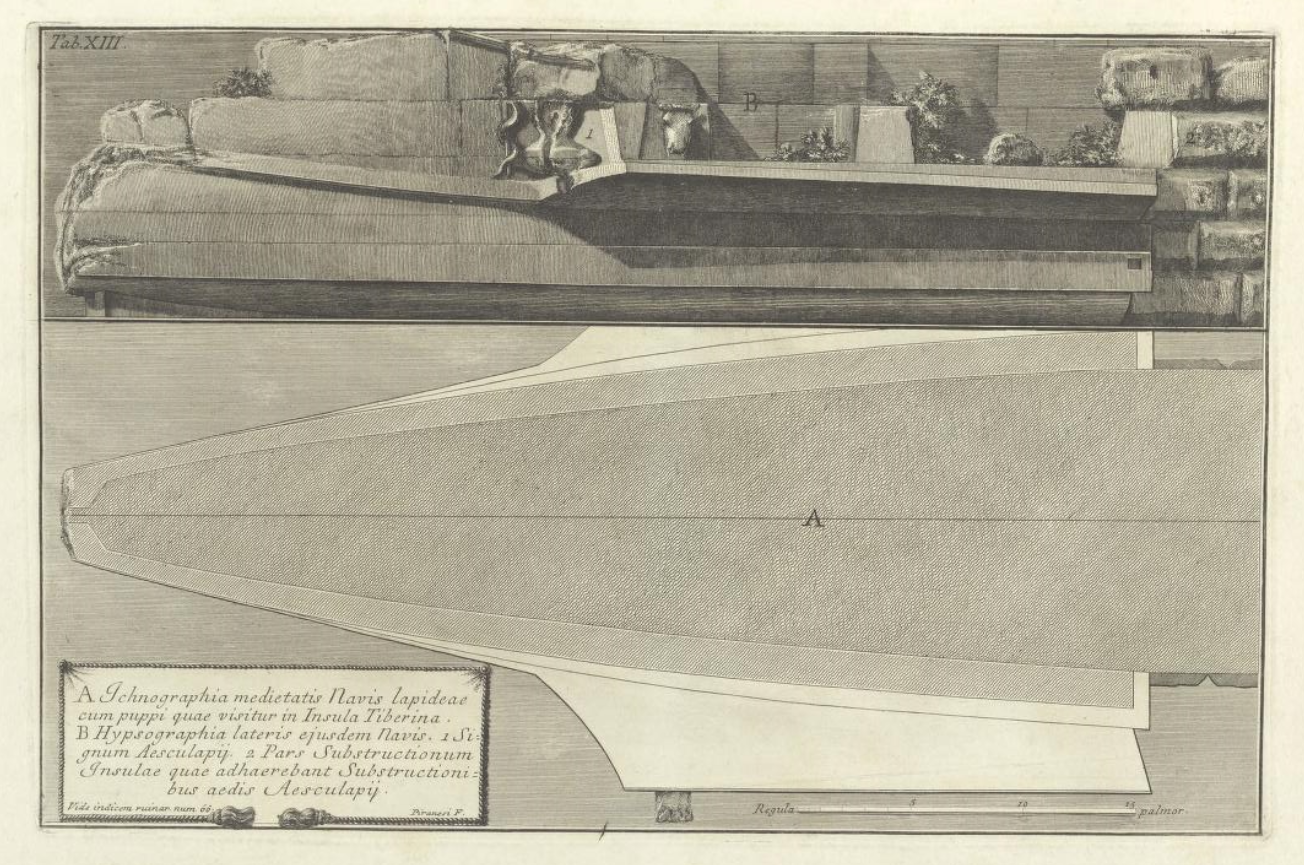
Ichnographia medietatis Navis lapideae cum puppi quae visitur in Insula Tiberina
1 media/Isola Tiberna from Campus Martius_thumb.png 2021-06-22T11:45:58-07:00 Jeanne Britton e120651dde677d5cf1fd515358b14d86eb289f11 22849 2 from Il Campo Marzio dell'antica Roma, The Getty Institute plain 2021-06-22T12:45:27-07:00 Jeanne Britton e120651dde677d5cf1fd515358b14d86eb289f11This page is referenced by:
-
1
2019-02-15T16:45:07-08:00
View of the Tiber Island
16
Veduta dell’Isola Tiberina
plain
2023-06-20T11:59:44-07:00
In this view, which falls within a series of views related to water, Piranesi presents the substructure, history, and immediate surroundings of the Tiber Island. Vivid contrasts between light and shadow emphasize the abundant foliage that nearly overwhelms the individual stones on the lowest levels, and the vantage point brings the viewer face-to-face with the island’s physical and historical foundations. The caption, which appears to be surrounded by foam, seems to emerge from the water in order to relate historical myth and identify major landmarks. First, it tells readers that the human face protruding towards the viewer is that of Aesculapius, the Greek god of healing, to whom, according to legend, an ancient temple on the island was dedicated. The myth of this temple’s origins has quite literally reshaped the island. This location was chosen for the temple when a Roman delegation, sailing from Epidauros with a statue of the Greek god, witnessed the snake that they had, following custom, taken from a Greek temple, swim ashore on the island. This story came to be so closely connected with the island that its foundations were in fact reshaped so as to resemble a ship, with the face of Aesculapius and the snake both carved into travertine blocks near the island’s southeastern edge. In a plate in the Campus Martius volume, Piranesi visualizes this foundation story, depicting the hypothetical ship underneath the island.
In the view from the Vedute di Roma above, Piranesi’s annotations highlight elements of the island and its surroundings that are given expansive attention elsewhere: the effigy of Aesculapius, the bridge called the Quattro Capi (formerly the Bridge of Fabricius), and the Ponte Ferrato (formerly the Bridge of Cestius). The island is also the subject of a small view in his volume devoted to the Campus Martius, where it is faintly etched and dramatically framed by the remnants of what is today known as the Ponte Rotto or Broken Bridge. The images from the Campus Martius volume present the island at a distance, either visually or historically, and the detailed studies from the Antichità Romane are, in keeping with that work’s focus, devoted to structural elements of antiquity’s engineering marvels. This view of the island’s contemporary reality stands out for boldly confronting viewers and, importantly, readers with the mythic foundations of one of Rome’s ancient boundaries. (JB)
To see this image in the Vedute di Roma, volume 16 of Piranesi’s Opere, click here.