Thanks for your patience during our recent outage at scalar.usc.edu. While Scalar content is loading normally now, saving is still slow, and Scalar's 'additional metadata' features have been disabled, which may interfere with features like timelines and maps that depend on metadata. This also means that saving a page or media item will remove its additional metadata. If this occurs, you can use the 'All versions' link at the bottom of the page to restore the earlier version. We are continuing to troubleshoot, and will provide further updates as needed. Note that this only affects Scalar projects at scalar.usc.edu, and not those hosted elsewhere.
The Digital PiranesiMain MenuAboutThe Digital Piranesi is a developing digital humanities project that aims to provide an enhanced digital edition of the works of Italian illustrator Giovanni Battista Piranesi (1720-1778).Works and VolumesGenres, Subjects, and ThemesBibliographyGlossary
carved on the monument the name Claudio, who had built it, and Vespasian who restored it
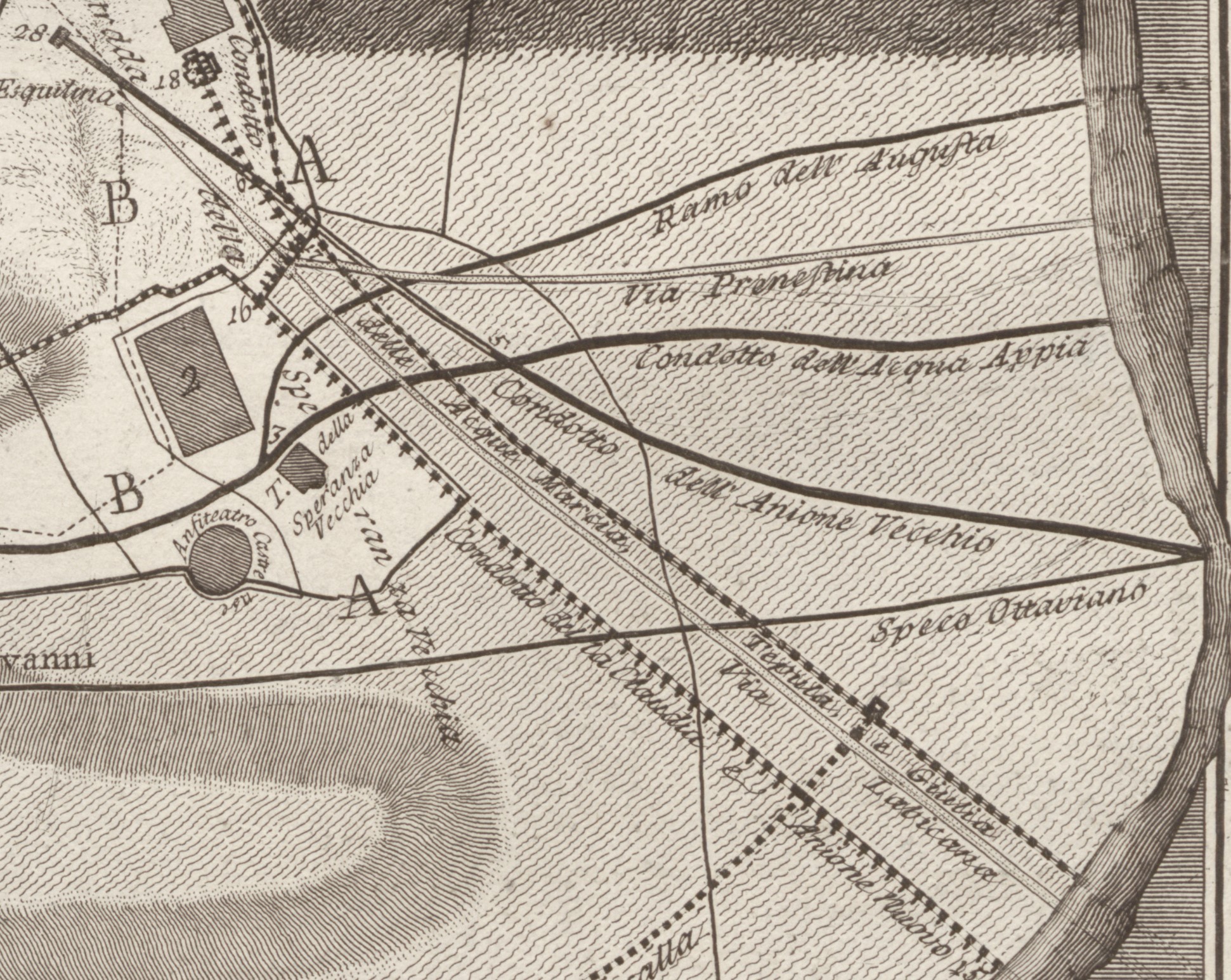
12019-02-13T16:04:31-08:00View of the Monument Erected by the Emperor Titus Commemorating His Restoration of the Aqueducts of the Anio and Claudia25Veduta del Monumento eretto dall’Imperadore Tito Vespasiano per aver ristaurati gl’ Aquedotti dell’Acque dell'Anione nuovo e Claudia essendovi scolpito in esso il nome, di Claudio, che lo edificò, e di Vespasiano che lo restauròplain2023-06-19T09:02:52-07:00This magnificent gate, known as the Porta Maggiore or Porta Prenestina, lies at the convergence of eight aqueducts and two ancient roads. The full title of the image explains that the monument was erected by Titus Vespasian to commemorate the restoration of two aqueducts—the Anio [Aniene nuovo] and Claudia, which, along with the two ancient roads identified in the captions (the Via Labicana and Via Prenestina), can be seen in the close-up from his “Topographical Map of the Roman Aqueducts” in the Antichità Romane below. Filling the height of the plate, but neatly contained by its margin, this gate resembles a triumphal arch that celebrates the control of nature rather than the dominance over people. Piranesi vividly renders the rusticated style of the monument’s travertine, using sharp relief to create seemingly undulating surfaces of stone. People peek out from a door, draw water from the fountain, and gesture beside and, it seems, in tandem with, the annotation that points to Via Prenestina.
A complex intersection in antiquity, this site here becomes an intersection of different media. The text of the monument’s inscription, when joined with that of Piranesi’s etched caption, draws attention to the significance of inscription and print as methods of commemoration, preservation, and communication. In this image, the visual appearance of the heavily-shadowed and carefully rendered inscription reinforces an ambiguity that Renaissance antiquarians appreciated about inscriptions: the written word, whether inscribed or printed, is always visual as well as verbal (Barkan 27). If Piranesi’s vedute often ask to be experienced both verbally and visually, the dramatic detail, lengthy inscription, and substantial caption in this word-image composite make it a virtual assault on its beholders’ interpretive methods. Piranesi’s Italian caption, which includes a long title and key, condenses the Latin inscription and highlights its materiality, noting of the monument that “scolpito in esso il nome, di Claudio, che lo edificò, e di Vespasiano che lo restaurò.” As a piece of three-dimensional stone, the caption takes on illusionistic materiality, and Piranesi seems to reinscribe the construction and renovation of the aqueducts, arches, and gate into their natural setting. In this image, even with its magnificently legible inscription, Piranesi seems, though the content and appearance of his caption, to attend to the ways that inscriptions can call into question relationships between materiality and meaning (Bachner 4). Piranesi’s captions—engraved in copper but also inscribed into metal before being inked and printed—amplify such interrogations of media and historical interpretation. (JB)
To see this image in the Vedute di Roma, volume 16 of Piranesi’s Opere, click here.