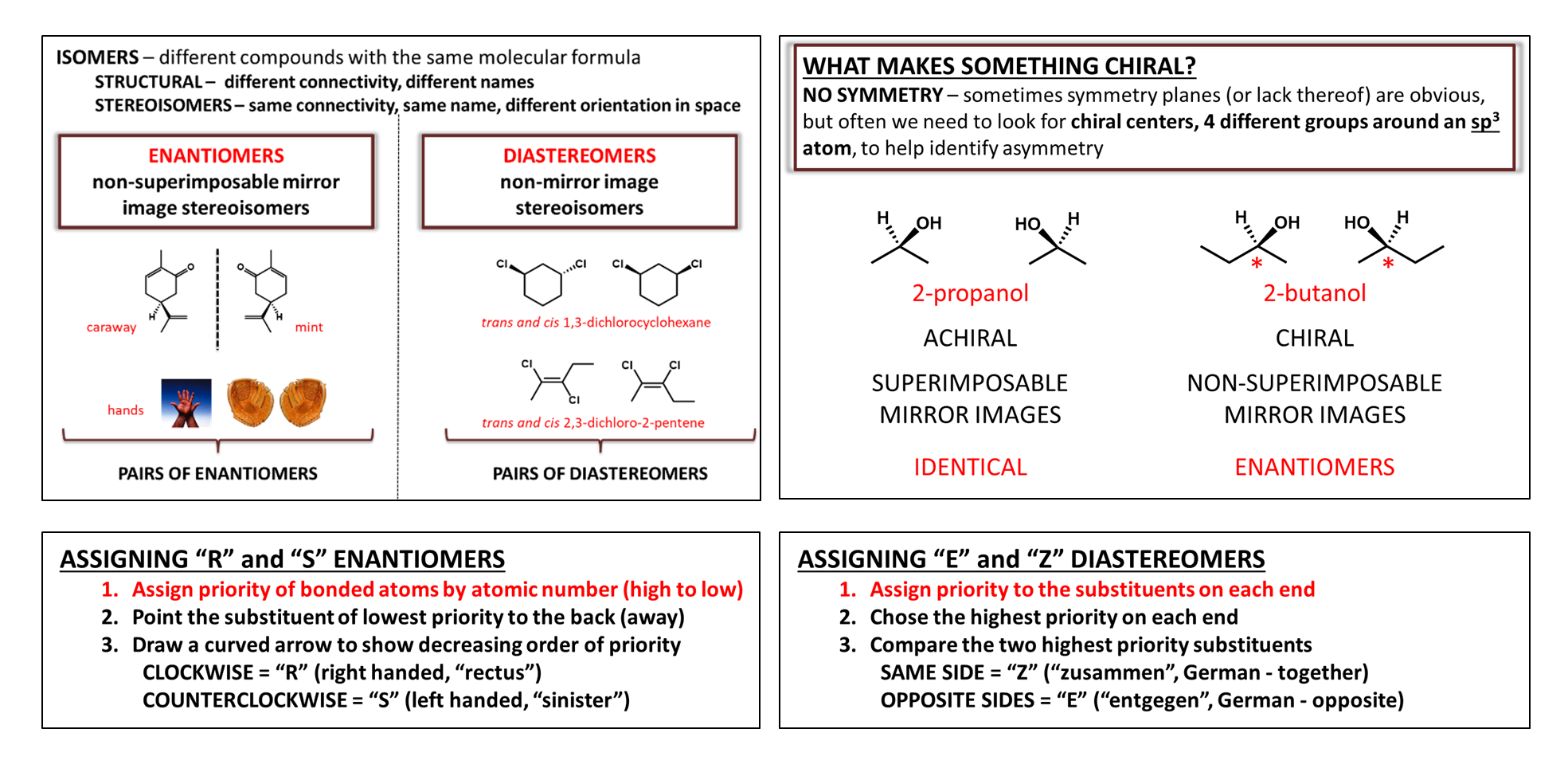
Enantiomers – mirror image stereoisomers, same connectivity (same IUPAC name)
Diastereomers – non-mirror image stereoisomers, same connectivity (same IUPAC name)
Structural isomers – same formula, but different connectivity (different IUPAC name)
Resonance structures – same structure, different localization/view of pi electrons
This page is referenced by:
-
1
media/section 2 key image.png
2020-02-09T17:05:19-08:00
Lecture 6: Stereochemistry I
4
image_header
2020-08-28T08:08:57-07:00
Objectives and skills
KEY INFORMATION SUMMARY
PROBLEMS
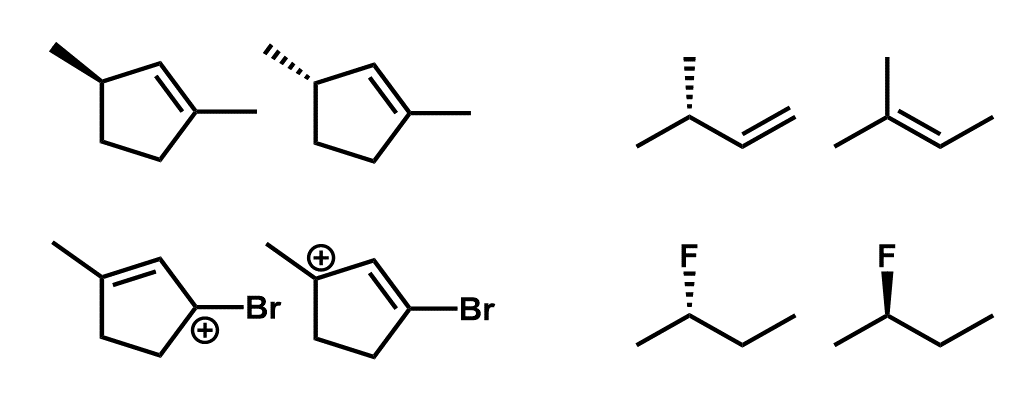
Problem 6.1: Isomers - Label each of the following pairs of structures as enantiomers, diastereomers, structural isomers, or resonance structures. SOLUTION
- Explain the differences between the terms listed above. SOLUTION
If you made some mistakes or want to practice more, review the concepts that gave you trouble and work on this extra problem. If you're good, move to the problem below ;)
Problem 6.2: Mirror images and enantiomers
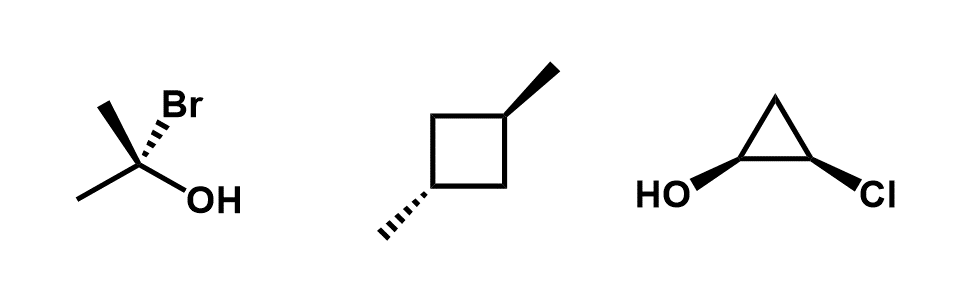
Draw the mirror image of each structure below and determine if the images are superimposable (and represent the same compound) or non-superimposable (and represent enantiomers). SOLUTION
If you made some mistakes or want to practice more, review the concepts that gave you trouble and work on this extra problem. If you're good, move to the problem below ;)
Problem 6.3: Stereoisomer notations - Rank the following substituents in terms of chirality priority: -OH, -SH, -Br, -C(CH3)3, -CH2OH. SOLUTION
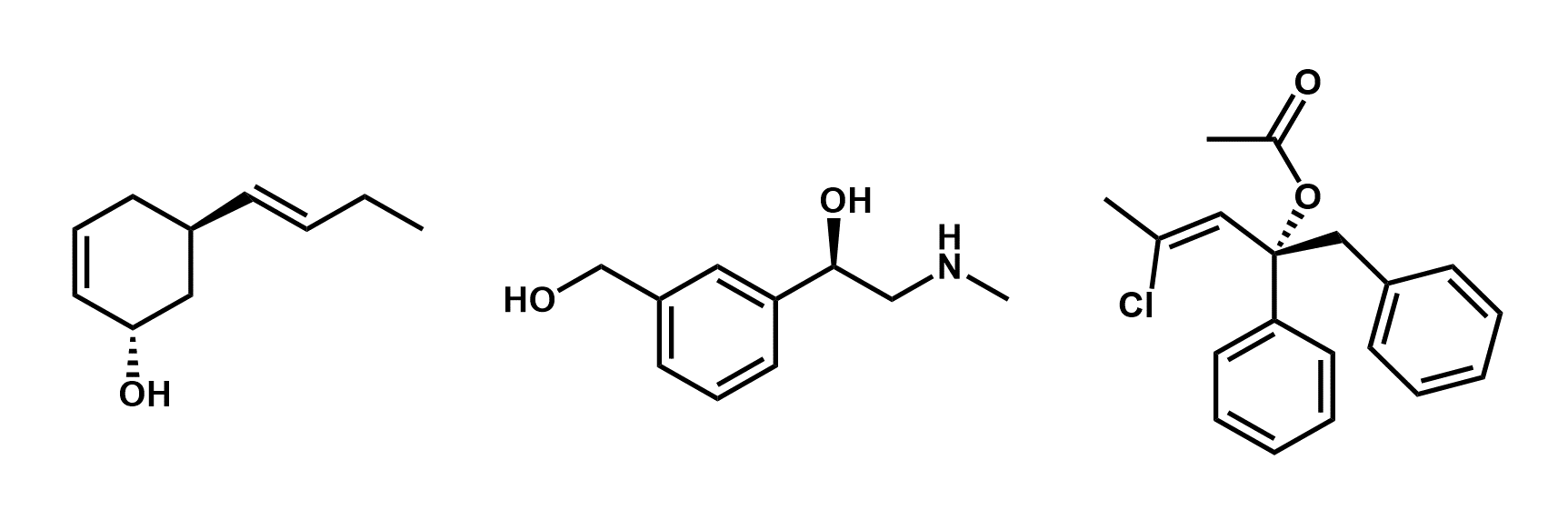
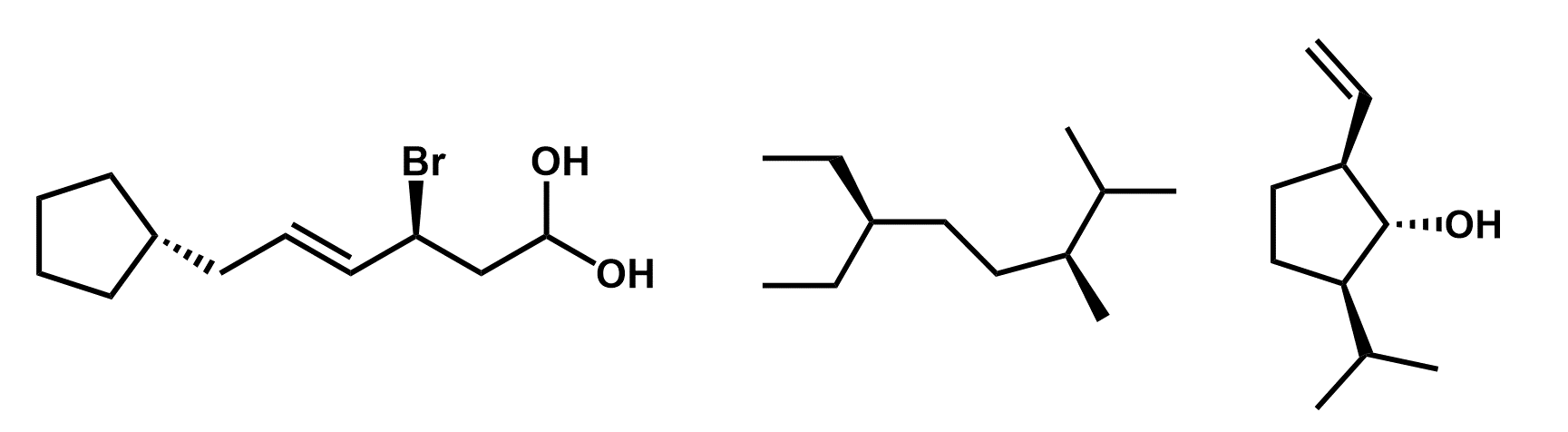
- Circle all the chiral centers in the structures below and label with R/S notation. SOLUTION
- Circle all the alkenes (ignore benzene rings) in the structures below and label with E/Z notation. SOLUTION
If you made some mistakes or want to practice more, review the concepts that gave you trouble and work on this extra problem. If you're good, move to the problem below ;)
Problem 6.4: Stereochemistry and nomenclature - Draw accurate structures (using wedges/dashes) to represent (2R,3S)-2,3-dichloropentane, (2S,3S)-2,3-dichloropentane, (2E,4S)-4-chloro-3-phenyl-2-penten-2-ol. SOLUTION
- Determine the IUPAC name of each structure below. SOLUTION
If you made some mistakes or want to practice more, review the concepts that gave you trouble and work on this extra problem. If you're good, move to the next lecture ;)