Thanks for your patience during our recent outage at scalar.usc.edu. While Scalar content is loading normally now, saving is still slow, and Scalar's 'additional metadata' features have been disabled, which may interfere with features like timelines and maps that depend on metadata. This also means that saving a page or media item will remove its additional metadata. If this occurs, you can use the 'All versions' link at the bottom of the page to restore the earlier version. We are continuing to troubleshoot, and will provide further updates as needed. Note that this only affects Scalar projects at scalar.usc.edu, and not those hosted elsewhere.
Organic ChemistryMain MenuLecture 1: Introduction to Molecular OrbitalsLecture 10: Intermolecular Forces and Intro to ReactivityLecture 11: Alkenes as Nucleophiles ILectures 12 and 13: Alkenes II & IIILecture 14: Benzenes as Nucleophiles ILecture 2: Molecular Orbitals in Organic StructuresLecture 3: Molecular Orbitals and ResonanceLecture 4: Molecular Orbitals and AromaticityLecture 5: Nomenclature and IR SpectroscopyLecture 6: Stereochemistry ILecture 7: Stereochemistry IILecture 8: Newman and Fisher ProjectionsLecture 9: Conformations and Cyclohexane RingsJulio Terra2fb22914f73f9e5a767bf7fb83987dca0e153e4a
Draw a mechanism and reaction coordinate diagram to describe the reaction below. SOLUTION
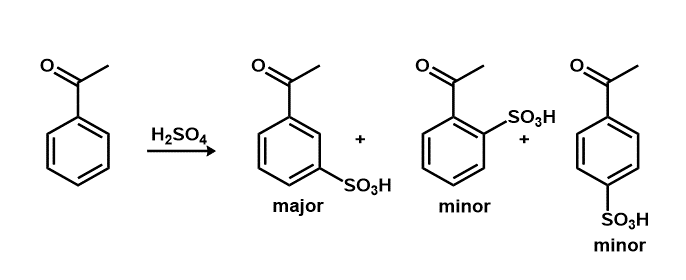
Explain why the major product is favoured. SOLUTION
If you made some mistakes or want to practice more, review the concepts that gave you trouble and work on this extra problem. If you're good, move to the problem below ;)
Problem 15.2: Reactivity
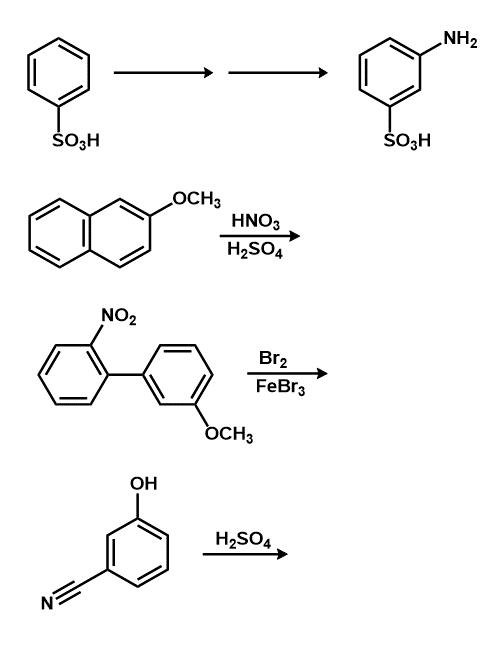
Fill in the missing pieces to complete the transformations below. SOLUTION
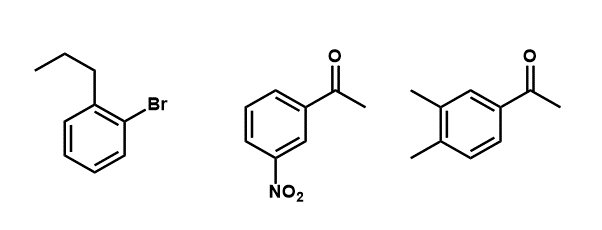
Propose a reasonable synthesis of each of the following molecules from benzene. SOLUTION
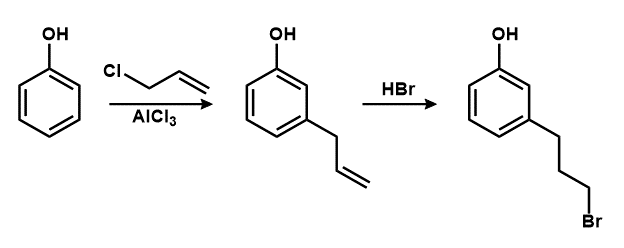
Find the error(s) in the two-step synthesis below. Propose a corrected synthesis. SOLUTION
If you made some mistakes or want to practice more, review the concepts that gave you trouble and work on this extra problem. If you're good, move to the next lecture!! ;)