Thanks for your patience during our recent outage at scalar.usc.edu. While Scalar content is loading normally now, saving is still slow, and Scalar's 'additional metadata' features have been disabled, which may interfere with features like timelines and maps that depend on metadata. This also means that saving a page or media item will remove its additional metadata. If this occurs, you can use the 'All versions' link at the bottom of the page to restore the earlier version. We are continuing to troubleshoot, and will provide further updates as needed. Note that this only affects Scalar projects at scalar.usc.edu, and not those hosted elsewhere.
Organic ChemistryMain MenuLecture 1: Introduction to Molecular OrbitalsLecture 10: Intermolecular Forces and Intro to ReactivityLecture 11: Alkenes as Nucleophiles ILectures 12 and 13: Alkenes II & IIILecture 14: Benzenes as Nucleophiles ILecture 15 objectives and skillsLecture 2: Molecular Orbitals in Organic StructuresLecture 3: Molecular Orbitals and ResonanceLecture 4: Molecular Orbitals and AromaticityLecture 5: Nomenclature and IR SpectroscopyLecture 6: Stereochemistry ILecture 7: Stereochemistry IILecture 8: Newman and Fisher ProjectionsLecture 9: Conformations and Cyclohexane RingsJulio Terra2fb22914f73f9e5a767bf7fb83987dca0e153e4a
Determine units of unsaturation for benzene and other cycloalkenes.
Understand the limitations of Kekulé structure of benzene.
Draw resonance structures and interpret MO diagram of benzene p-system.
Recognize cyclic delocalized p-systems.
Apply Huckel’s rule to determine aromatic, anti-aromatic, and non-aromatic classifications for rings (including heterocycles and cation/anonic organic ring structures).
Draw p-system MO diagrams for conjugated ring structures.
Rationalize aromaticity in polycyclic aromatic hydrocarbons (PAHs).
Skills
Critical assessment using abstract concepts
Comparison of fine details
Connection of chemical properties to biochemical properties
This page is referenced by:
1media/kisscc0-atomic-orbital-computer-icons-chemistry-orbitals-5b7136eca13a03.6431040415341462846604.png2020-02-01T13:09:01-08:00Lecture 4: Molecular Orbitals and Aromaticity6image_header2020-02-06T19:04:36-08:00Objectives and Skills
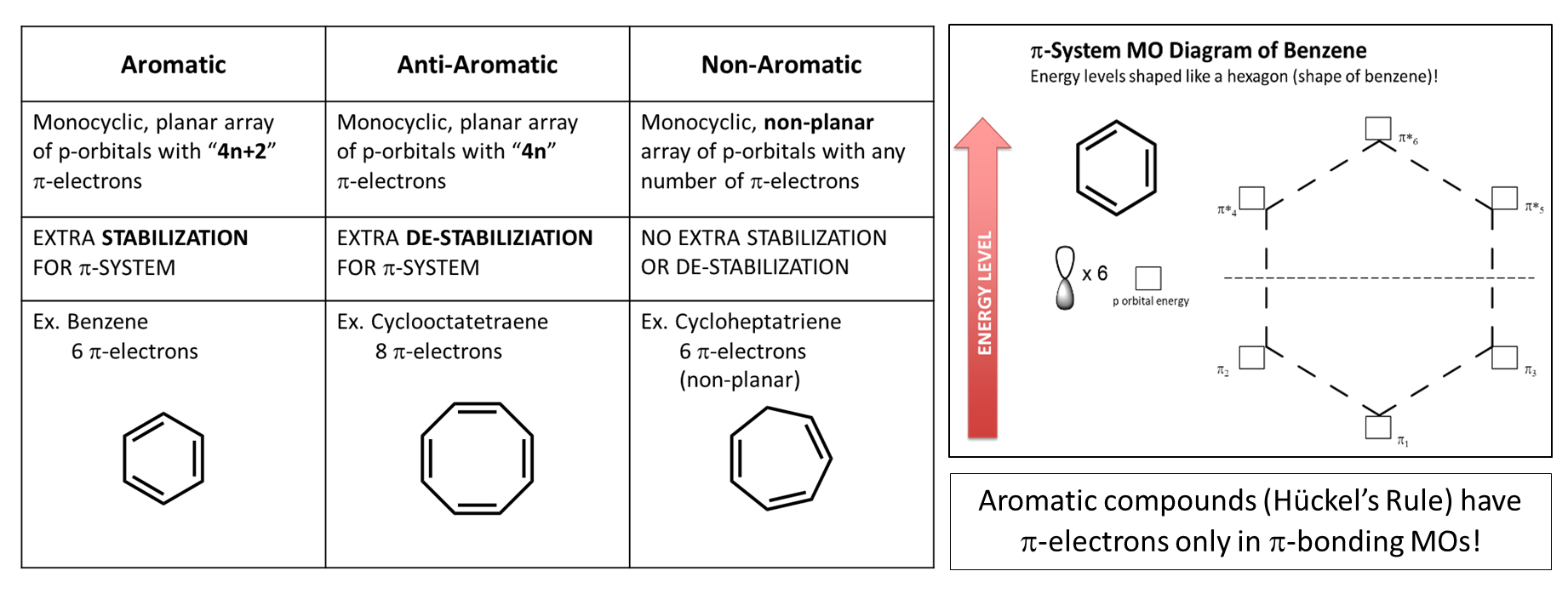
KEY INFORMATION SUMMARY
HERE you can find extra resources to help you with this lecture!
PROBLEMS
Problem 4.1: Benzene Properties
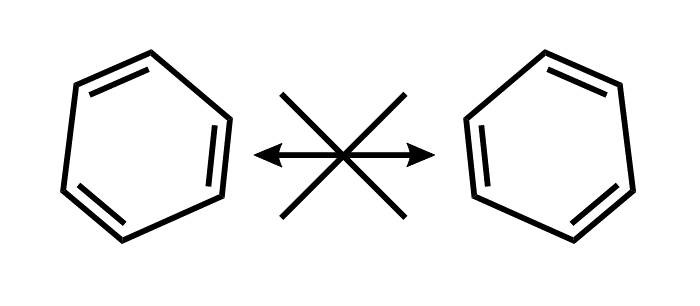
Explain why we cannot use two Kekulé structures (alternating single-double C-C bonds of different lengths) to show benzene resonance. SOLUTION
Draw the proper resonance structures for benzene. SOLUTION
If you made some mistakes or want to practice more, review the concepts that gave you trouble and work on this extra problem. If you're good, move to the problem below ;)
Problem 4.2: Aromaticity
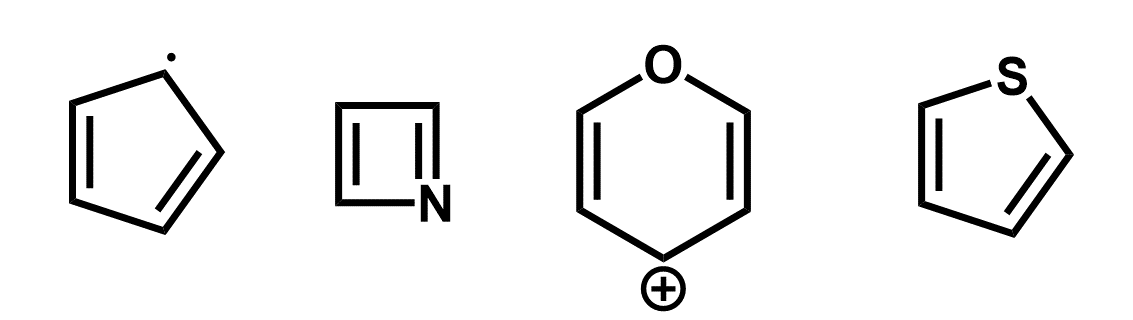
Assign the classification of aromatic, anti-aromatic, or non-aromatic to each of the structures below using Hückel’s Rule and check your classifications using the polygon method for p-system MO. SOLUTION
If you made some mistakes or want to practice more, review the concepts that gave you trouble and work on this extra problem. If you're good, move to the problem below ;)
Problem 4.3: Polycyclics and Ring Shapes
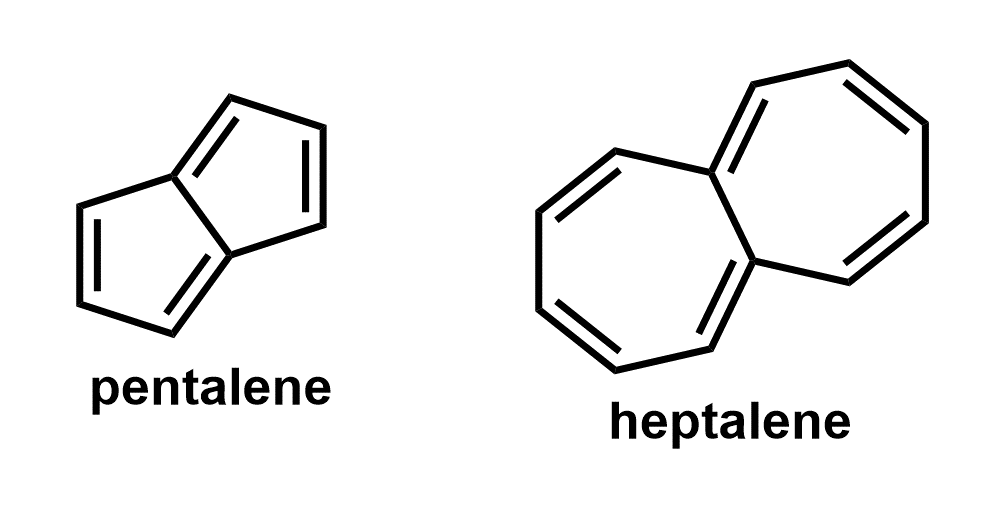
Pentalene is unstable, even at -100°C, whereas heptalene can be made and is shown to react like a acyclic alkene. Explain the difference. SOLUTION
If you made some mistakes or want to practice more, review the concepts that gave you trouble and work on this extra problem. If you're good, move to the next lecture ;)