The consensus statement
1 2023-12-08T20:03:58-08:00 Bonnie Morris/Julia Tanenbaum/Angela Brinskele ef6dc7f76d6383521c985b036594e440c4099a58 43632 1 Written by Nancy MacNeil to summarize the efforts towards changing the CDC definition of AIDS in women. Covers testimonty given at a public meeting between AIDS activists and medical and healthcare professionals. 2023-12-08T20:03:58-08:00 Bonnie Morris/Julia Tanenbaum/Angela Brinskele ef6dc7f76d6383521c985b036594e440c4099a58This page has tags:
- 1 2023-12-15T20:13:30-08:00 Bonnie Morris/Julia Tanenbaum/Angela Brinskele ef6dc7f76d6383521c985b036594e440c4099a58 Mary Lucey and Nancy MacNeil Collection Bonnie Morris/Julia Tanenbaum/Angela Brinskele 6 plain 2024-03-25T19:32:36-07:00 Bonnie Morris/Julia Tanenbaum/Angela Brinskele ef6dc7f76d6383521c985b036594e440c4099a58
This page is referenced by:
-
1
2023-11-13T14:45:07-08:00
Changing the CDC Definition
30
plain
2024-06-23T10:14:13-07:00
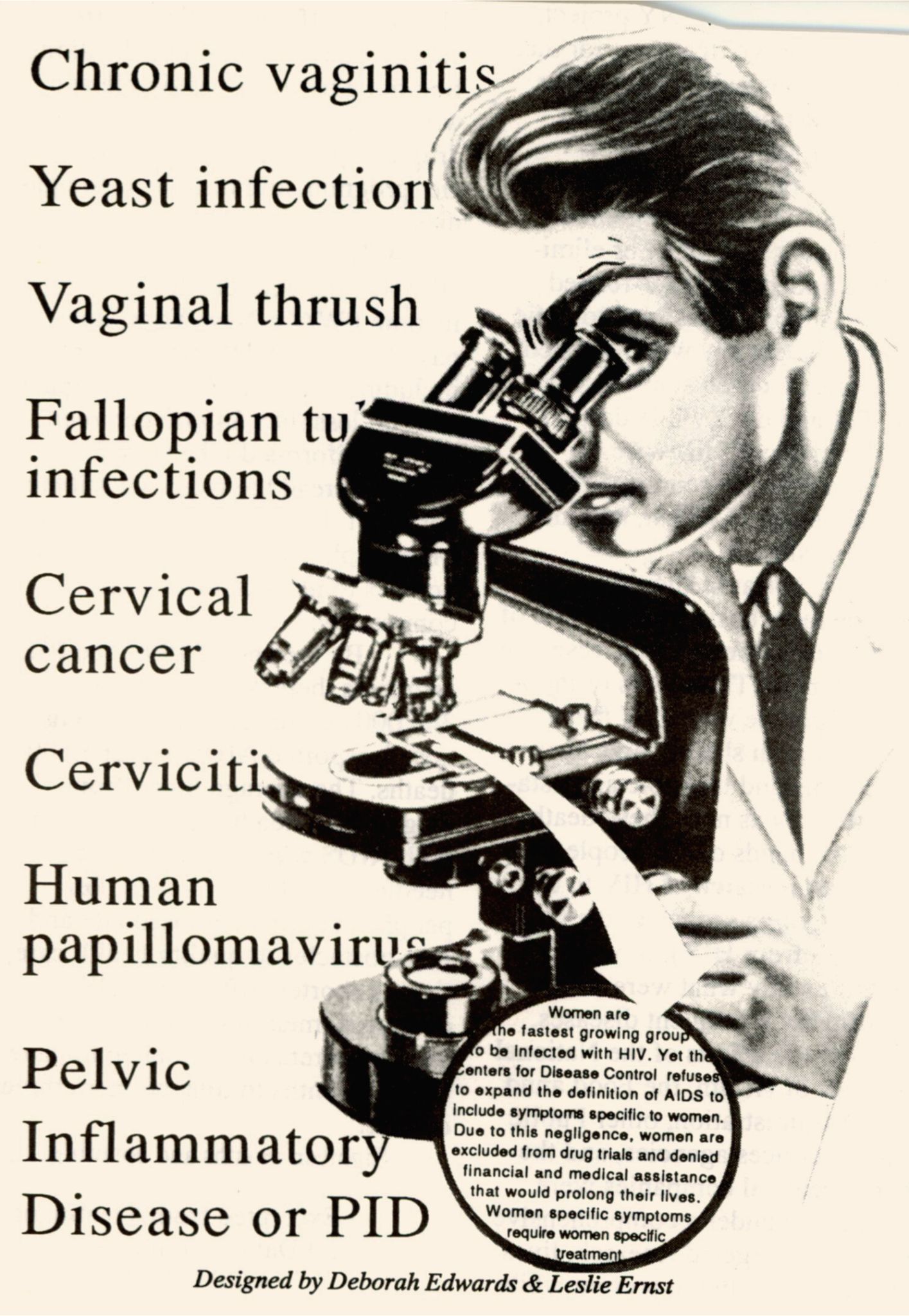
Women Falling Through the CracksThe CDC’s definition of AIDS was biased towards how the disease appeared in men. Women, especially women of color, who were getting AIDS were not being diagnosed, and therefore not receiving treatment and quickly dying. According to statistics compiled in 1994 by AIDS Project Los Angeles, more than three-fourths of women with AIDS were Black and Hispanic, and the two primary modes of transmission were intravenous drug use and heterosexual contact with at-risk partners,[1] though transmission between lesbians and women sleeping with women was not counted.
“...when it comes to women AIDS activists, the sexism, racism, and lespophobia [sic] of these researchers becomes apparent. They assume that any white woman AIDS activist is a lesbian, HIV-, has never been pregnant and has no children. On the other hand, they assume that any Latina or Black woman AIDS activist is heterosexual, HIV+, has been pregnant and does have children. None of these assumptions are correct. The researchers don't even talk about Native Americans or Asian Pacific Islanders.”[2]
The expansion of the CDC’s definition would change the criteria in testing for AIDS in women, raising the number of T cells that indicate when HIV has progressed to AIDS. The new definition would also include clinical manifestations, also called opportunistic infections (OI) or co-infections, other diseases that appear because of the progression of the virus to AIDS. These persistent OI were often gynecological, and overlooked, misdiagnosed, or ignored by doctors because they look like other diseases, or were reported by intravenous drug users (IDU), in which HIV/AIDS can appear differently. Some of these opportunistic infections include: [3]
- Bacterial Infections
- Chronic vaginal yeast infections
- Recurrent bacterial pneumonia
- Pulmonary Tuberculosis
- Cervical cancer
- Tuberculosis
- Sexually Transmitted Diseases
- Malignancies
- Human T-lymphotropic virus 2 (HTLV-II)
- Hepatitis
The expansion to the definition of AIDS would lead to more accurate counting of those debilitated from HIV/AIDS in healthcare surveillance, more inclusive research for AIDS treatments and cures, and more money devoted to research. To individuals, this recognition and more accurate diagnosis would bring treatment, support and counseling, preventative education to slow the spread, and agency to make more informed decisions about their health. It was understood that the impact of this affects not just women, but ALL affected by HIV and AIDS.
Demanding ChangesAfter disappointing talks with Dr. James Curran, leader of the CDC’s HIV/AIDS task force in November 1989, AIDS activists launched a national campaign to raise awareness on women getting AIDS were falling through the cracks of healthcare action and policy regarding HIV/AIDS. The first demonstration was in Atlanta in February 1990, and on World AIDS Day, December 1, 1990 across the US, activists protested the CDC.[4]
In December 1990 after years of pressure from AIDS activists, the first Women and HIV Conference was held. There, HIV+ women and allies demanded changes to the CDC definition, changes to disability regulations regarding HIV/AIDS, and the inclusion of women in clinical trials. They confronted Dr. James Curran, Dr. Anthony Fauci, head of the National Institute of Allergy and Infectious Diseases (NIAID), and Dr. Dan Hoth, director of the Division of AIDS (DAIDS) at NIAID.[5]
In June 1991, continued protests demanded that 13 clinical manifestations of AIDS seen in women and injected drug users be added to the definition. Only in November was a single revision agreed upon by the CDC, listing 200 T-cells as a condition for AIDS diagnosis. Disagreement between activists and the CDC researchers continued with no changes being made. Eventually on September 2, 1992,[6] in a public meeting with CDC researchers, and Dr. Curran, ACT UP Women’s Coalition agreed on the following statement:“The Coalition Consensus Statement Is: The Surveillance Definition of AIDS must be expanded to include the following conditions when found in the presence of HIV infection. 1) Cervical Cancer. 2) Pulmonary Tuberculosis. 3) Recurrent Bacterial Pneumonia. Without modification of the definition to include these additional conditions, countless individuals will continue to become ill and die without ever receiving an AIDS diagnosis.
We chose these three conditions in an attempt to satisfy the CDC's concern that only illness with an established link to HIV and with high rates of morbidity and mortality should be included in the definition. We chose these three conditions out of our original list of 13, because despite the CDC's double standard, we have the most thorough documentation on the three listed. The coalition does not accept that the inclusion of 200 T-Cells will result in an accurate enough surveillance. Many of us continue to have reservations about the exclusion of other conditions and we are convinced that what constitutes AIDS is more than 26 illnesses. However , we propose this consensus statement because time is of the essence. In an effort to move forward the coalition offers this consensus statement in its entirety as a workable solution to the stalemate on expanded surveillance.”[7]
This meeting included a series of panels to present arguments on each proposed condition to be added to the definition. On each was a woman representing HIV+ community members. There were portions where audience members were allowed to provide testimony, ask questions, or generally speak. In Nancy MacNeil’s transcript and commentary of this event she documents women who tell their experience living with HIV, AIDS, and opportunistic infections (OI) that manifest alongside the disease.
Some of the testimonies given in the meeting on September 2, 1992:
"I've waited over two years for this opportunity, two years, more often than not, for a woman living with HIV/AIDS in America is a lifetime. In this the second decade of AIDS it is ludicrous that we are still discussing that HIV manifests itself gynecologically in women. How can anyone be so absurd as to say that pelvic Inflammatory Disease, that occurs every time that a woman menstruates, with pain so bad that when it's happening she faints, is not debilitating enough to be considered to be life threatening? In 1986, I had a yeast infection that became so aggravated that my clitoris was so swollen that it hung below my vaginal lips. There was no physician that could give me comfort. I now get vaginal yeast infections every month. They are not the kind that you see those pretty women comfortably sitting on couches advertising for over the counter brand cures. Mine are so severe, I cannot sit, stand or lie down comfortably. The itching and burning becomes so intense that I cannot sleep and if I do fall asleep, I sometimes scratch myself, which leads to other infections that are generally treated with antibiotics, that give me the yeast infections again. I find it suspect that although vaginal yeast infections have been around for ages...precisely at the time that female AIDS activists began to apply pressure to CDC to get the word out that chronic vaginal yeast infection was a sign of HIV infection in women, pharmaceutical companies suddenly came out with an over the counter cure. Now women could quietly cure themselves, at home, alleviating the responsibility of the medical community, and letting the CDC off the hook. It makes sense to me...think about it. Between 1984 and 1987, I had six hospitalizations for recurrent bacterial pneumonia. Two of those coupled with endocarditis again. In 1988, I presented with cervical dysplasia. I want to note here that on each one of those hospitalizations, I was discharged. I was also homeless, actively an intravenous drug user and selling myself by having unprotected sex in exchange for my drug. No one ever bothered to ask me to get tested for HIV. In 1990, I had to have a hysterectomy due to cervical cancer. The day of my hysterectomy, I was finally diagnosed "HIV Positive". The only reason I was tested is because I told my surgeon that my ex-boyfriend had tested positive a month before. I am in no way unique! Recurrent bacterial pneumonia, cervical cancer, chronic vaginal yeast infections and pulmonary tuberculosis, are more common than not in HIV positive women. ... IF I, A LAY PERSON, KNOW THIS?, THEN HOW CAN THE CDC WHO SET POLICY FOR THIS ENTIRE NATION NOT KNOW THIS? ! ? The horror of your neglect is that unfortunately, other countries throughout the world use the CDC definition for an AIDS diagnosis. Common sense tells you, if your definition is based on tests done primarily on men, then women whose internal organs are entirely different will present with different diseases. [...] It's strange to live in a country that first, due to my race, then my gender, my economic and now my health status, considers me unnecessary. Your message seems to be that "We'll let you all talk and then hopefully, you'll get tired enough and sick enough to be quiet!" Well, let me tell you, THINK AGAIN!! My HIV positive sisters and I will continue for as long as it takes to be a visible and vocal lesion in the side of CDC policy makers until we are treated equally, by having our lives and our health considered as important as those of men. I leave you with these words...So that every time you hear my voice or see my face, you'll know that I am holding YOU accountable and YOU responsible for the unnecessary suffering of women the world over!! And I will not distort my voice, I will not cover my face and I certainly will not live the remainder of my life hiding in shadows!!! My name is Wendy Alexis Modesty, and I am a proud Afro-American Woman, who despite the CDC is LIVING with AIDS is Syracuse, New York.”[8]
”AIDS patients will be missed in the official national count if we are not first seen by physicians and second if the physician mis-diagnoses our symptoms. Right now those of us being excluded have little or no access to health care, including drug rehabilitation. We do not have primary care physicians or access to expensive testing. Due largely to institutionalized racism and sexism, in this country, both economic and otherwise, a disproportionate number of women, mostly Afro-American and Latinas are infected and going untreated. We do not have access to private health care. We have to use public health care systems, when necessary and if they are available. Many of us do not seek healthcare until we are very ill. It is essential that the true scope of this epidemic be recorded, and indicator diseases affecting all people with HIV/AIDS are recognized and represented in the CDC definition of AIDS." Kerri Durran, ACT UP/Boston [9]
Read the full report written by Nancy.
Citations
[1] AIDS Project Los Angeles, “AIDS Among Women–United States 1994,” February 27, 1995, drawer 01-01, folder 5, subfolder 2, Subject Files, The June L. Mazer Lesbian Archives, Los Angeles, CA.
[2] Maxine Wolfe, “The ACT UP Network Women’s Issues Committee at the December ACTG Meetings,” January 31, 1992, box 1, folder 9, Mary Lucey and Nancy MacNeil Collection, The June L. Mazer Lesbian Archives, Los Angeles, CA.
[3] Nancy MacNeil, “A Report on The Patient Care Committee of the ACTG by ACT UP/LA's Treatment and Data Committee,” January 10, 1991, box 2, folder 12, Mary Lucey and Nancy MacNeil Collection, June L. Mazer Lesbian Archives, Los Angeles, CA.
[4] Nancy MacNeil, “The Consensus statement and the CDC - Transcript / Commentary,” 1992, box 1, folder 8, Mary Lucey and Nancy MacNeil Collection, The June L. Mazer Lesbian Archives, Los Angeles, CA.
[5] Nancy MacNeil, “The Consensus statement and the CDC - Transcript / Commentary,” 1992.
[6]Kenneth G. Castro, John M. Ward, and Laurence Slutsker, et al, “1993 Revised Classification System for HIV Infection and Expanded Surveillance Case Definition for AIDS Among Adolescents and Adults,” 1993, https://www.cdc.gov/mmwr/preview/mmwrhtml/00018871.htm.
[7] Nancy MacNeil, “The Consensus statement and the CDC - Transcript / Commentary,” 1992.
[8] Nancy MacNeil, “The Consensus statement and the CDC - Transcript / Commentary,” 1992.
[9] Nancy MacNeil, “The Consensus statement and the CDC - Transcript / Commentary,” 1992.