Thanks for your patience during our recent outage at scalar.usc.edu. While Scalar content is loading normally now, saving is still slow, and Scalar's 'additional metadata' features have been disabled, which may interfere with features like timelines and maps that depend on metadata. This also means that saving a page or media item will remove its additional metadata. If this occurs, you can use the 'All versions' link at the bottom of the page to restore the earlier version. We are continuing to troubleshoot, and will provide further updates as needed. Note that this only affects Scalar projects at scalar.usc.edu, and not those hosted elsewhere.
12017-06-08T14:13:32-07:00Anne Heath09732d720ba4faf961eef7443cd7fb56ebae6841190962From Album of Launay, 19th Centuryplain2025-03-04T03:25:05-08:00Anne Heath09732d720ba4faf961eef7443cd7fb56ebae6841
This page has annotations:
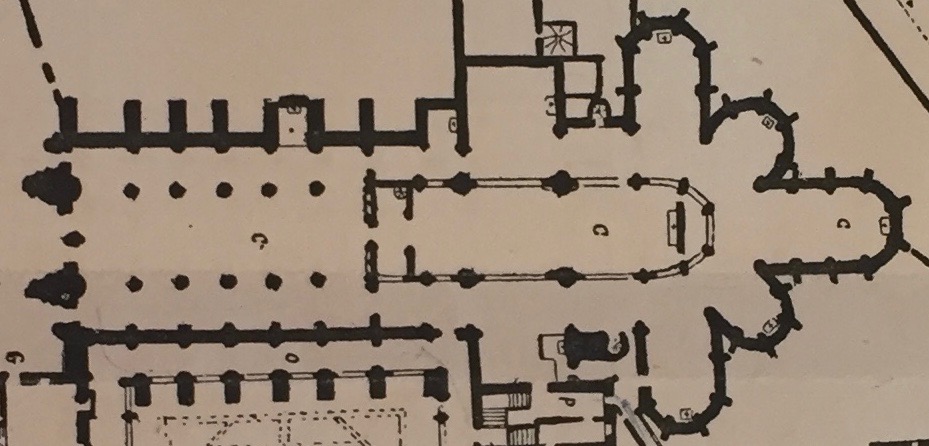
12017-06-08T14:14:09-07:00Anne Heath09732d720ba4faf961eef7443cd7fb56ebae6841Chapel of Mary MagdaleneAnne Heath5Vendome Floor Planplain2025-03-04T03:31:14-08:00Anne Heath09732d720ba4faf961eef7443cd7fb56ebae6841
12017-06-08T14:16:09-07:00Anne Heath09732d720ba4faf961eef7443cd7fb56ebae6841Church entrance after 1450Anne Heath5Vendome Floor Planplain2025-03-04T03:33:02-08:00Anne Heath09732d720ba4faf961eef7443cd7fb56ebae6841
12017-06-08T14:15:01-07:00Anne Heath09732d720ba4faf961eef7443cd7fb56ebae6841Public Presentation of the Holy TearAnne Heath3Vendome Floor Planplain2025-03-04T03:34:25-08:00Anne Heath09732d720ba4faf961eef7443cd7fb56ebae6841
12025-03-04T03:35:24-08:00Anne Heath09732d720ba4faf961eef7443cd7fb56ebae6841Chapelle des fontsAnne Heath2Stained glass of Miracle of the Holy Tearplain2025-03-04T03:36:34-08:00Anne Heath09732d720ba4faf961eef7443cd7fb56ebae6841
This chapter examines medieval people’s interaction with the Holy Tear through the lens of Lazarus Friday (Vendredi de Lazare), the Friday before Passion Sunday in the liturgical calendar, which started the pilgrimage season to La Trinité. I argue that the monks reserved La Trinité’s north aisle, built between the fourteenth and sixteenth centuries, for devotion to the Holy Tear.
The first section traces the pilgrimage route, which culminated in an encounter with the Holy Tear. First, Pilgrims proceeded along the north aisle to the chapel of Mary Magdalene, where he or she was confronted with three stained-glass windows with scenes in the life of Mary Magdalene. The path culminated in the choir where a device presented the Holy Tear suspended from gold chains to the pilgrims. The second section addresses the development of a private mass to the Holy Tear within the context of a chapel built into the nave, now called the Chapelle des Fonts. The final section examines the material culture of pilgrimage including pilgrims' badges indulgences and the processions founded by Louis de Bourbon count of Vendôme in 1428.
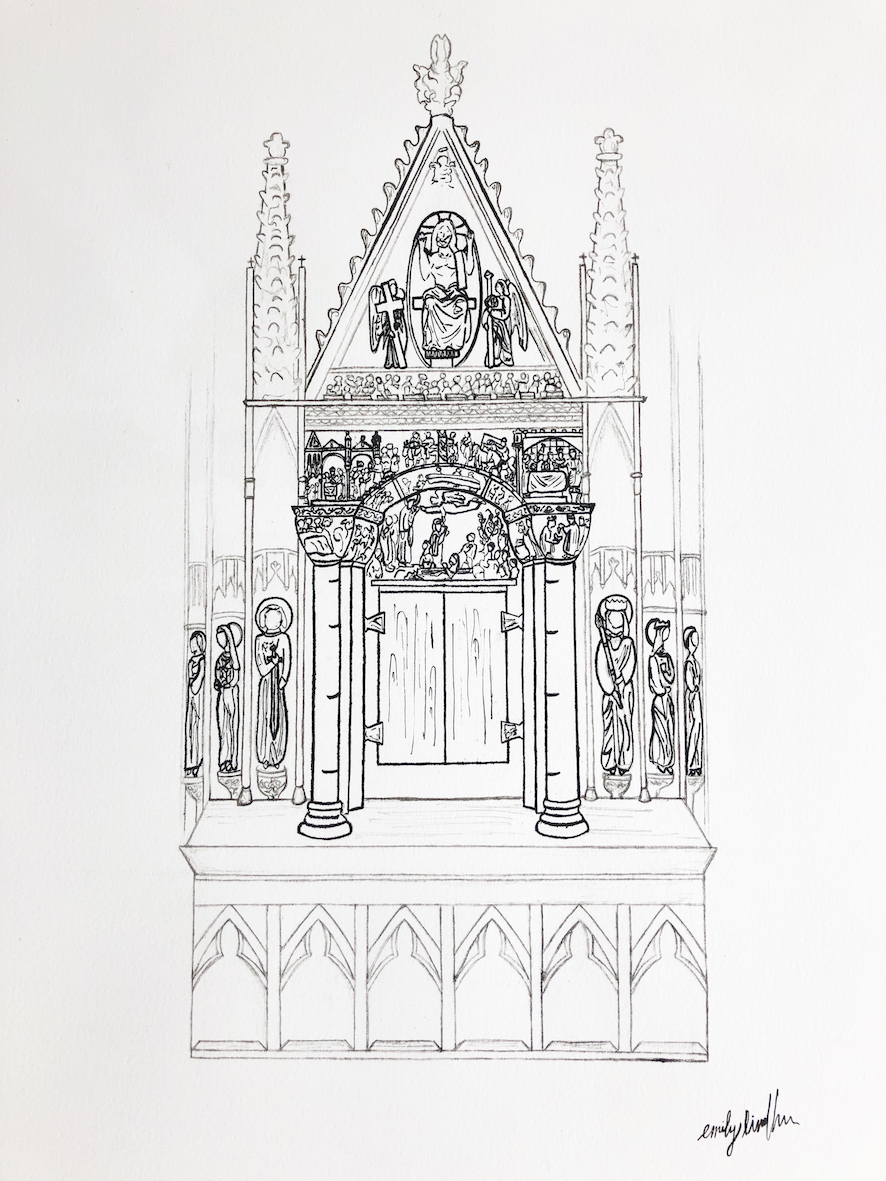
The two visual sources from Boudan and Mabillon depict the center portion of the shrine and focus on the sculptural imagery on the arch and architrave. However, a significant part of the shrine is missing from both representations. This may have been due to the artists’ interest only in the sculptural program relevant to the legend of the Holy Tear, or that the missing portion of the shrine could have been dismantled by the seventeenth century. The Benedictine monk Germain Millet, who was a resident at La Trinité as a member of the Congregation of St. Maur, offers a likely first-hand account of the shrine when it was installed in the choir.
We offer this potential reconstruction of the shrine based on Millet’s text and the visual sources by Boudan and Mabillon We also considered the marble tomb of Dagobert, a contemporaneous structure installed in the choir of Saint-Denis in Paris and the façade of Chartres Cathedral, as comparative monuments. Click on the images below to see the text from Millet, Histoire de la Sainte Larme, pp. 34-35.
The monks installed the shrine in the choir of La Trinité, with the shrine’s back lodged in the choir screen, so that the sculptural program faced inwards towards the altar.