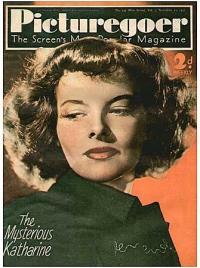
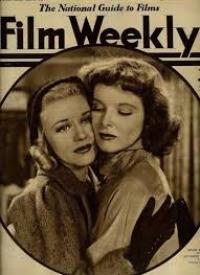
The Press: From Adoration to Animosity
Kate also sat down with Movie Classic’s James Fidler for a rare interview. The 1933 article, “Katharine Hepburn Answers Twenty Startling Questions,” discusses the rumors that Kate has $16 million and why she wears overalls around the studio (they are comfortable, save wear and tear on expensive clothes and it “amazes people.”) Kate also admits she has a temper, and when asked what she dislikes most about motions pictures, she responded “Publicity about my private life…. Interviewers—like yourself—pry until actresses have no secrets from the world.”
In a 1934 Photoplay article, Virginia Maxwell published a photo of Kate in Jeans, loafers and a trench coat smoking and wrote an article called, “Katharine Hepburn’s Inferiority Complex,” exploring how Katharine became a success without beauty or fame, within six months of landing in Hollywood. The article suggests that if Katharine had been “pretty as a child,” she would not have “become famous.” Fortunately, for Katharine, she was “intelligent enough to know she could not compete as a pretty child,” the psychologist Maxwell interviewed said. “So, it became important for her to achieve, to be somebody.” Maxwell comments that many people believe Hepburn has a “superiority complex.”
The positive press can be seen with other magazines as well from 1933 through 1935.With her star shining bright in Hollywood Hepburn tried to “make it” on Broadway. After a disastrous Broadway run in 1934 with “The Lake,” Kate was the subject of a three-page Kenneth Baker article in Photoplay Magazine in July 1934, titled “What’s ahead for Hepburn.” Although Kate did not speak to the press, Baker turned to the director of her films for comments, who painted her a victim of Broadway snobbery in the article. The magazine agreed, suggesting Kate devote her efforts to her work in Hollywood. If she does, Baker sees only one thing ahead for her … “a crown.”
Even the technical people behind the cameras were fascinated with Hepburn. A September 1933 Journal of the Society of Motion Picture engineers note that Katharine Hepburn has a “dual personality: her masculine phase finds its physical expression in a depressed forward larynx, which gives her the hard, clipped dry masculine voice. When she becomes emotionally feminine she [can breathe freely].”
But with stardom and power came arrogance. Hepburn became increasingly private, refusing most interviews and refusing to attend celebrity functions. An April 1937 Screenland Editor’s Page open letter to Hepburn foreshadowed Hepburn’s exile from Hollywood. Admonishing her disdain for fans and fan magazines, the editor publishes a large photo of Hepburn holding a tennis racket over her face to prevent the press from taking a picture of her. After describing her atrocious behavior to a young female reporter, the editor notes that Hepburn’s appearance in “Sylvia Scarlett,” was mediocre compared to Cary Grant and that her next film, “A Women Rebels” would have been more aptly titled “And so did the audience.” The editor warns Hepburn to come down off her “self-constructed pedestal.” And, later listing all of the stars who know how to play the game with the press, the Editor concludes, the astute business woman I believe you to be, if not the artist I hoped you were, is seemingly blind to signs and portends. Wear slacks under a mink coat; cover your face if you wish. But you’d better be good on the screen. Or do you want to turn into Hepburn the Invisible Woman.”
The backlash is evident from columns written by these film magazines. For example, a July 1938 Photoplay spread by Adelheid Kaufmann, “What! Another Scarlett O’Hara,” laid out the fans and press’s problems with the “Great Kate” quite bluntly. Reporting on the ‘wrap’ of the picture “Holiday,” he noted that “everyone noticed that Hepburn—the hellion of Hollywood—had become a tame little lamb. No longer did she object when a few chosen visitors were allowed to visit her set….[and] to everyone’s surprise the unsociable Hepburn stayed [through the company party…. Hepburn was completely charming and natural. Gone was all trace of the enfant terrible of former days.” Attributing this off-screen image transformation as related to her attempt to secure the lead role as Scarlett O’Hara, the author noted that objections to her lack of feminine sexuality, not on-set personality was the core problem.
Recognizing Hepburn’s ongoing problem with the press, Photoplay quoted Hepburn in a July 1938 issue, “If I don’t feel like having my picture taken at a tennis match, why should I? If I feel like putting my hands over my face, why shouldn’t I. Posing for pictures takes time. You know that I will not be anything but myself for anybody. Why don’t you leave me alone?” Likewise, a fan letter to Photoplay in September 1936 opined, “I still can’t see what people see in Katherine Hepburn. You can’t possibly call that brusqueness, those stiff gestures, that fierceness of her nostrils charming… We want feminine girls on the screen, and by feminine I don’t mean cute.”
Absent off-screen positive publicity, the audience can only see the fabricated character on screen as the “real” Hepburn, not the human within (as ideally constructed by the studios and star).