Thanks for your patience during our recent outage at scalar.usc.edu. While Scalar content is loading normally now, saving is still slow, and Scalar's 'additional metadata' features have been disabled, which may interfere with features like timelines and maps that depend on metadata. This also means that saving a page or media item will remove its additional metadata. If this occurs, you can use the 'All versions' link at the bottom of the page to restore the earlier version. We are continuing to troubleshoot, and will provide further updates as needed. Note that this only affects Scalar projects at scalar.usc.edu, and not those hosted elsewhere.
Josie Andrews 412 Midterm Projects
Main Menu
Introduction
The Ideological Function of Stars: Contradictions and Promises of Individualism.
Prompt Analysis
Little Women (George Cukor 1933)
Tomboyism: Negotiating and Celebrating a Strong, Sprited Woman in the Great Depression
Sylvia Scarlett (George Cukor, 1936)
"Woman of the Year" (George Stevens, 1942)
Conclusion
Bibliography
CATCH ME IF YOU CAN
The Contradictions and Promises of Individualism in the Films of Katharine Hepburn 1933-1942
Josephine Andrews
3a113b8327c230bc7c10dd21f21428c4f7bcd00c
Sylvia Scarlott
1 2018-03-04T03:58:57-08:00 Josephine Andrews 3a113b8327c230bc7c10dd21f21428c4f7bcd00c 28637 1 Film Still 1 plain 2018-03-04T03:58:57-08:00 Josephine Andrews 3a113b8327c230bc7c10dd21f21428c4f7bcd00cThis page is referenced by:
-
1
media/Scarlet3.jpg
2018-03-04T05:36:03-08:00
Sylvia Scarlett (George Cukor, 1936)
28
plain
2018-03-11T17:52:19-07:00
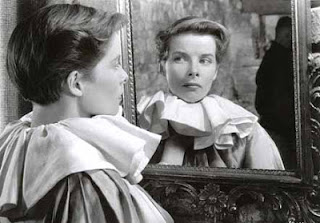
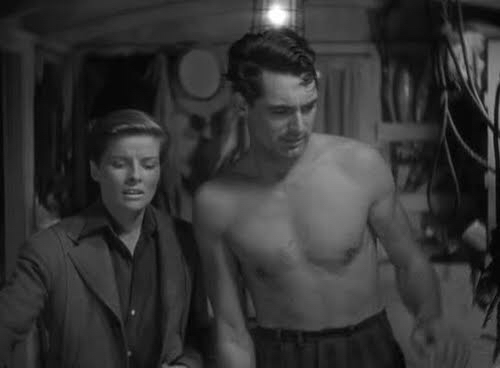
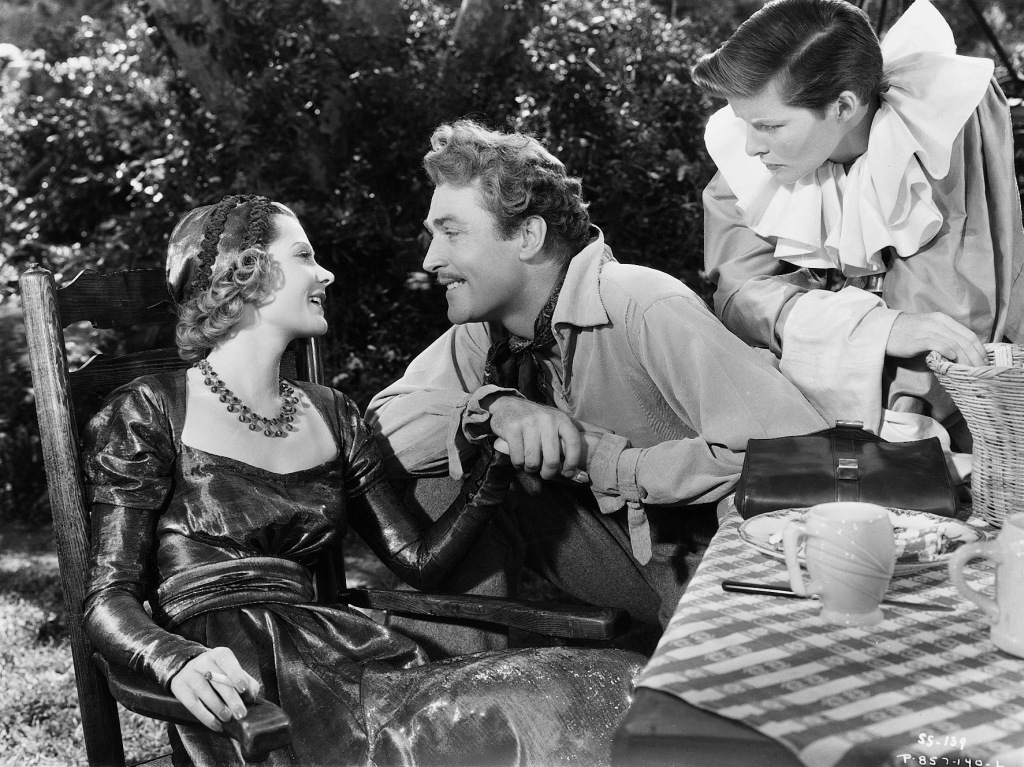
With Little Women and an Oscar to her credit (Morning Glory, 1933), Hepburn had become an accomplished actress that was adored by fans and critics alike. Exuding charm and vitality, she gave such an inspired performance as Jo that the audience seemed to go along with whatever she did. She received a second Oscar nomination in 1935 for her performance in Alice Adams (George Stevens, 1935). Suddenly, Hepburn discovered she could write her own ticket. The ticket she chose was a series of gender-bending films, including George Cukor’s film, Sylvia Scarlett (1935), a quirky British tale of a con artist and his daughter (Hepburn), a cross-dressing teen who chops her locks to accompany her dad on his escape from France. Along the way, they meet a bigger con, Monkley (Cary Grant), a daffy maid Maude who funds their traveling “Pink Pierrot” show, Michael Fane, an artist Sylvia falls in love with, and Lily, a rather self-centered wealthy Russian woman who supports Fane.
The role was perfect for Hepburn. She gets to don men’s pants, dance around the countryside as a teenage boy, drink, and have all the freedoms of a man. Unfortunately, the film was negatively framed as one of the queerest films ever made in Hollywood, and the role and film were not perfect for a 1935 audience (Doty 35). Most critics of the era panned it, and it was a complete box office disaster.
This was a clear example of when contradictions between a star’s image and other intertextual images and norms were so fundamental, the star image completely broke down. There are a myriad of contradictions but the most irreconcilable are: (1) Sylvia disregards all codes of femininity and never manages or fully resolves them at the end; and (2) Hepburn’s on-screen performance of a goodhearted, vulnerable, but independent young woman could not be reconciled with her public persona of her “real” self as one of an unsociable, unlikable shrew, who scorned her fans and the press.
While Hepburn’s androgynous look is highly sexy, Sylvia disregarded all codes of femininity. Cross-dressing has transformed Hepburn’s persona into a young teenage boy. The romantic lead, Michael Fane, ponders what attracts him to Sylvester and he says “I know what it is that gives me a queer feeling when I look at you!” The audience knows too, and it is bothersome that he is attracted to someone who is a young pretty boy. We have hope for Sylvia when she falls in love with Michael and steals the dress to transform into an attractive young woman. Fane professes relief that Sylvia is a woman—explaining his attraction. But, he also calls her “a freak of nature,” (again a homophobic word), when Sylvia cannot walk ladylike, talk ladylike or even sit ladylike as she did in the beginning of the film. Eventually, when Sylvia must put back on her boys’ clothes, the two fall in love. But, when they escape the train at the end and kiss, you still feel as if you just watched an older man seduce a young teen boy. And, the "kiss" scene between Maude and Sylvia.... well, just watch:
Even more significantly, Sylvia’s violation of feminine codes essentially declares to the audience that women no longer needed to be attractive to men. Whether this is true because men are attracted to other men (Fane’s attraction to Sylvester), or simply because women no longer want to be the object of the male gaze, neither contradiction is managed or reconciled by Hepburn in the film or off-screen. To the contrary, as Dyer explains in his Marilyn Monroe analysis, men and women both find pleasure from being seen as desirable by others, and to suggest otherwise is not something most fans would choose to identify with. This contradiction is irreconcilable.
Sylvia Scarlett would eventually lead to Hepburn being labeled box office poison in 1938, and her temporary return to the east coast. The core problem: Hepburn did not understand the intertextual nature of her star image as an aristocratic “independent woman” or its relationship to social norms and acceptable transgressions of feminine boundaries. She suffered from hubris at a time when her star image already included words like “too masculine,” “too aggressive,” and “too rough” (Britton). Yet, Hepburn did nothing to make herself more acceptable to the feminine codes of the 1930s or more accessible to the fans so they could embrace her eccentricities.
Off-screen, the public initially embraced her eccentricities, as evidence by a 1933 Movie Classic Magazine article; “Will It Be Trousers for Women,” with Hepburn listed among the half a dozen women who endorsed trousers. Similarly, a 1934 Hollywood magazine article, “Hollywood Goes Hepburn,” applauds “Katy Hepburn” for making trousers fashionable, noting everyone wants to be “strutting Hepburns.” But, on-screen, anything that began to look more like “transvestitism” than fun and games (Jo in Little Women) or need (the beginning of Sylvia Scarlett) were too much of a paradox to the norms of the time. And, as Hepburn became more and more hostile with the press, there was little access to the “real” Hepburn in promotional material, press, or critical reviews. Fans therefore had little reason to modify the negative on-screen Sylvia Scarlett image.
As Dyer explained, audiences can choose to accept or reject star images. When an image is ambiguous or clearly in conflict, we construct meaning and identity based upon our own prior experiences and culture. In this way, different spectators find meaning in different ways in their lives. Typically, when a clash occurs, fans, studios and stars will try to resolve, manipulate, or mask the contradictions (Dyer 64). However, occasionally, some stars expose or embody an alternative (contradictory) position which cannot be managed and “threatens to fragment the image” altogether (Stars 64). This film asks a largely heterosexual 1935 audience to accept gender queerness and bisexuality on the same terms for construction of heterosexual couples. No matter what Kate's intention, this contradiction needed to be resolved in the public eye. It was ignored.