Thanks for your patience during our recent outage at scalar.usc.edu. While Scalar content is loading normally now, saving is still slow, and Scalar's 'additional metadata' features have been disabled, which may interfere with features like timelines and maps that depend on metadata. This also means that saving a page or media item will remove its additional metadata. If this occurs, you can use the 'All versions' link at the bottom of the page to restore the earlier version. We are continuing to troubleshoot, and will provide further updates as needed. Note that this only affects Scalar projects at scalar.usc.edu, and not those hosted elsewhere.
Josie Andrews 412 Midterm ProjectsMain MenuIntroductionThe Ideological Function of Stars: Contradictions and Promises of Individualism.Prompt AnalysisLittle Women (George Cukor 1933)Tomboyism: Negotiating and Celebrating a Strong, Sprited Woman in the Great DepressionSylvia Scarlett (George Cukor, 1936)"Woman of the Year" (George Stevens, 1942)ConclusionBibliographyCATCH ME IF YOU CANThe Contradictions and Promises of Individualism in the Films of Katharine Hepburn 1933-1942Josephine Andrews3a113b8327c230bc7c10dd21f21428c4f7bcd00c
1media/Littlewoman2.jpg2018-03-04T06:00:37-08:00Little Women (George Cukor 1933)35Tomboyism: Negotiating and Celebrating a Strong, Sprited Woman in the Great Depressionplain2018-03-09T16:57:19-08:00
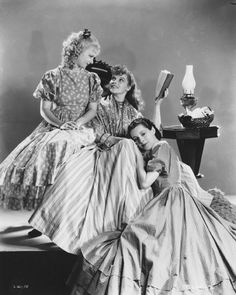
Dyer notes that films and the textual construction of star images reflect the times in which they are produced. Katharine’s second film, “Little Women” was released at the height of the Great Depression. This was a particularly difficult time for women because they were expected to work both inside and out of the home yet they were also expected to step aside and give their jobs to unemployed men. Films during this time period, often had leading ladies who were strong, smart, “fast-talking” dames, who basically told it like it was (Sklar 170-172). Released in the fall of 1933, “Little Women” is not only one of the earliest full length features after the advent of sound, but is the perfect construction of a “Woman’s film.” “Little Women” was breaking Radio City Music Hall’s box-office records, with more than 20,000 fans still storming the theater weeks after the opening, and Katharine stood alone at the top of the Marquis (Variety, December 26, 1933). Solidifying her star power, Variety crowned her the second most popular female star in America (Mae West was first) (Pierpont).
Hepburn's Jo both reinforces and contradicts the social ideals of the Great Depression time period. Hepburn’s spirited, strong Jo provides a character that young women in the Depression could model their behavior after. Even when the film reverses gender roles, at least temporarily, Hepburn’s Jo is still a woman necessary for the hardships of the Great Depression.
Set in the Civil War, like the Great Depression women in the audience, Jo March is smart, authentic, and kind-hearted. Except for stingy, rich Aunt March, the family does charity work, and she is one of the first to give up her Christmas breakfast to an ill single immigrant mother with starving children (something very important to a Great Depression audience). Jo also chops off her hair to ensure her mother has enough money to travel to her ill father.
Hepburn masterfully constructs a Jo that has both feminine and masculine qualities. Jo fences, puts on self-written plays (and pants) to act the role of a mustachioed villain and the handsome blonde hero, cuts her hair like a boy, throws snowballs, climbs down walls, yells “Christopher Columbus” and talks like a boy, has the economic freedom to turn down a marriage proposal to her wealthy best friend Laurie, and moves alone to New York to pursue her writing. Jo also explicitly states that she wishes she were a man, and her long stride, rough and tough manner, physical strength and even her name highlight her masculinity.
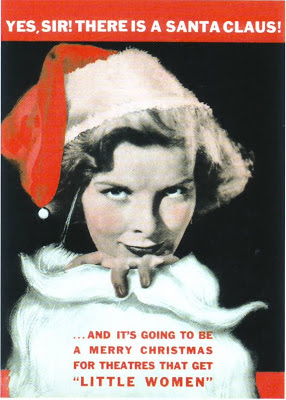
Yet, Jo's feminine side is equally evident. We are reminded that she is emotionally vulnerable throughout the film, and her gown for Laurie’s ball and later the opera provided young women fashion and beauty ideals. The opera scene also reminds us that, in reality, Katharine Hepburn is a stunning socialite woman.And the film promotional campaign targets young women (and men) with the promise that they would see lovely costumes and lovely women.
In contrast, the men are largely effeminate or peripheral to the story line.
In the end, under an umbrella in the rain, the film reinforces the 1930s cultural values that happiness can only be found in family and marriage. Jo’s elderly suitor, Professor Bhaer, asks her to marry him. This is a man who darns his own socks and takes her to operas and will not stand in the way of her independence or freedom, and with not even a single kiss on screen, Jo says yes. Yet, based on the popularity of this film and the ease it negotiated gender reversal, as Susan Ware in “Holding Their Own: American Women in the 1930s” noted, the status of women was improving in the 1930s, and Hepburn’s Jo contributed to the negotiation of this new status.
Hepburn’s star image and Jo's image both tell the story of a tomboy who wants the freedom to be an author and have a successful career, just like a man. The idea that Hepburn was the parts she played quickly became a studio gambit. Publicizing “Little Women,” Cukor announced at the time of the film’s release that she’d been “born to play Jo,” since she came from the same educated, upper-class New England family as the Marches. And, Kate is “tender and funny, fiercely loyal… Kate and Jo are the same girl” (Pierpont New York Magazine). We will see this same confirmation of star image that "merges" character on screen with off-screen public persona in the other Hepburn films examined during this period.
12018-03-09T17:01:44-08:00Little Women Smashes Box Office Records7Little Women Smashes Box Office Recordsplain2018-03-11T17:58:09-07:00 During the Depression, movies were a popular form of escapism, particularly for women, and affordable entertainment for audiences ("Women, Impact of the Great Depression On"). With an Oscar under her belt for Morning Glory, Hepburn’s exuberant performance in Little Women broke Box Office records, with 20,000 people sixteen days after opening storming Radio City Music Hall to try and get a seat. In a two-page RKO promotional piece, Variety Magazine’s December 26, 1933 ad stated: “Christopher Columbus: Show Business Has Never Known Anything Like It.” The advertisement then provides an entire page of touted excited theater operators praising the film as the “largest gross in history,” “crowds have been standing in line all day,” and the film has “given theater operators a real reason … to be thankful.” The November 17, 1933 New York Times review of the film effused excitement for Miss Hepburn’s interpretation of Jo, stating that “She talks rather fast at times, but one feels that Jo did, and after all one does not wish to listen to dialogue in which every word is weighed when the part is acted by a Katharine Hepburn [who] goes darting through this picture without giving one a moment to think of her as other than Jo.”