Nostalgic Femininity
MIZUNO Toshikata 水野年方
1866–1908
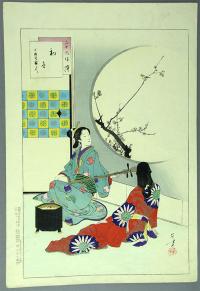
First Warbler: Woman of the Manji Era [1658-1661]
初音 万治頃婦人
![First Warbler: Woman of the Manji Era [1658-1661]](http://scalar.usc.edu/works/japanese-prints-st-kates/media/1259_web.jpg)
From the series Thirty-six Beauties Compared
1893 (Meiji 26)
Polychrome woodblock print; ink and color on paper
Courtesy of St. Catherine University Archives & Special Collections
Two girls observe the seasonal bloom of the plum blossom tree as they celebrate the transition between late winter and spring. One of the girls serenades the perched warbler outside her window with a traditional three-stringed instrument called a shamisen (三味線). Inspired by Fujiwara-no-Kintō’s poetry anthology titled Thirty-six Master Poets, Mizuno Toshikata created this and thirty-five other prints to encompass the customs, manners, and fashions from Japanese ancient times to the Meiji present.
UTAGAWA Kunisada II 歌川国定 二代
Japanese, 1823–1880
Genji at Sugatami Bridge, 12th Month
十二ヶ月源氏の姿見
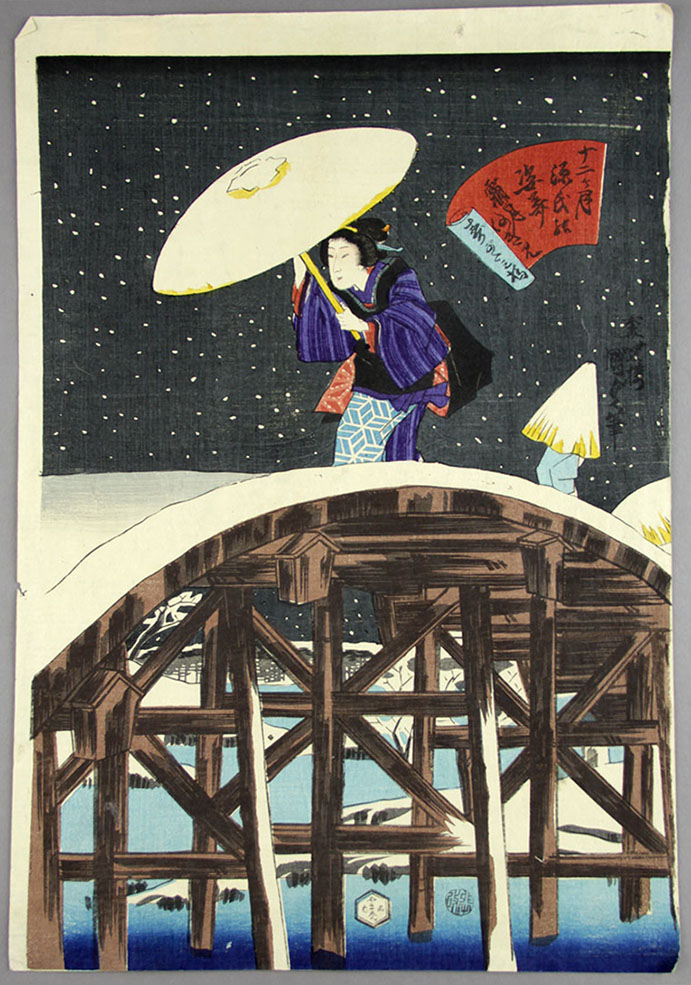
From the series Twelve Months of Genji
1867 (Keiō 3)
Polychrome woodblock print; ink and color on paper
Courtesy of St. Catherine University Archives & Special Collections
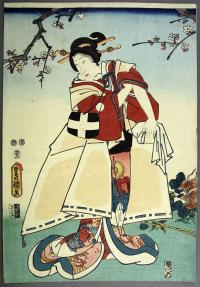
A woman in a purple kimono crosses Sugatami bridge. She fights the wind and protects herself from the engulfing snow with merely an umbrella. Originally, this print was but one panel in a full triptych that illustrates figures from The Tale of Genji, one of the greatest Japanese literary works and the world’s first novel. The famous work was written by Heian-period lady-in-waiting Murasaki Shikibu in the twelfth century.
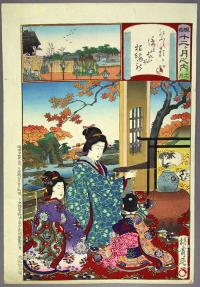
YŌSAI Nobukazu 楊斎延一
Japanese, 1874–1944
November
十一月
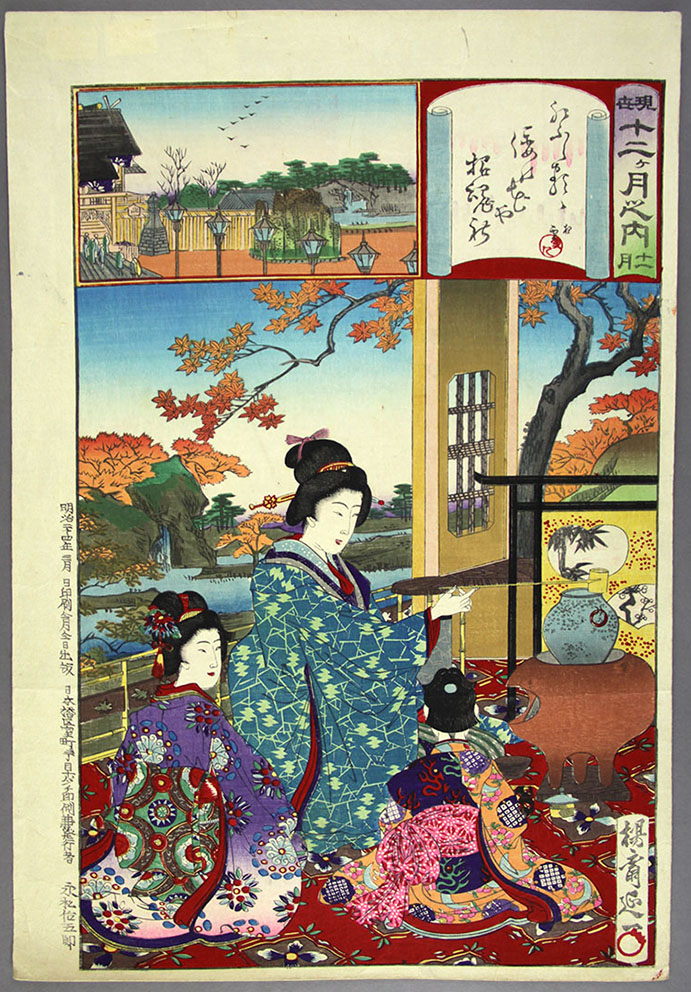
From the series Twelve Months in the Present Day
1891 (Meiji 24)
Polychrome woodblock print; ink and color on paper
Courtesy of St. Catherine University Archives & Special Collections
A woman teaches the traditional art of a Japanese tea ceremony (sadō, 茶道) to her two young female apprentices against the backdrop of a garden. The blue water and sky contrast with the rich orange glow of Japanese maple trees (momiji, 紅葉). Rather unexpectedly, the top left vignette hints at the modern context of the print with the inclusion of gas lamps that were not introduced to Japan until 1872. The deep red color seen in the carpet is also indicative of new synthetic dyes imported from the West. Yōsai Nobukazu thus carefully blends traditional subject matter with new technologies of the modern age.
TOYOHARA Kunichika 豊原国周
Japanese, 1835–1900
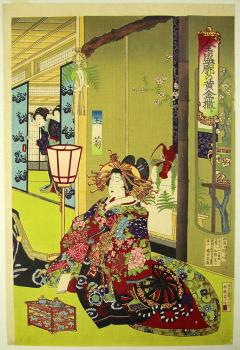
Courtesan of Okamoto-ya, no. 7
岡本 葉うた虎之巻 七
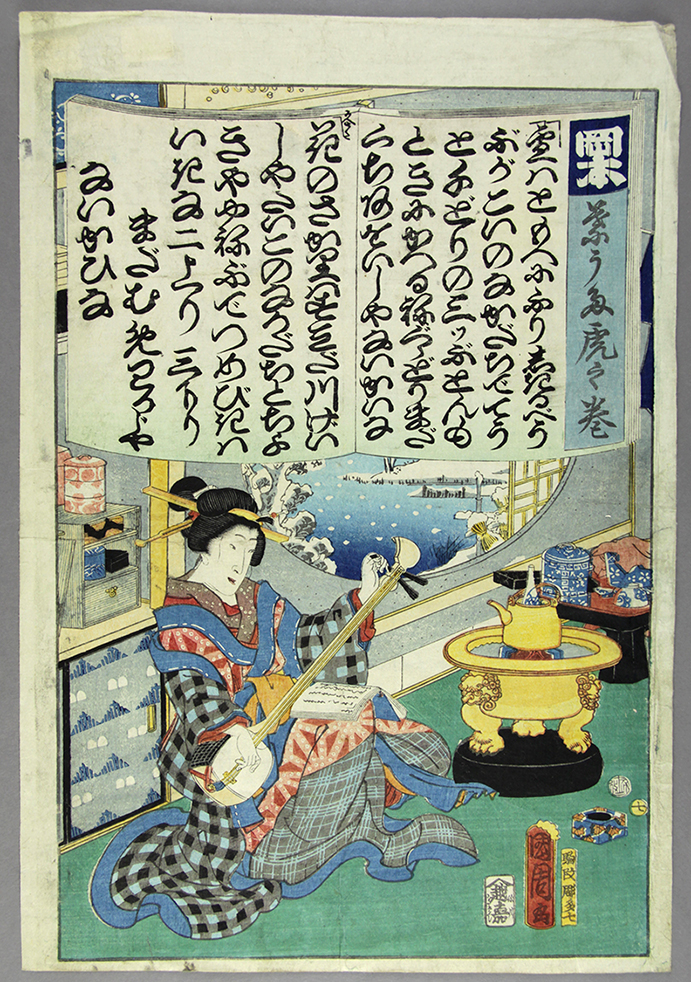
From the series How to Master Marginal Songs
1862 (Bunkyū 2)
Polychrome woodblock print; ink and color on paper
Courtesy of St. Catherine University Archives & Special Collections
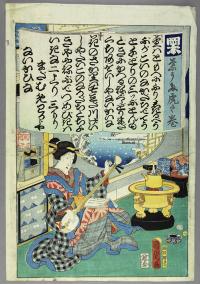
A courtesan of House Okamoto leisurely tunes her shamisen. She is about to play a type of song called hauta (端うた), which was originally performed by blind and amateur musicians in mid-18th century Osaka. She warms her sake and wears loose robes, enjoying the winter landscape outside her window. This print highlights the relaxed atmosphere of the brothel.
YŌSHŪ Chikanobu 楊洲周延
Japanese, 1838–1912
Spring-Colored Garden in Snow
春色園の雪

1879 (Meiji 12)
Polychrome woodblock print; ink and color on paper
Courtesy of St. Catherine University Archives & Special Collections
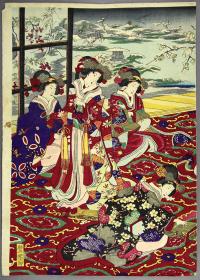
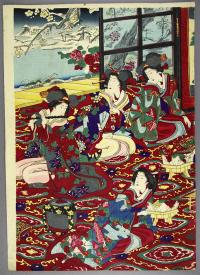
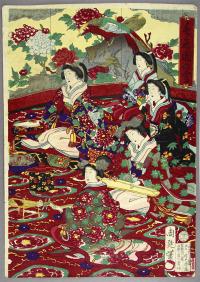
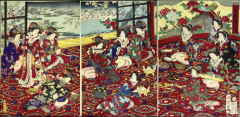
While this interior scene lights up in bright spring colors, snow blankets the outside garden and plum blossom tree in late winter. Women engage in music and merrymaking entirely in feminine company. The screen in the background features pheasants amid peonies. Peonies—or the “king of flowers,” as they were known in East Asia—are associated with spring. They symbolize love and feminine beauty, in addition to wealth and rank. Here, the flower is repeated across the folding screen, several women’s kimonos, and the floral pattern of the floor beneath them. The abundant use of a deep synthetic red is a hallmark of this print and showcases new modern technologies transforming printmaking in the late 19th century.
UTAGAWA Kunisada I 歌川国定
Japanese, 1786–1864
Three Kinds of Drunks in the Modern World
当世三人上戸
1853 (Kaei 6)
Polychrome woodblock print; ink and color on paper
Courtesy of St. Catherine University Archives & Special Collections
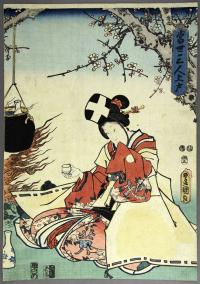
Three women imbibe and enjoy each other's company under the plum blossoms in late winter. The bottle of sake is warmed in a pot hanging from a tree over a fire. Utagawa’s inscriptions describe the various reactions people have when intoxicated. They are, from right to left: the sad drunk (泣き上戸), weeping into her sleeve; the angry drunk (怒り上戸), rolling her sleeve in anticipation; and the merry drunk (笑い上戸), giggling at the others. This humorous tale of the dangers and pleasures of alcohol touches on universal qualities of intoxication in the modern world.
MIYAGAWA Shuntei 宮川春汀
Japanese, 1873–1914
First Month: Oibane (Battledore & Shuttlecock)
其一 追羽子
From the series Twelve Months of Beauties
1898 (Meiji 31)
Polychrome woodblock print; ink and color on paper
Courtesy of St. Catherine University
Archives & Special Collections
In his series Twelve Months of Beauties, Miyagawa Shuntei showcases the month of January by illustrating a traditional New Year’s game often played by women. The game depicted here, called hanetsuki (羽根突き), is similar to badminton in that it is played with a wooden paddle (hagoita, 羽子板) and a vibrantly colored shuttlecock. The game can be played in two fashions: by one person attempting to keep the shuttlecock aloft as long as possible, or by two people batting it back and forth. In this scene, the woman in the purple kimono failed to keep the shuttlecock aloft. As a rule, her defeat entails receiving a paintbrush mark in India ink on her face. The bystanders on the right giggle at the scenario as the loser is chased by the brush wielder against the backdrop of a barren tree and a tangled kite.
YŌSHŪ Chikanobu 楊洲周延
Japanese, 1838–1912
Snow in the Park
公園之雪
From the series Customs and Manners of Old Japan (Yamato)
1892 (Meiji 25)
Polychrome woodblock print; ink and color on paper
Courtesy of St. Catherine University
Archives & Special Collections
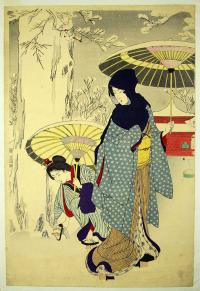
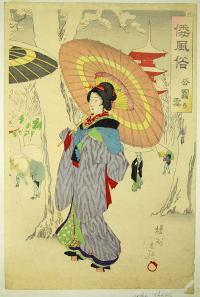
A group of women enjoys the beauty of freshly laid snow in a temple garden. This print showcases women’s fashion in the Edo period with rich details such as the winter hood (okoso zukin, 御高祖頭巾) and striking, bold patterns such as the polka dots on the left and a purple line-wave pattern on the right. A woman bends down to knock the snow from her sandals (geta, 下駄) and delicately holds the hem of her sleeve in her mouth to prevent it from touching the ground. The intense, red structures of a Buddhist temple visually punctuate the snowy landscape. A five-storied pagoda rises in the background of the right panel.
YŌSHŪ Chikanobu 楊洲周延
Japanese, 1838–1912
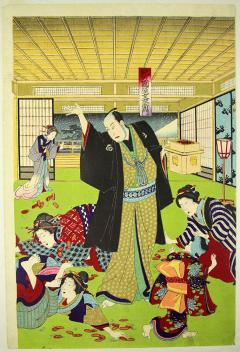
Scattering Gold in the Flourishing Pleasure Quarter: Tamagiku and Kinokuniya Bunzaemon
全盛廓の黄金撒キ 玉菊 紀の国屋文左衛門
1886 (Meiji 19)
Polychrome woodblock print; ink and color on paper
Courtesy of St. Catherine University
Archives & Special Collections
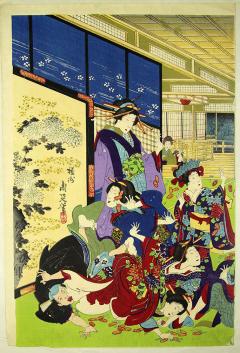
In a lively winter scene, Kinokuniya Bunzaemon, a successful merchant of the Edo period, scatters money upon the floor. Women and children tumble about the brothel trying to grab their share as Courtesan Tamagiku sits off to the right with an amused expression. Bystanders, intrigued by the commotion, look on in curiosity. A grouping of stacked rice cakes (kagami mochi, 鏡餅), topped with a lobster decoration behind Tamagiku, hint at the coming of a New Year.
YŌSHŪ Chikanobu 楊洲周延
Japanese, 1838–1912
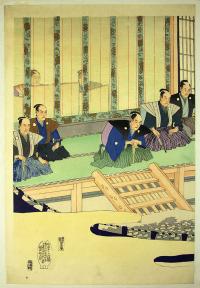
Depiction of an Official Hearing at Fukiage
於吹上公事上聴ノ図
From the series Chiyoda Outer Palace (Chiyoda Central Office)
1897 (Meiji 30)
Polychrome woodblock print; ink and color on paper
Courtesy of St. Catherine University
Archives & Special Collections
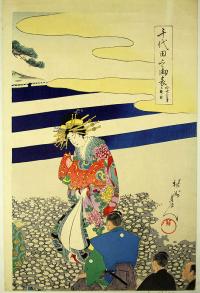
Two high-ranking shogunal concubines present a case to an official and his retainers at Fukiage, a manor in the private sector of Edo Castle. The beauty in the center dons an elegantly patterned red outer kimono with Japanese cranes dancing above crashing waves. Her black obi (帯), a broad sash worn around the waist of a Japanese kimono, features a dynamic golden dragon. She kneels down on a bamboo tatami mat atop a rocky surface before the male officials on the veranda. Yōshū Chikanobu shows off his attention to fine detail by delicately embossing the white crane and burnishing the black parts of the obi. The print offers a behind-the-scenes look at courtly life and politics prior to Japan’s modernization.
YŌSHŪ Chikanobu 楊洲周延
Japanese,1838–1912
Cherry Blossom Viewing
御花見
From the series Customs of the Inner Palace of Chiyoda Castle
1894 (Meiji 27)
Polychrome woodblock print; ink and color on paper
Courtesy of St. Catherine University
Archives & Special Collections
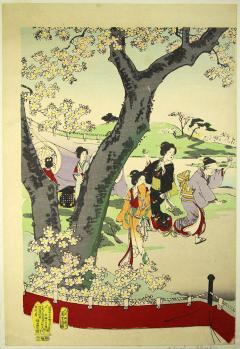
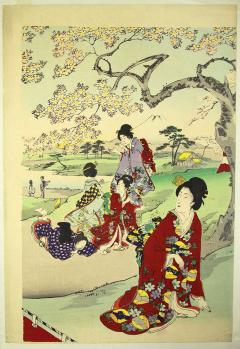
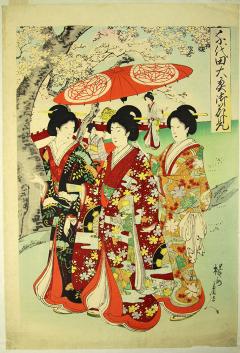
With Mt. Fuji looming in the distant background, sixteen women of the Tokugawa court enjoy cherry blossoms (sakura, 桜) on a spring day. Their court affiliation is apparent through the clan seal (mon, 紋) printed on their umbrellas in the pattern of three hollyhock leaves. On the left, women can be seen giggling and clapping as they play a game of tag (onigokko, 鬼ごっこ). On the right, three women walk and converse under a shared umbrella beneath the pale pink blossoms of flowers in full bloom.
YŌSHŪ Chikanobu 楊洲周延
Japanese, 1838–1912
Parading of the Mochi (Rice Cakes)
鏡餅ひき
From the series Customs of the Inner Palace of Chiyoda Castle
1895 (Meiji 28)
Polychrome woodblock print; ink and color on paper
Courtesy of St. Catherine University
Archives & Special Collections
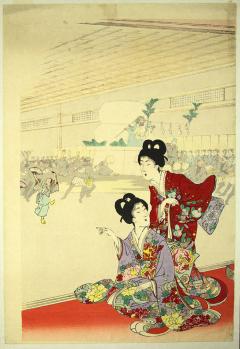
A New Year’s festival procession unfolds before five court ladies who watch excitedly as a float of giant stacked rice cakes (kagami mochi, 鏡餅) passes in front of them. Kagami mochi is a popular New Year’s decoration that symbolizes the coming and going of years. The orange on top represents the continuation of a family from generation to generation. Two generations of court ladies observe the parade dancers, who are adorned with auspicious New Year’s symbols, such as a lobster hat and a mythical tengu mask. The three observers on the right are the oldest of the five women, while the two girls in the center are between five and twelve years of age. The two girls wear their hair in a chigo-mage (稚児髷) style, a youthful style based on what boys wore in the 16th century Momoyama and Azuchi eras.
Contents of this tag:
- Depiction of an Official Hearing at Fukiage, B
- Cherry Blossom Viewing, A
- Cherry Blossom Viewing, B
- Spring-Colored Garden in Snow, A
- Cherry Blossom Viewing, C
- Parading of the Mochi (Rice Cakes), B
- Depiction of an Official Hearing at Fukiage, C
- Scattering Gold in the Flourishing Pleasure Quarter: Tamagiku and Kinokuniya Bunzaemon, A
- Spring-Colored Garden in Snow, B
- Parading of the Mochi (Rice Cakes), C
- Snow in the Park, B
- Snow in the Park, C
- Parading of the Mochi (Rice Cakes), A
- Three Kinds of Drunks in the Modern World, A
- Three Kinds of Drunks in the Modern World, B
- First Warbler: Woman of the Manji Era [1658-1661]
- Scattering Gold in the Flourishing Pleasure Quarter: Tamagiku and Kinokuniya Bunzaemon, B
- 12 Months in the Present Day, November
- Scattering Gold in the Flourishing Pleasure Quarter: Tamagiku and Kinokuniya Bunzaemon, C
- First Month: Oibane (Battledore & Shuttlecock), B
- Depiction of an Official Hearing at Fukiage, A
- Spring-Colored Garden in Snow, C
- Courtesan of Okamoto-ya, no. 7
- First Month: Oibane (Battledore & Shuttlecock), A
- Three Kinds of Drunks in the Modern World, C
- First Month: Oibane (Battledore & Shuttlecock), C
- Genji at Sugatami Bridge, 12th month