Displacement #1: Itinera as Methodology
Itinera approaches historical information from a theoretical standpoint very different than that of a traditional dissertation, book, or article project. A written history typically unfolds within a linear narrative. The choices of the author shape, mediate, and manipulate the raw data that are history's primary sources. Working with Itinera challenges the implicit sequencing of the historical narrative by subjecting this same information to a standardized set of curated criteria and also offering visualizations that can map this structured data as mobile collections of humans and objects in space and time.
My research on the collecting practices of an unlikely pair of eighteenth-century figures, Alexandre Lenoir, the French creator and director of the Musée des monuments français, and Alexander von Humboldt, the German naturalist and explorer, explores the possibilities and affordances of the non-linear, non-hierarchical approach used by Itinera to represent both the mobility of people and objects. My work on Alexander von Humboldt’s South American and Russian expeditions, which I began for the purposes of working as Itinera's project manager, focuses on the interactions of people moving across the globe. Humboldt traveled the world taking measurements and collecting data, hoping to trace the universal geographies of natural history. My research on Alexandre Lenoir, which is work that I am also doing for my dissertation project, explores the development of a chronology of French history out of displaced cultural artifacts. The Musée des monuments français was a Parisian history museum open from 1795 to 1816 composed of art objects, sculptures, and architectural fragments mobilized due to the nationalization of property during the French Revolution. My work with these two historical figures reflects the potential of Itinera as both a graphic model of data visualization and also, more theoretically, a methodological approach useful beyond Itinera's boundaries.
The fundamental building block of Itinera is the life event. The data included in a life event consists of a central person, a location, which can be a specific address or more generally "Rome," a timestamp, which can be the exact time of day or a series of days or weeks, and links to a series of other actors, who are the people participating in the life event at that specific place and time. Each of these actors has their own unique timeline of life events, and an agent profile that records, among other things, their date and place of birth, date and place of death, life role or occupation, and any pertinent familial or professional relationships. All of the relationships between time, place, and historical actor are carefully recorded into Itinera according to a defined schema. However, Itinera does not entirely avoid narrative history. The “description” portion of the life event is the only component that requires a traditional narrative account, and it is often in these narratives that the drama of human experience comes to life.
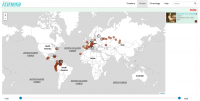
When viewed through the "Routes" visualization, Alexander von Humboldt's voyage on Itinera reads, like all journeys on Itinera, as a series of dots snaking across the globe. Fragmented groups cluster in Europe, a long, irregular line cuts across Russia, and two twisting paths meander along the western edge of South America and Venezuela. (Figure 1) A single dot highlights the Canary Islands and a few marks accumulate in the United States, Cuba, and Mexico. The map itself does not focus on giving a sense of the chronology of Humboldt's journey, but speaks more to the density of his life experience. A scroll along the bottom of the map allows the user to manage the dates of travel displayed on the map. Each dot itself opens a window with a painting of Humboldt taking notes, the location of the life event, the date Humboldt was at that location, and a description of the events that unfolded at that place and time.
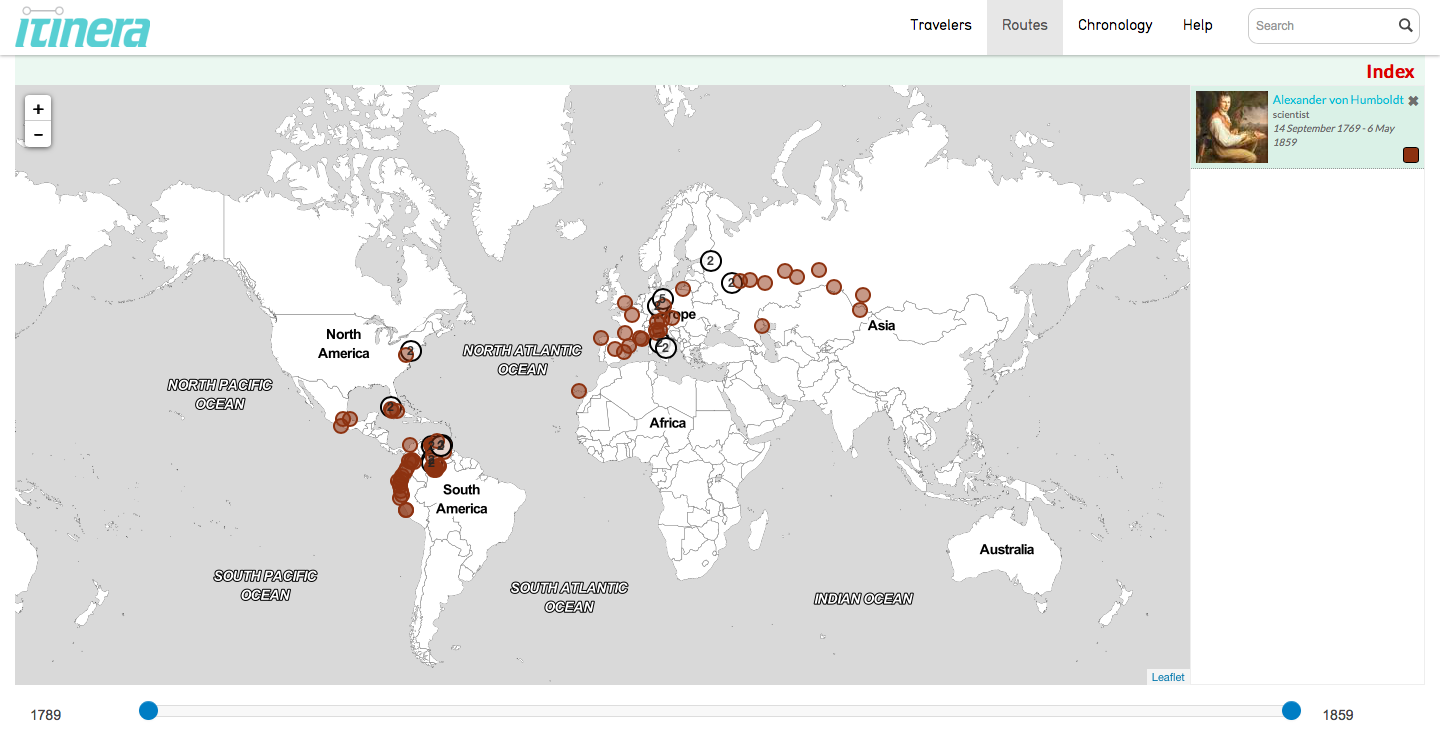
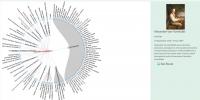
Switching to Itinera's "Chronology" function, the same dots are flattened into a temporal sequence. Here, the timeline reveals the intensity of Humboldt's movements in 1800 and again in the 1820's and early 1830's. Choosing another traveler from Humboldt's dense wheel of acquaintances creates an overlapping sequence of differently colored dots on both the "Routes" and the "Chronology" visualizations, revealing where Humboldt and his companions shared time and space. In large urban contexts such as Paris and Rome, multiple life events from numerous narrative-structured sources convene, offering the potential for new historical discovery. (Figure 2)
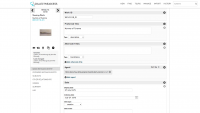
As more and more users add data to Itinera, these networks will become richer and denser. Itinera flattens traditional hierarchies. Connectivity emerges between known historical actors, such as Alexander von Humboldt and Johann Wolfgang von Goethe, as well as lesser known agents, such as Don Ignacio, a tiger hunter on the Apure River in Venezuela. (Figure 3)
As Project Manager of Itinera, I collaborated on the implementation of the object module. This was an extension of Itinera 's capabilities that created the opportunity to map the mobility and intersection of physical artifacts as well as human endeavors in both space and time. Itinera's agents are continuously moving, creating, and interacting with objects, essentially constructing and deconstructing both communities and collections. Alexander von Humboldt gathered physical samples, produced books, and created collections of natural objects during his travels. We needed to develop a way to represent those relationships. Thinking through the implications of such mobile objects is central to my dissertation research on the Musée des monuments français. After the nationalization of property during the French Revolution, artifacts of the church and the aristocracy were gathered into depots and processed for sale, reconstitution, or preservation. At the Petits-Augustins depot, Alexandre Lenoir found an opportunity to shape a collection for public display from displaced artifacts and art objects, which became the Musée des monuments français.
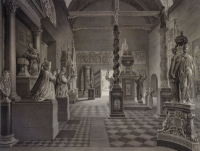
Indeed, the reorganization of artifacts into museum collections during the French Revolution extended to human remains, which introduced a unique challenge to Itinera’s data model. When I entered the exhumed body of Henri de La Tour d'Auvergne, Vicomte de Turenne into the system, I was asked to confront the boundaries of personhood and objecthood in both Itinera and in my own research. Turenne died in 1675 and was buried in the Basilica of Saint-Denis. His body was exhumed in 1793 and taken to Paris, first displayed at the Musèum d'histoire naturelle, then incorporated into the Musée des monuments français, until finally interred at Les Invalides. This presented a new set of problems to the recently created objects module. How does objecthood affect agency? Namely, is a deceased body a person or an object? We concluded it was both. The agent Turenne became the creator for the object Turenne at the moment of his death in 1675. New network relationships emerged between the agent Turenne, the object Turenne, and other Itinera agents who interacted with Turenne as a person, an interred body, or a museum object across space and time. (Figure 4)
After my tenure as Project Manager on Itinera, I have been continuing my dissertation research on the Musée des monuments français. The museum closed in 1816, and exists today only in texts, images, and archives. Lenoir organized the collection of the Musée des monuments français into a sequence of architectural and sculptural experiences. An Introduction Hall presented the origins of French art, followed by five immersive century rooms decorated in the manner of their eras, a sequence of exterior courtyards framed by large architectural fragments transported from Gaillon and Anet, and a picturesque garden, the Jardin Élysée, where monuments mingled with the tombs of a collection of important figures from French history, including Turenne. After 1816, the museum was dismantled and the objects relocated and reconfigured into new collections.
To organize my thoughts and my data on this collection, I began thinking about the systematic way Itinera processes historical information as a methodological research tool for my own work. To create a life event, we must mine a narrative for specific data standardized by Itinera's data model. In the case of my research, thinking more like Itinera helped me to see that the existing narrative descriptions of the museum were creating false hierarchies. Certain objects on display in the museum were given prominence, while other features were ignored or barely described. This created an incomplete record. Moreover, the Musée des monuments français was ephemeral, and each object in its collection had a unique history of mobility. I established a standardized set of criteria for each gallery of the museum. Using archival images and texts, I began to identify the origin, age, creator, position in the Musée des monuments français, and contemporary state of every object in the museum. (Figure 5)
The outcome of this research was a comprehensive index of all the objects on display at the Musée des monuments français. I potentially identified several lesser-known pieces of the collection, including a Trinity currently held by the Musée nationale de la Renaissance in Écouen, several Gothic bas-reliefs now at the Basilica of Saint-Denis, and the priants of Chréttienne Leclerc and Marie de Bourbon-Vendôme, now conserved at the Musée du Louvre and the Basilica of Saint-Denis. I reconstructed the organization of the hallways, courtyards, and other auxiliary spaces of the museum, giving a more complete impression of the overall museological experience. I traced patterns in the development of the museum and critical distinctions between the treatment of interior and exterior objects that significantly developed my research.
The product of my work using Itinera to study Alexander von Humboldt and Alexandre Lenoir was, in both cases, a unique visualization of a large collection of data. For Alexander von Humbolt, this visualization took the form of an interactive interlace of points on a map and a timeline representing the extent and intensity of major scientific enterprises. The graphic representation of Humboldt’s journey in Itinera continues to foster debate and collaboration between a diverse group of scholars. Examining the Musée des monuments français through the lens of Itinera, the reconstructed physical spaces and mobile relationships recovered from the data revealed new object relationships and a comprehensive view of the development and transformation of the collection. As an apparatus of visual knowledge and a research methodology, Itinera challenges the boundaries of narrative history for a richer, more complex historical understanding.
This page has paths:
- Itinera's Displacements Alison Langmead