Unit Three Assignment
Unit Four: Cold War Premises: Rebuilding Two Germanysdue on the first day of Unit Four at the start of class PRINTED
Double-spaced, 12-point font (Times New Roman or similar)
One 400 – 500 word essay & One 1000 – 1250 word essay
25% of final grade
Basic Requirements:
This assignment has two components. Both must be completed.
There is also a peer-review component to your assignment. Please come prepared with a first draft of Part One and an introductory paragraph, as well as the three images and three quotes you will use for Part Two during our 8B class meeting. You should bring two printed copies (one-sided only) of your texts (one for you, and one for your reviewer).
The peer-review component is worth 10% of your final paper grade. Failure to bring TWO COPIES to class will result in a two-grade penalty (A drops to a B+).
Please use artworks or events only from the Unit 3 Image Bank.
For all quotations or paraphrases, use a single citation-format consistently. Please use Chicago, MLA or APA. Feel free to include lecture and discussion material or any outside sources. YOU MUST CITE ALL OUTSIDE SOURCES IN-TEXT. Please include a bibliography or works cited page. (One total for both essays.)
Print, photocopy, or attach the original pages from your Unit Three Reading Journal to the back of your paper. Complete and attach the “Requirements Checklist” to the front of your paper.
Part One: Triumph of the Will: Documentary, Propaganda, or Both?
Is it possible to divorce form from content? What about in politically volatile circumstances? In other words, can a Nazi-era cultural artifact be interpreted purely for its aesthetics? Why or why not?
Think about this set of questions with regard to Leni Riefenstahl’s film Triumph of the Will (1935). Using specific scenes, filmic techniques, icons, and/or content from the film, write first how one might see this film (as Riefenstahl did) as a documentary. Then, write about how this film is propaganda. Finally, stake a claim! Do you think this is propaganda, documentary, or both?
Nota Bene: It is not a requirement, but you might be interested in reading the excerpt of the Leni Riefenstahl interview posted on the course website.
Requirements:
- Your essay must be between 400 and 500 words.
- Given how short this is, please do not include an introduction. Do not worry about offering historical detail about Leni Riefenstahl.
- Add as much as you like about the Nuremburg rally, but be sure to include citations for any additional research.
- Use at least two distinct scenes, filmic techniques, icons, and/or content from the film.
Part Two: The Cult of Art in Nazi Germany
Michaud argues that art in Nazi Germany was not simply an instrument of the regime, but actually a source of the racist politics upon which the Nazi myth was founded. Art was considered to be less a witness or mirror of history than a force capable of producing the future through the “creative work” of the artist, of Hitler as the “Artist-Führer,” and of the German people [Volk] as a whole.
Using at least three visual examples explain how the art and visual culture of the Third Reich materialized the Nazi myth. What sort of future was supposed to be produced through the Nazi “creative work”? How did the Nazi’s racist politics manifest in their art and visual culture?
Requirements:
- Your essay must be 1000 – 1250 words long.
- Use at least three quotations from different chapters of Michaud’s book. (The book has 5 chapters that are clearly numbered in the table of contents.)
- Use at least 3 visual examples provided in the Unit 3 Image bank. (Do not use visual examples from Triumph of the Will.)
Requirements Checklist
This page has paths:
- Unit Three: Total Control: Art and Culture in Nazi Germany Sara Blaylock, UC Santa Cruz
Contents of this tag:
- Old Man Reading a Newspaper; Otto Kirchner ca. 1937
- Portrait of the Führer (flanked by Amazonia, Paul Scheurle & World Fighter, Alfred Sachs); Fritz Erler, ca. 1939
- Leda and the Swan; Paul Mathias Padua, 1939
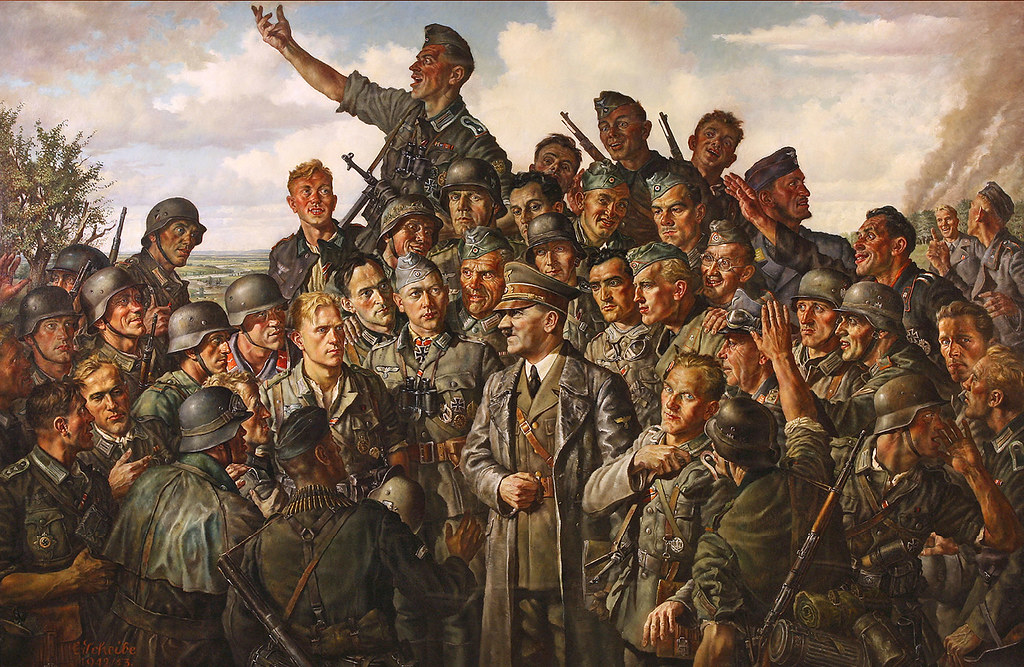
- Hitler at the Front; Emil Scheibe 1942-3
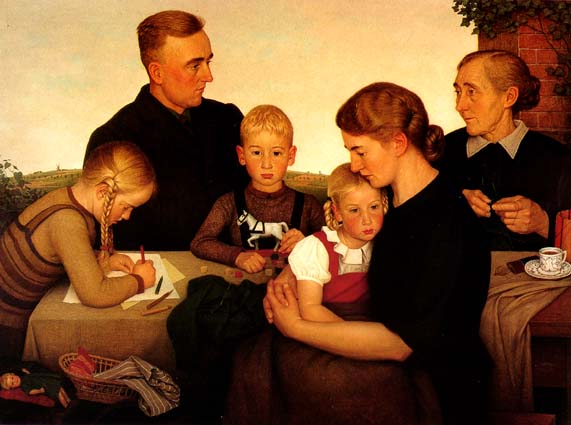
- Kalenberg Farm Family; Adolf Wissel 1939, 200 cm x 150 cm (78-3/4" x 59")
- Postcard for the Day of German Art 1933
- The Art Magazine; Udo Wendel, 1940,
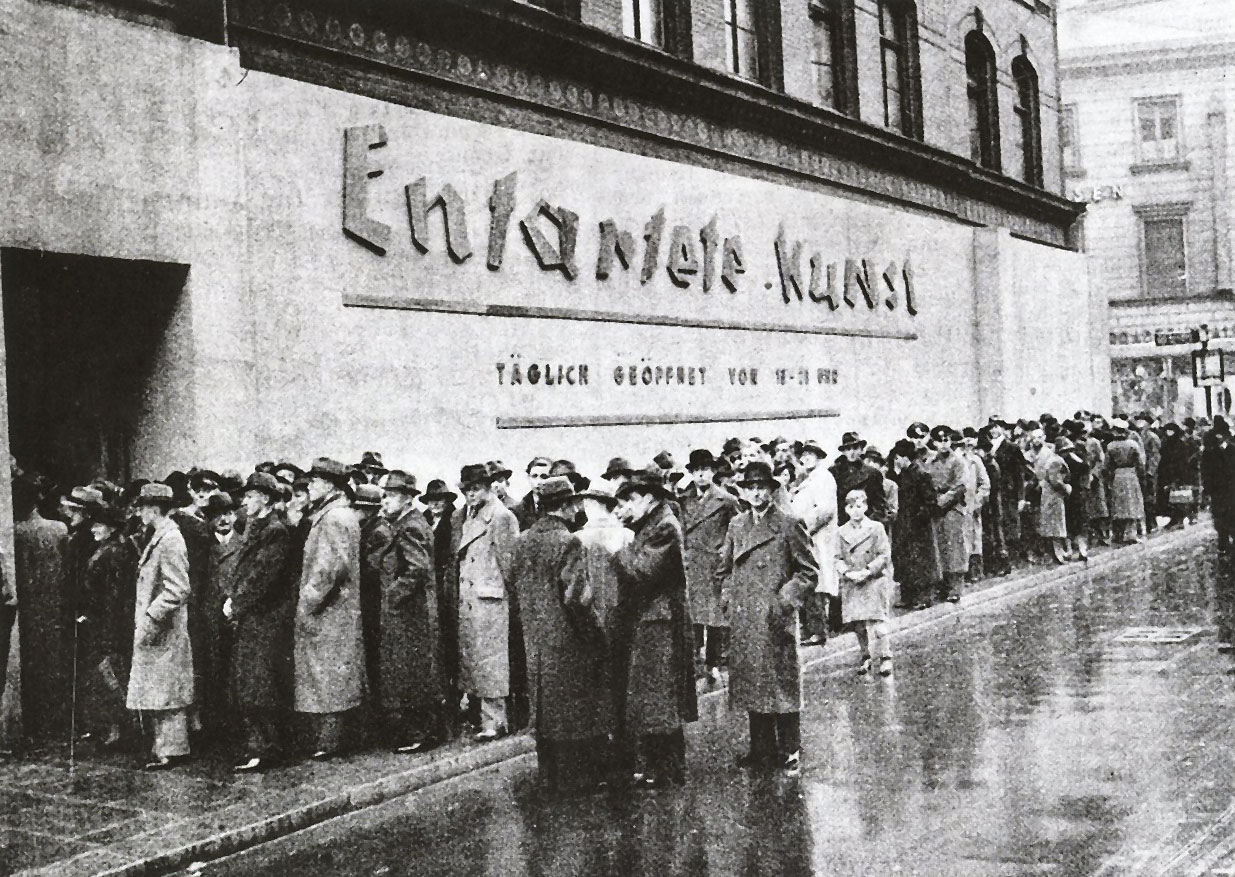
- Degenerate Art Exhibition, 1937 (Munich)
- Harvest; Karl Alexander Flügel, 1938
- Degenerate Art exhibition (1937) interior (Dada)
- The Sculptor of Germany; O Garvens, in Kladderdatsch, 1933, vol. 46, no. 49
- The Sower; Oskar Martin-Amorbach, 1937
- In the Steelworks; Arthur Kampf, ca. 1939
- Farm Girls Returning from the Fields; Leopold Schmultzer, ca. 1940
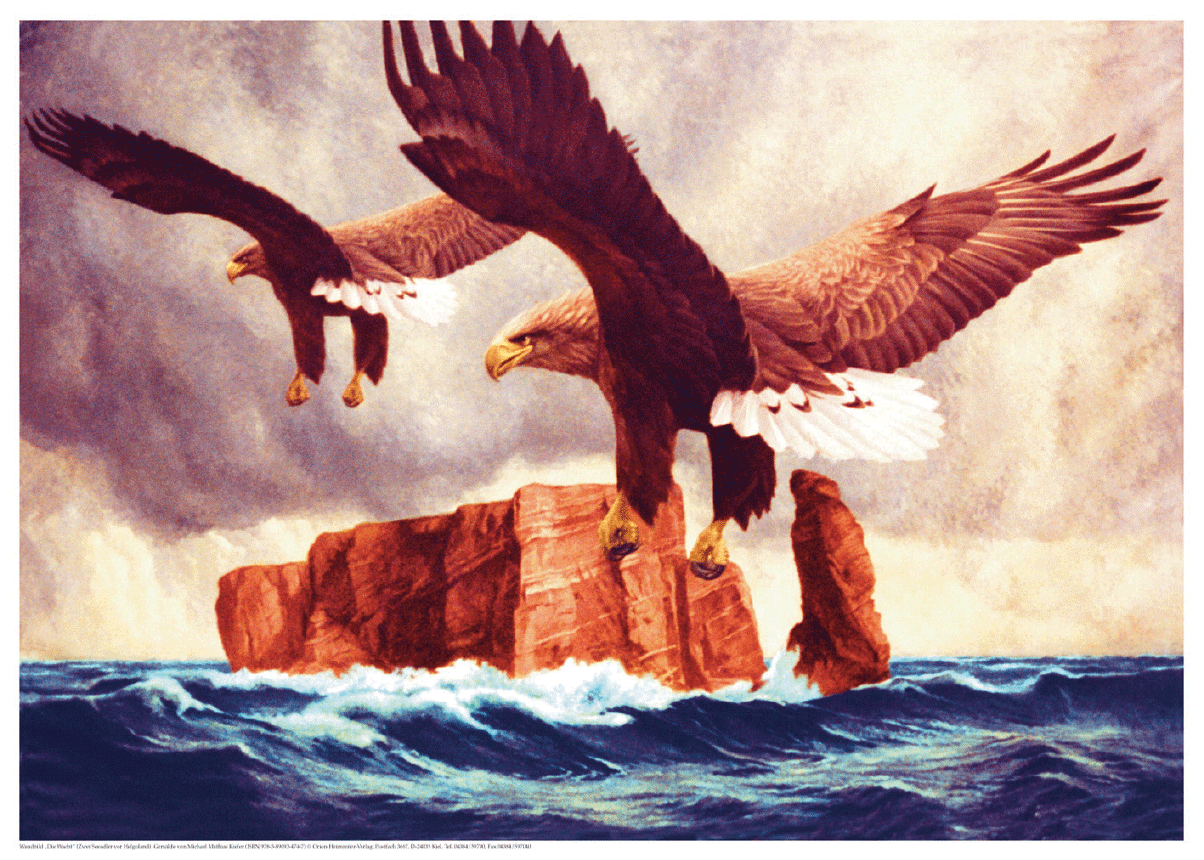
- Sentries; Michael Mathias Kiefer, 1940
- The Party and The Army; Arno Breker, 1938 (installed in the entry way to the Court of Honor of the Chancellery of the Reich)
- Readiness; Arno Breker, 1939
- The Awakening; Richard Klein, 1937, oil on canvas (Published in Kunst und Volk, 1937, no 8)
- Workers, Soldiers, Farmers; Hans Schmitz-Wiedenbrück, 1941
- The German Land; Werner Peiner, oil on canvas, 1933