Thanks for your patience during our recent outage at scalar.usc.edu. While Scalar content is loading normally now, saving is still slow, and Scalar's 'additional metadata' features have been disabled, which may interfere with features like timelines and maps that depend on metadata. This also means that saving a page or media item will remove its additional metadata. If this occurs, you can use the 'All versions' link at the bottom of the page to restore the earlier version. We are continuing to troubleshoot, and will provide further updates as needed. Note that this only affects Scalar projects at scalar.usc.edu, and not those hosted elsewhere.
Gospel Thrillers: Conspiracy, Fiction, and the Vulnerable Bible
Main Menu
Inside the Gospel Thrillers
An exploration of the contents of the novels and their genre
Behind the Gospel Thrillers: "Discovering" the Bible
Historical and social context for themes in the novels
Beyond the Novels: Gospel Thrills and U.S. Culture
Cultural spaces outside the novels in which the impulses of gospel thrillers are found
Extras: Reviews, interviews, and other media
Andrew S. Jacobs
45edf76073fc8204ba5adec5870047f3453dfd28
1994 The Lost Testament
1 media/1994 Last Testament_thumb.jpeg 2022-06-04T10:39:59-07:00 Andrew S. Jacobs 45edf76073fc8204ba5adec5870047f3453dfd28 12458 1 Paperback cover plain 2022-06-04T10:39:59-07:00 Andrew S. Jacobs 45edf76073fc8204ba5adec5870047f3453dfd28This page is referenced by:
-
1
media/1994 Last Testament.jpeg
2018-03-26T18:21:03-07:00
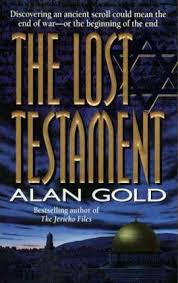
(1994) Alan Gold, The Lost Testament (Harper)
11
plain
2022-07-01T12:48:51-07:00
Alan Gold's was an international journalist in the 1960s and, after emigrating to Australia in the 1970s, began a successful career in advertising. Gold's advertising career ended dramatically with an Australian court case and a bankruptcy filing. This lively profile from the Sydney Morning Herald, written by Ben Hills in 1998, describes in frank detail Gold's personal background—raised in England by Jewish parents and married to a Jewish woman he met in Israel (but not, he notes emphatically, an Israeli woman)—and his abrupt and necessary career switch after a disastrous advertising campaign for women's underwear.
The Lost Testament is his second novel; he has gone on to write over a dozen novels since the early 1990s, often dealing with the Middle East, Judaism, and, more recently, women figures from history such as Jezebel, Boudicca, and Gertrude Bell. (A full list of his novels, published by diverse presses, is available on his Wikipedia page.) Gold is also a public speaker and regular columnist, devoting space to issues such as Zionism and women's health.
Although writing from and living in Australia since the 1970s, as the Hills profile notes Gold's publishers have marketed his novels as international books. Apart from the particular origins of the hero of Lost Testament, nothing marks them as particularly Australian in outlook or intended audience and, of course, it was published in the U.S. by Harper's.
Hero: Michael Farber, an ex-Jewish convert to Catholicism, is an Australian archaeologist who has frequently worked in Israel (where he initially converted); his son died as a child and he is estranged from his wife; he reconnects romantically in the novel with Judith, an Israeli biblical scholar
Villains: Jimmy Wilson, a cartoonishly evil and anti-Semitic, abusive, drug-addicted televangelist in league with ultra-Orthodox Israelis who want to reclaim the Temple Mount and shadowy agents of the Vatican (although not, notably, the U.S.-born Pope)
Gospel: An authentic testament by Jesus written during his time among the Essenes, before his preaching career, evidence of which is found among the Dead Sea Scrolls; smuggled out of Palestine in 132 by Jewish-Christians and buried in Ethiopia, it attests to Jesus' strong Jewish commitments
Reviews
An early novel by an Australian author received little press notice (even in Australian papers); as Farber's career has flourished it has remained in print and has some middling-to-positive reviews on the novel's Goodreads page.