Scalar's 'additional metadata' features have been disabled on this install. Learn more.
Ghost Metropolis: Los Angeles from Clovis to Nixon
Main Menu
Regimes: Ruling the Los Angeles Region from the Late Pleistocene to the 21st Century
Places and Paths of Los Angeles
Manna From Hell: Power and Politics from Region to World Power
Shadows: Visual Cultures and Mass Media of a Regional and Global Power
Segregated Diversity: The Geosocial Formation of Social Justice in the Late Twentieth Century
Richard 37th: Nixon, Los Angeles, and World Power
The American 1989: Los Angeles at the Climax of the 20th Century
Narrative Essay
Bibliographies, Filmographies, Gazeteers, Indexes
Mapping the Past: Theory, Methods, Historiography
Path
Credits
Root
Phil Ethington
e37d40405599cccc3b6330e6c4be064cc03ef7a5
note
1 2017-06-20T20:50:33-07:00 Phil Ethington e37d40405599cccc3b6330e6c4be064cc03ef7a5 677 1 Ed Jansen, "Edward Kienholz - The Beanery, 1965" Stedelijk Museum Amsterdam, 2012, https://www.flickr.com/photos/de_buurman/8071850570 plain 2017-06-20T20:50:34-07:00 Phil Ethington e37d40405599cccc3b6330e6c4be064cc03ef7a5This page is referenced by:
-
1
media/Warhol_CampbellsSoupCans.jpg
2013-07-14T16:33:56-07:00
Love with Strangers: LA Countercultures, Rise of an Art Capital, and the Ends of Art, 1950s-1990s
141
image_header
2018-07-19T17:30:14-07:00
“Art offers the possibility of love with strangers”
--Walter Hopps [1]
By the 1950s, Los Angeles had established a massive global presence, led by its motion picture and aeronautics/aerospace sectors, and its unique "lifestyle" export, attracting millions to settle there, and millions more to consume its products. Julius Shulman's photography epitomized the region's image-landscape of modernist mid-century Los Angeles--a built environment financed by major corporations and military contractors. New York's still-dominant Abstract Expressionist School had erased all representation from visual art, neatly ducking the wrath of McCarthyite political repression. Fear and repression stalked the American public sphere, but a mass uprising led by the Civil Rights movement and a growing band of cultural leftists stood up and claimed spaces for political freedom, freedom of expression, and personal freedoms, beginning with sexual liberations. This visual rebellion is epitomized by Kienholz's 1959 John Doe,
The achievements and impact of this rebellion, massively (although not exclusively) arising from Los Angeles, would be hard to exaggerate. The overthrow of classical aesthetics, in place for centuries, had reached a point of no return by the years 1959-1962, obliterating the distinctions between high and low art, between the rare and the everyday, and between the beautiful and the ugly. Censorship of art was defeated in the 1950s and 60s--much hinging on tests of "obscenity" in both the fine arts and motion pictures--which led immediately to the New Hollywood and new global standards for expression.
Ironies abound, thick with significance. Both San Francisco and Los Angeles became centers of resistance and rebellion to Cold War cultural repressions, in part because of their distance from the centers of authority on the East Coast. San Francisco's North Beach Beat rebellion, led by Alan Ginsberg and Lawrence Ferlinghetti at City Lights Bookstore, arose in a city with a long left-liberal tradition. While there were numerous ties between the San Francisco and Los Angeles cultural rebellions, Los Angeles took the lead by the 1960s. And the rebellion in Los Angeles took place at Ground Zero of the most repressive political culture outside of the Jim Crow South. It took place within the much more powerful rise of the mass- and religiously-based movement of the New Right, led by Richard Nixon and Ronald Reagan from Southern California. It took place inside of the First City of the "Military Industrial Complex" and under the nose of the nation's leading military-style urban police department, William Parker's proudly repressive LAPD.
Despite these pressures, LA's counter-culturalists not only won their battles in the 1950s and 60s, but built also the foundations for the rise of Los Angeles as a global fine arts capital. The 1950s Beats rejected everything about corporate, white-collar, conformist, Cold War commercial culture of the United States. But they also had deep connections with the commercial mass media, and those connections were central to their artistic practice. Like many an avant-garde before them, their revolution became institutionalized as the capitalist art market and the cultural aspirations of the Los Angeles monied elite strove visibly for “world-class” cultural stature, transforming that Beat underworld into a hierarchical overworld.
The central figures in this drama were Walter Hopps and Edward Kienholz, and the central place for this revolution was the Ferus Gallery co-founded by them at 736-A N La Cienega, in 1957. Walter Hopps provided intellectual, curatorial, and organizational leadership; Kienholz provided existential energy and creativity, and the very essence of American liberty as an artist. Bohemian culture rebels in the darkest days of McCarthyism, Hopps and Keinholz wove jazz music and street theatricality into the already-powerful stream of avant garde modernism directly transmitted from the Dada and Surrealist movements, and inspired a regional explosion of creativity by an electrified Los Angeles-area arts community. Collectively, the artists of the Los Angeles School achieved the ultimate culmination of an aesthetic revolution that literally ended a phase of Western art. If Renaissance was a rebirth of classicism, the Los Angeles School saw to its death. Paris, New York, and San Francisco also worked toward this turning point, but Los Angeles emerged as the spearhead. The revolution operated on several levels: The rejection of neo-classical aesthetics; The erasure of the boundary between commercial, popular, and mass cultural visual surfaces and those of fine art (while retaining a fine art market); and the collapse of censorship in the United States by the 1970s and the rise of a carnography of power.
Already the capital of global mass culture industry before World War II, Los Angeles was the most likely place to consummate this unholy mélange. Thanks to the courage and sheer, reckless joy of a handful of culture rebels, the Ugly became Beautiful; Art escaped—at least for a brilliant moment—the easel, the frame, and the clutches of cultural authority; and Walt Disney’s Wagnerian dream to combine all of the expressive arts was ultimately, ironically, even subversively, realized. But the story does not end with the simple emancipation of the human spirit. Defeating censorship in the United States also opened the floodgates of exploitation, the commodification of human beings in effigy and avatar, consuming the bodies themselves in orgiastic, even dionysian violence. That visual violence ruling the profit returns in movies, cable, and the internet, became wedded to the urban and international violence of state power during the Nixon and Reagan years, producing a global bloodbath: a carnography of power within which "Terrorism" is nested.
Beat Dada: Edward Kienholz
Shortly after the Action One show of 1953, Edward Kienholz arrived in Los Angeles like Paul Bunyan. Or like Odysseus, a trickster hero, this industrious, ambitious burly craftsman with no formal art education (except “rudimentary training as a boy”), was determined to be a great artist. Born in 1927 in Fairfield Washington, Kienholz grew up on a farm, where construction and repair of nearly everything of use (buildings, furniture, water pumps, guns, electrical equipment, tractors, engines, stone walls, etc.) is a matter of daily life. Kienholz “was so determined to have a career and take care of himself that shortly after high school he simply went out into the world.” Despite a few attempts to attend college, he hit the road, traveling mostly in the west. As a principled pacifist, Kienholz casually, openly dodged the Korean War draft, but never faced charges.
In Minneapolis he encountered a Rembrandt exhibition that “he often referred to as a decisive experience in persuading him to become an artist himself.” In 1953, he "set up a storefront studio in El Paso Texas, supporting himself doing odd jobs, painting [Thomas Hart] Benton-like figurative art, crossed with the abstraction of Miró” on found wooden surfaces. Active in El Paso was the WPA-era Student Arts League artist Tom Lea. Kienholz asked him to come review his work, and Lea, after a careful inspection, told him: “You have to go to New York or Los Angeles. I admire what you are doing—it has great courage—but it’s not going to survive here in El Paso.” For Kienholz the Westerner, Los Angeles was the only real choice.[7]
Kienholz preferred peripheral landscapes, setting-up shop in the San Fernando Valley in 1953 as a handyman jack of all trades, always wring scrupulous estimates and contracts. He painted the neat lettering on his International pickup truck door simply:“Edward Kienholz EXPERT [phone].” It is worth quoting the insightful prose of Walter Hopps at length to take stock of the character and art of Edward Kienholz at the time of his arrival in 1953:
“It was the beginning of the Beat period, and he had exactly the right attitude and sensibility to be part of it immediately. He had a very different background from important writers who came out of San Francisco, but his existential temperament and his willingness to solve problems and to improvise—whatever direction that might take him – put him in a league with them and even made him a kind of mentor to the LA scene.”
Kienholz’ “existential temperament” is an important observation. It oriented him to the everyday material and symbolic landscape, drawn literally from the cast-away artifacts of the Los Angeles world. And, coupled with his ambition, it empowered him to simply invent an LA art scene that he wanted to be part of. Kienholz scavenged for nearly everything he made. He developed his vision from within his extensively-varied craft experience with the materials of the world. Kienholz, a “natural leader” was also networking the LA arts scene together, literally building a significant spatial portion of the Los Angeles art world cityscape. Hopps continues: “He built and outfitted new coffeehouses, advising people on where to find good cheap rentals and how to bring them up to the minimum health code.” “Many experimental artists would turn up in these coffee houses, and that’s where Kienholz began to find his constituents.”[8] In his artworks, Kienholz always confronts the viewer bluntly with the ordinary, never shrinking from representational, symbolic and textual components, almost perfectly in unison with the theories of Marcel Duchamp, who came to admire his “vulgar” assemblages.
Walter Hopps had been doing essentially the same thing, less as an artist and more as a critic, educator, and entrepreneurial gallerist, by the time Kienholz arrived, and they almost inevitably joined forces, thanks to their compatibility. “We couldn’t have been more different sorts of people, but it was clear to both of us that we had an agenda to further the kind of art that interes4ted us in our own ways. I was a college boy, and didn’t dress like a beatnik; Kieinholz, in his heavy work clothes, rough and muscular, looked nothing like the stereotype of the artist. Many of the best artists of that period thought of themselves as workers: making art was their job, just as they ran a machine shop or cleared trash for a living…. Kienholz looked like a lumberjack just in for lunch. They identified physically and absolutely with the working class.”[9]
Kienholz and Hopps wrote out an “informal contract on a hot dog wrapper…shook hand and formed a new partnership.” Merging their two former galleries (Now and Syndell, respectively) the partners set up Ferus Gallery at 736-A North La Cienega Boulevard. Like Syndell, Ferus was also the name of a suicide—James Ferus, an artist friend of Hopps from high school.[10] Kienholz divided the space, with his studio into the back, ran and tended the studio while Hopps studied at UCLA and networked (teaching collectors, organizing shows, signing avant-garde San Francisco artists, like Hassel Smith, one of their first. Smith loaned them a Clyfford Still for their opening show; they also borrowed a Richard Diebenkorn.
By 1959 Kienholz had developed his low-relief paintings into fully three- dimensional illusionistic assemblages from found materials. Fearlessly confrontational toward the corporate, Cold War modernist ruling aesthetic, he executed a series of shocking parodies. John Doe (1959) is a vicious parody of the postwar white male. John Doe’s heart is replaced with a cross in a hole through which his castrated phallus is visible, placed in a special compartment. A painted sign on the front of the sculpture reads: “Riddle: Why is John Doe like a piano? Answer: Because he is square, upright, and grand.” But Kienholz wasn’t done savaging the pretense of the 1950s. Jane Doe (1960) is a severed head on a sewing table, the lace tablecloth serving as her skirt. Sardonically echoing Victorian fetishes, the legs are slender and lithe. The viewer of this work is invited to violate the figure, lifting her skirt and opening drawers, wherein one discovers her miscarried fetuses. This work is feminist in a very confrontational way. Finally, Kienholz in 1961 completed his little anti-family with Boy, son of John Doe. Boy is fused with his automobile; the trunk is filled with his hedonistic image-building consumer artifacts: condoms, beer cans, cigarettes. In Walter Hopps Hopps Hopps (1959), Kienholz unsparingly caricatured even his friend as a street hustler of art objects dressed, as he always was, in a neat suit and tie (indistinguishable from the commercial image of the suburban Father).
Kienholz started mounting major shows of his large-scale works at the second Ferus location (at 723 North La Cienega Boulevard) in 1959 and 1960. Hopps persuaded the young director of the Thomas Leavitt of the Pasadena Art Museum to mount an exhibit of very confrontational artworks in 1961, including A Bad Cop (Lt Carter) (1961): “Kienholz singled out a real bully from the Los Angeles Police Department and made a horrible-looking vertical piece, about 5 feet high, by tarring-and-feathering an industrial steel cabinet. A kind of phallus stuck up from the top of the box, and Kienholz had cut out a photograph of the actual Lieutenant Carter’s face and glued it on, making the piece pretty explicit.” Kienholz refused Leavitt's pleas to remove the direct references: “Can we just call it A Bad Cop?” he pleaded.[11]
26. By 1961 Kienholz was included in the Museum of Modern Art show “The Art of Assemblage,” organized by curator William Seitz. “The exhibition placed Kienholz in the company of Picasso, Schwitters, Duchamp and Cornell and really established his international reputation by introducing such major European museum figures as Pontus Hulten to his work.”[12] And he physical scale of Kienholz’s artistic output kept expanding. By 1962 he had completed a full interior space, a genre he called a “tableaux,” called Roxys (1961-2), a brothel scene containing grotesque sex workers. Surrealist dealer Alexander Iolas exhibited Roxys exhibited in his New York gallery in 1963. These moments of recognition, however, only dotted a much more extensive range of activities, primarily enacted on the stage of Los Angeles, as a very public figure leading the countercultural world.
Kienholz was not at all interested in taking his famous work to New York, a path taken by many who would follow in the Los Angeles booming art scene that Kienholz helped to build. In fact, he did not even attend the opening of the 1961 MOMA show, shunning the opportunity entirely. This quality makes him all the more interesting as a Los Angeles actor. Because actor he was, invading the Republican-dominated, anti-Communist, surburban, Cold War public culture of Los Angeles. No intervention better typifies his audacious radical stance than the major one-artist show that Maurice Tuchman, Director of the brand-new--and still very conservative--Los Angeles County Museum of Art, mounted in 1966. Included was Back Seat Dodge ’38 (1966), a chopped-down 1938 Dodge with a very graphic, in the midst of coital intercourse. The man, made of chicken wire complete with an erection penetrating a female mannikin, but the two figures share a common head because, as Kienholz said, they “have the same thing on their mind.” Grotesque, the piece caused a major furor with the Los Angeles Board of Supervisors, who almost shut down the show in their new museum's first year of operation. That it did not was a partial triumph in the battles with censorship. As a resolution of the obscenity crisis, it was agreed to station a LACMA docent at the door of the dodge, closing it when children were present.
Kienholz was not a formal, political leftist, but his art practice was pure political-cultural rebellion, far more radical than any organized party politics that sought actual governmental power—even remotely, like the Socialists or Communists. Kienholz did not merely slap the establishment in the face with his grotesque obscenities—in the long-established Parisian-modernist tradition of “epater le bourgoisie " (to taunt/abuse the middle class). He did intentionally shock the viewer, but he did so with a passionate and uncompromising purpose. His was a hostile, series of charges against specific injustices. To protest the execution of Caryl Chessman in 1960 by the State of California, and to protest the death penalty in general, he executed The Psycho-Vendetta Case (1960). In the year of Jack Kennedy’s spectacularly sunny starring role as the prince of Glamour in Los Angeles, Kienholz would have nothing of celebration. Into an open-able wooden case, he fashioned a bent-over male buttocks, complete with hanging testicles and open rectum, into which the viewer perforce stuck her/his face upon viewing. Inviting the viewer literally to lick Chessman’s arse, the text reads; “If you believe in an eye for an eye and a tooth for a tooth, stick your tongue out. Limit three times.”[13]
Having created many artist spaces in which artists met or showed or produced their work, Kienholz achieved one of his most powerful works portraying those artists within an encompassing space (surpassing almost the entire history of sculpture) that portrayed an actually inhabited space. The exploration of interior space as a social and cultural environment that Kienholz began in Roxys (1960-61) continues even more powerfully in The Beanery (1965). Barney’s Beanery was a popular bar and grill favored by the artistic avant-garde, standing on the north side of Holloway Dr. at the base of a steep hill connecting the Sunset Strip with Santa Monica Boulevard. Just out of sight of the commanding heights of Case Study House #22 (The Stahl House, Pierre Koenig 1960), Barney’s in the late 1950s and early 1960s was worlds apart from the spaces inhabited by Arts & Architecture John Entenza, Pierre Koenig, and Julius Shulman.
Kienholz opened this 90% scale assemblage, The Beanery (1965) in the parking lot of the real Barney’s Beanery. Social horror greets the eye of the viewer, where every denizen of the Beanery has a clock for a head, ticking time toward death, in agony or dispiriting decay dripping with the wet-seeming thick resins and bloody colors. According to critic Ed Jansen, "Kienholz first came up with the idea of creating his own version of the Beanery in 1958 but commenced work on August 28, 1964, upon reading the headline Children Kill Children in Vietnam Riots while visiting the bar. The harsh contrast between the “real time” represented by the newspaper headline and the “surreal time” of the bar’s customers impelled Kienholz to start work on the tableau. The newspaper conveys the sense that time – like the clocks – stopped on that particular day."Note
Ferus Gallery underwent a major transformation in 1958. Ferus artists were eager to emerge from the isolation of the original, low-rent off-street address (736-A) with its very underworld feel. In 1958 Hopps convinced Kienholz to sell his share in the gallery, persuaded Lucile and Norton Simon’s friend Sadie Moss to invest $125,000 as a “silent partner,” and brought the furniture salesman and art aficionado Irving Blum on to run the gallery, moving it across the street to 723 North La Cienega Boulevard.[18] By all accounts, the move to the new Ferus Gallery with the commercially-minded Blum at the helm increasingly mainstreamed the rebel art that it showcased. But it certainly seemed more rebellious than commercial for the first several years.
Then in 1959 a new major force arrived on the scene: Virginia Dwan, heiress to an industrial fortune and a critical eye as bold and rebellious as Hopps, opened a gallery in Westwood, at 1091 Broxton Ave, next to the UCLA campus, where she had studied art. Dwan, whose means enabled her no collect and also to commission new works, focused more on New York artists than Ferus, showing Robert Rauschenberg, Yves Klein, Ad Reinhardt, Joan Mitchell, Franz Kline, but she also showed and supported Angelenos Kienholz, Larry Bell, Tony Berlant, merging in her gallery the two poles of a common movement.
The year 1962 proved prolific for the movement that now gained a name: "Pop Art." Hopps and Blum persuaded Andy Warhol to mount his first one-artist exhibition at Ferus on 9 July 1962, consisting entirely of his 32 Campbell’s Soup Cans (1962).[19] In the same year, Hopps left Ferus to become a curator at the Pasadena Art Museum, where he organized the landmark exhibition: “New Paintings of Common Objects," running from 25 Sept to 19 October, Featuring Warhol, Lichtenstein, Ruscha, Robert Dowd, Wayne Thiebaud, and Jim Dine. Then in November, Virginia Dwan opened another Pop Art show, after moving to a larger space at 10846 Lindbrook, titled "My Country 'Tis of Thee." These exhibitions established a new, revolutionary principle of the artistic re-use of found, environmental visual culture, sensual or abhorrent, tricky and challenging but fine art without question. All reaching in the opposite direction than classical aesthetics had for centuries. Exalting the commonest visual material from everyday consumer culture as the objects of fine art, these artists practically up-ended the entire Western art tradition..
The Overthrow of Classical Aesthetics
Cementing the connections between Paris and Los Angeles in this moment of cultural upheaval was the arrival in 1963 of Marcel Duchamp himself, for his first-ever Retrospective show, organized by Walter Hopps at the Pasadena Art Museum, “By or of Marcel Duchamp of Rrose Sélavy,” October 1963. The show not only featured Duchamp’s Nude Descending a Staircase (1912), his mobiles, and the collaborative works he executed, as the model in drag, with Man Ray as “Rrose Sélavy”[29], but also his own performance playing chess with a nude Eve Babitz and a fully dressed Walter Hopps. (Duchamp by this time primarily saw himself as a chess master--whose published theorization of the “Endgame” is now considered classic).
“Aesthetics” is a term coined in 1750 by Alexander Gottleib Baumgarten. Immanuel Kant, G.W.F. Hegel, and other authorities on the concept reinforced Baumgarten’s contention that the visual evaluation of forms was a sensual, emotive, and spiritual kind of consciousness, categorically different than analytical and other types of cognition. In this classical paradigm, aesthetic sense is the way fine art is experienced. It takes the fine arts to be the ultimate achievement in engaging the mind aesthetically. The "Beautiful" is the highest achievement of this sense, lifting us from the everyday, the practical, the mundane, quotidian, and banal, scientific: it transports us close to God, or at least to a sublime transcendence. [19-b]
The overthrow of classical aesthetics arose from the two capitals of popular-cultural photography and cinema: Paris and Los Angeles. From Paris, Guy Debord helped to found “situationalist” art, in his new journal Internationale Situationniste. In his 1958 “Theses on Cultural Revolution,” he characterized “traditional art” (by which term he included all of the modernists, including Picasso and the Abstract Expressionists) as a genre in which “the degree of aesthetic success is thus measured by a beauty inseparable from duration, and tending even to lay claim to eternity.” The “Situationist goal” he proposed as an alternative “is immediate participation in a passionate abundance of life, through the variation of fleeting moments resolutely arranged. The success of these moments can only be their passing effect.”[28]
35. Thus, while the New York School of Abstract Expressionists saw itself as truly revolutionary modernists—breaking even with the play of perspectives and the residue of figuration in Picasso’s work to produce forms divorced from any existing or possible object—they were actually still part of Baumgartian aesthetics: producing uniquely valuable objects of beauty, pure art that spoke directly to the sensual, emotional and spiritual consciousness. By the 1940s, Clement Greenberg and his circle of critics (especially Harold Rosenberg) and artists (Willem de Kooning, Jackson Pollock, Franz Klein, Mark Rothko), mounted a powerful assault on representational and figurative art, completing the aesthetic movement by theorizing and producing an art that referred only to form.
Crucial to understanding the achievement of the Los Angeles scene circa 1962 are questions of space and time. Greenberg ruthlessly ridiculed the Albertian compositional rules of perspective, which he called “fictive space,” as antithetical to artistic value, and exalted “flatness” as the proper form of visual art.[20] “From Giotto to Courbet,” writes Greenberg, “the painter’s first task had been to hollow out an illusion of three-dimensional space on a flat surface. One looked through this surface as through a proscenium into a stage. Modernism has rendered this stage shallower and shallower until now its backdrop has become the same as its curtain, which has now become all that the painter has left to work on.”[21] The Abstract Expressionists were, therefore, culminating an attack on history itself. Heroically rejecting representation and referentiality, they sought a pure present devoid of history or context. “Frank Stella’s painting is not symbolic,” the Minimalist sculptor Carl André explained in 1959: “His stripes are the paths of brush on canvas. These paths lead only into painting.”[22]
The paths of the Pop Artists, indeed of all the Ferus artists beginning with Ed Kienholz, led back to the world, merged with it, erasing the very boundary between art and world. In the words of critic Douglas Crimp, it is work “whose dimension is literally or metaphorically temporal, and which does not seek the transcendence of the material condition of the signs through which meaning is generated.” The mutual interpenetration of fine art with everyday, commercial visual culture in this moment cannot be exaggerated. We are not, as Crimp explains, “in search of sources or origins, but structures of signification: underneath each picture there is always another picture.”[23]Photography's Ironic Arrival as Fine Art, 1961-66
The Pop Art revolution had an enormous and highly ironic impact on the status of photography as fine art. Despite more than a century of efforts by fine photographic artists since Nadar, Julia Margaret Cameron, Alfred Stieglitz, Edward Weston, and many others, the fine art establishment had successfully resisted photography’s inclusion in the halls of high culture. As late as the 1960s, fine art schools did not teach photography, galleries that showed easel paintings did not show photographs, and major museums did not hang photographs. Even the greatest photographs from established masters could be bought for a song. In effect, it was only when artists showed total disregard for classical aesthetics that the medium was accepted.
After his mentor James Dean's romantic 1955 death in a Porsche racing car, Dennis Hopper the actor Hippie became a Court Jester of the Hopps circle, working in various media but excelling photography. From Kerouac's On The Road (1957) through the works of Kienholz and Ruscha in the 1960s, the Beat and sixties counterculture was fascinated with car culture and the roadside vernacular of signage and retail structures. Gasoline stations, especially "Standard" stations, crew a satirical eye, and Hopper's Double Standard (1961) became a major reference point. Hopper’s Double Standard contrasts sharply with Julius Shulman's affirmation of commercial design. In this carefully staged photograph. Hopper uses the car as an actor, a model, and agent in the whole scene. Caught in mid-intersection, the driver, Hopper, (who, like a vampire, does not appear in the mirror) must have held the camera, so this is a one-handed action shot, the other hand on the moving tripod, as it were—the steering wheel. The car for Hopper is an extension of the photographic equipment, just as it would in Ruscha’s Every Building on Sunset Strip (1966).
Few artists did as much to transform photography than Edward Ruscha, who, while he is known best today for his painting, produced two photographic works that confounded critics and transformed the possibilities of the camera in the avant garde: Twentysix Gasoline Stations (1963) and Every Building on Sunset Strip (1966).
Edward Ruscha (pronounced “rooSHAY”), born in 1937 in Oklahoma City, knew by his early teens that he wanted to study art in Los Angeles, a city his family had visited. Intending to be a cartoonist or an animator, in 1956 he enrolled in Chouinard Art Institute, founded by Nelbert Murphy Chouinard (1879-1969) and supported financially by Walt Disney to ensure a steady supply of artist/animators. Ruscha was deeply impressed with the Abstract Expressionists, “but I saw finally that I couldn’t travel on this language. I couldn’t make abstract paintings.” Ruscha, like Hopps and Kienholz, was inspired by the “very pure art form” that the Abstract Expressionist had developed, but was much more interested in the visual landscapes of everyday America, particularly its popular culture.[14] Having intended to produce artwork for commercial popular culture, Ruscha instead transformed it into the subject of his artwork and became a founding figure, along with Andy Warhol, Roy Lichtenstein, and others.
While still in art school, Ruscha began painting words, fascinated by their look and sound, such as SWEETWATER (1958). Drawn, like anyone interested in the avant-garde to Ferus Gallery, Ruscha recalled “It was almost like a jazz catalog, where there are a lot of different voices under the same record label….Each had a very distinctive take on the world and on his work, and so that made it a very vital place to aspire to and to be.”[15] Having seen Robert Frank’s The Americans (1958), he was also powerfully influenced by roads, travel, and the every day cultural condition of North American culture. “I don’t have any Seine River like Monet,” he once said, “I’ve just got U.S. 66 between Oklahoma and Los Angeles.”[16] There he became fascinated by vernacular commercial architecture and signage on gas stations and other ordinary building. “Popular culture to me is printed matter and sound matter, what comes in your eyes and ears….It’s a way of todayness as opposed to, let’s say ‘nature.’”[17]
A signal breakthrough is the appearance of Edward Ruscha’s photographic books, Twentysix Gasoline Stations (1963) and Every Building on Sunset Strip (1966). “Photography had a reality to me then,” Ruscha recalled. “When I grew up in Oklahoma, photographers…were either nerds, or pornographers, or both. Then I saw Robert Frank’s Americans….I also started seeing the work of Walker Evans, which had a profound effect on me.” Walker’s intensely close, homely, unsparing documentary style was an inspiration to many in this moment, and the next, in the 1970s. For Ruscha, the inclusion of signs and words in Evans’s photographs was especially instructive. Even after this discovery, however, Ruscha still only considered photography “a secondary medium, and yet it had so much potential, I thought, for a painter.”[24]
For Every Building, Ruscha mounted a motor-driven 35-mm camera in his pick-up truck and shot mechanically, in a mockery of Hollywood tracking or background cameras. The book is composed of a single, 27-foot long accordion-folded page, with the north and south sides of Sunset printed in continuous montage. Caption text records the address of every building, and no other text is offered for explanation. Ruscha had worked as a printer’s devil, which imbued him with a lifelong love for bookmaking. “That’s what I wanted to do most of all, really, to make a book, not necessarily to take photographs.”[25] As the implications of Ruscha’s photographic work began to sink in, the impact was profound. He had, at long last, liberated fine art photography from the standards of easel painting, and recast the camera as a tool that no longer claimed elevation above the situated plain of historical landscapes. The unaesthetic camera returned to the industrial world to redeem the artistic content of the everyday.
Every Building is a colossal “found” artwork, following both Duchamp and Warhol. The bland black and white photography flattens the colorful diversity of the built surfaces and signage, exaggerating the mass-produced quality of Los Angeles’s commercial “strip” architecture. That is Ruscha’s joke: the “Sunset Strip” is a 27-foot continuous strip of paper. The lithography is carefully wrought (recall Ruscha’s love affair with book printing) to the specs of a slick catalog, are the conceptual equivalent of Warhol’s Campbell’s Soup Cans. Warhol chose a can label that had not changed since the Coolidge Administration, exhibited originally in the Ferus Gallery as a single line of products on a symbolic supermarket shelf. Warhol's own seeming mindless repetition of them followed Wallace Berman’s mid-50s experiments with the duplicating powers of Verifax machines and the gridding of found images.[26] Likewise, Ruscha would repeat the gasoline stations of his unaesthetic photographs, in series of exaggerated-perspective paintings, "Double Standard," (1969) quoting Hopper's 1961 photograph and parodying the rectilinear obsessions of the Southern California Modernists.
In 1970 Robert Heinecken became the first artist hired to teach photography on the fine arts side of a major American school of fine art: the UCLA School of Fine Arts. Until then, art schools taught photography in their commercial design programs.[30] His slogan became a mantra to hundreds of art students over the next three decades: “A photograph is not a ‘picture’ of something, but is an object about something.” Heinecken’s artworks are primarily composed of found images in magazines: he rarely used a camera. Thanks to the transformation of photographic art, the artistic visual force of a photograph can now be appreciated as fully situated.
New Spaces after the Watts Rebellion of 1965:
The arts, like everything else in United States, were punctuated in August 1965, by the near-simultaneous Voting Rights Act and the Watts Rebellion. The LA arts rebels of the Beat period through the Pop Art triumph of 1962, were a mostly white and male avant garde. The African American and women artists who were already active in the 1950s and early 60s, rapidly established footprints in the LA Arts scene in the years after Watts. The polymathic Samella Lewis, who arrived in Los Angels in 1964 with a PhD from Ohio State University, was the greatest champion of African American arts. Artist, gallerist, editor and institution-builder, Lewis was everywhere active, reproducing and reviving the Harlem Renaissance of the 1920s. An arts scholar, she co-edited with Ruth Waddy the landmark, two-volume Black Artists on Art (1969-71). Lewis was joined by Dale and Alonso Davis, who opened the Brockman Gallery in 1967, lasting until 1987. "Named for their maternal grandmother, who had ben a slave," the gallery featured mostly African American artists, as did Suzanne Jackson's short-lived but influential Gallery 32, in the Granada Building at 672 S Lafayette Park Place, from 1969-1970. (Jones, Kellie 2012: 15-21)
Conceptual, Feminist, and Street Performance Arts in the Cinematic City
Just as Ed Kienholz had to literally build new studio and gallery spaces to establish a footprint for the avant garde, so women, African Americans, and Latinos, carved spaces out of the fabric of Los Angeles to expand the arts beyond its Euro-American success stories. By the time the way they did so, in the late 60s and early 70s, the arts were saturated with politics (as one of the results of the overthrow of classical aesthetics. We have seen how the message-neutral Abstract Expressionist were answered by Kienholz's confrontational politics of human rights. Now the rights revolution was powering a new politics of racial and ethnic equality and also nationalism.
By the time in the early 1970s that Harry Gamboa, Jr., Willie Herrón, Glugio "Gronk" Nicandro, and Patssi Valdez formed the artist collective ASCO ("NAUSEA" in Spanish) Duchamp and Kienholz were already established inspirations. The Keinholz Back Seat Dodge stink at the newly-opened LACMA in 1966 was a sensation to every young artist in LA, especially in East LA, where chopped low-riders were invented. As Chavez's United Farm Workers movement mobilized thousands, a revolutionary sprit epitomized by Corky Gonzales's defiant poem, "I am Joaquin," swept the schools of LA, where Latino students were tracked into manual arts programs, and prohibited from speaking Spanish and intentially not prepared for college, Harry Gamboa Jr. and Patssi Valdez took part in the epochal "Blowouts" of 1968: massive walk-outs by students to demand quality education and an end to discrimination. Valdez, Gronk, Gamboa Jr., and Herrón erupted onto the LA art scene with a barrage of artistic practices that parodied everything, from the peak institutions of the Anglo-dominated arts establishment, to the now-orthodox Rivera-Orozco-Siquieros mural tradition, to Hollywood, even the New Hollywood that had to find a place for Latin culture.Note
Gamboa, Jr. dropped out after the 1968 Blowouts, but Valdez graduated in 1970, the year of the bloody Chicano Moratorium demonstration in East LA of August 29. A peaceful protest against the Vietnam War, was stormed by the Los Angeles Sheriff's Department, killing three, including the assassination of LA Times journalist Ruben Salazar at the Silver Dollar Cafe on Whittier Blvd. "For the previous three years," writes historian Edward J. Escobar, "militant Mexican-American activists, who called themselves Chicanos, had waged a campaign to end discrimination against people of Mexican descent living in the United States. Nationally, this campaign comprised several smaller struggles, addressing issues such as farm workers' rights, land tenure, educational reform, political representation, the war in Vietnam, and "police brutality." Note
These events, as much as any legacy from Duchamp, fueled the creative energies of ASCO, who staged a series of brilliant interventions during the 1970s and 1980s. A signal work was Spray Paint LACMA (1972). As the title suggests, ASCO "tagged" the exterior walls of the Los Angeles County Museum of Art, elevating graffiti to museum status while performing an Anglo stereotype of pachuco gangsters from the barrios. Designed by the Cold War modernist William Pereira, the LACMA campus had been sited at the La Brea Tarpits, far to the west of East LA, in the "Miracle Mile" segment of Wilshire Boulevard, adjacent to Beverly Hills.
ASCO went on to invent "walking" or "instant" murals," such as the one in which Gamboa, Herrón, and Gronk affixed Patssi Valdez to a wall on Whittier Boulevard," and "No Movies," which documented their absurdist-political interventions. No-Movies were performances from a script, but were only recorded on a single photographic slide. One 35-mm slide was in fact one frame of standard cinematic film. One frame cannot constitute a movie, hence the name, but the paradox of the piece lies in the potential, and the question of why not? And what is not? The list of ASCO's major No-Movies read like a non-filmography: "Tumor Hats" (1973); "First Supper (After a Major Riot)/Instant Mural"; Cruel Profit (1974); Á La Mode (1976); Search and No Seizure, La Dolce, Waiting For Tickets (1978). ASCO's street theater performance works drew heavily from Luis Valdez's Teatro Campesino, which in 1965 had begun performing skits on truck beds for farm workers in the fields being organized by Cesar Chavez's United Farm Workers.
In 1973 Willie Herron and Gronk created a (no-)mural on a prominent wall of Estrada Courts Housing Community, facing Olympic Boulevard. Titled "Moratorium," this curious mural discards all the 20th-century conventions of Mexican muralism. Gone are colors of Mexico: green, yellow, reds, browns, instead, a grid of black-and-white movie- or TV-style frame stills, document the tensions and terrors of the LA Sheriff's shotgun raid on the August 29 protestors. Like a film-strip, the Moratorium mural is also a grid, enabling a spatial compression of the events that took place in Laguna Park (soon thereafter renamed Ruben Salazar Park), Whittier Boulevard, and the site of Salazar's assassination, the Silver Dollar Cafe. The mural was executed just two years after the Moratorium, among scores of important, but by comparison, traditional, murals throughout the Estrada Courts complex, which had been built in 1940 to house Mexican migrant war workers and their families. The following year, 1973, ASCO staged another No-Movie, "First Supper (After a Major Riot)/Instant Mural." In this performance, they set a death-feast at a dinner table in the middle of Whittier Boulevard, on the course of the 29 August 1970 march, and then concluded their mock commemoration by taping Valdez to a nearby wall.
ASCO's street art practices completely dissolved and yet thematized all the boundaries that culminated as both hard and porous in the 1970s and 1980s: between art and non-art, between Anglo and Latino and Mexicano and Chicano, between Chicano and American, between mass culture and fine arts. ASCO's pioneering performance arts practice widened the mid-sixties "happenings" of the Beat-Hippy period, to what Meling Chang calls "Multicentric" performance art. ASCO's neighborhood-specific enactments of murals and "no-Movies" helped, as much as the formal art schools, to launch an unlimited decentering of the LA arts, and unlimited opportunities to extend Duchampian non-art.
Ironically, just as the the Los Angeles arts scene become even more militant and shifted to non-art, ephemeral and transient performance art (not collectable and therefore not commercially valuable) and to the meta-artistic Conceptual movement, the Los Angeles artists became more and more valuable as commodity-producers.
Conceptualism
Los Angeles not only became the center of a revolution in the very understanding of fine art photography, but also, as if the overthrow of classical aesthetics was not revolutionary enough, of Conceptual art, centered powerfully in Los Angeles, threw the arts into an entirely new dimension. This new upheaval erupted in the newest and most transformative art school in Los Angeles: CalArts, which also diversified its faculty, including the first significant proportion of women faculty.
CalArts popped-up in rural Valencia as a new kind of art school envisioned by none other than the Sorcerer of popular culture, Walt Disney. Early in his career as a great inventor of animation, Disney envisioned a new art form in the union of music and animation, which he explicitly realized in his third feature-length film, Fantasia (1940), conducted by Leopold Stokowski. Late in life, he saw the opportunity to train a new generation of multi-disciplinary artists who disregarded genre distinctions in an environment where all of the arts were explored in unison. Before he died in 1966, he had arranged for the merger of two struggling schools, Chouinard Art Institute, and the Los Angeles Conservatory of Music. Leaving fully 45% of his estate to this dream, Disney dubbed the new school the California Institute of the Arts, with the ambition to make it the “Cal Tech” of the arts, hence its nickname, “CalArts.” After several delays the campus was finally opened in 1971 on a sprawling campus in Valencia, miles north of Los Angeles. Taking the late Walt Disney at his word to achieve a truly revolutionary school, the hastily-assembled leadership hired a radical cadre of instructors drawn straight form the avant garde.
Almost immediately, CalArts became notorious for countercultural excesses. After reports that faculty regularly swam naked in the CalArts pool, an emergency board meeting was called, in which including Walt’s widow Lillian Disney and his brother Roy. Called to testify, one instructor proceeded to disrobe completely, shutting down the meeting can causing even more furor, resulting the resignation of its first president. Under the next president, Robert J. Fitzpatrick, the school stabilized and became the epicenter of a phenomenal output of avant-garde production.
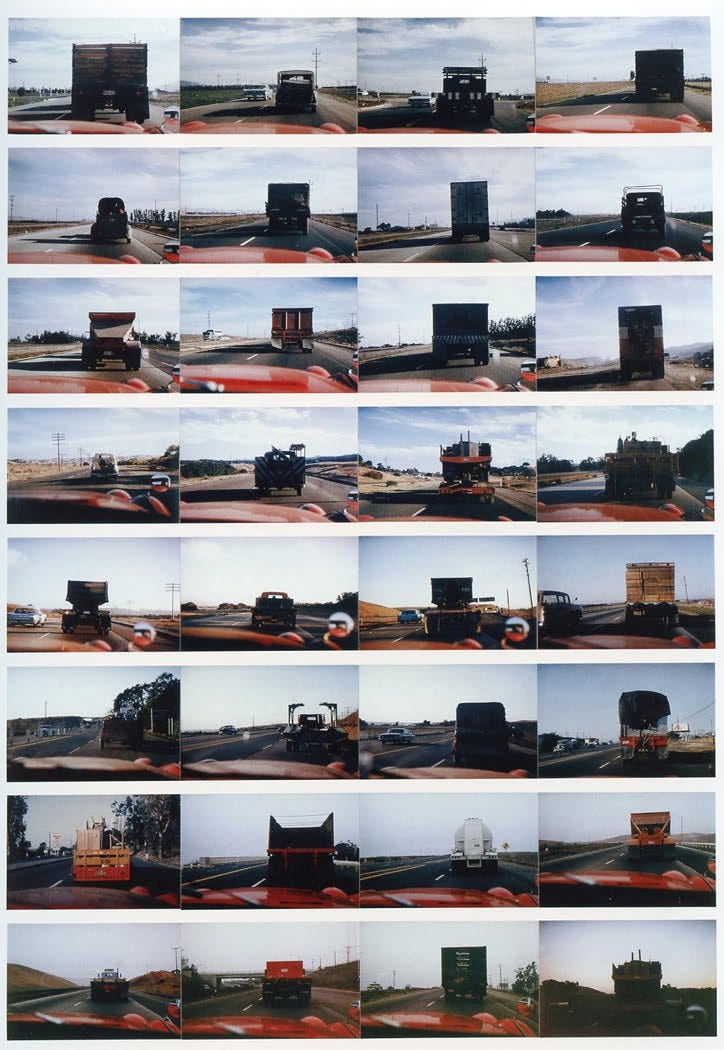
Conceptual art came to CalArts in the persons of its founding and early faculty: John Baldessarri, Jasmes Turrell, and Robert Irwin. Emerging form the Otis and Chouinard Art Institutes in 1959, John Baldessari (b. 1931 National City, California) rapidly fell into harmony with the Ferus artists, presenting photographic works as “The Back of All the Trucks Passed While Driving from Los Angeles to Santa Barbara, California, Sunday 20 January, 1963” (1963) taken through his windshield and presented as a grid. Baldessari, along with Ferus artists Robert Irwin and James Turrell, however, began pushing the logic of the art/world boundary collapse. Irwin’s “light and space” artworks made gallery spaces into interactive sites where lights and shadows on three-dimensional works created interactivity with the viewer and travelled far from any conception of the easel, the frame, or even sculpture. Dennis Hopper staged “happenings,” like the group construction of ice sculptures that fulfilled the situationist credo of time- and space-bound art. Baldessari’s great innovation was to incorporate art theory itself, to generate works that fulfilled a concept. In what Cheng (2002: 35) terms "redressive" practice, Allan Kaprow, who joined the faculty at CalArts in 1969, taught artists to "un-art themselves and give up any reference to being artists." In Situational Work (1974), Asher eschewed artworks entire, hollowing-out the very walls of the Claire Copley Gallery, exposing the "office" portion.Note
Despite the "redressive," subversive, and meta-critical turns in art practice, the LA avant garde quickly entered a burgeoning arts market, engaging the radicals with the Mating Dance of Tom Wolfe's metaphor. The first graduating classes from CalArts proved very successful. A wave of radical artists, known as the “CalArts Mafia” took the New York scene by storm in the 1970s. But these artists were largely absorbed by the “Art World” scene of New York. But this trend int eh 1970s nly continued an exodus that had already begin in the late 1960s. In 1966 Irving Bum closed the landmark Ferus Gallery and moved back to New York. Virginia Dwan left her Los Angels gallery open but opened a second in New York City by 1968 and made it her primary location. The cutting-edge magazine ArtForum, which had been founded in San Francisco and headquartered in Los Angeles on the floor above Ferus Gallery from 1965-67 moved in 1968 to New York to capture the citadel, and then become the new establishment.Note
Female avant garde artists were few in comparison to the men so numerously discussed here. Jay DeFeo (1929-1989) and Joan Brown (1938-1990) were major figures, but they were mostly based in San Francisco. CalArts broke significant ground in hiring some women faculty in the earliest years, and more aggressively in the late 1970s. Conceptualist and minimalist photographer Judy Fiskin was among this early cohort. "One thing I look back at now and wonder about, " Fiskin recalls, "is why did I think I could do this? Because there were no women the field!" She had taken a MA from UCLA but "therwe wer no women artists on teh UCLA arts faculty; I was at Berkeley before that: there were no women on the Berkeley facluty, and there were no women artists...basically." (Interview with Author 14 June 2006)
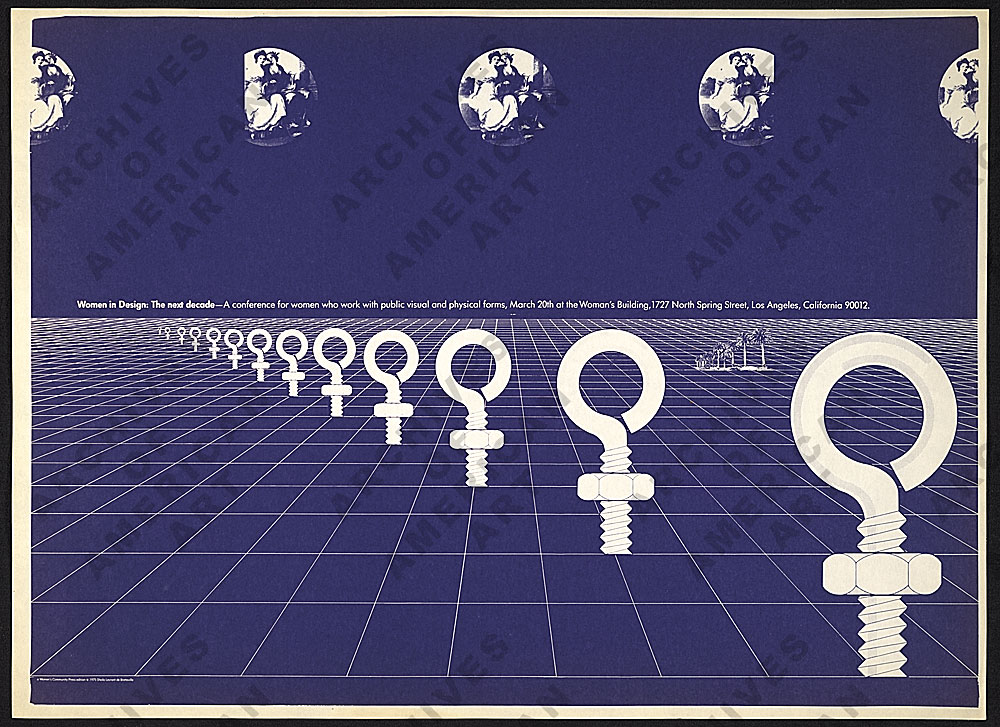
Following the practice of creating alternative art spaces was the effort headed by an artist who named herself after a different city, Judy Chicago (1939-). Teaching at CalArts, Chicago decided that women's work would never be equally valued in male-dominated institutions, so she quick in 1973 to founded Feminist Studio Workshop (FSW) and Womanspace Gallery in the former building of Otis College of Art and Design, near MacArthur Park. The named their new site the Women's Building (named in honor of the Women's Building at the 1893 Chicago World's Fair). Women in in Design Poster 1975
As women were still at the periphery of the avant garde, Los Angeles remained at the periphery of New York, despite its eruption as a center of artistic production. As Fiskin recalls, even by the 1970s "New York was teh center and we were the periphery. Even to say that we were the periphery was stretching it [laughs]. Chicago wan't anywhere either. There's the periphery and the non-existent. I think we existed between the periphery and the non-existent. Even Baldesssari had to show in Europe before he could show in New York. New York was it, and we weren't New York." It was Baldessari over anyone else who gave the LA avant garde its entree to New York success. He was "like a virtual employment agency. He could just place them in galleries in New York when they got out of school....And he was telling everyone that they had to go to New York." (Fiskin interview) “More than anyone else, remembers Nancy Chunn, "[Baldessari] had connections with all of the European artists; no one hit LA without coming up to CalArts.”Note
A spatial hierarchy in the art market put Los Angeles, despite its leadership in several areas, in the supply chain as a sourcve, not the ultimate destination, for arts and artists. The New York Galleries were more prestigious than those in LA, and those in LA with strong New York connections, like Virginia Dwan, Doug Christmas (whose gallery succeeded Dwan's), and Nicholas Wilder, who closed his LA gallery in 1975 and moved to New York as an artist, collector, and dealer. It was not until the early 21st century that Los Angeles and its galleries could claim status as even in the same league as New York.
Conclusion: Post-script(s)
"The historical period that the avant-garde shared with modernism is over. That seems an obvious fact," wrote Rosalind Krauss in her influential 1984 ArtForum essay "The Originality of the Avant-Garde: A Postmodernist Reception." Krauss made ArtForum her platform until 1976, when she left to found October, the next big thing in art criticism, totally devoted to the postmodern paradigm. It had seized leadership of American critical art discourse while en route from its origins in San Francisco to its sojourn in LA from 1965, through its move to New York in 1967, under the editorship of Philip Lieber. Krauss, eventually the Meyer Schapiro Professor of Modern Art and Theory at Columbia University, was one of the most influential voices declaring the end to modernist art in the profusive Glasnost of the 1970s. The Los Angeles contribution to this genuine global revolution in the arts, is impossible to measure, but obviously very heavy.Note
Avant-gardes in the fine arts have typically been absorbed by the establishment and commodified to the point where their original critical force is lost. The Art Market boomed in the 1980s Reagan Era of pro-capitalist growth and global capital accumulation. Wealthy and corporate art buyers parked their surplus capital in contemporary and mid-century art as a wise investment, also conspicuously displaying their social status. Radical artworks of the 1950s-1970s had become inspiration for industrial and fashion design by the 1980s.
But that familiar cycle, what Tom Wolfe called the "mating dance" of the avant garde with the art buyers, is by no means the whole story. Avant garde art has created utopian space in the cultural sphere, from urban spaces under siege, in Los Angeles since at least the 1921 Artes Populares exhibit of Mexican revolutionary art. Especially because the 1960s-70s LA avant garde exploded in the vacuum left by the fall of censorship in the American mass mediated public sphere, it created a two-way tunnel. Commodification of art objects, in other words, was matched by a more subtle but very real colonization of the channels of commercial culture by radical, rebellious, and humanitarian communication.
The LA avant-garde had not merely established an Arts Capital, they had carved holes in the walls of dominating Nixon-Reagan regime for the Uprising of 1988-1992, a story that is told in the essay titled Bloodbath.
Endnotes
[1] Although this quotation is widely attributed to Hopps, he presented it as the quote of a friend, during a 2005 talk at the Santa Monica Museum of Art: “A poet friend of mine, a UCLA student from the first Syndell Studio that we had, once said, ‘Art is the possibility of love with strangers.’” The poet’s identity is not known, but it should be noted that Hopps variously attributed the names of his two original galleries, Syndell and Ferus, deceased people in his past. My impression is that he liked to bury his creations in stories about others.
[2] “Conversation with Walter Hopps,” 16 November 2004, in “Modern Art in Los Angeles: The Beat years,” Audiorecording. Getty Research Institute, Special Collections. (Hereafter GRI) Quotation at 58 min 22 sec.
[3] “Conversation with Walter Hopps,” 16 November 2004, in “Modern Art in Los Angeles: The Beat years,” CD #2. GRI.
[4] Quotation in Hopps (1967): n.p.; Candida Smith (1995); Schrank (2009): Ch. 3.
[5] “Conversation with the ‘Beat Group’,” 19 November 2003, in “Modern Art in the Beat Years,” CD #7. GRI.
[6] Blum quoted in Grenier, ed (2006): 100.
[7] All quotations in this and the previous paragraph are from Hopps (1996), p. 26.
[8] Hopps (1996): 27.
[9] Hopps (1996): 29.
[10] Hopps (1996): 30.
[11] Hopps (1996), p. 33.
[12] Hulten acquired a Kienholz masterpiece, The State Hospital, in 1966 for the Stockholm Moderna Museet. Hopps (1996), p. 33-4.
[13] Hopps (1996), p. 83.
[14] Hopps (1993): 107.
[15] Isenberg (2000): 197.
[16] Hopps (1993): 100. This quotation is actually Hopps quoting Ruscha in conversation with Ruscha.
[17] Isenberg (2000): 198.
[18] “Conversation with Walter Hopps,” 17 November 2004. “Modern Art in Los Angeles: The Beat years,” “Modern Art in the Beat Years,” CD #3. GRI.
[19] Coplans (1962); Plagens (2000), 138; Grenier, ed. (2006): 102.
[19b] Coplans (1962)
[20] Greenberg ([1948] 1986) :222.
[21] Greenberg (1961), p. 136.
[22] Quoted in Thierry de Duve (1990): 245.
[23] Crimp (1984): 184, 186.
[24] Ruscha quoted in Hopps (1993): 100.
[25] Ruscha quoted in Hopps (1993): 101.
[26] Varnedoe (2001).
[27] Missing Foonote here!
[28] Quoted in McDonough (2001): 93.
[29] A French pun on “Eros, c’est la vie.”
[30] “It was because of [Don] Chipperfield’s recommendation that Heinecken began teaching photography in the UCLA extension division while he was still a graduate student. When the art division underwent changes in 1961, Heinecken initiated photography into the fine arts curriculum. In 1962 the graduate program began.” Katzman has process right but the dates wrong. Katzman (1984): 50.
[31] Grody (2006): 15-25. -
1
2018-07-19T17:31:05-07:00
Beat Dada: Ed Kienholz, 1952-1962
9
plain
2018-07-20T04:25:23-07:00
Shortly after the Action One show of 1953, Edward Kienholz arrived in Los Angeles like Paul Bunyan. Or like Odysseus, a trickster hero, this industrious, ambitious burly craftsman with no formal art education (except “rudimentary training as a boy”), was determined to be a great artist. Born in 1927 in Fairfield Washington, Kienholz grew up on a farm, where construction and repair of nearly everything of use (buildings, furniture, water pumps, guns, electrical equipment, tractors, engines, stone walls, etc.) is a matter of daily life. Kienholz “was so determined to have a career and take care of himself that shortly after high school he simply went out into the world.” Despite a few attempts to attend college, he hit the road, traveling mostly in the west. As a principled pacifist, Kienholz casually, openly dodged the Korean War draft, but never faced charges.
In Minneapolis he encountered a Rembrandt exhibition that “he often referred to as a decisive experience in persuading him to become an artist himself.” In 1953, he "set up a storefront studio in El Paso Texas, supporting himself doing odd jobs, painting [Thomas Hart] Benton-like figurative art, crossed with the abstraction of Miró” on found wooden surfaces. Active in El Paso was the WPA-era Student Arts League artist Tom Lea. Kienholz asked him to come review his work, and Lea, after a careful inspection, told him: “You have to go to New York or Los Angeles. I admire what you are doing—it has great courage—but it’s not going to survive here in El Paso.” For Kienholz the Westerner, Los Angeles was the only real choice.[7]
Kienholz preferred peripheral landscapes, setting-up shop in the San Fernando Valley in 1953 as a handyman jack of all trades, always wring scrupulous estimates and contracts. He painted the neat lettering on his International pickup truck door simply:“Edward Kienholz EXPERT OL-4720].” It is worth quoting the insightful prose of Walter Hopps at length to take stock of the character and art of Edward Kienholz at the time of his arrival in 1953:It was the beginning of the Beat period, and he had exactly the right attitude and sensibility to be part of it immediately. He had a very different background from important writers who came out of San Francisco, but his existential temperament and his willingness to solve problems and to improvise—whatever direction that might take him – put him in a league with them and even made him a kind of mentor to the LA scene.
Kienholz’ “existential temperament” is an important observation. It oriented him to the everyday material and symbolic landscape, drawn literally from the cast-away artifacts of the Los Angeles world. And, coupled with his ambition, it empowered him to simply invent an LA art scene that he wanted to be part of. Kienholz scavenged for nearly everything he made. He developed his vision from within his extensively-varied craft experience with the materials of the world. Kienholz, a “natural leader” was also networking the LA arts scene together, literally building a significant spatial portion of the Los Angeles art world cityscape. Hopps continues: “He built and outfitted new coffeehouses, advising people on where to find good cheap rentals and how to bring them up to the minimum health code.” “Many experimental artists would turn up in these coffee houses, and that’s where Kienholz began to find his constituents.”[8] In his artworks, Kienholz always confronts the viewer bluntly with the ordinary, never shrinking from representational, symbolic and textual components, almost perfectly in unison with the theories of Marcel Duchamp, who came to admire his “vulgar” assemblages.
Walter Hopps had been doing essentially the same thing, less as an artist and more as a critic, educator, and entrepreneurial gallerist, by the time Kienholz arrived, and they almost inevitably joined forces, thanks to their compatibility. “We couldn’t have been more different sorts of people, but it was clear to both of us that we had an agenda to further the kind of art that interes4ted us in our own ways. I was a college boy, and didn’t dress like a beatnik; Kieinholz, in his heavy work clothes, rough and muscular, looked nothing like the stereotype of the artist. Many of the best artists of that period thought of themselves as workers: making art was their job, just as they ran a machine shop or cleared trash for a living…. Kienholz looked like a lumberjack just in for lunch. They identified physically and absolutely with the working class.”[9]
Kienholz and Hopps wrote out an “informal contract on a hot dog wrapper…shook hand and formed a new partnership.” Merging their two former galleries (Now and Syndell, respectively) the partners set up Ferus Gallery at 736-A North La Cienega Boulevard. Like Syndell, Ferus was also the name of a suicide—James Ferus, an artist friend of Hopps from high school.[10] Kienholz divided the space, with his studio into the back, ran and tended the studio while Hopps studied at UCLA and networked (teaching collectors, organizing shows, signing avant-garde San Francisco artists, like Hassel Smith, one of their first. Smith loaned them a Clyfford Still for their opening show; they also borrowed a Richard Diebenkorn.
By 1959 Kienholz had developed his low-relief paintings into fully three- dimensional illusionistic assemblages from found materials. Fearlessly confrontational toward the corporate, Cold War modernist ruling aesthetic, he executed a series of shocking parodies. John Doe (1959) is a vicious parody of the postwar white male. John Doe’s heart is replaced with a cross in a hole through which his castrated phallus is visible, placed in a special compartment. A painted sign on the front of the sculpture reads: “Riddle: Why is John Doe like a piano? Answer: Because he is square, upright, and grand.” But Kienholz wasn’t done savaging the pretense of the 1950s. Jane Doe (1960) is a severed head on a sewing table, the lace tablecloth serving as her skirt. Sardonically echoing Victorian fetishes, the legs are slender and lithe. The viewer of this work is invited to violate the figure, lifting her skirt and opening drawers, wherein one discovers her miscarried fetuses. This work is feminist in a very confrontational way. Finally, Kienholz in 1961 completed his little anti-family with Boy, son of John Doe. Boy is fused with his automobile; the trunk is filled with his hedonistic image-building consumer artifacts: condoms, beer cans, cigarettes. In Walter Hopps Hopps Hopps (1959), Kienholz unsparingly caricatured even his friend as a street hustler of art objects dressed, as he always was, in a neat suit and tie (indistinguishable from the commercial image of the suburban Father).
Kienholz started mounting major shows of his large-scale works at the second Ferus location (at 723 North La Cienega Boulevard) in 1959 and 1960. Hopps persuaded the young director of the Thomas Leavitt of the Pasadena Art Museum to mount an exhibit of very confrontational artworks in 1961, including A Bad Cop (Lt Carter) (1961): “Kienholz singled out a real bully from the Los Angeles Police Department and made a horrible-looking vertical piece, about 5 feet high, by tarring-and-feathering an industrial steel cabinet. A kind of phallus stuck up from the top of the box, and Kienholz had cut out a photograph of the actual Lieutenant Carter’s face and glued it on, making the piece pretty explicit.” Kienholz refused Leavitt's pleas to remove the direct references: “Can we just call it A Bad Cop?” he pleaded.[11]
26. By 1961 Kienholz was included in the Museum of Modern Art show “The Art of Assemblage,” organized by curator William Seitz. “The exhibition placed Kienholz in the company of Picasso, Schwitters, Duchamp and Cornell and really established his international reputation by introducing such major European museum figures as Pontus Hulten to his work.”[12] And he physical scale of Kienholz’s artistic output kept expanding. By 1962 he had completed a full interior space, a genre he called a “tableaux,” called Roxys (1961-2), a brothel scene containing grotesque sex workers. Surrealist dealer Alexander Iolas exhibited Roxys exhibited in his New York gallery in 1963. These moments of recognition, however, only dotted a much more extensive range of activities, primarily enacted on the stage of Los Angeles, as a very public figure leading the countercultural world.
Kienholz was not at all interested in taking his famous work to New York, a path taken by many who would follow in the Los Angeles booming art scene that Kienholz helped to build. In fact, he did not even attend the opening of the 1961 MOMA show, shunning the opportunity entirely. This quality makes him all the more interesting as a Los Angeles actor. Because actor he was, invading the Republican-dominated, anti-Communist, surburban, Cold War public culture of Los Angeles. No intervention better typifies his audacious radical stance than the major one-artist show that Maurice Tuchman, Director of the brand-new--and still very conservative--Los Angeles County Museum of Art, mounted in 1966. Included was Back Seat Dodge ’38 (1966), a chopped-down 1938 Dodge with a very graphic, in the midst of coital intercourse. The man, made of chicken wire complete with an erection penetrating a female mannikin, but the two figures share a common head because, as Kienholz said, they “have the same thing on their mind.” Grotesque, the piece caused a major furor with the Los Angeles Board of Supervisors, who almost shut down the show in their new museum's first year of operation. That it did not was a partial triumph in the battles with censorship. As a resolution of the obscenity crisis, it was agreed to station a LACMA docent at the door of the dodge, closing it when children were present.
Kienholz was not a formal, political leftist, but his art practice was pure political-cultural rebellion, far more radical than any organized party politics that sought actual governmental power—even remotely, like the Socialists or Communists. Kienholz did not merely slap the establishment in the face with his grotesque obscenities—in the long-established Parisian-modernist tradition of “epater le bourgoisie " (to taunt/abuse the middle class). He did intentionally shock the viewer, but he did so with a passionate and uncompromising purpose. His was a hostile, series of charges against specific injustices. To protest the execution of Caryl Chessman in 1960 by the State of California, and to protest the death penalty in general, he executed The Psycho-Vendetta Case (1960). In the year of Jack Kennedy’s spectacularly sunny starring role as the prince of Glamour in Los Angeles, Kienholz would have nothing of celebration. Into an open-able wooden case, he fashioned a bent-over male buttocks, complete with hanging testicles and open rectum, into which the viewer perforce stuck her/his face upon viewing. Inviting the viewer literally to lick Chessman’s arse, the text reads; “If you believe in an eye for an eye and a tooth for a tooth, stick your tongue out. Limit three times.”[13]
Having created many artist spaces in which artists met or showed or produced their work, Kienholz achieved one of his most powerful works portraying those artists within an encompassing space (surpassing almost the entire history of sculpture) that portrayed an actually inhabited space. The exploration of interior space as a social and cultural environment that Kienholz began in Roxys (1960-61) continues even more powerfully in The Beanery (1965). Barney’s Beanery was a popular bar and grill favored by the artistic avant-garde, standing on the north side of Holloway Dr. at the base of a steep hill connecting the Sunset Strip with Santa Monica Boulevard. Just out of sight of the commanding heights of Case Study House #22 (The Stahl House, Pierre Koenig 1960), Barney’s in the late 1950s and early 1960s was worlds apart from the spaces inhabited by Arts & Architecture John Entenza, Pierre Koenig, and Julius Shulman.
Kienholz opened this 90% scale assemblage, The Beanery (1965) in the parking lot of the real Barney’s Beanery. Social horror greets the eye of the viewer, where every denizen of the Beanery has a clock for a head, ticking time toward death, in agony or dispiriting decay dripping with the wet-seeming thick resins and bloody colors. According to critic Ed Jansen, "Kienholz first came up with the idea of creating his own version of the Beanery in 1958 but commenced work on August 28, 1964, upon reading the headline Children Kill Children in Vietnam Riots while visiting the bar. The harsh contrast between the “real time” represented by the newspaper headline and the “surreal time” of the bar’s customers impelled Kienholz to start work on the tableau. The newspaper conveys the sense that time – like the clocks – stopped on that particular day."Note
[7] All quotations in this and the previous paragraph are from Hopps (1996), p. 26.
[8] Hopps (1996): 27.
[9] Hopps (1996): 29.
[10] Hopps (1996): 30.
[11] Hopps (1996), p. 33.
[12] Hulten acquired a Kienholz masterpiece, The State Hospital, in 1966 for the Stockholm Moderna Museet. Hopps (1996), p. 33-4.
[13] Hopps (1996), p. 83.
[14] Hopps (1993): 107.
[15] Isenberg (2000): 197.
[16] Hopps (1993): 100. This quotation is actually Hopps quoting Ruscha in conversation with Ruscha.
[17] Isenberg (2000): 198.
[18] “Conversation with Walter Hopps,” 17 November 2004. “Modern Art in Los Angeles: The Beat years,” “Modern Art in the Beat Years,” CD #3. GRI.
[19] Coplans (1962); Plagens (2000), 138; Grenier, ed. (2006): 102.