Scalar's 'additional metadata' features have been disabled on this install. Learn more.
Ghost Metropolis: Los Angeles from Clovis to NixonMain MenuRegimes: Ruling the Los Angeles Region from the Late Pleistocene to the 21st CenturyPlaces and Paths of Los AngelesManna From Hell: Power and Politics from Region to World PowerShadows: Visual Cultures and Mass Media of a Regional and Global PowerSegregated Diversity: The Geosocial Formation of Social Justice in the Late Twentieth CenturyRichard 37th: Nixon, Los Angeles, and World PowerThe American 1989: Los Angeles at the Climax of the 20th CenturyNarrative EssayBibliographies, Filmographies, Gazeteers, IndexesMapping the Past: Theory, Methods, HistoriographyPathCreditsRootPhil Ethingtone37d40405599cccc3b6330e6c4be064cc03ef7a5
Newman 2000: 176
12016-05-26T16:31:13-07:00Phil Ethingtone37d40405599cccc3b6330e6c4be064cc03ef7a56771Noteplain2016-05-26T16:31:13-07:00Phil Ethingtone37d40405599cccc3b6330e6c4be064cc03ef7a5“Artforum’s relationship to new art was conceivably like that of Cahiers du Cinema’s to nouvelle vague film. I think because we were a cadre and conspicuous, not individuals spread around, we made a mark in interpreting the work. Galleries, museums and collectors were all more ore less in place to receive the innovators; it remained for critics to articulate what the values were, and why the reception.” – Kozloff quoted in Amy Newman, Challenging Art: Artforum 1962-1974. New York: Soho Press, 2000. p.176.
This page is referenced by:
12018-07-19T18:30:37-07:00Conceptualism and the the CalArts Mafia, 1971-19803plain2018-07-20T18:49:08-07:00Los Angeles not only became the center of a revolution in the very understanding of fine art photography, but also, as if the overthrow of classical aesthetics was not revolutionary enough, of Conceptual art, centered powerfully in Los Angeles, threw the arts into an entirely new dimension. This new upheaval erupted in the newest and most transformative art school in Los Angeles: CalArts, which also diversified its faculty, including the first significant proportion of women faculty.
CalArts popped-up in rural Valencia as a new kind of art school envisioned by none other than the Sorcerer of popular culture, Walt Disney. Early in his career as a great inventor of animation, Disney envisioned a new art form in the union of music and animation, which he explicitly realized in his third feature-length film, Fantasia (1940), conducted by Leopold Stokowski. Late in life, he saw the opportunity to train a new generation of multi-disciplinary artists who disregarded genre distinctions in an environment where all of the arts were explored in unison. Before he died in 1966, he had arranged for the merger of two struggling schools, Chouinard Art Institute, and the Los Angeles Conservatory of Music. Leaving fully 45% of his estate to this dream, Disney dubbed the new school the California Institute of the Arts, with the ambition to make it the “Cal Tech” of the arts, hence its nickname, “CalArts.” After several delays the campus was finally opened in 1971 on a sprawling campus in Valencia, miles north of Los Angeles. Taking the late Walt Disney at his word to achieve a truly revolutionary school, the hastily-assembled leadership hired a radical cadre of instructors drawn straight form the avant garde.
Almost immediately, CalArts became notorious for countercultural excesses. After reports that faculty regularly swam naked in the CalArts pool, an emergency board meeting was called, in which including Walt’s widow Lillian Disney and his brother Roy. Called to testify, one instructor proceeded to disrobe completely, shutting down the meeting can causing even more furor, resulting the resignation of its first president. Under the next president, Robert J. Fitzpatrick, the school stabilized and became the epicenter of a phenomenal output of avant-garde production.
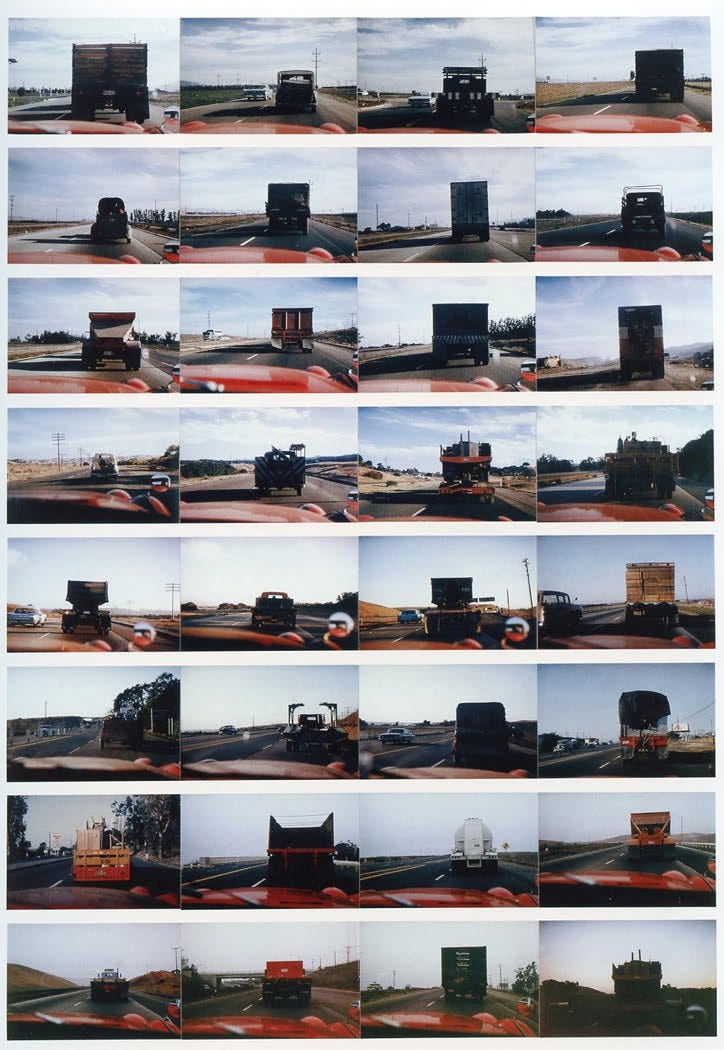
Conceptual art came to CalArts in the persons of its founding and early faculty: John Baldessarri, Jasmes Turrell, and Robert Irwin. Emerging form the Otis and Chouinard Art Institutes in 1959, John Baldessari (b. 1931 National City, California) rapidly fell into harmony with the Ferus artists, presenting photographic works as “The Back of All the Trucks Passed While Driving from Los Angeles to Santa Barbara, California, Sunday 20 January, 1963” (1963) taken through his windshield and presented as a grid. Baldessari, along with Ferus artists Robert Irwin and James Turrell, however, began pushing the logic of the art/world boundary collapse. Irwin’s “light and space” artworks made gallery spaces into interactive sites where lights and shadows on three-dimensional works created interactivity with the viewer and travelled far from any conception of the easel, the frame, or even sculpture. Dennis Hopper staged “happenings,” like the group construction of ice sculptures that fulfilled the situationist credo of time- and space-bound art. Baldessari’s great innovation was to incorporate art theory itself, to generate works that fulfilled a concept. In what Cheng (2002: 35) terms "redressive" practice, Allan Kaprow, who joined the faculty at CalArts in 1969, taught artists to "un-art themselves and give up any reference to being artists." In Situational Work (1974), Asher eschewed artworks entire, hollowing-out the very walls of the Claire Copley Gallery, exposing the "office" portion.Note
Despite the "redressive," subversive, and meta-critical turns in art practice, the LA avant garde quickly entered a burgeoning arts market, engaging the radicals with the Mating Dance of Tom Wolfe's metaphor. The first graduating classes from CalArts proved very successful. A wave of radical artists, known as the “CalArts Mafia” took the New York scene by storm in the 1970s. But these artists were largely absorbed by the “Art World” scene of New York. But this trend int eh 1970s nly continued an exodus that had already begin in the late 1960s. In 1966 Irving Bum closed the landmark Ferus Gallery and moved back to New York. Virginia Dwan left her Los Angeles gallery open but opened a second in New York City by 1968 and made it her primary location. The cutting-edge magazine ArtForum, which had been founded in San Francisco and headquartered in Los Angeles on the floor above Ferus Gallery from 1965-67 moved in 1968 to New York to capture the citadel, and then become the new establishment.Note
A spatial hierarchy in the art market put Los Angeles, despite its leadership in several areas, in the supply chain as a source, not the ultimate destination, for arts and artists. The New York Galleries were more prestigious than those in LA, and those in LA with strong New York connections, like Virginia Dwan, Doug Christmas (whose gallery succeeded Dwan's), and Nicholas Wilder, who closed his LA gallery in 1975 and moved to New York as an artist, collector, and dealer. It was not until the early 21st century that Los Angeles and its galleries could claim status as even in the same league as New York.