Scalar's 'additional metadata' features have been disabled on this install. Learn more.
Ghost Metropolis: Los Angeles from Clovis to Nixon
Main Menu
Regimes: Ruling the Los Angeles Region from the Late Pleistocene to the 21st Century
Places and Paths of Los Angeles
Manna From Hell: Power and Politics from Region to World Power
Shadows: Visual Cultures and Mass Media of a Regional and Global Power
Segregated Diversity: The Geosocial Formation of Social Justice in the Late Twentieth Century
Richard 37th: Nixon, Los Angeles, and World Power
The American 1989: Los Angeles at the Climax of the 20th Century
Narrative Essay
Bibliographies, Filmographies, Gazeteers, Indexes
Mapping the Past: Theory, Methods, Historiography
Path
Credits
Root
Phil Ethington
e37d40405599cccc3b6330e6c4be064cc03ef7a5
"LeMay Bombing Leaflet"
1 2014-11-09T16:26:45-08:00 Phil Ethington e37d40405599cccc3b6330e6c4be064cc03ef7a5 677 4 Caption from Williams 2002: "Front side of OWI notice #2106, dubbed the “LeMay bombing leaflet,” which was delivered to Hiroshima, Nagasaki, and 33 other Japanese cities on 1 August 1945. The Japanese text on the reverse side of the leaflet carried the following warning: “Read this carefully as it may save your life or the life of a relative or friend. In the next few days, some or all of the cities named on the reverse side will be destroyed by American bombs. These cities contain military installations and workshops or factories which produce military goods. We are determined to destroy all of the tools of the military clique which they are using to prolong this useless war. But, unfortunately, bombs have no eyes. So, in accordance with America's humanitarian policies, the American Air Force, which does not wish to injure innocent people, now gives you warning to evacuate the cities named and save your lives. America is not fighting the Japanese people but is fighting the military clique which has enslaved the Japanese people. The peace which America will bring will free the people from the oppression of the military clique and mean the emergence of a new and better Japan. You can restore peace by demanding new and good leaders who will end the war. We cannot promise that only these cities will be among those attacked but some or all of them will be, so heed this warning and evacuate these cities immediately.” (See Richard S. R. Hubert, “The OWI Saipan Operation,” Official Report to US Information Service, Washington, DC 1946.)" Source: Josette Williams, "The Information War in the Pacific, 1945", CIA Studies in Intelligence Vol. 46, No. 3 (2002), online at https://www.cia.gov/library/center-for-the-study-of-intelligence/csi-publications/csi-studies/studies/vol46no3/article07.html plain 2014-11-09T16:30:29-08:00 Phil Ethington e37d40405599cccc3b6330e6c4be064cc03ef7a5This page is referenced by:
-
1
2015-02-18T21:48:25-08:00
Target Tokyo: Los Angeles and Accountability for U.S. War Crimes in Europe and Japan, 1943-1945
250
Narrative Essay
image_header
2017-07-13T10:57:15-07:00
"The attack or bombardment, by whatever means, of towns, villages, dwellings, or buildings which are undefended is prohibited." -- Article 25 of the Second Hague Convention, ratified by the United States Senate, 1907. Entered into force: 26 January 1910
This essay claims that the United States of America committed both war crimes and crimes against humanity during the firebombing and nuclear attacks on Japan in the years 1942-1945, and that Los Angeles bears a special portion of culpability for these crimes. (Acknowledgments). >Preamble
The indiscriminate mass slaughter of civilians in undefended cities through bombardment has been prohibited and condemned as unlawful at least since the Hague Convention of 1907, to which the United States is signatory. By standards recognized before the Second World War, and ever more so by international law today, the incendiary bombardment of undefended civilian residential districts of major cities with intent to ignite out-of-control firestorms is fully recognized as a war crime. It was so in 1944-5, and it is so today, by binding treaties ratified by the U.S. Senate, and by the vast weight of international humanitarian standards set by the United States and other nations. United States presidents and high-ranking officials have made incessant public declarations of revulsion against the targeting of defenseless civilians for mass slaughter. There is no uncertainty about the illegality and immorality of intentionally targeting to kill defenseless civilians. Since the 1940s, U.S. military commanders, scholars, and journalists both in the U.S. and worldwide, have acknowledged that the U.S. deliberately killed, with incendiary weapons of mass destruction, hundreds of thousands of defenseless civilian noncombatants, targeted under the labels "urban area" and "urban industrial area." Given the superb scholarship and a mountain of declassified government archives documenting the intentional development of anti-civilian residential incendiaries for the purpose of burning Japanese cities, the amazing thing is that the United States government (President, Congress, Supreme Court), has never acknowledged historical wrongdoing in face of these these horrifying realities. Quite the contrary: U.S. politicians and public leaders have evaded accountability for these war crimes and crimes against humanity, most notoriously when the 104th U.S. Congress, in 1996, cancelled the Smithsonian Institution's interpretive exhibit of the Enola Gay B-29 that dropped the atomic bomb on Hiroshima. That Congress, under the leadership, ironically, of a PhD in History, Newt Gingrich, shamefully censored twenty years of scholarship and a half-century of the official record itself. That willfully ignorant denial and nationalist bravado about the moral upper-hand, is sadly consistent with the history of lies and cover-ups conducted on a massive bureaucratic scale that this essay documents. Let the U.S. War Department's own 1947 United States Strategic Bombing Survey (USSBS) report state the facts:
"As a result of the American air offensive against Japan, 500 separate targets were bombed and an average of 43 percent of Japan's largest 66 largest cities were destroyed. More than two-thirds of the civilian population experienced air raids, and more than one-third personally experienced bombing. As estimated from the Morale Division sample survey, approximately 1,300,000 people were injured and approximately 900,000 killed as a result of the bombings. Bombing, or the threat of bombing, resulted in the mass disruption of the lives of countless millions of people, including the evacuation of more than 8,500,000 persons from cities." (USSBS, War Department, The Effects of Strategic Bombing on Japanese Morale. Washington, DC, June 1947), pp. 2-3.
These figures include the nuclear attacks on Hiroshima and Nagasaki, which are together usually numbered at 250,000 immediate civilian deaths. The SBS is frank about the indiscriminate nature of the bulk of the attacks:
"More than 500 separate targets in Japan were subjected to bombing attack during the period June 1944 to 15 August 1945. The large majority of these received precision bombing on specific industries or installations but 66 cities were subjected to urban area saturation tactics, attacks directed against whole areas of the city rather than at specific targets. Of the 160,300 tons of bombs dropped on Japan, 128,000 tons were dropped on the 66 cities. Damage to these cities ranged from 99 percent of the built-up area of Toyama to 11 percent of Amagasaki, with an average of 43 percent per city, by American estimates." (USSBS, War Department, The Effects of Strategic Bombing on Japanese Morale.Washington, DC, June 1947), p. 34.
Repeatedly citing the March 9-10 1945 Firebombing of Tokyo, which left more than 100,000 civilians dead, former U.S. Secretary of Defense Robert S. McNamara openly confessed to committing "war crimes" with General Curtis LeMay in the line of his duties with the XX and XXI Bomber Command -- the US Army Air Force units that waged the savage incendiary attacks on Japanese cities from November 1944 through August of 1945. This confession, first aired in Errol Morris's documentary, The Fog of War (Sony Pictures Classics, 2003), is critically analyzed below. By the sheer numbers established by the U.S. Strategic Bombing Survey, the systematic civilian killing by the United States Army Air Force, Twentieth Air Force, XX (HQ Kharagphur, India) and XI (HQ Saipan, Guam) Bomber Commands, all under Commanding General Henry Harley "Hap" Arnold, qualifies as an atrocity of unprecedented proportions. The United States killed more than a third of a million noncombatants in just three instants of extreme violence: The 9-10 March 1945 Tokyo firebombing attack, during which 325 B-29's, dropped 1,665 tons of M-69 napalm incendiaries, and the atomic attacks of 6 August 1945 Hiroshima and 9 August Nagasaki. If we add the U.S. Army Air Force's participation in Dresden and Berlin urban-area attack to the U.S. Strategic Bombing Survey estimate of 900,000 civilians killed in Japan, then the US has more than 1 million dead civilians on its conscience. That conscience is the unacknowledged accountability for a major crime against humanity.
This essay explores a haunting most terrible not only for the United States, but for Los Angeles in particular. The greatest evil of the twentieth century is the mass killing of civilian noncombatants, in genocides that range in form from the Nazi Holocaust, in Stalin's purges and famines, and the RAF's terror-bombing campaign against Germany. The United States committed its own version of these atrocities, and those crimes were accomplished by many key, indispensible actions that took place in Los Angeles. Southern Californians contributed very significantly to this outcome. As with any crime, its moral after-effects have lingered ever since, haunting the living with downstream injustices. How does any city shape world history, and what portion of responsibility should it bear for what happened worldwide? What portion of responsibility does any place and people bear for the global actions of its government and soldiers? After addressing this question, I will narrate the longer background for the US planning for wholesale killing of civilians. We shall see that Los Angeles bears responsibility for three reasons: 1) As the leading innovator and producer of air war weaponry-- although ironically no B-29s were produced in Los Angeles; 2) As the leading instrumentality of propaganda that consciously suppressed the truth and manufactured a cover-up story, the paper trail of which is easy to document; and 3) As the home of the largest number of the U.S. mainland's Issei and Nisei Japanese community, Los Angeles's ruling regime practiced extreme race hatred within an Anti-Japanese movement that dated from at least 1906.This essay, narrating and correlating global fields of action, weaves strands by the following titles in successive sections:1) An introduction to international air war doctrine through the Air War Crisis of 1936-1939.2) The Development of U.S. War Plans for the Industrial Killing of Japanese Civilians, 1941-19453) "Central Directives": U.S. Office of War Information (OWI) Disinformation Campaign about Area Bombing, 1944-454) Hollywood's Contribution to the Area-Bombing Cover-up5) Thirty Seconds Over Tokyo (1943-44)6) The Screenplay: Shaping the Message about Killing Civilians7) "We Kill'em with Fil'm": Target Tokyo, Narrated by Ronald Reagan (OWI-USAAF First Motion Picture Unit, 1945)8) Accountability? Robert S. McNamara's Flawed War Crimes Confession.9) War Birds Coming Home To Roost: The Repressed Image of Los Angeles as Aerial Target10) Historical IndictmentAfter considering the central importance of urban area bombing in World War II, this essay recounts the evolution of U.S. air war doctrine toward the killing of civilians. The analysis turn to the War Department/Hollywood/Press collaboration in the production of propaganda that covered-up the urban area bombing by portraying it as precision bombing. In numerous U.S. government Office of War Information documents, we can observe the awareness of the illegal and immoral nature of the US actions, coupled with consistent, intentional plan to tell a completely different story, one that avoids contradicting the principles declared by the U.S. for many years up to the 1940.I next present an extended analysis of this state/media industry nexus in the remarkable M-G-M production, Thirty Seconds Over Tokyo, written by Dalton Trumbo, starring Spencer Tracy and released in November 1944 to coincide with the first major B-29 attack on Japan from the newly-conquered air base in Saipan. This film belongs to an important subset of the numerous wartime films that featured the story of the Doolittle Raid, including, Destination Tokyo (Warner, 1943) starring Cary Grant, and The Purple Heart (Twentieth Century Fox, February 1944). We will also examine an important documentary produced by US Army Air Force's First Motion Picture Unit (FMPU, starring then-Captain Ronald Reagan as narrator: Target Tokyo (War Department, 1945). The essay then returns to a critical evaluation of the apparent confession by Robert S. McNamara in Errol Morris's 2003 documentary, Fog of War, and turns to a final consideration of the role of the Los Angeles in the commission of the war crimes, and concludes with a restatement of the historical indictment presented in this essay. The Air-War Crisis of 1936-1939 In his 1921 Command of the Air and later writings, the Italian fascist Giulio Douhet articulated the chilling logic of genocidal warfare. Fascism is anti-humanitarian. It mocks and scorns the humane values that grew through the Renaissance and Enlightenment of Western civilization, and calls for a return to brutal values of the Roman Empire. Unsurprisingly, the Douhet scoffed at the moral principles that inform the 1907 Hague Conference treaties. Reasoning that because modern urban societies are the nerve centers of nations, the jugular of an enemy, he enthusiastically advocated using bombs and poison gasses to eradicate humans and all living things in a spectacle of horror so great, that social breakdown would occur throughout the entire nation, and all other principal cities would immediately sue for peace. Such appalling slaughter would, he boldly asserted, prove humane by saving millions of lives such as those lost slowly in futile trench-warfare battles of the recent Great War. (Pape 1996, pp. 55-86). This is a fascist inversion of morality, easy to recognize as an evil future for any civilization. Mark well that many leading Americans, from Mary Pickford to Joseph Kennedy to Charles Lindburgh admired Italian fascism in the 1920s. Douhet's air-force-founding counterpart in America was William L. “Billy” Mitchell, who knew Douhet's writings very well, and wavered between enthusiastic embrace of Douhet's genocidal approach, and one that respected established laws of war, embodied in the Hague Conventions: that civilians are not combatants and therefore illegitimate targets. Mitchell did at times agree with Douhet that terrorizing civilian populations would be a necessary part of disrupting the social fabric and economy of the enemy. This evolved into the option of last resort in U.S. air war doctrine by the beginning of 1930s. Under the leadership of Mitchell, and later, General Henry Harley “Hap” Arnold, the U.S. Army Air Forces developed the American strategy, sometimes called "Lenient Douhet," which holds that the goal of paralyzing the enemy with precision strikes can be accomplished through attacks on vital industrial and transportation facilities to critically disrupt an enemy nation, with a minimized impact on civilian "collateral damage." This "precision bombing" strategy has the virtue of not being deliberately anti-civilian, but it inevitably involves civilian casualties.
The Air Corps Tactical School (ACTS) was the branch of the War Department responsible for developing the guiding doctrines of air strategy and tactics. By the late 1930s, ACTS had drawn-up elaborate plans for the precision bombing of military and supply-chain objectives, beginning with the enemy’s air force, proceeding to its industrial capacity to produce warplanes, tanks, ships, and vital spare parts such as ball bearings. But the "Severe Douhet" strategy was always held in reserve, just as the U.S. continued to develop chemical weapons after they were banned by the Geneva Conventions of the 1920s. The Air Corp Tactical School held that modern, urban, industrial society depends on the orderly operation of complex urban-centered systems. Mass transit, water supplies, electricity, and most of all, the manufacture of weapons, should be disrupted, to undermine the enemy’s ability and will to fight. Targeting these objectives does presuppose a large number of civilian casualties, because the workers in transit systems and industrial plants are civilians. So are the families living in surrounding areas to rail stations and factories. This is how "civilian casualties" slipped into a moral grey zone. In total disregard for the Hague Convention treaties of 1907, the transit worker or aircraft worker became a military target. That part is mostly accepted. Next in the moral descent is considering the massive overloading of civilian disaster relief systems. All major cities had fire-suppression systems, and enough transportation and supply-chain resources to keep people healthy and productive. Overwhelming those systems, it was surmised, in order to let the fires destroy the aircraft factories, would also then bring the national war machine to a halt.
At this level of thinking, civilian casualties were not merely justified as "collateral damage” (meaning unintended). Civilian death and terror promised mass disruption and dysfunction. “De-housing” workers and diverting the nation's labor power and infrastructure to rescue and recovery were part of the plan. While during the 1920s, the Royal Air Force inflicted "Air Control" on newly-formed Iraq after the Great War, "bombarding villages and tribes as needed to put down unrest and subversive activities" (Satia 2006: 16), no military power had attempted even a Lenient Douhetian attack on a city before the joint Spanish Fascist - German air attack on Guernica, Spain in 1936 (subsequently commemorated in Picasso's famous canvas). Then suddenly, as if on a signal, in 1937 Mussolini's Italian forces bombed Ethiopian villages, and Japanese Imperial forces bombed the cities of Shanghai, Nanking, Canton, Hankow, Chengdu, Kunming, and Chongqing. All of these fascist/imperialist bombings provoked widespread public outrage by the Western democracies. (Orr, 2014).
Reacting to the Japanese aerial bombing of Chinese cities, the League of Nations unanimously approved a Declaration on the "Protection of Civilian Populations Against Bombing From the Air in Case of War, 30 September 1938." It was an urgent plea to all member and non-member States, to adopt a most explicit prohibition the aerial bombing of civilian non-combatants. The Declarations's principles were unambiguous:
"1) The intentional bombing of civilian populations is illegal;2) Objectives aimed at from the air must be legitimate military objectives and must be identifiable;3) Any attack on legitimate military objectives must be carried out in such a way that civilian populations in the neighbourhood are not bombed through negligence."
The Declaration noted "though this principle...does not require further reaffirmation, it urgently needs to be made the subject of regulations specially adapted to air warfare and taking account of the lessons of experience." This last phrase was added because the League members--which excluded the United States of course--saw these principles as already axiomatic in existing treaties, such as the 1907 Hague Conventions.
The League did not speak for the United States, but President Roosevelt's 1 Sept. 1939 "Appeal" against bombing of civilians in would be set in such morally unambiguous terms, precisely because the international law, precedent, and standards were clear. The fear of the Douhetian option only increased by 1939. This option remained seductive because it had never been tested. The Spanish-German, Italian, and Japanese attacks of 1936-8 did not involve sufficient numbers of bombers, however, to truly paralyze--let alone obliterate--a city. Air power strategists had already determined that a true firestorm would require at least 100 bombers and many tons of bombs. By 1938, however, the German Luftwaffe was the largest air force on Earth, uniquely capable of a full city-destroying attack. Knowing that fascists were ruthless enough to use Douhet's doctrine, a near panic by Roosevelt's Ambassador to France, William C. Bullitt, about the vulnerability of France, to an overwhelming, paralyzing air attack. He drafted the impassioned Appeal that President Roosevelt made on 1 September 1939, as Hitler's invasion of Poland began:I am therefore addressing this urgent appeal to every government which may be engaged in hostilities publicly to affirm its determination that its armed forces shall in no event, and under no circumstances, undertake the bombardment from the air of civilian populations or of unfortified cities, upon the understanding that these same rules of warfare will be scrupulously observed by all of their opponents. I request an immediate reply.
--Franklin D. Roosevelt (U.S. Department of State, Foreign Relations of the United States, 1939: General (Washington, D.C.: Government Publishing Office, 1956), p. 542).Thus ended Air-War Crisis of 1936-9, and also the American conscience. The fear that the fascists would really execute Douhet's doctrines came true, greatly empowering the Douhetians in the US AAF. The impassioned pleas based on morality and decades-old international treaties were over.
The Development of U.S. War Plans for the Industrial Killing of Japanese Civilians, 1941-1945
Not long after Roosevelt's unambiguous appeal, in 1940 Hitler's Luftwaffe began to target cities in attacks on Rotterdam and the London Blitz. After a very short and unsuccessful trial at attacking military and industrial targets, the United Kingdom's Royal Air Force (RAF), under the command of Sir Charles Portal and General Arthur “Bomber” Harris, emphasized the night-time terror bombing of civilians and cultural monuments; the RAF’s secondary targets were military objectives. Harris, a sincere follower of Douhet, ordered the RAF into a deliberate "terror bombing" campaign against German cities from 1940-1945, repeatedly attacking Berlin, Munich, Cologne, Dresden, Hamburg, and many secondary and even village-sized cities. (Hansen 2008; Grayling 2007; Dower 1986, 2010).
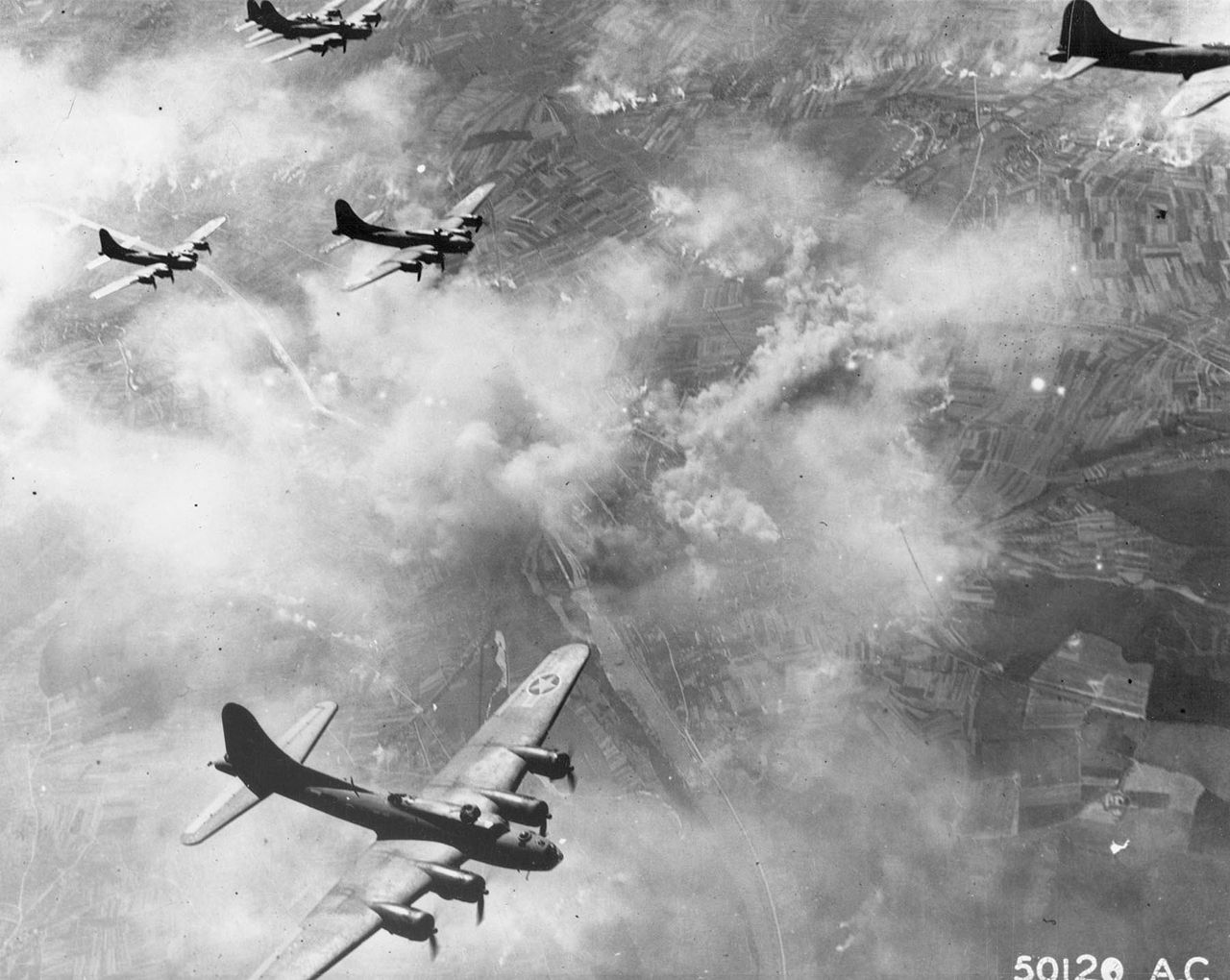
Within weeks of the 7 December Japanese raid on Pearl Harbor, Roosevelt told his cabinet that the U.S. should strike Japan from the air as soon as possible in order to boost morale and force the Japanese to dedicate more resources to homeland defense. (Glines 1998, p. 10). The Joint Chiefs of Staff, under Chair of the Joint Chiefs, George C. Marshall, then planned what became known as the "Doolittle Raid," a one-way flight of 16 B-25 "Mitchell" medium bombers from the deck of the USS Hornet, a Yorktown-class aircraft carrier. to targets in Tokyo, Yokohama, Nagoya, and Osaka. It was a daring plan. Because the Hornet's deck was only long enough for the medium-range B-25s to take-off, but not long enough for them to land, the flight path continued over Japan to China, where each crew attempted to reach allied Kuomintang Chinese territory just beyond the Japanese lines. Because of an early departure due to Japanese sightings of the Hornet, the B-25s ran short of fuel, so not all could make it beyond Japanese-held Chinese territory. All 16 aircraft successfully launched from the Hornet on 18 April 1942, flying 750 miles unescorted to their targets, and all but one of the sixteen aircraft either crash-landed, ditched at sea. Several landed behind enemy lines and managed to escape to Kuomintang territory. The sixteenth made it to Soviet territory and was detained for the remainder of the war. Of the 80 crew, 69 returned to safety; 3 died in combat; 8 were taken POW, of whom three were executed and one died in captivity. When news of the Doolittle Raid broke in the United States that April of 1942, the airmen were widely hailed as heroes and the operation was a huge public relations success for the War Department. (The fate of the missing eight airmen was not known for another year). The Doolittle Raid served throughout the war as a prism through which passed the propaganda and disinformation campaign about area versus precision bombing. The War Department took steps to maximize the symbolic message of the attack not only as payback for Pearl Harbor and a down-payment on future attacks. It was the ultimate standard used to portray the nature of the U.S. tactics and strategy to defeat Japan. But it was extremely unrepresentative of the actual "Air Plan for the Defeat of Japan," which began operations in June of 1944. The Doolitte Raid was most immediately claimed as a just retribution for two reasons: a) as payback for Pearl Harbor; and 2) as payback for ingratitude and false friendship following U.S. support in the 1923 Great Kanto Earthquake, which leveled Tokyo. The U.S. had swiftly aided in the rescue and recovery efforts, for which American officers were given campaign medals by the Imperial Army. Now these medals, like the thousands of cherry trees planted around Washington D.C., were portrayed landmarks in a history of sinister, back-stabbing deception. In an on-deck ceremony just prior to the attack, staged for newsreel cameras, Admiral Halsey and Major Doolittle wired these very Japanese medals of gratitude to the fins of the 500-lb bombs, to be "returned" to the city the Americans had once helped to recover. The wrath of the U.S. overwhelmed that of Poseidon, re-destroying Tokyo with far more devastation than the Kanto Earthquake had achieved. Despite the elaborate planning for the Doolittle Raid by the U.S. Army Air Force, it was still a minor scale operation by comparison to rapidly building a mighty bomber force, first of B-17s built mainly in Los Angeles, and waging logistical warfare by transferring an entire air force to the British Isles. U.S. Air power would be deployed primarily to Europe for the fist two years primarily (1942-3), before the eventual shift to the Pacific Theatre in 1944. A naval war had to be waged and a new generation of Very Long Range (VLR) bombers--the pressurized, high-altitude B-29 Superfortress. U.S. Navy fleets engaged the enemy at Midway, Coral Sea, and the Philippines, with the goal of establishing forward bases close enough to launch large flotillas of heavy bombers against Japan. The heavy bombers then available were the B-17 Flying Fortresses, almost all of which were shipped to the European Theatre.
This joint effort in the European Theater, by the UK's RAF and the US AAF, was known as the Combined Bomber Offensive, or CBO. It was part of the merged leaderships of the US and UK's top command: the Combined Chiefs of Staff, the US Joint Chiefs of Staff, alongside the UK's Chiefs of Staff Committee. The only level above this Combined Chiefs were President Roosevelt and Prime Minister Winston Churchill. Building on decades of air war strategic planning, the CBO's targeting decisions were guided by an elite panel of experts called the Committee of Operations Analysts (COA), which "brought together military specialists and a group of civilians with considerable experience in analyzing large, complex problems. Its members and consultants included the banker Thomas W. Lamont of J.P. Morgan and Company, corporation attorneys Gujideo R. Perera and Elihu Root, Jr., W. Barton Leach, one time professor at Harvard Law School; Edward S. Mahon of the Office of Strategic Services...and Edward Mead Earle, of the Institute for Advanced Study, chairman of a Princeton faculty military studies group and an expert on the history of strategic thought." (Schaffer 110-111). The U.S. counterpart to Harris was Ira Eaker, appointed by General Arnold to assume command of the "Mighty Eighth" 8th Bomber Command. General Eaker strongly represented the dominant opinion among the top commanders, opposing area bombing, as immoral and less harmful to the enemy than precision attacks on war materiel. Arriving in London on 21 February immediately clashed with Harris, who wanted the U/S. to double his raids on German civilians. It was Eaker's great achievement to keep the 8th, while under his command, dedicated to precision approach, and studies have since proven him right. The US AAF crippled the German war machine for more effectively than the RAF, by successfully degrading its aircraft factories and then depriving Germany of petroleum.
The US AAF - RAF split on strategy was reproduced within the US AAF ranks. While General Arnold backed the majority view for a limitation to military-industrial precision targets, he never ruled-out area bombing. Indeed, the first important air raid against the Japanese Empire, the Doolittle Raid on Tokyo of 18 April 1942, included incendiaries targeted on "flimsy" residential sections of the city. Already in 194*, Arnold asked the National Defense Research Council to develop an incendiary bomb that used cheap, plentiful materials. (Existing incendiaries depended on rare material like magnesium and phosphorous) This led to Standard Oil and Harvard Professor of Chemistry Louis Feiser's, Chemical Division of the National Defense Research Council, discovery of "Napalm," a gellied gasoline that sticks mercilessly to its targets. Testing his creations on the banks of the Charles River in 1942, the weapon that evolved, the M-69 Incendiary, which surely counts as among the most horrific ever developed and deployed on a mass scale. They were small: a plain steel pipe 20 inches long and weighing only 6 lbs (2.7 Kg), it was detonated with a time-delay 5 seconds so that it could fall into the inner structure of wooden houses. When detonated, it spewed globs of flaming gellied gasoline up to 50 feet. The M-69 is a weapon from the workshops of Hell. Petroleum itself was Manna From Hell, enriching nations with the corrupt remains of living things millions of years entombed deep in the underworld for millions of years. To be burned alive by any means is the ultimate vision of torture, but to be burned alive by a jellied substance that cannot be extinguished achieved a new low in cruelty.
The sinister nature of this weapon can be more completely appreciated by noting that it was developed alongside the suicide bat-bomb, a fantastic program that attempted to use live, flying bats by the millions (yes, the War Department did have a reasonable supply in such numbers in the giant caves of Arizona: millions of hibernating bats that could be easily harvested) with incendiaries strapped to their bodies, which would roost in the eves of Japanese buildings and then detonate where the incendiary would have greatest effect, on the underside of rooflines (Couffer, 1992; Neer 2013). This program nearly became operations, but was aborted after large portion of an air base was destroyed during a test run. Ironically, Arthur Szyk's infamous 1942 Collier's Magazine depiction of the Japanese as a race of bomb-carrying bats more accurately portrayed the United States. National Defense Research Council (NRDC)'s Incendiaries and Petroleum Warfare Division, tested the M-69 on exact replicas of Japanese and German residential apartment buildings on the Dugway Proving Grounds in Utah in May of 1943. It was found successfully to overwhelm a standard firefighting crew based on known Japanese municipal fire departments.
The War Department did not test the M-69s on industrial targets. The rationale all along had been that Japanese cities were mostly built of wood, highly flammable, and therefore most susceptible to Douhet's doctrine. The "Japanese Village" was designed and built by the NRDC's Incendiaries and Petroleum Warfare Division, which secured the services of Antonin Raymond, an architect referred to the NRDC by the American Institute of Architects. Raymond had worked in Japan for twenty years, and assured that the test structures were authentic down to the type of wood and the omnipresent tatami mats. Tatami mats being in short supply, the NRDC sent a detail all the way to Hawaii to acquire enough for burning and re-burning the structures. RKO Studios supplied thousands of still photos of Japanese home interiors (used for constructing movie sets) for the builders of the Japanese village to assure that all details were accurate. (Kerr 1991: 29-30). The Committee of Operations Analysts (COA) shifted its attention from Europe to Japan in 1943 and on 11 November 1943 presented General Arnold with a massive incendiary plan to cripple the Japanese war machine. "The COA recommended staging the fire raids between December and May, when wind conditions and humidity would most effectively promote teh spread of fire." (Schaffer 112). It is important to note that the goal was to go far beyond the burning of particular factories or military bases: it was to initiate a genuine city-destroying firestorm.
One study considered by the COA proposed using 1,690 tons of M-69s to ignite firestorms in twenty leading cities and it was projected, "devastate 180 square miles, render twelve million people--70 percent of the population of those cities--homeless, disrupt essential services, engulf administrative agencies with overwhelming relief and repair problem..." (Schaffer 122). In June of 1944 the COA established a Joint Incendiary Committee, also called the "Incendiary Subcommittee," which carried out the most detailed studies in preparation for for firebombing. One of many complex challenges they undertook to resolve was to suppress and render ineffective Japanese civil defense efforts, at one point concluding that "incendiaries must...be combined with anti-personnel devices to kill or injure people who tried to extinguish the flames before they became uncontrollable." (Schaffer 113).
This June 1944 report now brought to the operational stage the plans initially presented by the COA to General Arnold on 11 November 1943:
Apparently, the OWI was so unconcerned about the specifically civilian nature of the incendiary planning that it released almost complete informatoin about the successful development of napalm M-69s to the press in July of 1944. "New Fire Bombs Created to Burn Jap Villages" the Los Angels Times gleefully reported, citing "a recent disclosure that complete reproduced "villages"--one Japanese and one German -- were laid flat in a Utah desert in actual bombing tests," (Lorania K. Francis, "New Fire Bombs Created to Burn Jap Villages," Los Angeles Times, 9 July 1944, p. 9). Bound by its own inclination and the rules of the OWI, however, the LA Times did not reflect on the moral implications of a weapon designed to burn civilian villages. Curtis LeMay, the fierce and fearless Major in command of the 305th Bomb Group of more than 150 B-17s Flying Fortresses, came to favor Harris's approach, and his successful missions--with himself in the lead plane defying countless rounds of fighter and anti-aircraft fire--earned him respect for his courage. McNamara called him "extraordinarily belligerent." The Supreme Allied Command greatly valued extraordinary belligerence in commanders such as George S. Patton, and LeMay's bravado eventually earned him the promotion to General in command of the 20th and 21st Bomber Command B-29 Superfortress attacks on Japan. Beirne Lay, Jr's harrowing account of LeMay's attack on Regensburg, published in the Saturday Evening Post, leaves no doubt of the courage of the men who flew these missions over Germany's well-defended territories (Lay 1943). By this point in 1944, U.S. AAF commanders had accepted area bombing as "necessary." General Eaker did ultimately succumb to Harris' anti-civilian fury by joining the Dresden and Berlin raids. As Patton's 3rd Army raced across France toward Berlin and Red Army closed in from the East, The Pentagon planners had already begun the massive logistical operations to begin striking Japan with the newly-operational B-29s, a next-generation heavy bomber that, unlike the B-17, had a pressurized cabin, capable of flying as high as 30,000 feet, beyond the reach of Japanese defensive anti-aircraft guns and fighter aircraft. By June of 1944, the US AAF launched B-29 raids from eastern China, but the logistics involved to get fuel and bombs "over the hump" (the Himalayas) from India proved too burdensome. Once MacArthur's forces liberated Saipan in the Marianas, the entire operation was shifted to island bases within striking distance of all Japanese cities."Urban Industrial areas in Japan are few, concentrated, and vulnerable to incendiary attack. A relatively small weight of incendiaries effectively placed is believed adequate to cause great damage through destruction of industrial housing, essential public services and a significant number of industrial installations. Japanese war production (aside from heavy industry) is peculiarly vulnerable to incendiary attack of urban areas because of the widespread practice of subcontracting to small handicraft and domestic establishments. Many small houses in Japan are not merely places of residence, but workshops contributing to the production of war materials. These urban areas should be attacked during the period from December through May. Maximum industrial disruption in an urban area will be attained by attacks of a magnitude sufficient to overwhelm the fire fighting resources of the area in question; simultaneous attacks on many urban areas may overwhelm relief and repair facilities of the country as a whole."
During a re-shuffle of European Allied air assets under Eisenhower's command, Major General Jimmy Doolittle replaced Eaker in command of the "Mighty Eighth" in January 1944 remaining in command of the 8th until September 1945. He valiantly tried to uphold the American opposition to area bombing, protesting in clear terms when when Spaatz commanded the 8th to take part in the Combined Bomber Offensive's urban-area attacks on Berlin, warning that America's postwar reputation was at stake: "We will, in what may be remembered one of our last and best remembered operations regardless of its effectiveness, violate the basic American principle of precision bombing of targets of strictly military significance for which our tactics were designed and out crews trained and indoctrinated." (Hansen, 252, citing Miller 419). Doolittle and Eaker continued to protest or demand clarification of Spaatz's anti-civilian targeting orders through the attacks on Dresden and Cologne. In reaction to the terror-bombing plan against small-city railway stations, Operation CLARION in December 1944, Eaker warned Spaatz, that would "absolutely convince the Germans that we are the barbarians they say we are, for it would be perfectly obvious to them that this is primarily a large scale attack on civilians." (Schaffer, 91-93, quotation at 92). Spaatz overruled these objections and when the plan was put into effect in February 1945, he issued orders to commanders that in press releases: "Special care should be taken....against giving any impression that this operation is aimed, repeat aimed, at civilian populations or intended to terrorize them." (Quoted in Schaffer 94)
The Joint Chiefs' Committee Of Analysts (COA) in June of 1944 tasked its "incendiary subcommittee" to produce a new study, which would refine the estimates made in the 11 November COA report to General Arnold, discussed above. "The study had three goals," writes E. Bartlett Kerr, in the most thorough study of command decisions, Flames Over Tokyo (1991):
"(1) determine the forces it would take to burn Japanese cities, (2) evaluate the vulnerability of various ares of Japan, and (3) estimate the economic effects of successful attacks. Analysis actually focused on the first and third objectives." (Kerr 1991: 71).
In particular, the study revised the "A-2" report of 11 Nov. 1943 regarding the number of tons of M-69s it would take to instigate an uncontrollable fire, per square mile. The 1943 report had placed that at 6 tons per square mile, but the 1944 report boost that to 16-20 tons per square mile.
It also focused on the economic vulnerability of the key cities of Tokyo, Kawasaki, Yokohama, Kobe, Osaka, and Nagoya. The combination of these two findings helps explain the multiple, obliterating sorties of more than 500 B-29s against these cities. The goal, twisted into "economic" military objectives, was to devastate these cities in the American version of Douhet: focus on the legitimate "industrial" nature of the targets, which will deem civilian deaths "necessary" to the destruction of the "industrial" targets.
The industry-hidden-in-the-residential-neighborhoods framework was further refined in this document, approved ultimately by General Arnold. But notice the inadvertent admission that the extent of this industrial dispersion into residential neighborhoods was small by comparison to the legitimate industrial areas proper:
"In Tokyo, Osaka, and Nagoya between 15 and 20 percent of all manufacturing workers are employed in establishments so small in size that they can hardly be distinguished from dwelling units. These workshops are probably located in quite random fashion through the business, industrial and residential areas. Destruction of residential areas by fire would probably account for many small scale manufacturing enterprises."
For this reason, Kerr explains, the COA "team did not concern itself with specifying target factories in the cities." (Kerr 1991: 72).
B-29 Assaults from the Marianas
The Battle of Saipan, 15 June - 9 July 1944, finally established the forward air base necessary for the final B-29 assault on Japan to begin. At the cost of 3,425 U.S. soldiers killed, and more than 50,000 Japanese (approximately half soldiers and half civilians), the former Japanese air base, renamed Isely Field, received the first B-29, piloted by General Haywood Hansell himself, on 12 October. By 22 November, the date of the first high-altitude daylight "precision" raid Hansell commanded more than 100 B-29s. The establishment of the Saipan base, from newly-built and barely-tested B-29s in Nebraska, was documented in the War Department's 125th Information Film, Target Tokyo (May 1945), narrated by Ronald Reagan. By late 1944, the anti-Douhetians Eaker, Hansell and Doolittle had been overruled. We have seen that the Committee of Operations Analysts had already established that the final air campaign against Japan would rely heavily on urban-area incendiary attacks, hoped to be far more effective than in Europe because of the highly flammable wood and paper construction of Japanese cities. Nevertheless, during his brief command of the B-29s that had finally become operational in the Pacific Theatre, General Hansell was given his chance to try precision bombing against genuine military and industrial targets. But a combination of strong countervailing headwinds at the high altitudes for which the B-29 was designed, plus thick cloud cover, depleted both the precision and the damage done, by Hansell's November-December attacks. By New Year's Day 1945, General Arnold decided that General Hansell's attempts at "precision bombing" of Japan's military objectives, factories, rail and petroleum networks, were unlikely to play the decisive role that the AAF hoped to achieve. Hoping to win the war with Japan from the air before the amphibious forces under General MacArthur could reach the Home Islands, Arnold took the decision to adopt the more ruthless "area bombing" strategy favored by General Curtis LeMay, whom he put in command of the XX Bomber Command after reassigning Hansel. Immediately, Objective 3 in the 11 November 1943 COA targeting memorandum, "urban industrial areas," became the #1 priority. The COA had recommended incendiary-saturation bombing, sufficient to "overwhelm the fire fighting resources of the area in question" -- which is to say, start a firestorm that destroys out-of-control. This language is self-indicting on the war crimes standards. The wanton destruction of entire cities and killing of their non-combatant populations has never been legitimate. And yet these were exactly the plans. While the COA, and therefore the Joint Chiefs and Combined Chiefs, were very conscious of the "moral question" and thereby couched the plan in terms of "industrial" targets and small-shop manufacturing under the roofs of residential dwellings, the firestorm plan was designed to outrun any industrial district to destroy the city as a whole. Anyone can see this, so the Joint Chiefs must have. (Kerr 1991: 71-121; Craven and Cate 1948-51, Vol 5: 608-615; Schaffer 1985: 128-148).
Evidence shows that the highest military commanders: General "Hap Arnold," National Defense Research Council Director Vannevar Bush, and the Joint Chiefs of Staff, discussed the "moral question" of attacking densely populated civilian targets, but passed the responsibility for actually deploying that option to their civilian Commander-in-Chief: the President and his Secretary of War, Henry L. Stimson. After spending more than a year developing a plan to burn down most of Japan's major cities with thousands of tons of anti-residential M-69 incendiaries dropped by hundreds of B-29s, Vannevar Bush reminded Arnold that after a few live tests over Japan (the November-December 1944 raids, as it evolved), then US AAF should go "all out," but "the decision on the humanitarian aspects will have to be made at a high level if it has not been done already." (Schaffer 1985: 121). By that phrase, Bush undoubtedly meant Henry Stimson and Franklin Roosevelt (the only two men higher that General Arnold). Decades of scholarship have yet to document FDR's sign-offs, most probably because they were kept verbal. (Schaffer 1985: 107-110, Hansen 2008: 1-67). It is evident from this review of the military strategy and command decisions that the U.S. AAF deliberately targeted civilians in undefended cities, and that numerous commanders protested these attacks as violations of American (and presumably humanitarian) principles. What is also clear, however, is that the Committee of Operations Analysis did not develop these plans with an explicit goal of terrorizing the civilians. Instead, it developed the master alibi that became doctrine in the public relations disinformation campaign: the idea that in Japan, war production was subcontracted to small shops that were evenly dispersed throughout the residential sections of the major urban areas. This principle was established in the 11 November 1943 COA report to General Arnold:
The planners certainly recognized that they would be killing civilians on a giant scale, but labeled these civilian deaths as "necessary" because of the dispersed-production theory. Through this back door, the U.S. AAF under General Curtis LeMay re-framed area bombing as military-industrial bombing. But the method they chose: napalm (gellied gasoline) incendiaries in sufficient saturation to overwhelm existing fire departments, was a plan precisely to burn cities out-of-control, and hence to incinerate non-industrial worker housing as well. All Japanese civilians in the U.S. air strategy were legitimate targets, fulfilling Douhet's central premise. As the theory of destroying entire cities for the strategic purpose of winning a war is fascist, the United States Army Air Force commanders had become fascist at this stage. While the designation of urban areas as industrial seemed to provide cover for the Joint Chiefs to target civilians, one glaring oversight in the preparation of a moral defense against the charge of war crimes was the oft-repeated admission that Japanese cities were effectively undefended by November 1944. In stark contrast to the heavy losses suffered at the hands of German fighter defense in the Combined Bomber Offensive runs agains Germany, the Japanese had so few fighter aircraft that the B-29s were expected to encounter no effective air defense. General LeMay felt so confident about the ineffectiveness of even the ground-based anti-aircraft guns, that he convinced General Arnold to let him strip the B-29s of nearly all defensive armament, in order to achieve a higher payload of incendiaries. As Craven and Cate write in their official U.S. Army Air Force history of this campaign, test runs had found fighter defense to be "nil" and "the added bomb weight that could be carried in lieu of an average load of 8,000 rounds of machine-gun shells would be about 3,200 pounds, an appreciable increment." (Craven and Cate 1948-51, vol 5: p. 613). The official US Army Air Force history by Wesley Craven and James Cate describes the typical offensive preparation of a B-29 after LeMay's modifications in light of the undefended condition of his civilian targets:"Japanese war production (aside from heavy industry) is peculiarly vulnerable to incendiary attack of urban areas because of the widespread practice of subcontracting to small handicraft and domestic establishments. Many small houses in Japan are not merely places of residence, but workshops contributing to the production of war materials."
"Central Directives": U.S. Office of War Information (OWI) Disinformation Campaign about Area Bombing, 1944-45"With planes bombing individually from low altitudes, bomb loads could be sharply increased, to an average of about six tons per plane. Lead squadron B-29's carried 180 x 70-pound M47's, napalm-filled bombs calculated to start "appliance fires," that is, fires requiring attention of motorized fire-fighting equipment. Other planes, bombing on these pathfinders, were loaded with 24 x 500-pound clusters of M69's" Craven and Cate 1948-51, vol 5: 613).
With Executive Order 9182 of 13 June 1942, President Roosevelt established the Office of War Information (OWI), “to facilitate the development of an informed and intelligent understanding, at home and abroad, of the status and progress of the war effort and of the war policies, activities, and aims of the Government.” Roosevelt appointed the acclaimed CBS journalist Elmer Davis to head up the sprawling bureaucracy that resulted, eventually numbering more than 3,000 employees and a budget during its first year of $37 million."B-29 attacks on Japan should receive only moderate play [in the Middle East]. The people of the Middle East abhor the destruction of property and the killing of women and children which accompany area bombing, no matter how necessary these are to the war. To play up the destruction wrought by our air force against Japan does not serve our propaganda purposes in the Middle East." -- Office of War Information, Overseas Operations Branch, Washington D.C. Weekly Propaganda Directive. Middle East. 23 March 1945, p. 3.
Despite the idealistic phrasing of Roosevelt's enabling Executive order, the OWI was a propaganda machine of gigantic scale, maintaining official press briefing points to be promoted on all continents, to all audiences, with both an Overseas and Domestic branch. The majority of the OWI's work consisted of filtering, drafting, updating, and circulating monitoring and censoring news, information, and political viewpoints for all media markets. A review of the OWI's "Central Directives" and "Regional Directives" regarding the U.S. air policy and actions, shows that the OWI was fully aware of the devastating attacks on civilians, was fully aware that these attacks would be considered immoral by domestic and global publics, and shows the OWI actively colluding with the Combined Chiefs of Staff to cover-up the area attacks by portraying them as directed at military and industrial targets. Days after the devastating saturation-bombing attack on Tokyo that killed 100,000 persons, the OWI instructed:
The OWI instructed all press outlets to assure that their press releases are “written from scientific or technological point of view. Care should be taken to avoid any reference to effect of weapons on individual enemy soldiers or populations. Use of any material which might be construed as an effort to terrorize enemy soldiers or civilian populations must also be avoided.”"Every effort should be made to stress the military nature of the targets attacked. Stress on specific targets and on the importance of the small manufacturer and sub-contractor to Japan's war industry will be useful. Note the negative on unofficial comment on saturation-bombing. We should also place heavy stress on General LeMay's statement on the total destruction of Japanese industries." (OWI, Japan Regional Directive, 16 March 1945, p. 2)
After the 9-10 incendiary attack on Tokyo, the OWI's Central Directives and Regional Directives show a heightened determination to avoid accountability for the massive destruction and killing that was then underway. Knowing, of course that it was saturation bombing conducted on the basis of very clear predictions of effectiveness, the OWI sought to deflect any questioning about the fully Douhetian air plan then underway:
Just how much destruction should be reported, became a cause for official re-wording. The 14-21 March 1945 Central Directive instructs outlets to "Emphasize the point made by Major General Curtis LeMay that 'the only thing the Japs have to look forward to is the total destruction of their industries, their vital industrial plants devoted to the war effort." (p. 5) The subsequent update, however, retracts and revises LeMay's statement to read "'our determination to carry out the systematic disruption' of Japan's war industries." In OWI-speak, "there is a negative on..." meant that a certain idea or phrase is banned: "Consequently, for the time being there is a negative on the use of the term 'destruction' in connection with unconditional surrender..." ("Japan Regional Directive," 23 March 1945). Riddled throughout the OWI Central and Regional Directives are blatant admissions that the targets were undefended. There must have been some general amnesia about the unambiguous wording of the 1907 Hague Convention, because the fact that the cities were undefended seemed to be a tremendous propaganda advantage to the OWI, given the frequency with which they trumpeted that fact. We have already seen that General LeMay stripped his B-29s of defensive armaments in order to make more payload tonnage available to bombs. In the first Central Directive to follow the terrible 9-10 March raid on Tokyo (still the world record for single-raid death toll and physical destruction in winged warfare, including the two atomic attacks), the OWI wished to stress this important fact:"As part of our permanent air offensive give heavy play to communiques, photographs, and statements bf commanding officers of the 21st Bomber Command, especially official statements regarding the techniques of bombing now being employed. No unofficial comment on the merits or demerits of saturation bombingshould be used." (OWI Central Directive, March 14-21, 1945, p. 5)
>The 23 March 1945 OWI Regional Directive then goes into great detail about the spin that outlets and press releases must apply to LeMay's firebombing campaign. "Note particularly the following: 1) the ban on expressions of satisfaction, revenge, retribution, threats or moral concerns (this is a part of the overall aim to represent bombings simply as bombings and as a part of the war without attaching emotional significance to them)" ("Japan Regional Directive," 23 March 1945, pp 1-2). Likewise, in the Central Directive for 21-23 March the OWI instructed: "Refer to all B-29 raids as being directed against 'military or industrial areas.'" OWI, Central Directive , 21-28 March, pp. 1-2. The Directive continues:"Feature American statements concerning the lack of Japanese fighter interception or the ineffectiveness of anti-aircraft fire." (OWI Central Directive, March 14-21, 1945, p. 5)...and, on 23 March, the OWI Regional Directive:"Wherever possible, give heavy play to announced lack of Japanese fighter interception or ineffectiveness of anti-aircraft fire."
"We should always assume that our bombing is for purely military purposes. Identify, whenever possible, the military and industrial targets of the areas bombed. To other countries than Japan indicate the nature. of Japan's war economy which is based on small factories and household industries. Indicate the secondary military results of bomb damage': raid lines must be repaired:materials needed for military purposes must be consumed and manpower must be diverted. Avoid an apologetic or defensive tone or approach." (OWI, Central Directive , 21-28 March, pp. 1-2.)
Paying attention also to the sensitivities of their Middle Eastern audiences, the same OWI officers in the very same 23 March Directives, speak frankly about those "moral concerns": "B-29 attacks on Japan should receive only moderate play [in the Middle East]. The people of the Middle East abhor the destruction of property and the killing of women and children which accompany area bombing, no matter how necessary these are to the war. To play up the destruction wrought by our air force against Japan does not serve our propaganda purposes in the Middle East." -- Office of War Information, Overseas Operations Branch, Washington D.C. Weekly Propaganda Directive. Middle East. 23 March 1945, p. 3 The OWI's 23 March 1945 OWI Regional Directive also promotes the official "household industry" justification for the area bombing: "2) that we play only to other countries and not to Japan the line concerning Japan's small factories and household industries because this, too, would sound to the enemy as somewhat defensive and, because he is aware of the nature of his own economy." ("Japan Regional Directive," 23 March 1945, pp 1-2). Note the phrase "the line concerning Japan's small factories..." "The line" was and remains euphemism for a cover-story, revealing awareness that this is not truthful, something the enemy would know better than anyone" "play to other countries and not to Japan." The OWI was extremely successful in the short and long term, with its careful control over the "line" to "play" with the press. The Joint (US) and Combined (US+UK) Chiefs had, as we have seen, settled on the "necessary" killing of civilians justification based on the portrayal of Japanese war industry as dispersed into households. Let us now turn to the capstone of these coordinated propaganda efforts: Hollywood's feature film productions that operationalize the full arsenal of mendacity to cover for LeMay's savage attacks on urban civilians.Hollywood's Contribution to the Area-Bombing Cover-up
“The easiest way to inject a propaganda idea into most people’s minds," Office of War Information Director Elmer Davis succinctly stated "is to let it go through the medium of an entertainment picture when they do not realize that they are being propagandized.” Thus the OWI established in Los Angeles the Bureau of Motion Pictures (BMP), which at its peak in 1942-3 employed 142 persons who reviewed and censored nearly all scripts by the major studios. To head this difficult office, Davis appointed Lowell Mellett, one of FDR's media relations aides, who met frequently with the ego-heavy studio chieftains to implement an ambitious plan not merely to censor, but to shape the ideas, the message, and the meaning of Hollywood's most valuable assets: their major feature films, featuring their greatest movie stars--those ubiquitous role models for American men, women, and children. (Larson 1948, 436; Black and Koppes, p. 64). The major Hollywood studios hardly needed encouragement to produce patriotic feature films about American war heroes. "In the movie makers' ceaseless quest for variety and spectacle, the war was a godsend." Between 1 December 1941 and 24 July 1942, Hollywood had already made 72 "war features" (Koppes and Black 60-1). The challenge for the OWI was to shape and direct this output, not by censoring, but by actively propagandizing through the feature films as vehicles for the wartime government's message. Mellett's studio point-man was the Florida journalist Nelson Poynter (who would later found Congressional Quarterly). Together they developed by the summer of 1942 the "Government Information Manual for the Motion Picture Industry," which as Koppes and Black put it, "was a comprehensive statement of OWI's vision of America, the war, and the world." It encapsulated the Roosevelt Administration's global message, beginning with the Atlantic Charter and the Four Freedoms. As Koppes and Black, in their unsurpassed Hollywood Goes to War, convincingly argue, the "manual was a virtual catechism of the world view articulated by [Vice President Henry] Wallace in his Century of the Common Man" speech of 8 May 1942. It begins with the title of the OWI's greatest direct production, Frank Capra's "Why We Fight" series: We fight for democracy. Second the "the enemy was not the entire German, Japanese, or Italian people, nor even the ruling elites. Thirds, in Koppes and Black's redaction, the "United Nations," thirty in number, were to be given shared credit for victories and portrayed in a positive light (regardless of their often anti-democratic governments).. Fourth, the "home front" should be portrayed as supporting the war efforts in myriad ways: women as war workers, women steadfastly bearing sacrifices. In December of 1942, the Office of Censorship (separate but superior to the OWI) banned the depiction of labor disputes. (Koppes and Black 125) . Fifth, our "fighting forces" should be portrayed as very carefully trained, unified across racial, ethnic, and religious divisions (the so-called "multi-ethnic platoon"). The Manual stressed that feature movies should show and explain the purpose of the sacrifices of life and deferred life plans, in terms of preserving democracy and our way of life, which is intrinsically peaceful. (Koppes and Black, 65-71). While this agenda may seem like an unprecedented level of government intervention, in fact the U.S. motion picture industry was already heavily regulated, monitored, censored, controlled, and constrained. Recall that since the U.S. Supreme Court's 1915 Mutual Film Company ruling, movies were not protected by the First Amendment. Long before the OWI imposed the Bureau of Motion Pictures on Hollywood, its studios routinely "submitted all screenplays and finished pictures to the Production Code Administration; and dozens of state and municipal censorship boards passed on the suitability of films." (Koppes and Black 110). The story of the OWI in Hollywood is the story of incessant energy spent to infuse soup-to-nuts studio production with these values. It proved difficult, because several studios, especially those like RKO and Twentieth-Century Fox, which already catered to sensational potboilers, rushed into production after Pearl Harbor with blatantly racist, hate-mongering yellow-peril films, like their Little Tokyo, U.S.A. (1942). After failing to prevent off-message films like Little Tokyo, the OWI managed eventually to intervene early in the scripting process, persuading (mostly, not requiring) the screenwriters to show some Germans, Japanese, and Italians as good people, and keeping the blame on the fascist, militarist governments. It was the hardest to meet this standard concerning the Japanese. By the summer of 1942, the OWI had a five-person script analysis team to which every major studio submitted all of its scripts. Asking, first "Will this movie help win the war?" the OWI served as script doctors, and did in fact manage to cause numerous features to toe the "Century of the Common Man" line. But the propagandists enforced their ideas the least on the depiction of Japanese, who were routinely portrayed as fanatical, sneaky, duplicitous, and cruel. Neither Hollywood nor the OWI had to face co-workers, family, friends, and neighbors who were actually Japanese or Japanese Americans, because all 120,000 mainland Issei and Nisei were in concentration camps. They did, however, have German and Italian friends and family whom they did not wish to offend. (Koppes and Black, 65-81, 84). The 18 April 1942 Doolittle Raid, with its daring pilots striking the first blow against the Japanese homeland, and the adventurous escape from behind enemy lines, was high on many studios' development priority lists. Four major-production feature films were based on it: Bombardier (RKO, March 1943); Destination Tokyo (December 1943); The Purple Heart (Twentieth Century Fox, February 1944); Thirty Seconds Over Tokyo (M-G-M, November 1944). Lt. Col. Doolittle received a Congressional Medal of Honor for his valor after returning with all but 11 of his 80 crew members from a mission that was nearly suicidal. Every detail of the raid that could be pried loose was widely discussed in the press, and each crew member had a story to tell. The War Department may have suppressed participant accounts until the propaganda value could be held in reserve, like a weapon. The publicity mill ramped up at the first anniversary of the raid, in the spring of 1943. The first movie to the punch was RKO's Bombardier in May of 1943, a story almost entirely about the training of B-17 bomber crews. It had little to do with the Doolittle raid, except that its finale is a bombing run over Tokyo. B-17s were never used over Japan. The US AAF deployed the more advanced B-29s, but they were not within striking distance to Japan at the time this film was made. While the film did not match the facts, in a general sense it did portray accurately the massive logistical effort actually underway to train thousands of air crew in several specialties: pilots, navigators, bombardiers, radio operators, and gunners. The first film directly about the Doolittle raid to reach the screens was Warner Bros's Destination Tokyo, starring Cary Grant as the commander of a fictitious submarine, called the U.S.S. Copperfin. oGrant and his crew are on a fictional mission to support the Doolittle raiders by penetrating Tokyo Bay, landing a shore observation crew to gather air defense intelligence. Warner's December 1943 Gary Grant vehicle, Destination Tokyo, faithfully conforms to the OWI Manual, but ignores the OWI's message about "the enemy" by racializing evil characteristics into the Japanese characters. A downed Japanese pilot is spared from being machine-gunned during his parachute descent, and Captain Cassidy (Cary Grant) ordered the pilot rescued for interrogation, but he repays all this mercy (spared the machine gun and being left to die in the icy water), by literally stabbing an American sailor in the back--after which he is machine-gunned. The script portrays the Japanese as a race of treacherous warriors, deprived of childhood by a loveless, heartless militaristic culture. In a scene featuring the family-centric submariners discussing an American five-year-old's birthday party, the audience learns that in Japan the boys are given daggers at the age of five and raised to be assassins.Thirty Seconds Over Tokyo (1943-44)
M-G-M's Thirty Seconds Over Tokyo (November 1944), like Warner Bros' Casablanca, was timed to coincide with a continental invasion. Casablanca was a propaganda vehicle to fly cover for the U.S. invasion of North Africa at Casablanca in the same month of its release. Likewise, the development cycle of Thirty Seconds Over Tokyo coincided with a Joint Chiefs - OWI planning and propaganda campaign to control the message while planning to incinerate Japanese civilians in a area-bombing campaign designed to start firestorms and "destroying cities" in teh words of the OWI's "LeMay Bombing Leaflet" featured at the beginning of this essay. As would be expected in a biographical picture about the exploits of General Doolittle then in charge of the "Mighty Eighth" Air Force: a revered national hero, every word of the script was very carefully reviewed by the War Department. Indeed, it would be surprising of Doolittle himself had not been shown the script for approval. The opportunity for a factually-based film came when M-G-M acquired the rights to the first-hand account, serialized in Collier's Magazine on the first anniversary of the Tokyo raid. Written by Lieutenant Ted W. Lawson, who piloted "The Ruptured Duck," one of the sixteen B-25s, crash-landed on the Chinese coast, lost his mangled leg in a Chinese hospital, and returned to his supportive wife. The production files for Thirty Seconds Over Tokyo provide a direct window on the OWI - BMP - Hollywood propaganda machine. Thanks to the thorough record-keeping of M-G-M, the production files include a complete paper trail of this story's journey from a draft memoir by Lawson to the film's eventual release in November of 1944, a release that coincided neatly with the beginning of the massive B-29 incendiary campaign agains Japanese cities. Thirty Seconds, by all measures, was a co-production by the War Department and M-G-M. It became a vehicle to leverage the heroism of the Doolittle Raiders as the image to consume about the full strategic air-power attack on Japan, set to begin in November with the first test raids, and then in March, when winds were highest for maximum fire spread Indeed, precisely because Doolittle was opposed to Giulio Douhet's anti-civilian doctrine, he was the perfect cover for the urban area bombing campaign led by the Douhetian Ernest LeMay. Louis B. Mayer and Irving Thalberg committed their top talent, beginning with screenwriter Dalton Trumbo, who was at that moment Hollywood's highest-paid screenwriter. Mervyn LeRoy had been directing M-G-M's top films with its leading stars since producing and co-directing The Wizard of Oz in 1939: Norma Sheaerer (Thalberg's wife), Robert Taylor, Vivien Leigh, Greer Garson, Walter Pidgeon, and Lana Turner. For the lead role, Spencer Tracey was one of the studio's best assets. He had already won two Academy Awards for for Captains Courageous (1937) and Boys Town (1938), and in 1942, in Woman of the Year, had begun his long co-starring and private romantic partnership with Katherine Hepburn. A heart-throb for women and a role model for men, Spencer Tracy also resembled the real General Doolittle. They were, in effect, two leading culture heroes: one would portray the other.Ted Lawson's story was an ideal blend of personal and geopolitical. In 1940 Lawson had been studying aeronautical engineering at Los Angeles City College when he enlisted in the Army Air Force, trained as a pilot, and was deployed on early missions in the Pacific with the new B-25 medium bomber, called "Mitchell"s in honor of America's first Douhetian and founder of U.S. air power, William "Billy" Mitchell. He had just married and begun to plan a domestic future when he volunteered for the "extremely dangerous" (but unnamed) mission, hand-picked by Jimmy Doolittle. They story follows the elaborate preparations of the B-25 crews, who practiced taking off from extremely short landing strips without being told why. Eventually, aboard the U.S.S. Hornet en route to Japan, the crew is briefed by Lt. Col. Doolittle on the nature of the targets and the operation in all of its details. Lawson's non-fictional account is in fact an eyewitness account that gives us insight into moral framework of the very beginning point of the U.S. air campaign against Japan. Lawson--and eventually the M-G-M film--were quite explicit about the question of killing civilians. Given the minute attention to the "line" being promoted by the OWI regarding civilian casualties, the exact shape of the film's message regarding civilians as targets, along with deletions and editing, merits careful scrutiny. In Lawson's manuscript for the serialized Collier's account, the dramatic moment of revelation came during an all-crew meeting in the assembly room of the Hornet, in which Doolittle "cleared his throat and said, 'For the benefit of those of you who have been guessing, we are going straight to Japan. We're going to bomb Tokyo, Yokohama, Kobe, Osaka, and Nagoya." Lawson then introduces a crucial character, Lt. Cmdr Stephen Jurika, U.S.N., who had been Naval Attaché based in Tokyo for years and served as target expert for the mission:
"Jurika spoke on the history of Japan and China. He went into detail about the political setups of the countries, told us of the differences between the military and the peasant classes of Japan, the psychological differences between Chinese and Japanese, … and physiological differences." Later, during a meeting in which the airmen were poring over maps with Doolittle and Jurika, Lawson recounts the following, apparently spontaneous incident, in which both Doolittle and Jurika discuss the use of incendiaries and the bombing of civilian neighborhoods with the crew:
‘I know that town like a book,’ he’d [Jurika] say, and give us the location of this or that factory or plant. Finally we selected three targets in a reasonably straight line, and close together, and began the long job of memorizing their characteristics….Doolittle also told us we would carry another bomb, a 500-pound incendiary, something like the old Russian ‘Molotov breadbasket.’ This would have to be dropped, also from a low altitude, on obviously flammable sections of the city. The flammable [p. 36] section should be as near as possible to the other targets, so that we could let the incendiary go and then dive down out of the range of the antiaircraft fire. ‘If you can start seven good fires in Tokyo they’ll never put them out,’ Jurika promised us. ‘I know that Tokyo fire department very well. Seven big scattered fires would be too much for it to cope with.’
Doolittle interrupted one of these discussions about incendiary work. ‘It’s possible that some of you may be opposed to killing defenseless civilians…even Japs,’ he said.‘Naturally, you’re going to kill some of these people if you’re going to bomb their cities.If any man here feels that he can’t do this, I wish he’s drop out. It won’t go against him. I’ll understand.’
When nobody spoke up, Jurika had something else to say. ‘I wouldn’t worry too much about setting fires in flimsy-looking sections of Tokyo,’ he said. ‘The Japanese have done an amazing job of spreading out some of their industries, instead of concentrating them in large buildings. There’s probably a small machine shop under half of these fragile-looking roofs.’
Before this manuscript reached Collier's. War Department censors deleted (crossed-out) this entire passage with their red pencil. The complete original draft is in the M-G-M files, with the red pencil labeled "War Department"). Clearly, Lawson had touched upon the most sensitive issue in air war strategy, and the War Department was not ready let this issues go public in the spring of 1942. If Lawson's memory and account of this ship-board conversation in April of 1941 is accurate, then Jurika was voicing an already well-known observation about Japanese cities: that they were particularly vulnerable to fire, and that an out-of-control fire could be initiated with little difficulty. Most probably, the War Department censors, whose job was mainly to eliminate public disclosure of information useful to the enemy, sought to suppress this passage because it represented real air strategy then in the planning stages for the ultimate attempt to defeat Japan through air power. Also prominent in this excised dialogue is an early rehearsal for the "necessary killing" of civilians and the master alibi: the "line" that Japanese war production was subcontracted-out to thousands of small shops hidden beneath the "fragile-looking roofs" of the "obviously flammable sections of the city." Doolittle's seemingly spontaneous warning about the need to kill "innocent civilians" is followed by Jurika's reassurance that the little houses are really weapons factories. Dalton Trumbo had already produced a draft of the screenplay by the 14th of April 1943, more than a month before the first installment of the Collier's articles began on 22 May 1943. The second and third installments of the series ran in the 29 May and 5 June issues. In late December of that year, he joined the Communist Party. “I hope this doesn’t sound as some might interpret it,” Trumbo explained decades later to his biographer Bruce Cook:
If he joined the Communists only in December, months after completing the script, how can we be sure of his ideological convictions from March to August of 1943? The answer is pretty evident from the rest of his explanation to Cook in 1970:“but the growing reaction against communism—and in Hollywood the formation of the Motion Picture Alliance for the Preservation of American Ideals—convinced me that there was going to be trouble. And I thought I wanted to be part of it if there were.” (Cook: 147-9)
It seems from this that Trumbo’s views were consistent for years, and his affinity for the Communists was certified during the production of this film, when the script was largely out of his hands in any case. His primary mission, it seems, in 1943-4 period was to join the fight against global fascism. While in San Francisco writing speeches for the U.S. Secretary of State Stettinus, he joined a correspondent’s tour of the Pacific War. Trumbo actually flew a B-25 combat mission as an observer, on a bombing run against the Japanese island of Kyushu. When cloud cover made this attack impossible, the crew dropped their payload on the small island of Kikai Shima instead. Trumbo showed nothing but enthusiasm about this action. (Cook 1977: 155-7). In the HUAC investigations of Hollywood begun in 1947, Trumbo would be hounded by the FBI and the House Un-American Activities Committee, but he refused to talk. As one of the "Hollywood Ten," he was convicted of contempt of Congress and served 11 months in a federal penitentiary. After his release, he and his wife moved to Mexico, where he ghost-wrote many forgettable, but also several major screenplays, including Roman Holiday, starring Cary Grant and Audrey Hepburn. Trumbo's ultimate punishment for his leftist convictions is ironic, given his faithful work to implement the OWI's official line and cover-up of atrocities. The fear of leftist, communist screenwriters was based on an exaggerated belief in the power of movies to brainwash the masses—not to mention a naïve view of how movies get written in a corporate environment. The governments of all major powers saw movies as vital means to manage their masses—with mass culture. Thirty Seconds was produced to be a propaganda movie, based on the OWI’s Movie-maker’s Manual, so through the archive of successive treatments and scripts, we can observe precisely how Trumbo executed the OWI manual with a particular emphasis on its Anti-fascist doctrines.“I didn’t want to have the advantage of those years of friendship and then to escape the penalties. Now that may sound odd. I don’t think it’s of at all. That was part of my motive. If they hadn’t been my friends, I wouldn't have joined.” (Cook: 147-9)
The Screenplay: Shaping the Message about Killing Civilians
The 8 May 1943 draft of the full screenplay (Under the title “Aeronautical Engineer,”), begins with a remarkable “Preface”, in which Trumbo summarizes OWI - M-G-M’s explicit propaganda purposes, “that the motion picture resulting from it can and must contribute constructively and dynamically to the public morale”:
The second objective of the film is to prepare the American people for casualties. By 1943, tens of thousands had given their lives. It was a major goal of the OWI to cover Uncle Sam’s ass, so to speak:“We wish to make a picture which every service man will recognize as authentic – which every relative of service men will find reassuring, even comforting – and which every American will view with a sense of pride and heightened determination.”
“In presenting the careful training, the perfection of the equipment, the mathematically exact plans for the Tokyo raid, we hope to assure every service man’s family that he is sent into combat only after the finest training and with the finest equipment in the world: that any miscarriage of his mission thereafter is attributable to the constant military hazard of chance, for which, as the Tokyo records prove, he is also forewarned and prepared.”Whether or not this Preface was written by Trumbo, the prose imparts the moral grandeur of a liability waiver and sets the framework for the film's propaganda purpose. These first two points of the “Preface,” may well have been written by an OWI staffer, but the third one is polemical in voice, Trumbo we presume:
Trumbo’s screenplay has the classic three act form. In Act I, Ted Lawson, played by Van Johnson, is introduced as loving newlywed husband. His young wife Ellen (played by Phyllis Thaxter), is, like her girlfriends, planning a family. At the beach while their men train for the raid, Ellen and Emmy York--wife of Captian "Ski" York (Paul Langdon)--reveal their pregnancies. Ellen cheerfully opines that if something did happen, then a "that would be a little bit of Ted still living!" Ted fearlessly volunteers for an “extremely dangerous” mission with Doolittle, however, the family scenes alternates with increasingly ominous training scenes. Act I concludes with Ted’s departure, which Ellen bears bravely, pledging that their unborn child assures that he will return. Act II is a masterful dramatization of the actual Doolittle raid, accurate down to details. The action takes place primarily aboard the USS Hornet, highlighting friendly, mutually-admiring relations between the Army Air force crews and the Navy sailors who were their hosts. Not long out to sea, Doolittle reveals for the first time that the mission is to attack Tokyo. The speeches and dialogue in this Act are all recognizable as OWI-inspired, and some are verbatim copies of the top-secret Joint Chiefs of Staff war plans, examined above. The act concludes with the bombing run itself. Act III Is about the thrilling escape from enemy skies toward unoccupied Nationalist China, the crash of Ted’s B-25, the Ruptured Duck, in the surf, and the surviving crew’s rescue by friendly Chinese. This adventure-packed act, featuring scene after scene of cheerfully selfless, grateful Chinese, without whom the Doolittle crews would never have survived in such numbers--is full of adventure, but the central dramatic arc hinges on the amputation of Ted’s leg. During his recuperation, he dreams constantly of his dear wife, and his wife anxiously awaits news of his survival. It finally comes, and the film concludes with their reunion in Washington D.C.’s Walter Reid Hospital. With the Capitol building itself as the background outside the window, newly-promoted General Doolittle presides over their cheerful reunion. He helps Ted overcome his feeling of inadequacy by demanding that he get back into the fight, and Ellen’s unconditional love proves that his manhood is secure. As Robert Fyne observes, the storyline’s three “even sections,” can be “classified as home, the attack, and—finally—the sacrifice for democracy” In each of the three acts, Fyne notes, Ted is always supported by a family-collective: the conjugal one, then that of the masculine Navy-Air Force sailor-soldier comradery in the second act. The confined interior spaces of the Hornet are intimate and domestic, I would add, heightening this masculine family. In act three, the Chinese villagers provide that same level of safety and caring security. Ted’s surgeon is a young Chinese doctor whose father is not far away, leading military resistance to the Japanese in the field; women nurse the helpless warrior back to health, sitting up in time to greet the high-spirited Doolittle and a large group of the surviving B-25 crew, how had re-grouped in time to close around him again, as they return safely to their families in the U.S. (Fyne, 1994: 57-63, quotation at 57). In one respect, Trumbo’s and OWI’s anti-racist agenda, the film excels. Alone among the four major studio film treatments of the Doolittle Raid, this film does not racialize the enemy as the Japanese people. Instead, following the OWI Manual, it defines the enemy as the militarist regime that ran the government. As in the OWI LeMay Bombing Leaflet, “America is not fighting the Japanese people but is fighting the military clique which has enslaved the Japanese people” (see leaflet at beginning of this essay, above). However, within this humane antiracism, Trumbo fought with fifty-caliber words. Audiences today watch the 1947 expurgated version. This still-popular, heroic victor’s film was much in demand in the postwar years, but the newly friendly Japanese would have been offended by the film’s original war hate. Thankfully, M-G-M’s production files preserve the “continuity” script, an exact reel-by-reel reconciliation of the final shooting script and the final cut of the film, as acted, edited, and voiced-over. From this we can see exactly how Trumbo framed “the enemy,” and how he rebutted the Hearst chain’s “war of Oriental races against Occidental races for the domination of the World:” In this scene, the Jurika, the ship-board expert on Japanese society, addresses an all-crew meeting:"We hope, in some degree at least, to establish the falsity and danger of an editorial paragraph recently appearing in the Hearst newspapers as follows: ‘ The war in the Pacific is the World War, the war of Oriental races against Occidental races for the domination of the World.’ American parents whose sons have been carried from death on the backs of Chinese guerrillas will not readily subscribe to the theory of Oriental-Occidental war to the death." (Trumbo, “Aeronautical Engineer” 5/8/43, Folder T-972).
These shots and lines from Reel 4 were cut in 1947, leaving only the tail-end of the exchange, in which an airman named Gray asks:JurikaI was Assistant Naval Attache at our embassy in Japan long enough to learn a few things about the orient. In the first place, get the word ‘yellow’ out of your minds. To say this is a war of the white races against the yellow is an insult to our 400,000,000 Chinese Allies. The Chinese are one of the most tolerant and civilized peoples on earth. You’ll like ‘em. The Japanese on the other hand is the Nazi of Asia.Jurika c.s.He’s fanatically devoted to the divine right of his leaders to conquer the world.JurikaHe has become a rapist, a looter, and a murderer. He’ll abide by no rule of civilized peoples.Jurika o.s.He’ll stop at no cruelty.
This exchange, ironically, is even more ominous without the full scene. Trumbo’s script is remarkably explicit regarding the killing of civilians. Indeed, a central task of this propaganda film was to convey the Joint Chiefs’ and OWI’s “line” about the “necessity” of killing civilians. Trumbo’s achievement was both to justify these actions and to humanize soldiers who dropped the bombs. The most remarkable scene is the very first in which the urban industrial nature of the targets is addressed, by Doolittle himself, in the dramatic speech in which he unveils to the entire air crew that their mission is to attack Japan. [CLIP] This passage had been deleted from Lawson’s Collier’s article, but Trumbo put it back in for the film. Remember, this is not just screenwriting. Lawson claims that Doolittle actually said these words in preparation for the bombing. Doolittle’s speech accomplished a great deal in very few lines:Just what should we do, Mr. Jurika? How should we conduct ourselves in case we are forced down over…Gray o.s…Japan?JurikaMy advice is– see that you’re not forced down over Japan.”
The first sentence asserts the OWI official line. The U.S. attacks only “military targets.” The second line makes explicit what everyone already knows: “in an operation of this nature, you can’t avoid killing civilians.” The Joint Chiefs, including most explicitly General Arnold, sealed their moral argument for killing civilians with a syllogism: “because war plants are manned by civilians,” the killing is “necessary.” Now the script allows the airmen to be good moral men, who would reasonably be concerned about these facts, so Doolittle gives them a decent and honorable exit, “if you feel you might consider yourself afterward as a murderer.” But he has already given them all a moral escape hatch. These acts constitute “necessary killing.” Now that the commander of the operation has framed the moral question, subsequent scenes portray the airmen themselves coming to terms with it. Later, in a moon-lit night scene on deck, Lawson and Bob Gray (Robert Mitchum) talk about their feelings:“Let me repeat what I have previously said: You are to bomb the military targets assigned to you, and nothing else. Of course, in an operation of this nature, you can’t avoid killing civilians, because war plants are manned by civilians. If any of you have moral feelings about this necessary killing of civilians – if you feel you might think of yourself afterward as a murderer – drop out, and we can substitute someone else in your place. No one will blame you for your feelings.”
Dropping “a ton of high explosives on one of the biggest cities in the world” will result in “killing a bunch of people.” The men are allowed to reflect on it, but also confirm that they are not "getting squeamish.” The reason? This “necessary killing” will prevent the loving wife back home from suffering the same fate. Note the small scale of the imagined attacks: "one" on Ellen, or " bomb" dropped on Japan. The Doolittle Raid was by necessity a very small-scale raid with 16 medium-size B-25s, but Thirty Seconds Over Tokyo was released in theaters to coincide with the onslaught of very heavy B-29 attacks that were 100 to 1000 times more powerful, deadly, and destructive. The Doolittle Raid did not primarily target civilians: the LeMay Raids of 1944-45 did target civilians. A world of difference separates these attacks of 942 and 1944-45, but the movie, Thirty Seconds, artfully covers for the criminal LeMay attacks of 1944-45 with a heroic story of the legally legitimate, mostly symbolic Doolittle attacks of 1942. "We Kill'em with Fil'm": Target Tokyo, Narrated by Ronald Reagan (OWI-USAAF First Motion Picture Unit, 1945) In concert with codifying the propaganda points for press releases about US military actions and co-producing features films with major Hollywood studios and stars, the Office of War Information also made "Information" films for public consumption, distributed by the patriotic War Activities Council of the motion picture industry. The WAC, upon its formation in 1942, committed the industry's 16,000 motion picture theaters to show any film provided by the War Department. The First Motion Picture Unit (FMPU) of the Army Air Force, a uniformed service composed largely of Hollywood industry writers, directors, cinematographers, and actors like Clark Gable and Ronald Reagan, produced more than 400 films throughout the War, supplying what are best classified as extended, semi-dramatized and entertaining propaganda newsreels. The Army Air Force FMPU's motto, was, officially, "We Kill'em with Fil'm." Target Tokyo culminates the strands of strategy, planning, propaganda and knowing cover-up that we have traced to this point. It begins with a credit sequence that frankly declares urban area bombing: portraying Japanese civilian fire defense crews becoming overwhelmed with a firestorm, culminating on a wooden Japanese structure burning in profile. Reagan's narrative begins in the next frames, which cut to a railroad yard in Grand Junction, Nebraska, "the exact geographic center of the United States," Reagan proudly observes. The 22-minute film walks methodically through the OWI's central keys: crews well-trained and provisioned, drawn from all walks of life. They land at Saipan and recall (backstory) the sacrifices (2,500) in the Battle of Saipan: "thinking about it made every man was anxious to get ether, to make Saipan pay off." (Target Tokyo, 9:00) Lead bombers are introduced. Lead plane in this mission is Dauntless Dotty, piloted by *** who also piloted the B-17 Memphis Belle (along with the same Bombardier). "Remember them?" Reagan asks? That was a plug for one of the FMPU's best-known films, The memphis Belle (date). Viewers then follow a long and very cinematic sequence of 100 *** B-29s taxi-ing in long queues and endless take-offs. Reagan grimly narrates that this is the "historic" first strategic strike at Japan with the full air power of the "Battle for Japan." As airmen kill six hours to the target (1,600 miles each way), the narration shifts to Pearl Harbor, the ultimate, righteous injury to invoke for this very attack: "To return a visit that had been paid to Pearl Harbor." Reagan's narrator then reflects on the crews' pride for being in the first mission to "destroy Tokyo." The narrator specifically counts 2,000 dead, and the major ships destroyed, as the cause of this payback. Despite the title, the target of this attack was not in fact, Tokyo proper, but the capital city's industrial suburb of Yokohama, 12 miles to the east. The target named specifically in the film is the Nakajima Aircraft Plant. By international law, this was a very legitimate military target, beautifully documented here. This artful documentary proved invaluable for misrepresenting the actual nature of the B-29 raids on Japan. The storyline of Target Tokyo is truly heroic, therefore, because under General Hansell's command, the officers and crew of the XXI Bomber Command resisted war crimes by respected the contemporaneous standards of law and morality. But ironically, the first, 24 November 1944 air raid on Yokohama was, as we have seen, a military failure. Hansell was the last hold-out against Douhetian urban area-bombing. The film never mentions that this raid failed to destroy its targets due to excessive jet-stream headwinds at high altitudes, and very low bombing accuracies. After less than a month of ineffective daylight "precision" bombing with the new B-29s, Arnold swapped Hansell for his Douthetian Curtis LeMay, with the mandate to take the B-29s to low altitudes with M-69 Napalm incendiaries. The transfer of command took place in January, and but Hansell's strategy was carried through most of February. The following summary is made from from the mission tables compiled by E. Bartlett Kerr, in his excellent and sympathetic study, Flames Over Tokyo (1991: Appendix D, "XXI Bomber Command Missions, 1944-45", pp. 324-336)). The first of LeMay's low-altitude incendiary raids was against Tokyo with 229 B-29 "Superfortresses" on 24 February, followed by a 192-bomber raid on 4 March. These two were just warm-ups, however for the 325-strong B-29 raid of 9-10 March, which killed more than 100,000 civilians. As if that were not enough, Arnold and LeMay slammed Nagoya with a flotilla of 310 B-29s and 301 against Osaka on 13 March; 300 against Kobe on 16 March; and a return attack on Nagoya with 310 Superfortresses on 18 March. All of those raids were primarily incendiary attacks: loaded nearly completely with M-69 Napalm to start a uncontrollable fires. By the third, 24 March B-29 attack on Nagoya, LeMay had switched the weapon and target systems for the XXI Command back to high explosive attacks on aircraft and other military factories, waterways, and transportation points. These legitimate targets remained priorities except for a pair of raids on Tokyo and Kawasaki on 15 April, until the 8th of May, 1945. A veritable unleashing of Hell began on the 10th of May, when LeMay began to alternate his legitimate attacks with newly gigantic urban-area incendiary raids. On the 14th of May, LeMay ordered five hundred and twenty-four (524) B-29s to attack Nagoya again with incendiaries. Three hundred and nine B-29s attacked Tachikawa with incendiaries and a record 558 B-29s hit Tokyo "urban and industrial areas" with incendiaries on the 19th of May. The XXIst returned with 498 B-29s on the 25th, and 510 B-29s hit Yokohama on the 29th. These were the very days that the U.S. Army Air Force's First Motion Picture Unit released Target Tokyo to the War Activities Committee of the Motion Picture Producers and Distributors of America (MPPDA), which in turn assured that it would be screened in 16, 000 theaters nationwide. Robert A. Lovett, Assistant Secretary of War for Air, sent a brief letter to "Mr. Si Fabian, Chairman, Theaters Division, War Activities Committee of the Motion Picture Industry, 1501 Broadway, New York City." The letter impresses upon Fabian the importance of this film at this time: "To illustrate how effectively the utilization of our resources contributes towards ultimate victory in the Pacific, and to emphasize the necessity for continued military-industrial collaboration towards that end, the Army Air Forces on May 24 ill release a documentary picture, ‘Target Tokyo’” The War Activities Committee did indeed, live up to its pledge, and favorable reviews began to appear the week before the film opened in 16,000 theaters for 16 weeks. Target Tokyo closes with a powerful bust-like headshot of General Arnold confidently declaring that "no part of Japan is outside of our range,", most impressively, "The Battle for Japan is now underway. Full speed ahead!" Arnold summarized what may be the most essential, defining element of the incendiary air war against Japan: it was the world's first attempt to win a war primarily through air power. The Battle of Japan--as Arnold called it--was a strategic campaign. With single attacks numbering as many as 665 B-29s, the intent was to end the war through air power alone. There were in fact no invasion plans set for sooner than November of 1945. Between Thirty Seconds Over Tokyo and Target Tokyo, we have a nearly complete record of government-industry collaboration in the knowing cover-up of war crimes. Let us merely review the succinct summary by the U.S. Strategic Bombing Survey:TedIt’s hard to figure. Yet here we are. All I ever wanted to be was an aeronautical engineer. I joined the army in ’40 because I figured it was the best way to learn. I wasn’t sore at anybody. But here you suddenly realize you’re going to drop a ton of high explosives on one of the biggest cities in the world.GrayYou aren’t getting squeamish are you?TedOh no. No, of course not. I don’t pretend to like the idea of killing a bunch of people, but it’s the case of drop a bomb on them or pretty soon they’ll be dropping one on Ellen.GrayYeah, that’s right.”
As estimated from the Morale Division sample survey, approximately 1,300,000 people were injured and approximately 900,000 killed as a result of the bombings. Bombing, or the threat of bombing, resulted in the mass disruption of the lives of countless millions of people, including the evacuation of more than 8,500,000 persons from cities." (USSBS, War Department, The Effects of Strategic Bombing on Japanese Morale. Washington, DC, June 1947), pp. 2-3.
Based on Kerr's tables drawn from the War Department records, The average sortie size for attacks on precision, military targets was ***, while the average / median sortie size carrying Napalm M-69s, was ***. The relative tonnage implied by this 10 x difference in flotilla size, is borne out in the USSBS's summary, quoted at the head of this essay:
"More than 500 separate targets in Japan were subjected to bombing attack during the period June 1944 to 15 August 1945. The large majority of these received precision bombing on specific industries or installations but 66 cities were subjected to urban area saturation tactics, attacks directed against whole areas of the city rather than at specific targets. Of the 160,300 tons of bombs dropped on Japan, 128,000 tons were dropped on the 66 cities. Damage to these cities ranged from 99 percent of the built-up area of Toyama to 11 percent of Amagasaki, with an average of 43 percent per city, by American estimates."(USSBS, War Department, The Effects of Strategic Bombing on Japanese Morale. Washington, DC, June 1947), p. 34.
Allied air war doctrine for incendiaries called for mixing them with HE (High Explosives) to break up structures so that more flammable parts would be exposed to the incendiaries. For that reason, we cannot assume that all 128,000 tons dropped on the 66 cities that absorbed the saturation-style bombing,--78% of the total dropped on Japan by the XXI Bomber Command--were M-69 napalm incendiaries. But we can assume that the majority were, because LeMay's officers listed these as "urban-area" "incendiary" attacks. With this assumption, we can easily calculate the number of 6-lb M-69 canisters were dropped on those 66 cities. One ton of incendiaries equals 800 canisters (clustered into hexagonal "aimable clusters"). Two-thirds of 128,000 tons is 84,480 tons of M-69s, each ton carrying 800 6-lb M-69 bomblets, in total, that is a staggering 67,584,000 horrific, gellied gasoline-spewing roman candles, which had been designed and tested against Japanese residential buildings, including tatami mats.
Accountability? Robert S. McNamara's Flawed War Crimes Confession.
To review, I began by narrating a history of the international law against bombing civilians in urban areas and the simultaneous rise in the 1920s of a formal military doctrine of winning wars strategically by ruthlessly obliterating major cities, in order to render helpless complex industrial nation-states. This was a fascist idea first propounded by ranking Italian Fascist, General Giulio Douhet. It's adoption by William "Billy" Mitchell, the founder of the US Army Air Force, was a significant setback to human rights, because it gave the anti-humanitarian militaristic immorality of fascism a toe-hold in the United States already in the mid-1920s. It is, sadly, not surprising, however, counter-humanitarian doctrines would be taken up in the mid-1920s: The (Hollywood-re-started since 1915, but deadly) Ku Klux Klan --America's home-grown fascism--was at the height of its power, and surprisingly legitimate public status at the same time). We have seen how the U.S. military high command was fully aware of the immorality and illegality of directly targeting civilian areas, and developed an alibi, which justified their use of this tactic. We have seen also how the Office of War Information, Motion Picture Bureau, along with the Army Air Force's First Motion Picture Unit, in collaboration with the Hollywood studios, filtered the news and entertainment media to erase the civilian targets from the message and replace them with military objectives. How do we address the question of accountability? First, I will critically review McNamara's putative confession. It's oversights represent a broad spectrum of "Fog" that has hung over the firebombing since the days when the OWI and Hollywood worked so well together to generate it. Clearing the OWI-Hollywood Fog is one of the key goals of this essay. I will review the excuses that have been floated, vis-a-via the indictment in this essay.
We can see clearly now the flaws in McNamara's account in Errol Morris's widely-cited documentary, The Fog of War (2003). McNamara crucially qualifies the existence of a stable moral standard before and during World War II. Frank as he is, McNamara also attempts to exculpate himself by framing his confession by framing it within an amoral world, in which killing civilian non-combatants by the hundreds of thousands somehow defies the test of right or wrong. These fire bombings, he claims, were just another episode in a world that had lost its moral compass. He claims that "the human race" has failed to define rules of war--which he only refers to as "I'll call it the rules of war"--as though he just coined the term! His premise in this "confession" is that there were no rules at the time. In fact, McNamara and LeMay knew full well that the rules of war had long forbidden, outlawed, and made abhorrent the bombardment of noncombatants in undefended cities. McNamara's confession is disingenuous in the way he insulates himself and his superiors from moral approbation. Secondly, both Morris and McNamara present a misleading, and indeed false picture of who made the decision to use incendiaries in low-altitude attacks against Japanese cities, beginning with Tokyo. According to McNamara, reinforced by Morris' lack of questioning on this point, it was General Curtis LeMay who decided to abandon high-altitude attempts at precision bombing and instead load the B-29s with thousands of tons of napalm incendiaries. It defies the operational history presented here, to think that LeMay could have made such a decision entirely on his own. Far beyond his immediate purview, a massive manufacturing and supply chain had been put in motion sufficient to produce, as I have estimated, 47 million 6-lb M-69 napalm bomblets, and to deliver those incendiary bombs by the time he took up his command of the 21st Bomber Command. We must recognize, however, that the Official U.S. Army Air Force history, co-edited by the respected University of Chicago (later Princeton University) historian Wesley Frank Craven, makes the following claim: "In the end the command decision was his alone, though apparently his wing commanders (O'Donnell, Power, Davies) were in accord with his plan." Craven and Kate, 1948-51, vol 5 612-3). Note the crucial adjective: "command" LeMay's decision was a "command decision," working that carried a great distinction in military terminology. The strategic decision had been made long earlier, far above LeMay's head. It was only left to him when to give the command and how exactly to carry it out. Although, as Schaffer observes, LeMay stated in his official report on the 9-10 March attack on Tokyo, that the object "was not to bomb indiscriminately civilian targets," he contradicted this in many quotes recorded outside of the official record. "We knew we were going kill a lot of women and kids...Had to be done." he wrote in his 1965 autobiography. (Schaffer 1985: 152, citing LeMay and Kantor 1965: 349, 384, 425). McNamara's finger-pointing at LeMay would have neatly isolated accountability to a field commander's decision in extreme circumstances. Something later regrettable perhaps, but committed in the so-called "fog of war." The "fog," as we have seen, was in fact produced by a disinformation campaign far beyond what the junior officer, Lt. Col. Robert Strange McNamara was aware of. Even LeMay was far below the level of both decision-making and disinformation-propaganda production. The Committee Of Analysts in their 1943 and 1944 reports had long earlier set the firebombing campaign in motion as the primary strategy for winning the Pacific War. Far from a confession, then, McNamara's account in Morris' Fog of War offers exculpatory excuses. He begins with the oldest alibi, the common-sense explanation that all morality broke down during that war. The most extreme tactics were being used by vicious enemies, who received in kind what they themselves inflicted as aggressors. The Japanese atrocities at Bataan, Nanjing, the beheading and disemboweling of the Doolittle Fliers, the Kamikazi attacks and mass forced suicides at Saipan and Okinawa, is all cited in a plea that essentially reads: "we all lost our humanity." When former U.S. Secretary of Defense Robert S. McNamara confessed in 2003 to "war crimes" in the Japan air raids, he did so only within this morally insulating framework--a world that had no moral bearing, so no actor within it could be fully faulted for not conforming to a standard that (allegedly) did not exist. We have seen how fully clear the moral standards were by the end of the Air War Crisis of 1936-39. Even throughout the war, morally courageous U.S. commanders, including Doolittle and Eisenhower, explicitly contested urban area bombing as morally wrong and strategically flawed. To be perfectly clear: the moral standards were very clear, except to fascists, who successfully undermined the humane morality of Euro-American civilization. What went wrong was that Americans, while not themselves identifiable as "fascists" per se, nevertheless adopted a deadly part of fascist immorality, and not for the first time. , JFK, LBJ, Nixon, Kissinger, Reagan, Bush, and many other future leaders were imbued with the entire legitimating ideology, which enabled them to justify the targeting of major metropolises with city-destroying A- and H-bombs. The second most commonly invoked alibi to exonerate the United States from war crimes guilt has been Truman's oft-repeated justification for dropping the two atomic bombs on Hiroshima and Nagasaki: to end the war quickly and to save American lives. E. Bartlett Kerr supports this theory regarding the incendiary strategy. This is what makes his through documentation of the firebombing campaign so outstanding. He was an enthusiast for the effectiveness of the campaign, dedicating his book to the "men of the Twentieth Air Force, both living and dead, who participate din the massive aerial bombardment of Japan, an assault which led to the country's surrender and the end of World War II." (Kerr, 1991, dedicatory page). Kerr does not in fact prove that point. It is evident that the Japanese High Command did not agree to capitulate until after the terror bombing of Hiroshima and Nagasaki, long after Tokyo, Nagoya, Osaka, and the 66 cities had been destroyed or devastated for many months. The strategic necessity of both of these have already been throughly called into question by scholars since Martin Sherwin's A World Destroyed (1975), through John Dower's 2010 Cultures of War. There was no plan to invade the Japanese homeland sooner than November of 1945, in "Operation Coronet." So, there was no particular hurry, especially in light of the peace overtures Japan had made, through the Soviets, asking only that the Emperor be retained. John Dower has thoroughly debunked the mythical hundreds of thousands of U.S. soldiers to be saved. In this long-practiced account, used primarily to justify the two atomic bombings, U.S. commanders and soldiers faced a massive slaughter were it to become necessary to invade the Kanto Plain amphibiously, so the killing of (hated Japanese) civilians by the hundreds of thousands became thinkable in order to save hundreds of thousands of additional U.S. lives. But the first invasion plan (called "Olympic") was not set until November of 1945, and the Kanto Plain was not to be invaded until March of 1946, in operation "Coronet." (Dower 2010: 225-7). It should be obviously to all, however, how flimsy this explanation really is. Soldiers are not trained to kill civilians in order to save themselves and other soldiers. They are only permitted to kill civilians when they get in the way of military objectives. And we have seen that the Committee of Operations Analysts (COS) reports to Arnold discarded this distinction and planned to kill civilians as a way of undermining the economic-military infrastructure of the nation. It was a strategic plan to prevent the need to invade, from the very beginning. By the Joint Chief's own analysis, only 15-20% of the industrial capacity was hidden among the civilian residential areas, and yet, those areas became the primary targets of 78% percent of the bomb tonnage dropped during the 1944-45 Battle of Japan. A more convincing, and widely--cited explanation of how the U.S. commanders, civilian and military, deliberately planned so many civilian deaths is the pervasive racism of the period. Indeed, the entire war in the Pacific has been labeled by respected such scholars as Gary Gerstle and John Dower, as a "Race War." This explanation must be given enormous weight. Justifying the killing by the hundreds of thousands certainly was enabled by a dehumanization of the enemy that racism can accomplish. As Robert Fyne points out, following the revelation by the New York Times on 6 October 1943, that the Japanese had beheaded and disemboweled three of the Doolittle fliers, "public hatred of the Japanese boiled over," and studios produced a slew of vitriolic, racializing films, which completely disregarded the OWI's plan to demonize only the fascist leadership for the Japanese Empire, not the people themselves. The landmark in this race-hatred genre was Twentieth-Century Fox's 1944 The Purple Heart, and unexpurgated account of those very fliers who were captured and beheaded. "Probably no other motion picture stoked up such hatred towards the Oriental enemy; the storyline--from start to finish--emphasized the savagery of life under Japanese captivity." This portrayal had grave implications of all American servicemen: "Under no circumstances...should an American serviceman be taken prisoner by the Japanese" (Fyne 1991: 63). As Dower explains, this mutually held belief by both Japanese and US soldiers, led directly to suicides an to violations of the Geneva conventions regarding the treatment of prisoners of war (Dower 1986: 3-73). The virulent racist Anti-Japanese movement in California had thrived since its origins in San Francisco in the first decades of the 20th century, and headed south to follow the exodus of Japanese Issei and Nisei from San Francisco to Los Angeles. Of the 142,000 people of Japanese descent, mostly US citizens ethnically cleansed by Roosevelt's Executive Order 9066, 110,000 lived in Los Angeles. The Los Angeles Times published preposterous, unfounded, and inflammatory claims of Japanese espionage plots, such as the warning that Japanese farmers aimed the caps of the tomato plants to orient Imperial bomber pilots to targets in Los Angeles. I have not taken the space in this essay to develop the leading role of Los Angels in the promotion of race hatred toward the Japanese as a "race," because this has been so thoroughly established by others (Daniels 1999, 2004, Brooks 2009, Kurashige 2010). The Hearst newspaper chain, based in San Francisco, and the Times Corporation, based in Los Angeles, the leading media outlets of the state, promoted extreme race hatred in premeditated distribution far in excess of any other source. Thus the last and most ignominious alibi, that state-sponsored, and mass-mediated racism of the "War Without Mercy" somehow explains the willingness of the United States's leaders to plan and carry-out the mass murder of more than 1 million civilians. That the United States, at all levels, from the person on the street to the President, failed to see the humanity in the Japanese people, does not explain so much as condemn. Indeed, it adds what the laws of murder call "aggravated circumstances." and points toward an even worse charge than war crimes: that of genocide. To say that Americans only killed so many civilian noncombatants out of the blindness of race hatred may be a desperate attempt at an "insanity" defense. It in fact falls far short of that, because the race hatred was so rationally produced. It only deepens the guilt because the war crime is overlaid by a hate crimes. War Birds Coming Home To Roost: The Repressed Image of Los Angeles as Aerial Target
In his Collier's articles of May-July 1943, Ted Lawson records his surprise at the appearance of the low-built, horizontal and modernist cityscape of Tokyo. It looked so similar, he felt, to Los Angeles. This is openly one of many points at which the logic of civilians-as-combatants implies that the U.S. civilian war workers wold have been legitimate targets had the Japanese not lost their aircraft carriers at Midway. Los Angeles was extremely deadly to Japan: It produced not only the aircraft that attacked Japan, but the oil that it ran on. Military plans at Imperial headquarters would just as certainly have targeted Los Angeles as their counterparts in Washington targeted the comparable Japanese military-industrial city, Osaka. Ironically, in order to create a convincing illusion of attacking a real city, the M-G-M- production shot stock footage from low-flying aircraft over both San Francisco and Los Angeles. Producer Zimbalist specifically instructed the second-unit crew to capture San Francisco as representative of the approach to Tokyo overall, and the industrial districts of Los Angeles to represent those industrial targets of the Doolittle Raid: Scenes to be shot over Los Angeles industrial section follow the general pattern of Mr. Gilles[pie’s test runs. These consist of flying low over the industrial section, coming up to the smelter. As we approach the smelter we go up to the height of 800 feet for bombing run. Also make several other low level runs over the industrial section for other cuts we will need. Also background for the Duck coming down from the bombing run to the hedge hopping level. This is to be covered by both straight ahead, side, and angles. Japanese signs to be made to be put up on selected buildings in Los Angeles area.” ("Notes of Sam Zimbalist," Folder T-981) Perhaps that is the most appropriate place to wrap-up this essay: with a frame-still from Thirty Seconds, in which the actual Los Angeles industrial structure has been dressed-up as an aerial warfare set with a full-scale Japanese sign. In a very real sense, Angelenos can say "We are Tokyo," we are the civilians who will be targeted by this same logic that the United States advocated in the Second World war. What was Los Angles to the war crimes indicted in this essay? Recall that Ghost Metropolis claims that all human action takes and make space. That all actions have a footprint. Los Angeles materially and ideologically supported the war crimes on such a scale that it can be counter-factually stated that the war crimes could not have happened without the indispensable contributions of Los Angeles: the air power equipment and the propaganda to cover it up.Historical Indictment
I hope to have supplied solid and specific evidence across an integrated case that stands like a tripod on three points: 1) That the United States, in knowing violation of existing international law and the principles declared by the United States's leaders as late as 1939, developed air war tactics and strategies that hinged on large-scale attacks on civilian populations; 2) That the U.S. Army Air Force, under the command of Franklin D. Roosevelt, Secretary of War Henry L. Stimson, General George C. Marshall, General Henry Harold "Hap" Arnold, and General Curtis LeMay, did, with malice aforethought, carry out the most extreme of these doctrines, the Fascist Douhet all-in-one "punishment," "denial" and "decapitation" strategy of destroying entire key cities and all living things in them, and 3) That this knowing leadership, with a visibly guilty conscience, from the Joint Chiefs of Staff though the information control bureaucracy of the Office of War Information and its Bureau of Motion Pictures, did lie about these crimes by intentionally mis-representing them as legitimate military operations. Hollywood's dream factories contributed mightily to the third leg of this tripod. The indictment presented here places a large part of the blame on the Los Angels-based propaganda machines that both promoted and covered-up the war crimes, knowingly. And it also tasks the Los Angeles metropolis with a finite portion of this culpability. I leave it now for readers to agree or disagree, with the hope that this discussion will soon escape the pages of scholarly publications like this one, and hundreds produced since Martin Sherwin's landmark text, A World Destroyed, of 1975. But I also should point out that I have departed with several of these scholars, especially by contesting Dower's thesis that World War II was responsible for converting the formerly unthinkable to the thinkable. I contend that the unthinkable was already being planned as early as the 1920s, and that the United States embraced the inhumane doctrines of fascist states when it began to plan urban area bombing as a war-winning strategy. These crimes have only been denied and covered up. Those responsible have not been called to account, and until they are the spirits of the dead will be restless and those of the living will never enjoy a just peace. BIBLIOGRAPHY
Bernstein, Barton. "The Atomic Bombings Reconsidered," Foreign Affairs 74:1 (Jan-Feb 1995), pp. 135-152.Brooks, Charlotte, Alien Neighbors, Foreign Friends: Asian Americans, Housing, and the Transformation of Urban California (Chicago: University of Chicago Press, 2009).Coletta, Paolo. "Launching the Doolittle Raid on Japan, April 18, 1942". The Pacific Historical Review, Vol. 63, No. 1, (February 1993).Bruce Cook, Dalton Trumbo (New York: Charles Scribner’s Sons, 1977)
Conrad Crane, Bombs, Cities, and Civilians: American Airpower Strategy in World War II (University of Kansas Press, 1993).Couffer, Jack. Bat Bomb: World War II's Other Secret Weapon. (Austin: University of Texas Press, 1992).Craven, Wesley Frank, and James Lea Cate, The Army Air Forces in World War II. 7 vols (Washington, D.C., 1948-1951; Reprinted U.S. Office of Air Force History, 1983). Vol. 2 Europe: Torch to Pointblank, August 1942 to December 1943.Craven, Wesley Frank, and James Lea Cate, The Army Air Forces in World War II. 7 vols (Washington, D.C., 1948-1951; Reprinted U.S. Office of Air Force History, 1983). Vol. 3 Europe: Argument to V-E Day, January 1944 to May 1945.Craven, Wesley Frank, and James Lea Cate, The Army Air Forces in World War II. 7 vols (Washington, D.C., 1948-1951; Reprinted U.S. Office of Air Force History, 1983). Vol. 5 The Pacific: Matterhorn to Nagasaki, June 1944 to August 1945.Culbert, David. "'Why We Fight': Social Engineering for a Democratic Society at War," in K.R.M. Short, ed, Film and Radio Propaganda in World War II, Knoxville: The University of Tennessee Press, 1983)., pp. 73-91.Daniels, Roger, The Politics of Prejudice: The Anti-Japanese Movement in California and the Struggle for Japanese Exclusion (Berkeley: University of California Press, 1999).Daniels, Roger, Prisoners Without Trial: Japanese Americans in World War II (New York: Hill and Wang, 2004)Thomas P. Doherty, Projections of War: Hollywood, American Culture, and World War II. Revised Edn. (Columbia University Press, 1999)Dower, John. War Without Mercy: Race and Power in the Pacific War. New York, NY: Pantheon Books, 1986.
Dower, John. Cultures of War: Pearl Harbor / Hiroshima / 9-11 / Iraq. New York, NY: W. W. Norton & Company, Inc., 2010.Fyne, Robert. The Hollywood Propaganda of World War II. (Scarecrow Press, 1994).Glines, Carroll V. The Doolittle Raid: America's Daring First Strike Against Japan. New York: Orion Books, 1988.
Grayling, A.C. Among The Dead Cities: The History and Moral Legacy of the WWII Bombing of Civilians in Germany and Japan. New York, NY: Walker Publishing Company, Inc., 2006.Peter Hansen, Dalton Trumbo, Hollywood Rebel: A Critical Survey and Filmography (Jefferson, North Carolina: Mcfarland and Company, Inc, Publishers, 2001).Randall Hansen, Fire and Fury: The Allied Bombing of Germany, 1942-1945 (New York: NAL Caliber, (Penguin Group, 2009)
Hasegawa, Tsuyoshi. Racing the Enemy: Stalin, Truman, and the Surrender of Japan. Cambridge, MA: Belknap Press of Harvard University Press, 2006.Kerr, E. Bartlett, Flames Over Tokyo: The U.S. Army Air Forces' Incendiary Campaign Against Japan, 1944-45. (New York: Donald I. Fine, Inc, 1991).
Knell, Herman. To Destroy a City: Strategic Bombing and Its Human Consequences in World War II. Cambridge, MA: Da Capo Press., 2003.Koppes, Clayton R., and Gregory D. Black, Hollywood Goes to War: How Politics, Profits and Propaganda Shaped World War II Movies (University of California Press, 1990).Kurashige, Scott. The Shifting Grounds of Race: Black and Japanese Americans in the Making of Multiethnic Los Angeles (Princeton, N.J.: Princeton University Press, 2010).Lay, Beirne Jr. "I Saw Regensburg Destroyed," Saturday Evening Post, 6 November 1943). Reprinted in Reporting Wordl War II: Amnerican Journalism, 1938-1946 (New York: Library of America, 1995).LeMay, Curtis, with MacKinlay Kantor, Mission With LeMay: My Story (New York: 1965).
Linenthal, Edward T., and Tom Engelhardt, ed. History Wars: The Enola Gay and Other Battles for the American Past. New York, NY: Henry Holt and Company, LLC., 1996.Robert M. Neer, Napalm: An American Biography. (Cambridge, Mass: Harvard University Press, 2013).Robert A. Pape, Bombing to Win: Air Power and Coercion in War (Cornell University Press, 1996).Ralph, William, Improvised Destruction ()[wrongly endows LeMay with independence]Priya Satia, "The Defense of Inhumanity: Air Control and the British Idea of Arabia, American Historical Review 111:1 February 2006): 16-51.Ronald Schaffer, Wings of Judgment: American Bombing in World War II (New York: Oxford University Press, 1985
Sherwin, Martin. A World Destroyed: Hiroshima and Its Legacies. Palo Alto, CA: Stanford University Press, 2003.
ARCHIVAL DOCUMENTS
Joint Chiefs of Staff{*] Series, 1943-1945, National Archives
* (“Combined Chiefs of Staff “ or “CCS” in documents.
1943-08-20
“Air Plan for the Defeat of Japan, Joint Chiefs of Staff,” Aug 20, 1943.
Records of the Joint Chiefs of Staff, Part 1: 1942-1945, The Pacific Theater, Joint Chiefs of Staff National Archives, College Park, Maryland. Accessed via durable URL:
http://search.proquest.com/histvault?q=003183-001-0530
1943-09-11
“Studies on defeat of Japan, Joint Staff Planners,“ Sep 11, 1943.
Records of the Joint Chiefs of Staff, Part 1: 1942-1945, The Pacific Theater, Joint Chiefs of Staff National Archives, College Park, Maryland. Accessed via durable URL: http://search.proquest.com/histvault?q=003183-001-0549
1943-09-16
“Studies on defeat of Japan, Combined Chiefs of Staff,” Sep 16, 1943.
Records of the Joint Chiefs of Staff, Part 1: 1942-1945, The Pacific Theater, Joint Chiefs of Staff National Archives, College Park, Maryland. Accessed via durable URL:
http://search.proquest.com/histvault?q=003183-001-0576
1944-10-04
Plans for the Defeat of Japan within Twelve Months after the Defeat of Germany, Joint Staff Planners,” Oct 04, 1943.
Records of the Joint Chiefs of Staff, Part 1: 1942-1945, The Pacific Theater, Joint Chiefs of Staff National Archives, College Park, Maryland. Accessed via durable URL: http://search.proquest.com/histvault?q=003183-004-0221.
1944-04-06
“Optimum Use, Timing, and Deployment of Very Long Range Bombers in the War against Japan, Joint Chiefs of Staff,” Apr 06, 1944. Records of the Joint Chiefs of Staff, Part 1: 1942-1945, The Pacific Theater, Joint Chiefs of Staff National Archives, College Park, Maryland. Accessed via durable URL: http://search.proquest.com/histvault?q=003183-001-0749
1944-11-11
“Weight of strategic air effort for operations leading to defeat of Japan, Joint Chiefs of Staff,” Nov 11, 1944. Records of the Joint Chiefs of Staff, Part 1: 1942-1945, The Pacific Theater, Joint Chiefs of Staff National Archives, College Park, Maryland. Accessed via durable URL: http://search.proquest.com/histvault?q=003183-001-0864
1945-03-22
“Weight of strategic air effort by very long range bomber aircraft and proposed deployment and operations leading to defeat of Japan, Joint Staff Planners.” Mar 22, 1945. Records of the Joint Chiefs of Staff, Part 1: 1942-1945, The Pacific Theater, Joint Chiefs of Staff National Archives, College Park, Maryland. Accessed via durable URL: http://search.proquest.com/histvault?q=003183-002-0030
1945-06-16
“Details of campaign against Japan, Joint Staff Planners,” Jun 16, 1945. Records of the Joint Chiefs of Staff, Part 1: 1942-1945, The Pacific Theater, Joint Chiefs of Staff National Archives, College Park, Maryland. Accessed via durable URL:
http://search.proquest.com/histvault?q=003183-002-0239
Office of War Information (OWI) Records Series, National Archives.
1944-09-01 to 1945-07-31
Central Directives, Office of War Information Overseas Branch, Sep - Nov 30, 1944; Nov 1944-Jan 1945; Jan-Mar 1945; Mar-May 1945; May-July 1945. Information Control and Propaganda: Records of the Office of War Information, Part 2: Office of Policy Coordination, Series A: Propaganda and Policy Directives for Overseas Programs, 1942-1945. Record Central Directives: Central Directives, OWI Overseas Branch. Office of War Information. National Archives, College Park, Maryland. Accessed via durable URL:
http://search.proquest.com/histvault?q=003446-002-0001
“Regional Directives on military, political, and economic issues, Office of War Information Overseas Branch,” Mar 01, 1945 - Mar 31, 1945. Information Control and Propaganda: Records of the Office of War Information, Part 2: Office of Policy Coordination, Series A: Propaganda and Policy Directives for Overseas Programs, 1942-1945. Record Central Directives: Central Directives, OWI Overseas Branch. Office of War Information. National Archives, College Park, Maryland. Accessed via durable URL: http://congressional.proquest.com/histvault?q=003446-007-0778
“Regional Directives on military, political, and economic issues, Office of War Information Overseas Branch,” Apr 01 – Apr 30 1945. Information Control and Propaganda: Records of the Office of War Information, Part 2: Office of Policy Coordination, Series A: Propaganda and Policy Directives for Overseas Programs, 1942-1945. Record Central Directives: Central Directives, OWI Overseas Branch. Office of War Information. National Archives, College Park, Maryland. Accessed via durable URL: http://congressional.proquest.com/histvault?q=003446-002-0001 -
1
2014-10-25T12:59:48-07:00
Target Tokyo: Los Angeles and U.S. War Crimes in Japan, 1942-1945
100
Narrative Essay
plain
2015-02-18T21:47:27-08:00
"The attack or bombardment, by whatever means, of towns, villages, dwellings, or buildings which are undefended is prohibited." -- Article 25 of the Second Hague Convention, ratified by the United States Senate, 1907. Entered into force: 26 January 1910.This essay claims that the United States of America committed both war crimes and crimes against humanity during the firebombing and nuclear attacks on Japan in the years 1942-1945, and that Los Angeles bears a special portion of culpability for these crimes.The indiscriminate mass slaughter of civilians in undefended cities through bombardment has been prohibited and condemned as unlawful at least since the Hague Conventions of 1899 and 1907, to which the United States is signatory. Since before the Pacific War was over, since the immediate years after the war, U.S. military officials, scholars, and journalists both in the U.S. and worldwide, have acknowledged the facts that the U.S. deliberately and knowingly killed, with incendiary and nuclear weapons of mass destruction, hundreds of thousands of defenseless civilian noncombatants, and that the purpose of these attacks were to demoralize the Japanese people, as distinct from its military forces. U.S. politicians have evaded accountability for these war crimes and crimes against humanity, most notoriously when the *** U.S. Congress, in 1996, cancelled the Smithsonian Institution's interpretive exhibit of the Enola Gay B-29 that dropped the atomic bomb on Hiroshima, shamefully censoring twenty years of scholarship and a half-century of the official record itself.Let the War Department's own 1947 Strategic Bombing Survey report tell the facts:"As a result of the American air offensive against Japan, 500 separate targets were bombed and an average of 43 percent of Japan's largest 66 largest cities were destroyed. More than two-thirds of the civilian population experienced air raids, and more than one-third personally experienced bombing. As estimated from the Morale Division sample survey, approximately 1,300,000 people were injured and approximately 900,000 killed as a result of the bombings. Bombing, or the threat of bombing, resulted in the mass disruption of the lives of countless millions of people, including the evacuation of more than 8,500,000 persons from cities." (USSBS, War Department, The Effects of Strategic Bombing on Japanese Morale. Washington, DC, June 1947), pp. 2-3.These figures include the nuclear attacks on Hiroshima and Nagasaki, which are together usually numbered at 250,000 immediate civilian deaths. The SBS is frank about the indiscriminate nature of the bulk of the attacks:"More than 500 separate targets in Japan were subjected to bombing attack during the period June 1944 to 15 August 1945. The large majority of these received precision bombing on specific industries or installations but 66 cities were subjected to urban area saturation tactics, attacks directed against whole areas of the city rather than at specific targets. Of the 160,300 tons of bombs dropped on Japan, 128,000 tons were dropped on the 66 cities. Damage to these cities ranged from 99 percent of the built-up area of Toyama to 11 percent of Amagasaki, with an average of 43 percent per city, by American estimates."(USSBS, War Department, The Effects of Strategic Bombing on Japanese Morale. Washington, DC, June 1947), p. 34.Repeatedly citing the March 9-10 Firebombing of Tokyo, which left more than 100,000 civilians dead, former U.S. Secretary of Defense Robert S. McNamara openly confessed to committing "war crimes" with General Curtis LeMay in the line of his duties with the XX and XXI Bomber Command -- the US Army Air Force units that waged the savage incendiary attacks on Japanese cities from November 1944 through August of 1945. This confession, first aired in Errol Morris's documentary, The Fog of War (Sony Pictures Classics, 2003), is critically analyzed below.This essay explores a haunting most terrible for Los Angeles in particular, and for the United States. The greatest evil of the twentieth century, the mass killing of civilian noncombatants, was accomplished by many actions that took place in Los Angeles. Southern Californians contributed very significantly to this outcome, and its moral after-effects have lingered ever since, haunting the living because these crimes have only been denied, and covered up. Those responsible have not been called to account, and until they are the spirits of the dead will be restless and those of the living will never enjoy a just peace.By the sheer numbers established by the US Strategic Bombing Survey, the systematic civilian killing by the United States Army Air Force, Twentieth Air Force, XX (HQ Kharagphur, India) and XI (HQ Saipan, Guam) Bomber Commands, all under Commanding General Henry Harley "Hap" Arnold, qualifies as an atrocity of unprecedented proportions. The United States killed more than a third of a million noncombatants in just three instants of extreme violence: The 9-10 March 1945 Tokyo firebombing attack, during which 325 B-29's, dropped 1,665 tons of M-69 napalm incendiaries, and the atomic attacks of 6 August 1945 Hiroshima and 9 August Nagasaki. If we add the U.S. Army Air Force's participation in Dresden and Berlin urban-area attack to the U.S. Strategic Bombing Survey estimate of 900,000 civilians killed in Japan , then the US has more than 1 million dead civilians on its conscience. That conscience is the unaccepted accountability for a major crime against humanity.How does any city shape world history, and what portion of responsibility should it bear for what happened worldwide? What portion of responsibility does any place and people bear for the global actions of its government and soldiers? After addressing this question, I will narrate the longer background for the US planning for wholesale killing of civilians. We shall see that Los Angeles bears responsibility for three reasons: 1) As the leading innovator and producer of air war weaponry-- although ironically no B-29s were produced in Los Angeles; 2) As the leading instrumentality of propaganda that consciously suppressed the truth and manufactured a cover-up story, the paper trail of which is easy to document; and 3) As the home of the largest number of the U.S. mainland's Issei and Nisei Japanese community, Los Angeles's ruling regime practiced extreme race hatred within an Anti-Japanese movement that dated from at least 1906.After considering the central importance of urban area bombing in World War II, I will recount the evolution of U.S. air war doctrine toward the killing of civilians, and then I then will turn to my analysis of the War Department/Hollywood/Press collaboration in the production of propaganda. The state/public nexus is crystal clear in the remarkable M-G-M production, Thirty Seconds Over Tokyo, starring Spencer Tracy and released in November 1944. A critical analysis of this, Destination Tokyo (Warner, 1943) starring Cary Grant, and Target Tokyo (War Department, 1944), narrated by Sgt. Ronald Reagan, will conclude this essay.The Air-War Crisis of 1936-1939In his 1921 Command of the Air and later writings, the Italian fascist Giulio Douhet articulated the chilling logic of genocidal warfare. He scoffed at the moral principles that inform the 1907 Hague Conference treaties, unsurprising for a fascist. Because modern urban societies are the heart and nerve centers of nations, using poison gases to eradicate humans and all living things in a spectacle of horror so great, that social breakdown would occur. Such appalling slaughter would, he boldly asserted, actually would prove humane by saving millions of lives such as those lost slowly in futile trench-warfare battles of the recent Great War. (Pape 1996, pp. 55-86). This is a fascist inversion of morality, easy to recognize as an evil future for any civilization. And mark well that many leading Americans in the 1920s admired Italian fascism.In his military writings in the 1920s and 30s, American air power founder William L. “Billy” Mitchell wavered between enthusiastic embrace of Douhet's genocidal approach, and one that respected established laws of war, embodied in the Hague Conventions: that civilians are not combatants and therefore illegitimate targets. Mitchell did at times agree with Douhet that terrorizing civilian populations would be a necessary part of disrupting the social fabric and economy of the enemy. This evolved into the option of last resort in U.S. air war doctrine by the beginning of 1930s. Under the leadership of Mitchell, and later, General Henry Harley “Hap” Arnold, the U.S. Army Air Forces developed the American strategy, sometimes called "Lenient Douhet," which holds that the goal of paralyzing the enemy with precision strikes can be accomplished through attacks on vital industrial and transportation facilities, could critically disrupt an enemy nation. Air Corps Tactical School (ACTS) was the branch of the War Department responsible for developing the guiding doctrines of air strategy and tactics. By the late 1930s, ACTS had drawn-up elaborate plans for the precision bombing of military and supply-chain objectives, beginning with the enemy’s air force, and industrial capacity including vital spare parts such as ball bearings. But the "Severe Douhet" strategy was always held in reserve, just as the U.S. continued to develop chemical weapons after they were banned by the Geneva Conventions of the 1920s.Modern, urban, industrial society depends on the orderly operation of complex urban-centered systems. Mass transit, water supplies, electricity, and most of all, the manufacture of weapons, should be disrupted, to undermine the enemy’s ability and will to fight. Targeting these objectives does presuppose a large number of civilian casualties, because the workers in transit systems and industrial plants are civilians. So are the families living in surrounding areas to rail stations and factories. This is how "civilian casualties" slipped into a moral grey zone. In total disregard for the Hague Convention treaties of 1907, the transit worker or aircraft worker is a military target. That part is mostly accepted. Next in the moral descent is considering the massive overloading of civilian disaster relief systems. All major cities had fire-suppression systems, and enough transportation and supply-chain resources to keep people healthy and productive. Overwhelming those systems, it was surmised, would also then bring the national war machine to a halt.At this level of thinking, civilian casualties were not merely explained or justified as "collateral damage” (meaning unintended). Civilian death and terror promised mass disruption and dysfunction. “De-housing” workers and diverting the nation's labor power and infrastructure to rescue and recovery were part of the plan. While during the 1920s, the Royal Air Force inflicted "Air Control" on newly-formed Iraq after the Great War, "bombarding villages and tribes as needed to put down unrest and subversive activities" (Satia 2006: 16), no military power had attempted even a Lenient Douhetian attack on a city before the joint Spanish Fascist - German air attack on Guernica, Spain in 1936 (subsequently commemorated in Picasso's famous canvas). Then suddenly, as if on a signal, in 1937 Mussolini's Italian forces bombed Ethiopian villages, in 1937, and Japanese Imperial forces bombed the cities of Shanghai, Nanking, Canton, Hankow, Chengdu, Kunming, and Chongqing. All of these fascist/imperialst bombings provoked widespread public outrage by the Western democracies. (See Orr, forthcoming 2014).Before turning to story of the Roosevelt Administration's propaganda of lies and Hollywood's participation, it helps to review the appallingly explicit and determined planning effort that preceded the B-29 atrocities, conducted years prior to the attacks of winter and spring of 1944-45. In the law of homicide, we can see a clear evidence of massive, bureaucratic "malice aforethought" required to convict on the charge of premeditated murder.Reacting to the Japanese aerial bombing of Chinese cities, the League of Nations unanimously approved a Declaration on the "Protection of Civilian Populations Against Bombing From the Air in Case of War, 30 September 1938." It was an urgent plea to all member and non-member States, to adopt a most explicit prohibition the aerial bombing of civilian non-combatants. The Declarations's principles were unambiguous:"1) The intentional bombing of civilian populations is illegal;2) Objectives aimed at from the air must be legitimate military objectives and must be identifiable;3) Any attack on legitimate military objectives must be carried out in such a way that civilian populations in the neighbourhood are not bombed through negligence."The Declaration noted "though this principle...does not require further reaffirmation, it urgently needs to be made the subject of regulations specially adapted to air warfare and taking account of the lessons of experience." Note that the League, as well as the Roosevelt Administration, saw no moral ambiguityThe Spanish-German, Italian, and Japanese attacks of 1936-8 did not involve sufficient numbers of bombers, however, to truly paralyze--let alone obliterate--a city. Air power strategists had already determined that a true firestorm would require at least 100 bombers and many tons of bombs. By 1938, however, the German Luftwaffe was the largest air force on Earth, uniquely capable of a full city-destroying attack. Knowing that fascists were ruthless enough to use Douhet's doctrine, a near panic by Roosevelt's Ambassador to France, William C. Bullitt, about the vulnerability of France, to an overwhelming, paralyzing air attack. He drafted the impassionaed appeal that President Roosevelt made on 1 September 1939, as Hitler's invasion of Poland began:I am therefore addressing this urgent appeal to every government which may be engaged in hostilities publicly to affirm its determination that its armed forces shall in no event, and under no circumstances, undertake the bombardment from the air of civilian populations or of unfortified cities, upon the understanding that these same rules of warfare will be scrupulously observed by all of their opponents. I request an immediate reply. --Franklin D. Roosevelt (U.S. Department of State, Foreign Relations of the United States, 1939: General (Washington, D.C.: Government Publishing Office, 1956), p. 542).The Development of U.S. War Plans for the Industrial Killing of Japanese Civilians, 1937-1944 Not long after Roosevelt's unambiguous appeal, in 1940 Hitler's Luftwaffe began to target cities in attacks on Rotterdam and the London Blitz. After a very short and unsuccessful trial at attacking military and industrial targets, the United Kingdom's Royal Air Force (RAF), under the command of Sir Charles Portal and General Arthur “Bomber” Harris, emphasized the night-time terror bombing of civilians and cultural monuments; the RAF’s secondary targets were military objectives. Harris, a sincere follower of Douhet, ordered the RAF into a deliberate "terror bombing" campaign against German cities from 1940-1945, repeatedly attacking Berlin, Munich, Cologne, Dresden, Hamburg, and many secondary and even village-sized cities. (Hansen 2008; Grayling 2007; Dower 1986, 2010). After Pearl Harbor, the U.S. Army Air Force, following the Allie's agreement to prioritize the Eruopean ove rthe Pacific Theater, built up its main attack forces in teh UK, alongside the RAF. The U.S. counterpart to Harris was Ira Eaker, appointed by Gernnal Arnold to assume command of the "Mighty Eighth" 8th Bomber Command. The top air strategists in teh US AAF were divided between those who advocated Douhetian area bombing and those who advocated "precision" bombing approaches. The dominant opinion among the top commanders was that the U.S. opposed area bombing, and General Eaker strongly represented that view. Arriving in London on 21 February immediately clashed with Harris, who wanted the U/S. to double his raids on German civilians. It was Eaker's great achievement to insist on the precision approach, and studies have since proven him right. The US AAF crippled the German war machine for more effectively than the RAF, by successfully degrading its aircraft factories and then depriving Germany of petroleum.The US AAF - RAF split on strategy was reproduced within the US AAF ranks. While General Arnold backed the majority view for a limitation to military-industrial precision targets, he never ruled-out area bombing. INdeed, the first important air raid against the Japanese Empire, the Doolittle Raid on Tokyo of 18 April 1942, included incendiaries targeted on "flimsy" residential sections of the city. Already in 194*, Arnold asked the National Defense Research Council to develop an incendiary bomb that used cheap, plentiful materials. (Existing incendiaries depended on rare material like magnesium and phosphorous) This led to Standard Oil and Harvard Professor of Chemistry Louis Feiser's, Chemical Division of the National Defense Research Council, discovery of "Napalm," a gellied gasoline that sticks mercilessly to its targets. Testing his creations on the banks of the Charles River in 1942, the weapon that evolved, surely counts as among the most horrific ever developed and deployed on a mass scale. They wer small: a plain steel pipe 20 inches long and weighing only 6 lbs (2.7 Kg), it was detonated with a time-delay 5 seconds so tha it could fall into the inner structure of wooden houses. When detonated, it did not explode, but ratehr spewed a jet of flaming gellied gasoline up to 20 feet.The M-69 was tested on exact replicas of Japanese and German residential apartment buildings on the Dugway Provising Grounds in Utah in May of 1943, and found to succesfully overwhelm a standard firefighting crew base d on JapaenseCurtis LeMay, a fierce Major in command of the 305th Bomb Group of more than 150 B-17s Flying Fortresses, came to favor Harris's approach, and his successful missions earned him respect for his courage (he flew at the lead of his missions) and for his ruthlessness (McNamara called "extraordinarily belligerent."eventually earned him the promotion to General in command of the 20th and 21st B-29 Superfortress attacks on Japan.This was the US AAF’s dominant approach in the European Theatre. But, while the US doctrine was decidedly in favor of military targets, Commanders from President Roosevelt down through the Joint Chiefs of Staff and Air Force Generals, also reserved for special use, the targeting of civilian populations with the intent of sowing terror and demoralizing the population at large.[RESUME HERE} *** By the end of the war in Europe and the Pacific, it had become a given that great civilian centers would be devastated in war zones. Los Angeles was the largest and most important U.S. city on the Pacific Coast. As the headquarters of the all-important aircraft industry, it would certainly have been the first target, among the other certain targets of Seattle, home of Boeing Aircraft, Portland, San Francisco, and San Diego, but the Japanese lost their capacity to strike across the Pacific when they lost four aircraft carriers at the Battle of Midway.Before, during, and after World War II (1939-1945), the United States armed forces developed and executed plans to deliberately target civilian populations from the air using heavy bombers laden with high explosives, incendiaries (gellied gasoline, phosphorous, and other sticky fire accelerants), and anti-personnel fragmentation bombs, in order to terrorize, “dehouse” demoralize, disrupt, and disorganize their whole society. This “Douhetian” strategy was well known and was very brutal.The US AAF in the European and Pacific Theaters very intentionally practiced both precision-bombing against military targets and “area bombing” of flammable civilian districts in order to sow terror and dislocation, and to undermine the will of the population to support its government. Incendiaries intended to create firestorms in central cities, such as “napalm” or “M-69” were developed by Standard Oil and other US firms in the early 1940s, and thereafter deployed in Vietnam. The planning and use of these terror weapons against civilian populations was known within the US leadership (White House, Cabinet, and Joint Chiefs of Staff) as the “moral question” or the "humanitarian question" in US aerial targeting decisions. The 25 March 1945 Firebombing of Tokyo, which killed more than 100,000 men, women, and children in a single night’s firestorm inferno, and the two atomic bombs against Hiroshima and Nagasaki on 6 and 9 August 1945, were not hasty decisions. They were the result of a long-developed strategy of “terror bombing” that always presented the second track in US strategic bombing theory to civilian leadership, who were given the choice by the military commanders.IIronically, the question of whether it was moral to break the morale of the civilian population. Evidence shows that the highest military commanders: General "Hap Arnold," National Defense Research Council Director Vannevar Bush, and the Joint Chiefs of Staff, discussed the "moral question" of attacking densely populated civilian targets, but passed the responsibility for actually deploying that option to their civilian Commander-in-Chief: the President and his Secretary of War, JHenry L. Stimson. After spending more than a year developing a plan to burn down most of Japan's major cities with thousands of tons of anti-residential M-69 incendiaries dropped by hundreds of B-29s, Vannevar Bush reminded Arnold that after a few live tests over Japan (the November-December 1944 raids, as it evolved), then US AAF should go "all out," but "the decision on the humanitarian aspects will have to be made at a high level if it has not been done already." (Schaffer 1985: 121). By that phrase, Bush undoubtedly meant Henry Stimson and Franklin Roosevelt (the only two men higher that General Arnold). Decades of scholarship have yet to document FDR's sign-offs, most probably because they were kept verbal. (Schaffer 1985: 107-110, Hansen 2008: 1-67). The Roosevelt Administration's repeated and globally broadcast opposition to urban area bombing meant that Roosevelt himself needed to be kept completely silent on the issue, and it led the War Department and its Office of War Information to wage a widespread and long-lasting disinformation campaign, insisting publicly during all of the planning and all of the mass killing, that the U.S. targeted only "precision" military and war-industrial targets. The OWI did all this to shape the international press coverage of the US AAf's incendiary area-bombing attacks in 1944-5, but it went further and collaborated with Warner Brothers and M-G-M to produce two dramatic feature docu-dramas to project the same official cover-story about military-industrial targets. In all of these cases, OWI press disinformation officers left clear evidence that they were fully aware of the reality of the war crimes that they were covering-up.McNamara's Confession and the "Dark Ethics" of U.S. Air War DoctrineWe can see clearly now the flaws in McNamara's account in Errol Morris's widely-cited documentary, The Fog of War (200*). McNamara crucially qualifies the existence of a stable moral standard before and during World War II. Frank as he is, McNamara also attempts to exculpate himself by framing his confession by framing it within an amoral world, in which killing civilian non-combatants by the hundreds of thousands somehow defies the test of right or wrong. These fire bombings, he claims, were just another episode in a world that had lost its moral compass. He claims that "the human race" has failed to define rules of war--which he only refers to as "I'll call it the rules of war"--as though he just coined the term! His premise in this "confession" is that there were no rules at the time. In fact, McNamara and LeMay knew full well that the rules of war had long forbidden, outlawed, and made abhorrent the bombardment of noncombatants in undefended cities. McNamara's confession is disingenuous in the way he insulates himself and his superiors from moral approbation.Secondly, both the Morris and McNamara present a misleading, and indeed false picture of how the decision to use incendiaries in low-altitude attacks against Japanese cities, beginning with Tokyo. According to McNamara, reinforced by Morris' lack of questioning on this point, it was General Curtis LeMay who decided to abandon high-altitude attempts at precision bombing and instead load the B-29s with thousands of tons of napalm incendiaries. First, it defies reason that LeMay could have made such a decision on his own, given that a massive supply chain had already delivered thousands of tons of incendiary bombs by the time he took up his command of the 21st Bomber Command. McNamara's accusation of LeMay would have neatly isolated accountability to a field decision in extreme circumstances--regrettable perhaps, but committed in the so-called "fog of war." The "fog," in fact, was produced by a disinformation campaign far beyond what the junior officer, Lt. Col. Robert Strange McNamara was aware of. Even LeMay was far below the level of both decision-making and disinformation.In the United States, ever since the end of the Second World War, it has been the official and common-sense explanation that all morality broke down during that war. The most extreme tactics were being used by vicious enemies, who received in kind what they themselves inflicted as aggressors. When former U.S. Secretary of Defense Robert S. McNamara confessed in 2003 to "war crimes" in the Japan air raids, he did so only within this morally insulating framework--a world that had no moral bearing, so no actor within it could be fully faulted for not conforming to a standard that did not exist.This justification is false. The moral standards were very clear, except to fascists, who successfully undermined the humane morality of Euro-American civilization. What went wrong was that Americans adopted fascist immorality, and not for the first time.Another justification has been the "situational ethics" account. In this, U.S. commanders and soldiers faced a massive slaughter if it were necessary to invade the Japanese home islands, so the killing of (hated Japanese) civilians by the hundreds of thousands became thinkable in order to save hundreds of thousands of additional U.S. lives. This explanation is as common as it is cowardly and nonsensical. Soldiers don't kill civilians to save themselves.Burning the Japanese Village for Practice: Planning to Burn Families in the HomesThroughout the Second World War the U.S. Army Air Forces planned for, and carried-out massive incendiary raids that targeted densely populated residential districts. General "Hap" Arnold dedcided, in *** of 1944, that General Hansell's attempts at "precision bombing" of Japan's military objectives, such as war production factories or railroad and petroleum networks, had been unsuccessful. Hoping to win the war with Japan from the air before the amphibious forces under General MacArthur could reach the Home Islands, Arnold took the decision to adopt the more ruthless "area bombing" strategy favored by General Curtis LeMay, whom he put in command of the XX Bomber Command after reassigning Hansel.Disinformation and Hollywood-Government Propaganda: U.S. Office of War Information and Lying about Terror Bombing, 1944-45With Executive Order 9182 of 13 June 1942, President Roosevelt established the Office of War Information, “in recognition of the right of the American people and of all other peoples opposing the Axis aggressors to be truthfully informed about the common war effort.” The record of the OWI shows otherwise. It was a propaganda machine of gigantic scale, maintaining official press briefing points to be promoted on all continents, to all audiences, not just those in the United States.the OWI instructed scientists and other civilian experts to have all programs related to incendiaries “written from scientific or- technological point of view. Care should be taken to avoid any reference to effect of weapons on individual enemy soldiers or populations. Use of any material which might be construed as an effort to terrorize enemy soldiers or' civilian populations must also be avoided.”A particularly revealing instance of the US War Department deliberately raising the "moral question" appears in the M-G-M production, Thirty Seconds Over Tokyo (Released November 1944). The film portrays the "Doolittle Raid of 18 April 1942," also known as the "Tokyo Raid," a daring and dangerous mission led by Lt. Col James "Jimmy" Doolittle." Sixteen medium bombers, B-25 Mitchells, were advanced to within 800 miles of Japan on the aircraft carrier USS Hornet. Barely able to lift off from a carrier deck, these bombers were fated to a one-way trip to China via Tokyo, because the carrier deck was too short for landing.During a crucial scene, Doolittle, played by one of M-G-M's top leading men Spencer Tracy, lectures an entire gathering of the sixteen crews, on the moral question, and offers them the option of dropping out, if it would make them "feel like murderers."Conclusion: Culpability and AccountabilityThe truth, as I hope to have made clear, is that the perpetrators of these War Crimes knew that they had chosen an illegal, publicly condemned moral course, and then covered that crime in the darkness of Classified communications. The Office of War Information, in collaboration with the Hollywood studios, then filtered the news and entertainment media to erase the civilian targets from the message and replace them with military objectives.BIBLIOGRAPHY Conrad Crane, Bombs, Cities, and Civilians: American Airpower Strategy in World War II (University of Kansas Press, 1993)Dower, John. War Without Mercy: Race and Power in the Pacific War. New York, NY: Pantheon Books, 1986. Dower, John. Cultures of War: Pearl Harbor / Hiroshima / 9-11 / Iraq. New York, NY: W. W. Norton & Company, Inc., 2010. Grayling, A.C. Among The Dead Cities: The History and Moral Legacy of the WWII Bombing of Civilians in Germany and Japan. New York, NY: Walker Publishing Company, Inc., 2006.Randall Hansen, Fire and Fury: The Allied Bombing of Germany, 1942-1945 (New York: NAL Caliber, (Penguin Group, 2009) Hasegawa, Tsuyoshi. Racing the Enemy: Stalin, Truman, and the Surrender of Japan. Cambridge, MA: Belknap Press of Harvard University Press, 2006. Knell, Herman. To Destroy a City: Strategic Bombing and Its Human Consequences in World War II. Cambridge, MA: Da Capo Press., 2003. Linenthal, Edward T., and Tom Engelhardt, ed. History Wars: The Enola Gay and Other Battles for the American Past. New York, NY: Henry Holt and Company, LLC., 1996.Robert M. Neer, Napalm: An American Biography. (Cambridge, Mass: Harvard University Press, 2013).Robert A. Pape, Bombing to Win: Air Power and Coercion in War (Cornell University Press, 1996).Priya Satia, "The Defense of Inhumanity: Air Control and the British Idea of Arabia, American Historical Review 111:1 February 2006): 16-51.Ronald Schaffer, Wings of Judgment: American Bombing in World War II (New York: Oxford University Press, 1985 Sherwin, Martin. A World Destroyed: Hiroshima and Its Legacies. Palo Alto, CA: Stanford University Press, 2003.
-
1
2015-02-16T16:42:13-08:00
Target Tokyo 2
1
Trial Narrative Essay Backup
plain
2015-02-16T16:42:13-08:00
"The attack or bombardment, by whatever means, of towns, villages, dwellings, or buildings which are undefended is prohibited." -- Article 25 of the Second Hague Convention, ratified by the United States Senate, 1907. Entered into force: 26 January 1910.
This essay claims that the United States of America committed both war crimes and crimes against humanity during the firebombing and nuclear attacks on Japan in the years 1942-1945, and that Los Angeles bears a special portion of culpability for these crimes.The indiscriminate mass slaughter of civilians in undefended cities through bombardment has been prohibited and condemned as unlawful at least since the Hague Conventions of 1899 and 1907, to which the United States is signatory. Since before the Pacific War was over, since the immediate years after the war, U.S. military officials, scholars, and journalists both in the U.S. and worldwide, have acknowledged the facts that the U.S. deliberately and knowingly killed, with incendiary and nuclear weapons of mass destruction, hundreds of thousands of defenseless civilian noncombatants, and that the purpose of these attacks were to demoralize the Japanese people, as distinct from its military forces. U.S. politicians have evaded accountability for these war crimes and crimes against humanity, most notoriously when the *** U.S. Congress, in 1996, cancelled the Smithsonian Institution's interpretive exhibit of the Enola Gay B-29 that dropped the atomic bomb on Hiroshima, shamefully censoring twenty years of scholarship and a half-century of the official record itself.Let the War Department's own 1947 Strategic Bombing Survey report tell the facts:"As a result of the American air offensive against Japan, 500 separate targets were bombed and an average of 43 percent of Japan's largest 66 largest cities were destroyed. More than two-thirds of the civilian population experienced air raids, and more than one-third personally experienced bombing. As estimated from the Morale Division sample survey, approximately 1,300,000 people were injured and approximately 900,000 killed as a result of the bombings. Bombing, or the threat of bombing, resulted in the mass disruption of the lives of countless millions of people, including the evacuation of more than 8,500,000 persons from cities." (USSBS, War Department, The Effects of Strategic Bombing on Japanese Morale. Washington, DC, June 1947), pp. 2-3.
These figures include the nuclear attacks on Hiroshima and Nagasaki, which are together usually numbered at 250,000 immediate civilian deaths. The SBS is frank about the indiscriminate nature of the bulk of the attacks:"More than 500 separate targets in Japan were subjected to bombing attack during the period June 1944 to 15 August 1945. The large majority of these received precision bombing on specific industries or installations but 66 cities were subjected to urban area saturation tactics, attacks directed against whole areas of the city rather than at specific targets. Of the 160,300 tons of bombs dropped on Japan, 128,000 tons were dropped on the 66 cities. Damage to these cities ranged from 99 percent of the built-up area of Toyama to 11 percent of Amagasaki, with an average of 43 percent per city, by American estimates."(USSBS, War Department, The Effects of Strategic Bombing on Japanese Morale. Washington, DC, June 1947), p. 34.Repeatedly citing the March 9-10 Firebombing of Tokyo, which left more than 100,000 civilians dead, naming a dozen more of the 66 cities targeted for indiscriminate bombing, former U.S. Secretary of Defense Robert S. McNamara openly confessed to committing "war crimes" with General Curtis LeMay in the line of his duties with the XX and XXI Bomber Command -- the US Army Air Force units that waged the savage incendiary attacks on Japanese cities from November 1944 through August of 1945. This confession, first aired in Errol Morris's documentary, The Fog of War (Sony Pictures Classics, 2003), is critically analyzed below.This essay continues the principle of haunting explored throughout Ghost Metropolis, to the greatest evil of the twentieth century: the mass killing of civilian noncombatants. A trails of actions inscribed into the landscapes of Southern California contributed to this outcome, and its moral after-effects have lingered ever since, haunting the living through crimes that can only be covered up, but not called to account. By the sheer numbers established by the US Strategic Bombing Survey, the systematic civilian killing by the United States Army Air Force, Twentieth Air Force, XX (HQ Kharagphur, India) and XI (HQ Saipan, Guam) Bomber Commands, all under Commanding General Henry Harley "Hap" Arnold, qualifies as an atrocity of unprecedented proportions. What kind of metric can compare the 9-10 March 1945 Tokyo firebombing attack, numbering 325 B-29's and *** tons of incendiaries, the atomic attacks of 6 August 1945 Hiroshima and 9 August Nagasaki? In these three cities alone the United States killed more than a third of a million noncombatants in three instants of extreme violence. No nation has deliberately killed more civilians through aerial bombardment than the United States. If the SBS estimate of 900,000 civilians in Japan is added to the US AAF's participation in the Berlin and Dresden area firebombing attacks, the US has more than 1 million dead civilians on its conscience. That conscience is the unsettled accountability for a major crime against humanity.How does any city shape world history, and what portion of responsibility should it bear for what happened worldwide? What portion of responsibility does any place and people bear for the global actions of its government and soldiers? After addressing this question, I will narrate the longer background for the US planning for wholesale killing of civilians. We shall see that Los Angeles bears responsibility for three reasons: 1) As the leading innovator and producer of air war weaponry-- although ironically no B-29s were produced in Los Angeles; 2) As the leading instrumentality of propaganda that consciously suppressed the truth and manufactured a cover-up story, the paper trail of which is easy to document; and 3) As the home of the largest number of the U.S. mainland's Issei and Nisei Japanese community, Los Angeles's ruling regime practiced extreme race hatred within an Anti-Japanese movement that dated from at least 1906.After considering the central importance of urban area bombing in World War II, I will recount the evolution of U.S. air war doctrine toward the killing of civilians, and then I then will turn to my analysis of the War Department/Hollywood/Press collaboration in the production of propaganda. The state/public nexus is crystal clear in the remarkable M-G-M production, Thirty Seconds Over Tokyo, starring Spencer Tracy and released in November 1944. A critical analysis of this, Destination Tokyo (Warner, 1943) starring Cary Grant, and Target Tokyo (War Department, 1944), narrated by Sgt. Ronald Reagan, will conclude this essay.War Crimes and the Question of CulpabilityMajor world-class cities of the warring nations were major targets during the 1930s and throughout the Second World War. The fascists in Spain and Japanese militarists began the cycle. From 1937 to 1941, Japanese Imperial forces bombed the cities of Shanghai, Nanking, Canton, Hankow, Chengdu, Kunming, and Chongqing, provoking widespread public statements of outrage by American and European governments. (See Orr, forthcoming 2014). Franco's forces had notoriously recruited Italian Fascist and German Nazi aircraft to bomb Guernica in 1936, commemorated in Picasso's famous canvas. On 1 September 1939, as Hitler's invasion of Poland began, President Roosevelt issued an impassioned appeal:I am therefore addressing this urgent appeal to every government which may be engaged in hostilities publicly to affirm its determination that its armed forces shall in no event, and under no circumstances, undertake the bombardment from the air of civilian populations or of unfortified cities, upon the understanding that these same rules of warfare will be scrupulously observed by all of their opponents. I request an immediate reply. Franklin D. Roosevelt (U.S. Department of State, Foreign Relations of the United States, 1939: General (Washington, D.C.: Government Publishing Office, 1956), p. 542)
Hitler's Luftwaffe began to target cities in the Rotterdam attack of 1940, the London Blitz, beginning that year. Under the command of Sir Arthur "Bomber" or "Butcher" Harris, the RAF retaliated and pursued a deliberate "terror bombing" campaign against German cities from 1940-1945, repeatedly attacking Berlin, Munich, Cologne, Dresden, Hamburg, and many secondary and even village-sized cities. By the end of the war in Europe and the Pacific, it had become a given that great civilian centers would be devastated in war zones. Los Angeles was the largest and most important U.S. city on the Pacific Coast. As the headquarters of the all-important aircraft industry, it would certainly have been the first target, among the other certain targets of Seattle, home of Boeing Aircraft, Portland, San Francisco, and San Diego, but the Japanese lost their capacity to strike across the Pacific when they lost four aircraft carriers at the Battle of Midway.Cities became the most seductive target because they are allegedly perpetrators in warfare: it is possible logically to condemn them as essential to the enemy nation's ability to wage war. The achievement of airborne technology is one of the great achievements of urban civilization at the dawn of the 20th century. But war planners quickly recognized that, because cities produced high technological achievement, warfare should target those cities, in order to destroy an enemy's source of strength. The "modern," industrialized military is the product of entire societies--its engineers, skilled workers in war production plants; workers in food and fuel supply chains,producers of essential components like ball bearings, and then this logic extends to anyone who supports a worker, wives, husbands, and children. The "women and children", like a hostage, would draf the woker away from his or her productivy. Established "air war doctrine" since the beginning of the 20th century has always included the principle that there are no innocent civilians.If Hell is the fiery nightmare of burning pain, and petroleum is Manna from Hell, then Napalm-filled M-69 is the Weapon from Hell.In other words, the reigning principle that has been used to justify the targeting of civilians has been that they are condemned by their real responsibility for the acts of war directed by presidents and generals. If this "no innocent civilians" principle has been applied to many major cities, including London, Berlin, and Tokyo, then it must have applied doubly to Los Angeles, which was the center for production of the warplanes that dominated the skies of all continents of the planet in 1944-45, and also the center of the motion picture propaganda efforts by the United States as a warring nation.[STOP READING HERE]Setting aside the "no innocent civilians20 Aug 1943 Air Plan for The Defeat of Japancrept into the bloodlines of the American republic.--Production of: Warplanes, Propaganda, Political Mobilization--A metropolitan region can bear a significantly higher share of responsibility, as LA does, as site of hatred and persecution that poured that venom into its propaganda machine, having hands-on experience in the Round-Up of January 1942, and the first strike against Japan in the Doolittle Raid. This wraps up my argument in this introductory section (1-2 paragraphs) of my essay.How the United States Planned to Kill Civilians on a Mass Scale, 1920s-1940s--Douhet and Mitchell--International Law--US Reaction to Japanese bombing of Chinese, Nazi-Fascist bombing of Spain (Guernica)--Dark Ethics: The Classified Air War Doctrine and the Public Lies from OWI and HollywoodHollywood's PropagandaOverall Propaganda Machine--FMPU, OWI, etcFilms:Thirty Seconds Over TokyoTarget TokyoMcNamara's Confession and the "Dark Ethics" of U.S. Air War DoctrineMcNamara's account in this widely-cited documentary, however, qualifies his confession by framing it within an amoral world, in which killing civilian non-combatants by the hundreds of thousands somehow defies the test of right or wrong. These fire bombings, he claims, were just another episode in a world that had lost its moral compass. He claims that "the human race" has failed to define rules of war--which he only refers to as "I'll call it the rules of war"--as though he just coined the term! So the premise, to be clear, for this "confession" is that there were no rules at the time. In fact, McNamara and LeMay knew full well that the rules of war had long forbidden, outlawed, and made abhorrent the bombardment of noncombatants in undefended cities. McNamara's confession is disingenuous in the way he insulates himself and his superiors from moral approbation. The truth, as I shall show below, is that the perpetrators of this war crime knew that they had chosen an illegal, publicly condemned moral course, and then covered that crime in the darkness of Classified communications. The Office of War Information, in collaboration with the Hollywood studios, then filtered the news and entertainment media to erase the civilian targets from the message and replace them with military objectives.How the United States Planned to Kill Civilians on a Mass ScaleBefore, during, and after World War II (1939-1945), the United States armed forces developed and executed plans to deliberately target civilian populations from the air using heavy bombers laden with high explosives, incendiaries (gellied gasoline, phosphorous, and other sticky fire accelerants), and anti-personnel fragmentation bombs, in order to terrorize, “dehouse” demoralize, disrupt, and disorganize their whole society. This “Douhetian” strategy was well known and was very brutal. In his 1921 Command of the Air, and later writings, Giulio Douhet, (an Italian Fascist), advocated flat-out genocide, using poison gases to eradicate humans and all living things in a spectacle of horror so great, that social breakdown would occur. Following a distinctly fascist logic, Douhet asserted that such appalling slaughter would actually be humane, saving millions of lives such as those lost slowly in futile battles of the recent Great War.In his writings, American air power founder William L. “Billy” Mitchell agreed with Douhet that terrorizing civilian populations would be a necessary part of disrupting the social fabric and economy of the enemy. Mitchell, however, and US air power strategists after him, including World War II air forces commander Henry Harley “Hap” Arnold, rejected Douhet’s outright embrace of genocide, and maintained a principled prioritization of ostensibly non-civilian targets: the precision bombing of military and supply-chain objectives, beginning with the enemy’s air force, and industrial capacity including vital spare parts such as ball bearings. This was the US AAF’s dominant approach in the European Theatre. But, while the US doctrine was decidedly in favor of military targets, Commanders from President Roosevelt down through the Joint Chiefs of Staff and Air Force Generals, also reserved for special use, the targeting of civilian populations with the intent of sowing terror and demoralizing the population at large. The 25 March 1945 Firebombing of Tokyo, which killed more than 100,000 men, women, and children in a single night’s firestorm inferno, and the two atomic bombs against Hiroshima and Nagasaki on 6 and 9 August 1945, were not hasty decisions. They were the result of a long-developed strategy of “terror bombing” that always presented the second track in US strategic bombing theory to civilian leadership, who were given the choice by the military commanders. In the United Kingdom, under the command of Sir Charles Portal and General Arthur “Bomber” Harris, the priority was reversed: The primary track for the Royal Air Force (RAF) during most of World War II was night-time terror bombing of civilians and cultural monuments; the RAF’s secondary targets were military objectives (Hansen 2008; Grayling 2007; Dower 1986, 2010).These anti-civilian strategic goals had been very clearly theorized by the founders of US (“Billy” Mitchell) , UK (Hugh Trenchard), and Italian (Giulio Douhet) theorists. The Air Corps Tactical School (ACTS), which developed US Air strategy and tactics, committed the US to a modified, “lenient” Douhetian doctrine. The US Army Air Force should precision-target key “choke points” of a modern, urban, industrial society, which depends on the orderly operation of complex urban-centered systems. Mass transit, water supplies, electricity, and most of all, the manufacture of weapons, should be disrupted, to undermine the enemy’s ability and will to fight. Civilian casualties in this model were not merely explained or justified as“ collateral damage,” meaning unintended. Civilian death and terror were intended as a result of the “densely populated” neighborhoods surrounding the key transportation and manufacturing “choke points” in the civilian-military economy. “De-housing” workers and diverting their energies to rescue and recovery were part of the plan. The US AAF in the European and Pacific Theaters very intentionally practiced both precision-bombing against military targets and “area bombing” of flammable civilian districts in order to sow terror and dislocation, and to undermine the will of the population to support its government. Incendiaries intended to create firestorms in central cities, such as “napalm” or “M-69” were developed by Standard Oil and other US firms in the early 1940s, and thereafter deployed in Vietnam. The planning and use of these terror weapons against civilian populations was known within the US leadership (White House, Cabinet, and Joint Chiefs of Staff) as the “moral question” in US aerial targeting decisions. It was also, ironically, intended to break the “morale” of the civilian population, presumably undermining the collective psychology of the civilian population which had been targeted for terror (Schaffer 1985: 107-110, Hansen 2008: 1-67).Throughout the Second World War the U.S. Army Air Forces planned for, and carried-out massive incendiary raids that targeted densely populated residential districts. General "Hap" Arnold dedcided, in *** of 1944, that General Hansell's attempts at "precision bombing" of Japan's military objectives, such as war production factories or railroad and petroleum networks, had been unsuccessful. Hoping to win the war with Japan from the air before the amphibious forces under General MacArthur could reach the Home Islands, Arnold took the decision to adopt the more ruthless "area bombing" strategy favored by General Curtis LeMay, whom he put in command of the XX Bomber Command after reassigning Hansel.The planning for these attacks was extensive, involving thousands of participants, and had the approval of the very top level commanders, including most knowingly, Air Force General Henry "Hap" Arnold. These participants did not, however, wish the public to know just how deliberately they were targeting civilians for massive aerial assault, in attacks numbering up to 1,000 B-29 heavy bombers. Instead, the official policy of the United States was to target only military objectives, a practice known as "precision bombing." The alternative, "area bombing," meaning the indiscriminate destruction of whole cities with the intent of displacing and demoralizing their populations. The War Department very clearly planned for area bombing incendiary raids in spite of the official policy, but were forced to keep these plans hidden from public view due to the widespread condemnation of the practice by US leaders, beginning with President Franklin D. Roosevelt. The Japanese aerial attacks on civilians in Chinese cities was repeatedly denounced by the US State Department and cited several times as "barbarous" by FDR in his major speeches, including the Quarantine The Aggressors speech of ****. And the Nazi participation in the fascist bombing of civilians in Guernica, Spain, was also widely condemned.Despite all of the attempts at covering-up the actual civilian targeting decisions, American commanders and public leaders frequently discussed the moral questions involved, and disagreed with one another, mostly behind closed doors. Some of these discussions did see the light of day, appearing in newspaper, magazine, newsreel, documentary, and even feature film productions by the major studios.A particularly revealing instance of the US War Department deliberately raising the "moral question" appears in the M-G-M production, Thirty Seconds Over Tokyo (Released November 1944). The film portrays the "Doolittle Raid of 18 April 1942," also known as the "Tokyo Raid," a daring and dangerous mission led by Lt. Col James "Jimmy" Doolittle." Sixteen medium bombers, B-25 Mitchells, were advanced to within 800 miles of Japan on the aircraft carrier USS Hornet. Barely able to lift off from a carrier deck, these bombers were fated to a one-way trip to China via Tokyo, because the carrier deck was too short for landing.During a crucial scene, Doolittle, played by one of M-G-M's top leading men Spencer Tracy, lectures an entire gathering of the sixteen crews, on the moral question, and offers them the option of dropping out, if it would make them "feel like murderers."BIBLIOGRAPHY Dower, John. War Without Mercy: Race and Power in the Pacific War. New York, NY: Pantheon Books, 1986. Dower, John. Cultures of War: Pearl Harbor / Hiroshima / 9-11 / Iraq. New York, NY: W. W. Norton & Company, Inc., 2010. Grayling, A.C. Among The Dead Cities: The History and Moral Legacy of the WWII Bombing of Civilians in Germany and Japan. New York, NY: Walker Publishing Company, Inc., 2006. Hasegawa, Tsuyoshi. Racing the Enemy: Stalin, Truman, and the Surrender of Japan. Cambridge, MA: Belknap Press of Harvard University Press, 2006. Knell, Herman. To Destroy a City: Strategic Bombing and Its Human Consequences in World War II. Cambridge, MA: Da Capo Press., 2003. Linenthal, Edward T., and Tom Engelhardt, ed. History Wars: The Enola Gay and Other Battles for the American Past. New York, NY: Henry Holt and Company, LLC., 1996. Sherwin, Martin. A World Destroyed: Hiroshima and Its Legacies. Palo Alto, CA: Stanford University Press, 2003.