Scalar's 'additional metadata' features have been disabled on this install. Learn more.
Ghost Metropolis: Los Angeles from Clovis to NixonMain MenuRegimes: Ruling the Los Angeles Region from the Late Pleistocene to the 21st CenturyPlaces and Paths of Los AngelesManna From Hell: Power and Politics from Region to World PowerShadows: Visual Cultures and Mass Media of a Regional and Global PowerSegregated Diversity: The Geosocial Formation of Social Justice in the Late Twentieth CenturyRichard 37th: Nixon, Los Angeles, and World PowerThe American 1989: Los Angeles at the Climax of the 20th CenturyNarrative EssayBibliographies, Filmographies, Gazeteers, IndexesMapping the Past: Theory, Methods, HistoriographyPathCreditsRootPhil Ethingtone37d40405599cccc3b6330e6c4be064cc03ef7a5
Hertz 2003: 78
12016-05-25T14:31:37-07:00Phil Ethingtone37d40405599cccc3b6330e6c4be064cc03ef7a56771Noteplain2016-05-25T14:31:38-07:00Phil Ethingtone37d40405599cccc3b6330e6c4be064cc03ef7a5Nancy Chunn quoted in Hertz, Richard. Jack Goldstein and the CalArts Mafia. Ojai: Minneola Press, 2003, ,p. 78.
This page is referenced by:
12018-07-20T18:50:30-07:00The Art of Feminism and Women of the LA Avant Garde, circa 19751plain2018-07-20T18:50:30-07:00Female avant garde artists were few in comparison to the men so numerously discussed here. Jay DeFeo (1929-1989) and Joan Brown (1938-1990) were major figures, but they were mostly based in San Francisco. CalArts broke significant ground in hiring some women faculty in the earliest years, and more aggressively in the late 1970s. Conceptualist and minimalist photographer Judy Fiskin was among this early cohort. "One thing I look back at now and wonder about, " Fiskin recalls, "is why did I think I could do this? Because there were no women the field!" She had taken a MA from UCLA but "therwe wer no women artists on teh UCLA arts faculty; I was at Berkeley before that: there were no women on the Berkeley facluty, and there were no women artists...basically." (Interview with Author 14 June 2006)
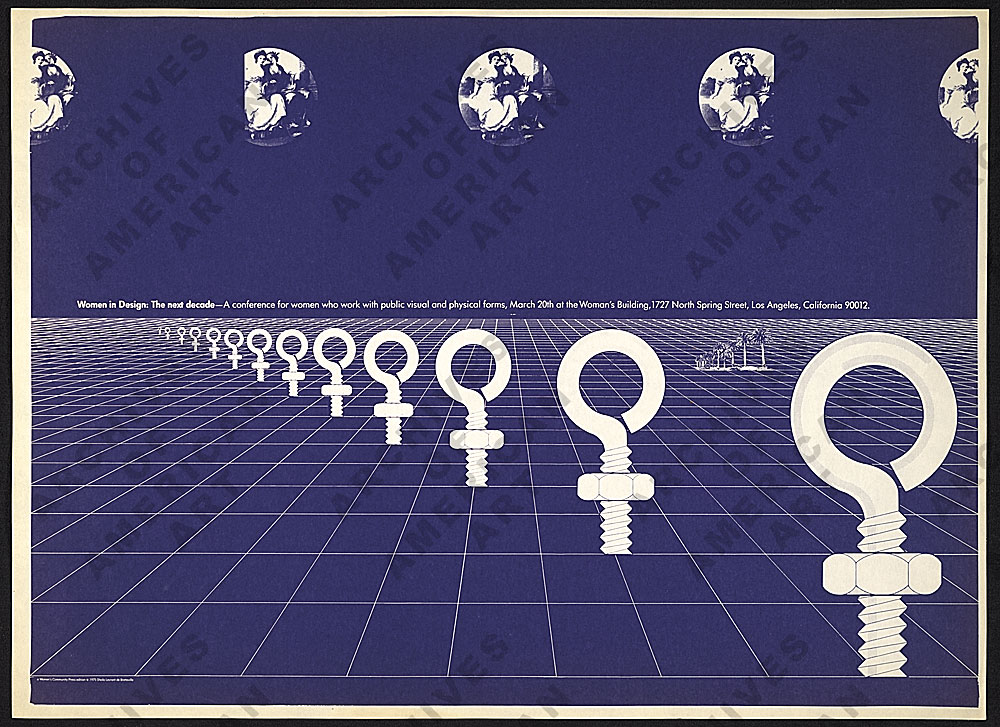
Following the practice of creating alternative art spaces was the effort headed by an artist who named herself after a different city, Judy Chicago (1939-). Teaching at CalArts, Chicago decided that women's work would never be equally valued in male-dominated institutions, so she quit in 1973 to founded Feminist Studio Workshop (FSW) and Womanspace Gallery in the former building of Otis College of Art and Design, near MacArthur Park. The named their new site the Women's Building (named in honor of the Women's Building at the 1893 Chicago World's Fair). Women in in Design Poster 1975
As women were still at the periphery of the avant garde, Los Angeles remained at the periphery of New York, despite its eruption as a center of artistic production. As Fiskin recalls, even by the 1970s "New York was teh center and we were the periphery. Even to say that we were the periphery was stretching it [laughs]. Chicago wan't anywhere either. There's the periphery and the non-existent. I think we existed between the periphery and the non-existent. Even Baldesssari had to show in Europe before he could show in New York. New York was it, and we weren't New York." It was Baldessari over anyone else who gave the LA avant garde its entree to New York success. He was "like a virtual employment agency. He could just place them in galleries in New York when they got out of school....And he was telling everyone that they had to go to New York." (Fiskin interview) “More than anyone else, remembers Nancy Chunn, "[Baldessari] had connections with all of the European artists; no one hit LA without coming up to CalArts.”Note