Scalar's 'additional metadata' features have been disabled on this install. Learn more.
Ghost Metropolis: Los Angeles from Clovis to Nixon
Main Menu
Regimes: Ruling the Los Angeles Region from the Late Pleistocene to the 21st Century
Places and Paths of Los Angeles
Manna From Hell: Power and Politics from Region to World Power
Shadows: Visual Cultures and Mass Media of a Regional and Global Power
Segregated Diversity: The Geosocial Formation of Social Justice in the Late Twentieth Century
Richard 37th: Nixon, Los Angeles, and World Power
The American 1989: Los Angeles at the Climax of the 20th Century
Narrative Essay
Bibliographies, Filmographies, Gazeteers, Indexes
Mapping the Past: Theory, Methods, Historiography
Path
Credits
Root
Phil Ethington
e37d40405599cccc3b6330e6c4be064cc03ef7a5
Columbian Mammoth, c. 30,000 BP
1 2013-11-24T22:48:42-08:00 Phil Ethington e37d40405599cccc3b6330e6c4be064cc03ef7a5 677 2 Columbian Mammoth, c. 30,000 BP. Los Angeles Natural History Museum. (La Brea Tar Pit). CC. plain 2013-11-24T22:50:49-08:00 Phil Ethington e37d40405599cccc3b6330e6c4be064cc03ef7a5This page is referenced by:
-
1
2017-07-06T15:27:29-07:00
Regime I: Megafauna Regis, 2.5 Million BP to 13,000 BP
104
image_header
2019-09-20T16:10:51-07:00
The current Quaternary Period began 2.58 million years ago with the onset of the Pleistocene Epoch, during which the Los Angeles Basin was a resource-rich haven for the largest, and fiercest land mammals that ever stalked the Earth. This was the reign of the Megafauna, during which fearsome giants ruled and shaped the Los Angeles Basin. The giantism of the Quarternary holds the key to the region's deepest characteristic: the three-way dynamic abundance, climatic instability, and violence.The law of nature is that which she has taught all animals; a law not peculiar to the human race, but shared by all living creatures, whether denizens of the air, the dry land, or the sea. -- The Institutes of Justinian (533 CE)
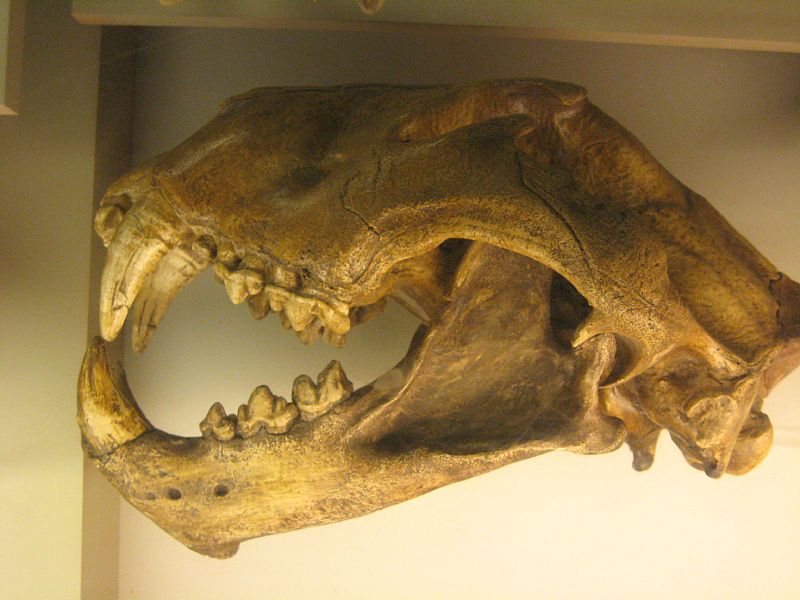
Truly ferocious were the giant predators. At the apex of predation was the Short-Faced Bear (Arctodus simus), the largest mammalian carnivore yet discovered, as large as 1,000 Kg (2,200 lbs, or one metric ton). Arctodus, 2 m / 6 ft tall at the shoulder, stood 3 m / 12 ft on its hind legs, and could slash with its 6-inch claws as high as 5 m / 15 ft. By comparison, Arctodus was more than four times the size of the Brown bear, today's Grizzly bear: Ursus arctos horribilis, at 180 kg / 400 lbs, Arctodus, who could run as fast as 30 miles per hour, was "a colossal omnivorous bear whose diet probably varied according to resource availability."Note
Giant felines were the specialists in meat. Best known perhaps is the Saber-toothed cat (Smilodon californicus), with its short swords for canine teeth. But Smilodon was outclassed by the American Lion (Panthera leo atrox), which weighed as much as 523 kg /1,153 lb and was far larger than today's African Lion.
Largest of all was the Columbian Mammoth, Mammuthus columbi, weighing up to 10 metric tons (22,000 lbs). Paramylodon harlani (Harlan's ground sloth) reached 10 feet in length and 2 metric tons (4,000 lbs) in California. Its cousins in South America reached 20 feet and 8 metric tons. Moving slowly while browsing, to conserve energy, Paramylodon was surprisingly swift in self-defense: long arms tipped with 7-inch claws kept predators at bay. It clearly defended itself well enough against all but human beings to thrive for almost 5 million years, until the first arrival of Homo sapiens about 11,000 years ago.
The giantism of these land herbivores was proportional to the richness of the Southern California landscape that supported such extravagant biomass for millions of years. Columbian mammoths ate as much as 320 kg / 700 lbs of vegetation per day. Like today's elephants and their own contemporary American mastodons (Mammut americanum), the mammoth was a migratory herd animal, which both grazed herbs and grasses from the ground and browsed for edible shrubs, roots, fruit, and bark, and the foliage and twigs from trees. Assuming that the herds of mammoths resembled those of today's African or Indian elephants, somewhere between 10 and 50 individuals would have grazed and browsed together, consuming as much as ten tons of plant matter per day, or 300 tons per month. A large percentage of this tonnage returned to the soil as dung, which fertilized the soil in equally vast quantities.
Consuming the landscape was not all these herds accomplished. As they migrated, each herd pounded the Earth with their collective weight of perhaps 200 tons on average. Stomping through the principal mountain passes and along the food-rich margins between the plains and the shrub lands and oak savannas, these super-massive beings inevitably created large paths. In some cases, these "mammoth highways" laid the basis for today's major roads and freeways.
Undoubtedly, the many predators eager to feed on the plump herds of mammoths and mastodons would have ambushed them wherever possible, chasing the herds and individuals, which would have stomped and packed the open plains and valleys where they fed, so the combination of consuming everything smaller than a tree and stomping the smaller plants, kept the Los Angeles Basin free of forests and climax shrub (chapparal) communities. The mammoths and mastodons were only the largest herd animals to consumer and stomp the Southern California plains.
Vast herds of Bison (Bison antiquus): Tule Elk (Cervus canadensis nannodes); Pronghorns (Antilocapra americana) consumed its flowers, grasses, and small shrubs, further preventing shrub and forest cover. The hooves of a thousand bison, or of elk or pronghorns, chased by swift predators, would have had a massive flattening impact on the grazing lands, while the mowing effect of such hungry herbivores would have kept the plains open and ready for a maximum yield of fresh herbs and grasses each spring rainy season.
When Homo sapiens first found it about 13,000 years ago, the Los Angeles Basin was literally a land of giants. They encountered “capital accumulation" in the form of biomass, and hunted the megafauna with devastating impact. The hunters of the Clovis culture, who arrived during a during a period of catastrophic climate change, pushed to extinction not only the giant herbivores but the giant cats, lions, and bears that fed on them. This was the first major ecological collapse for the region.
While the arrival of humans forced an end to the age of giants in Los Angeles Basin, the legacy of those millions of years was incalculable and affects every living thing today. Predation and competition for the resources of the region has remained proportional to great riches of its soils, vegetation, watersheds, and coastal marine ecologies. The accumulation of so much biomass has preserved in the alluvial soils a nearly inexhaustible fertility for native woodlands and for agriculture, viticulture, and horticulture.
Most fatefully, the biomass of millions of years has rested for ages entombed in the deep lakes of petroleum oil. Unlocking those fossil-fuel resources has opened the gates of Hell, as Los Angels industrialists raided the tombs of the Miocene, Pliocene, and Pleistocene giants. Los Angeles is still one of the richest oil fields in the world (estimated at more than 10 billion barrels) still lies untapped in Pluto's Basement. In our age of global warming, we may at last be learning the wisdom of keeping these spirits undisturbed.Note.