Thanks for your patience during our recent outage at scalar.usc.edu. While Scalar content is loading normally now, saving is still slow, and Scalar's 'additional metadata' features have been disabled, which may interfere with features like timelines and maps that depend on metadata. This also means that saving a page or media item will remove its additional metadata. If this occurs, you can use the 'All versions' link at the bottom of the page to restore the earlier version. We are continuing to troubleshoot, and will provide further updates as needed. Note that this only affects Scalar projects at scalar.usc.edu, and not those hosted elsewhere.
Film Studies in Motion: From audiovisual essay to academic research video
Main Menu
Introduction
Chapter I: From Scribe to Screen
Chapter II: Current Practice
Chapter III: Closing the Gap
Final Remarks
References
Thomas van den Berg
05debbe0c938b9e7170e68167598b10193a9540e
Miklos Kiss
bab68bf9457e82557cb440971c8c3307eac46327
Figure 36a
1 2016-07-02T03:50:49-07:00 Miklos Kiss bab68bf9457e82557cb440971c8c3307eac46327 8115 1 plain 2016-07-02T03:50:49-07:00 Miklos Kiss bab68bf9457e82557cb440971c8c3307eac46327This page is referenced by:
-
1
2016-03-10T06:26:07-08:00
Re-purposing current practice
6
plain
2016-07-02T03:53:20-07:00
Let us talk about ‘ideal’ form and function. We want to take a moment here to clarify that our approach does not only look to build on
found in critical writing, or that we consider video essays mereprinciples enabled by commercialoff-shoots and amateurparatexts . We believe that thefilmmaking work done thus far by critics, fans and scholarsvideographic very potent building blocks that, when combined, rearranged and supplemented, can easily flourish into a bigger and more potent form of Videographic Film Studies. In Chapter II we have made an attempt to pull apart the general denominator of ‘essay video’, and devise distinct categories based on shared governing traits. In order to complement these endeavors with what we hope will flourish into the category of ‘autonomous explanatory research video’, we propose to start by recapitulating what has already been created in audiovisual work, and then take different aspects from these videos and recombine them into a new aesthetic. To underline what comes next, we want to reflect upon the following: withalso provides pieces of writing, it is not uncommon to adopt a different approach per segment. Somehow, audiovisual literacy has not (yet) matured enough to indulge in the same way. In part we think that this is because audiovisual efforts, up to date, have been relatively ‘modest’. They are moderate in the sense that they generally span around 2-10 minutes, and base themselves on either small or vaguely demarcated topics. In both cases, extensiveextensive or in-depth exploration are circumvented, which allows for videos that are shorter and play on a smaller scale than one might assume from an average length research paper.contextualization
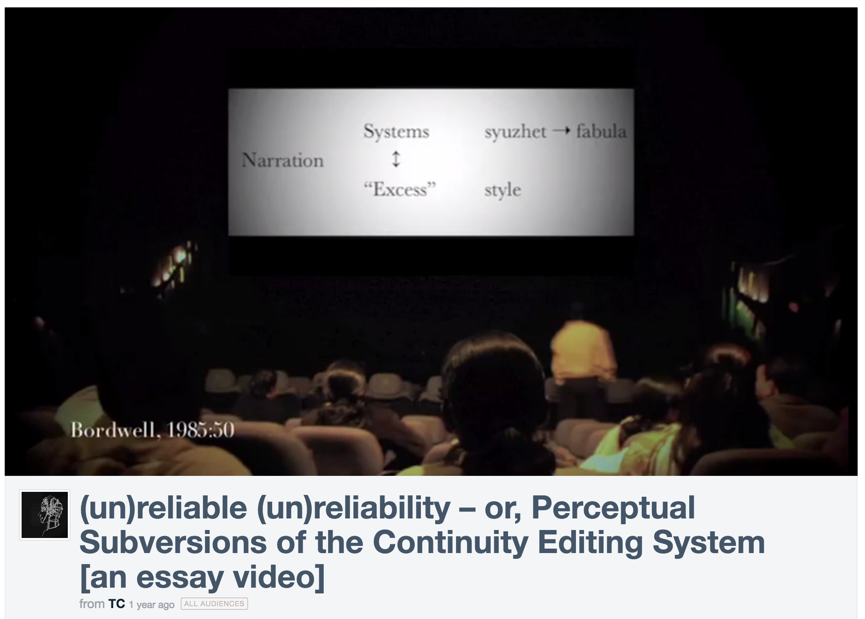
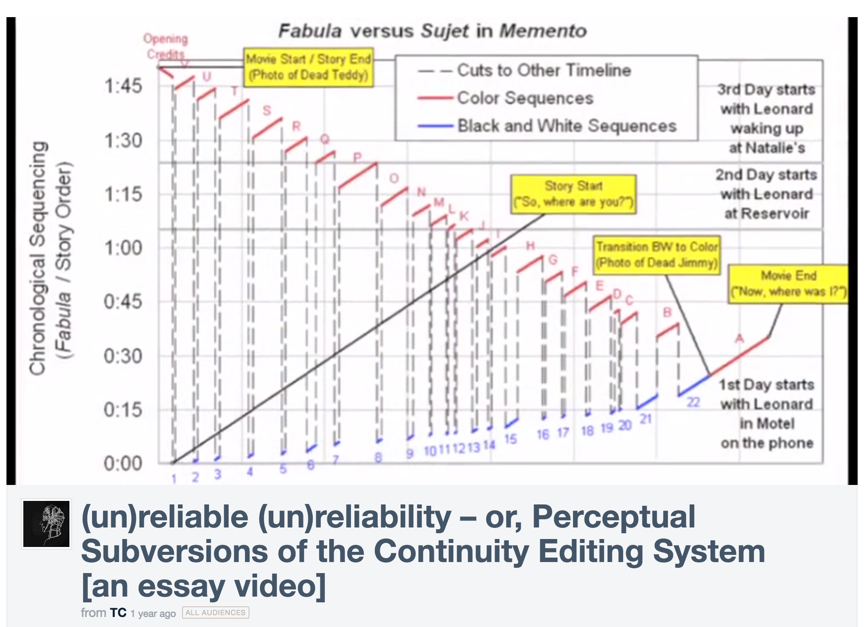
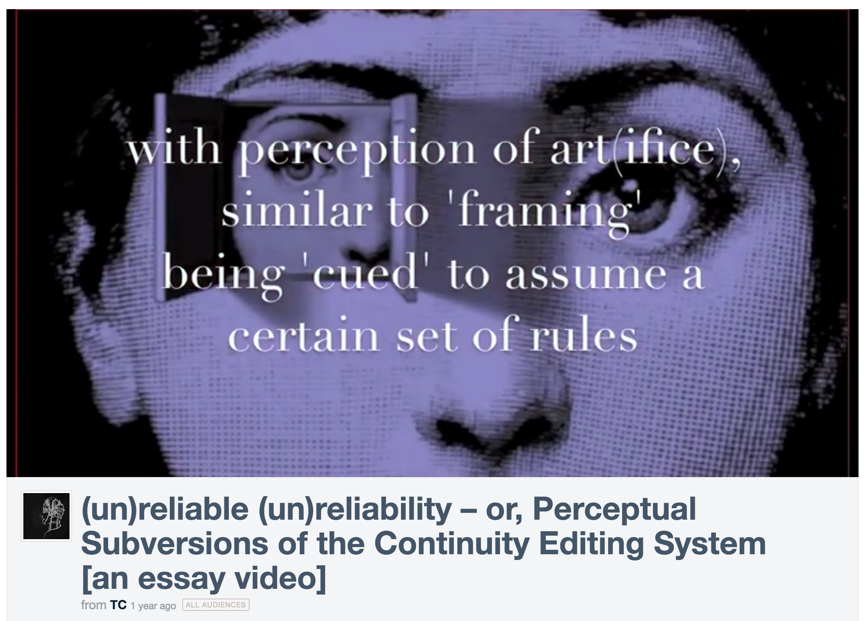
​When looking at compared to the segments that make up a written explanatory argumentative piece, one could easily fit approaches taken in separate videos as techniques for a combination of segmentscurrent audiovisual practice a larger video. For instance, an ‘annotated excerpt’ generally provides ‘entrance’ into a film, and briefly indicates a focal point. Compared to a piece of writing, this would parallel to a preface. ‘Video lectures’ are proving themselves to be purposeful ways of conveying information by means of oscillating between on-screen text and verbal narration, but also are perhaps one of the more logical modes of communication for incorporating added, explanatory, material. Lectures call for paraphrase and citation, and logically they have been thein form thus implement external information most extensivelyfar to [87. ] Because of these inherent traits, the methods and aesthetics of the video lecture are a logical fit for a more expansive subject introduction, the video’s point of focus, and even the presented methodology and framework. Examples of this can be found in what is already the most analytical form yet, including the most ‘complete’ quotations, namely the category of ‘for formalism’. For the ‘body text’ or truly analytical part of a video essay, this mode of presentation would, again, be a logical modus operandi due to the combination of various editing and annotative approaches. This way, one can round out thevideographic and explanatory elements of analysis in a way that is on par with written analysis. Techniques such asexplorative or kaleidoscopiccompilational can easily be fitted in for illustrative purposes. Elements of video lecture modes could also be employed, varying between showing only text-slides, presenting slides underneath voice-over (with either redundant or complementary information), or having a voice-over lecture while the visuals illustrate the words either directly or symbolically. ‘Symbolic’ illustration can quickly lead to overly personal affect or at least tends to give way to such associations. However, when kept at a feasible distance, it can in fact be a very potent and lucid technique (see, for example, the stills and graphs employed in (supercuts un reliable () un reliability [Figure 36]).)
As mentioned earlier, due to the evanescent nature of video delivery (with text one can adjust one’s reading-speed, flip back a few ; with video this is not the case, the video strides on at a pre-set speed), it would be advised to provide at least the most essential information redundantly. The exact measurements of this balance are dependent on subject matter, its theoretical depth, anticipated audience, general aesthetic choices like speed of delivery and tone, as well as its external technological factors such as the image and sound quality of the delivery. In any case, it is known that multi-modal representations generally yield better results of information consumption than mono-modal deliverypages etc. . [88] (This only underlines our earlier plea for complete use of film’s in both the scholar’s work as with film quotation.)textuality