The Face Lift
Intro
The book cover has often been one of the most important ways publishers capture and direct the reader’s attention. Think about the way that you browse a bookstore, physical or digital. More often than not, the cover is the first thing that catches your eye, it’s the first thing you see. It’s the difference between putting the book in your hand down and picking up another one that looks more interesting.
But as we have discussed previously (check where this will be located within the pdf, if not, go into more detail), the way that we read books, and in which format, is changing. The cover has to change, too.
What IS a cover?
A cover is the physical representation of any work. No, it doesn’t necessarily have to actually be physical. A cover often includes important data: title, author, if it is part of a series, and aims to do so in a way that will catch your attention and make you flip to the book excerpt. A cover also tries to represent what the book within contains. Some covers might even have awards or blurbs from other authors.
Think of a cover as a face. The face contains the majority of the features that identify any one person— if every single book in a bookstore was just plain white with simple black lettering, it would be physically impossible to tell one book from another. What’s more, a cover exists to catch our interest. A boring book cover is a book that doesn’t get read. Craig Mod, over in his article Hack the Cover, has a lot of pertinent points about the Book Cover: where it’s been, what it’s doing, where it’s going. In particular: “Here, the cover is a protector of the signatures and the binding. It allows the books to fly in and out of the stacks a thousand times, and still be usable. In the digital world, our books are protected by ubiquity. They are everywhere and nowhere. They multiply effortlessly and can fly continuously without damage or rot. They don't need covers like printed book need covers.”
On most points, I think we can all agree that the way we consume literature has changed, is changing, and will change. On the other hand, it is difficult to say that you browse through a digital space just looking at the metadata. How many people would choose a book solely on the year it was published, the current price, and how quickly you could have it shipped to your home, or download? That is not to say that metadata has no purpose in the digital world. It does. Metadata is a useful tool for what could be described as an ‘extended cover’. It could include genres, intended age group, novel length, or even suggest books similar to the one you are currently looking at!
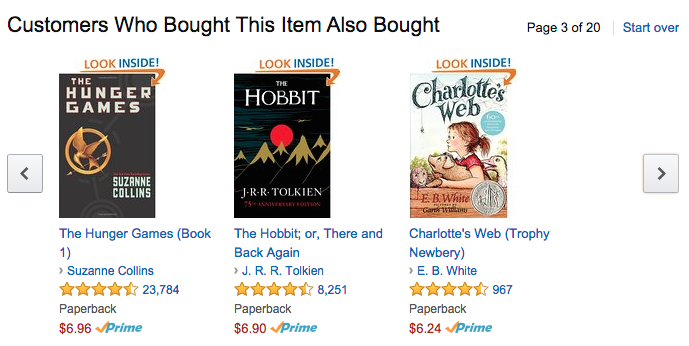
The point is, the Cover is changing. It functions as it always has: catching the eye. It just needs a, er, a facelift! What a Cover should be? The visual aspect of a cover should ‘cover’ six things. * A focal point
- Contrast
- Balance
- Movement
- Rhythm
- Unity/ul
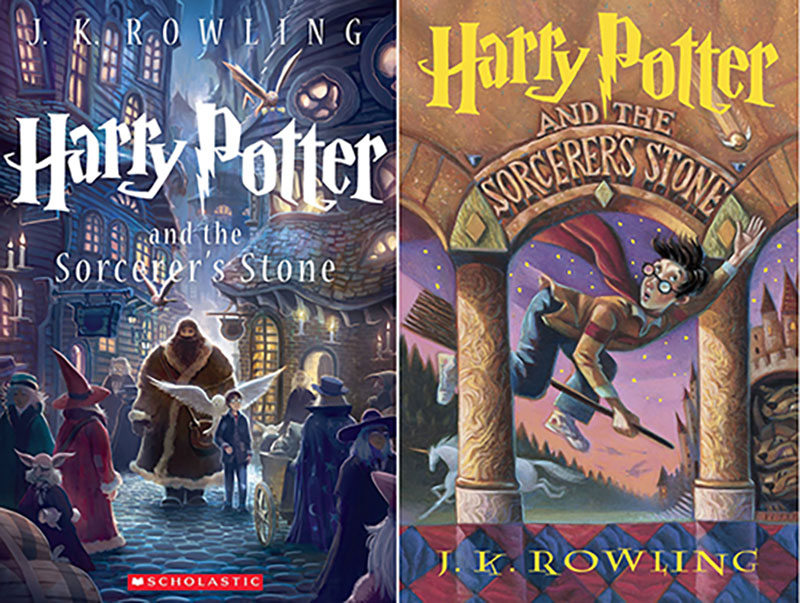
When designing a book cover you may want it to transfer across different devices. You should have a good focal point to draw the eye. Contrast to help with legibility and readability. Balance keeps things from being overwhelming while movement and rhythm keep the cover interesting. The most important principle is unity, because every principle must work to unify the cover. Pictured below are two different versions of the same book. The book on the left has clarity, good detail, and color. It tells an exciting and interesting story. It is easily identifiable from the metaphorical shelf. The book on the right has a dull use of color and Harry is the only recognizable thing in the image. There isn’t much content about the story. This does address a new problem, when it comes to cover design: on some devices the only representation of a book is a small icon about the size of your thumb. How do you include all these principles in something so small?

New Digital Covers
Physical book covers haven’t really transitioned well into the digital age. When shopping for a book on Amazon, the cover is given little precedence over things like reviews, ratings, or other important data. Craig Mod in Hack the Cover once again states that products like the Kindle remove the intimacy that a book cover can provide. Also: “We jump in and out of digital texts with little to no procession. In contrast, every time you set down a physical book, the cover is staring up at you. And every time you pick it back up, you have to go “through” the cover to get to the text. Do that five times and you'll never forget the title or author.” Which further proves the point of intimacy between a reader and a book’s cover. We should start rebuilding that relationship back up with digital covers. When working with covers for new digital design, you may find that less is more. There are new covers that introduced GIFs and animations, opening up a whole new realm of possibilities. However, you can run into the same problems with animated book covers as you can with regular book covers; often less is more. A design that is too complicated can draw away from your focal point.
Below are examples of two different book covers, one works and the other one does not. Harry Potter and the Sorcerer’s Stone works well because it seems simple and interesting. You still get the iconic lightning bolt but the stone is the focal point. The neutral brown background helps the red of the stone stand out. The shine of the stone is subtle but captures the eye. The font is smaller than the font used on the physical book. It has also been relocated to the bottom of the cover. The Illustrator removed the author’s name because the information is already provided elsewhere.
(The Strange Case of Doctor Jekyll and Mister Hyde) The cover for The Strange Case of Doctor Jekyll and Mister Hyde is one that has too much going on. While the cover embodies the main character’s life, it is not legible and very difficult to read. The colors are all too saturated. The yellow colored background is very hard to look at. The green and red clash with the yellow and make the text hard to read.
The Web Cover
More and more book-related fads are popping up as the Digital Age progresses. Book trailers are becoming more and more popular, Twitter launches, Facebook campaigns, but the fad that is perhaps becoming the most popular, is the Web Cover. A Web Cover functions like a cover would in the physical world. Information about the Author? Sure. Reviews and blurbs from readers and authors and publishing houses? Definitely. Where to purchase? Absolutely. With a Web Cover, you aren’t having to battle the issue of physical space like you would with a physical design, or even an icon. The only issue with a Web Cover is keeping that recognizable consistency between every version of a book. The image or icon that you design will move from a graphic for a website, to a Twitter Image, to a Facebook Post, to a Youtube video, back and forth dozens of times. It has to be recognizable.
The Face of this Project
At the beginning we weren’t sure where this project was going to go, but as we continued to work on it an idea started to come to mind. The ultimate goal was to design an image that would transfer well between all mediums, and that included our Web Cover. It had to be something eye-catching, unique, but also not too complicated.
This page has paths:
- The Digital Book: Design, Structure, and Annotation Caleb Carroll